


 Claim Ownership
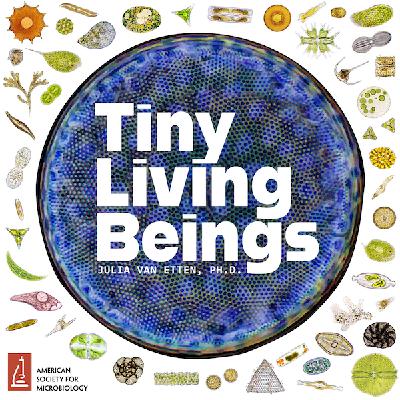
Tiny Living Beings
Subscribed: 17Played: 209
Subscribe

© Julia Van Etten 2021-2026
Description
Tiny Living Beings is where listeners get to know a scientist, a weird microorganism they like, and why they think it's interesting. Our planet is full of billions of different microscopic organisms, most of which are still unknown to science. The ones we do know are diverse and strange. Microbiology knowledge is often gatekept by scientists who discuss this information in exclusive professional circles, but more of these topics need to be shared with the public! Although generally upbeat and fun, conversations often tangentially address frustrations with society or become existential, which, because of the time we are living through, is inherently connected to any discussion of topical scientific information. Content is geared toward all ages and backgrounds, anyone who is scientifically curious.
31 Episodes
Reverse

Dr. Anna Cho introduces us to breviates, single-celled protists that crawl and swim through mud and other places with little or no oxygen, where most life as we know it couldn't "breathe". She explains how combining initial microscopy and sequencing of interesting-looking single cells from vast sample of many different microbial species allows her to probe the environment for organisms unknown to science. She then uses environmental sequencing methods, reading the DNA of everything in a sample of mud or water at once, to go back and find these tiny cells again and study them specifically. Along the way, we learn that these microbes have reworked their mitochondria, the "power plants" our own cells use to burn oxygen, into stripped-down versions that make energy without it, giving us a window into how life adapts to some of Earth's most unfamiliar environments. Anna is a postdoctoral researcher at Arizona State University. You can follow her on Bluesky, read her work on Google Scholar, or learn more about her current research. Links: Breviates on YouTube Breviates and other protists related to opisthokonts (us) by Matt Brown Breviatea on wikipedia. For more info on microbes and to follow updates of this podcast, find @couch_microscopy on Instagram or @couchmicroscopy on Bluesky. Subscribe to Tiny Living Beings via Apple Podcasts, Spotify, Android, Email or RSS and never miss an episode! The views and opinions expressed on this program are those of the host and guests and do not reflect the views of any institution.

We might not all know the term "Apicomplexa" but there are some famous apicomplexan parasites (protists) that infect humans, like those that cause malaria and cyclosporiasis, the latter of which dominated the news this summer. This week, Dr. Anthony Bonacolta came on the podcast to talk about relatives of these parasites that live on or infect corals, fireworms, fish, and sea cucumbers! Anthony talks about the type of work he does to find and characterize new protist species in the oceans, particularly within the corallicolid and ichthycollid lineages. Anthony is a postdoctoral research fellow at the University of British Columbia. Anthony is a postdoctoral research fellow at the University of British Columbia. You can follow him on Bluesky, read his work on Google Scholar, or learn more about his research on his website. Here are some resources we discussed on the episode: 1. Pocket-size guide to protists: https://www3.botany.ubc.ca/keeling/PDF/A_Pocket-Size_Guide_To_Protists_v2.1.pdf 2. Tree of Marine Apicomplexans from Anthony's recent paper: "Endosymbiotic Apicomplexans of Marine Holobionts: Microbial Parasites in a Warming Ocean" 3. Plastid evolution in Apicomplexa and related lineages from Jacko-Reynolds et al. 2025

Giant viruses changed what biologists thought a virus could be. This week, I interview Dr. James Van Etten, whose lab discovered chloroviruses 45 years ago. These are "giant", DNA-based viruses that infect Chlorella-like green algae around the world. Chloroviruses are abundant in lakes, ponds, and rivers and are one of the most common virus groups in these environments, even though most people have never heard of them. The algae they infect live as symbionts inside ciliates and Hydras where protection from infection may be a driving force behind establishing these mutualistic symbiotic relationships. James' decades of work have revealed the enormous genomes and bizarre biology of giant viruses and helped establish them as a major, once-hidden branch of life's virosphere. Here is a (growing) list from Jim of over 500 publications on chloroviruses. James "Jim" Van Etten is a William B. Allington Distinguished Professor of Plant Pathology at the University of Nebraska-Lincoln where he started his lab in 1966, originally focusing on fungal biology. That early work eventually led him somewhere unexpected: in 1980, alongside colleague Russell Meints, he discovered chloroviruses-giant, algae-infecting viruses that would go on to reshape scientific understanding of just how large and complex a virus can be. He was elected to the National Academy of Sciences in 2003 in recognition of this body of work, and remains an active researcher in the field he helped create decades later. Now for the elephant in the room: are Jim and I related? You will have to listen to the end to find out!
Eukaryotes are "complex" organisms with nuclei and membrane-bound organelles: plants, animals, fungi, and protists. Protists include many understudied lineages of fascinating organisms that challenge our understanding of cell biology, and so many protist species remain undiscovered. This week Dr. Angela Oliverio and Beryl Rappaport come on the podcast to discuss a new amoeba species called Incendiamoeba cascadensis that lives and reproduces at the highest temperature ever described for a eukaryote, earning the title of "fire amoeba". Angela and Beryl take us through their research and discovery process, highlighting the collaborative nature of their groundbreaking work. You can read about the structure, function, behavior, and genome of I. cascadensis in their recent preprint. On the episode, we discuss what this amoeba looks like, how it moves, its relatives, the volcanic lake it was found in, and current hypotheses for how it is able to survive in such hot temperatures. Angela explains how studying a novel species like this can leave us with more questions than answers which means that there is more exciting work to come! Angela Oliverio is an assistant professor of Biology at Syracuse University and Beryl Rappaport is a PhD student studying microbial eukaryote evolution and occasionally fermented foods in the Oliverio lab. You can follow them on Bluesky at @oliverio.bsky.social and @[email protected], and learn more about their research at http://oliveriolab.org/ and their Google Scholar pages (Angela, Beryl). They've also provided some links and photos for further reading, and make sure to read their preprint! A great thread by Beryl A geothermal amoeba sets a new upper temperature limit for eukaryotes preprint Extreme environments offer an unprecedented opportunity to understand microbial eukaryotic ecology, evolution, and genome biology perspective paper Lessons from Extremophiles: Functional Adaptations and Genomic Innovations across the Eukaryotic Tree of Life article Popular media articles about the fire amoeba in Nature and Scientific American More about amoebozoan amoebas: Wikipedia Brief history about Thermus aquaticus (bacteria) and the advent of PCR from USGS For more info on microbes and to follow updates of this podcast, find @couch_microscopy on Instagram or visit www.couchmicroscopy.com/store for merch! The views and opinions expressed on this program are those of the host and guests and do not reflect the views of any institution.
Microbes are everywhere, including inside our pets! This week, Ben Alverson comes on to give us a crash course in veterinary parasitology. He discusses the variety of worms and protists that can live inside mammals and cause problems ranging from being a mild nuisance to causing death. We talk about the different types of animals that get tested for these parasites including cats and dogs, zoo animals like big cats, and farm animals. Ben does a great job explaining how diagnoses are made from examining poop samples, what that process looks like, how identifications of different eggs and and parasites are made using microscopy, and treatment options. This episode showcases a non-academic career path in microbiology that's absolutely fascinating! (But it is not for the squeamish!) Ben Alverson is a microbiologist with experience in the veterinary field. He runs the brilliant Instagram account @veterinary_parasitology_ where he posts photos of ova (eggs) and parasites found in his work. I HIGHLY recommend following him! You can also find him on Twitter. Resources from this episode: Textbook recommendation: Diagnostic Parasitology for Veterinary Technicians (I posted the link from the publisher but I recommend looking for this used or free online) Vetpocket app For more info on microbes and to follow updates of this podcast, find @couch_microscopy on Instagram or visit www.couchmicroscopy.com/store for merch! The views and opinions expressed on this program are those of the host and guests and do not reflect the views of any institution or funder.

Comments

Download from Google Play

Download from App Store
 United States