


 Claim Ownership
Engineering Our Future
Subscribed: 10Played: 210
Subscribe

© Luis Duque
Description
Bridge and structural engineering news, one lesson from a public report, and a career note. Every Monday, from Luis Duque, a practicing bridge engineer. The archive holds 141 conversations with engineers about building a career.
luisduquepe.substack.com
luisduquepe.substack.com
143 Episodes
Reverse
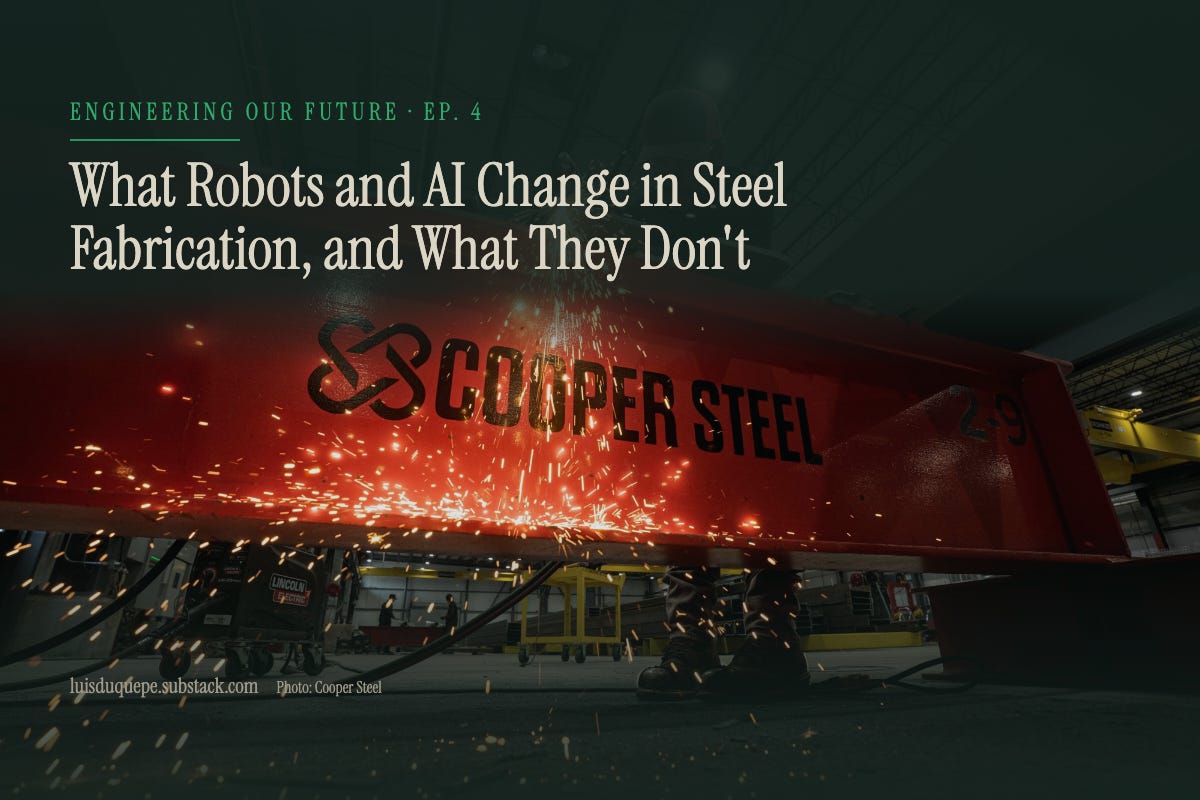
This episode is about technology in steel fabrication and construction: what new machines, models and software let shops and crews do, and what still limits them.Four stories come first: a 3D printer in Maine, a bridge slid into place in Pittsburgh, an HS2 viaduct launched over the M6, and a rail bridge in Wakefield, England, set to be replaced over Christmas.The main section follows steel from the mill to the fabrication shop, from the lengths mills offer to what Cooper Steel told reporters about the robots, models and tracking on its floor in Shelbyville, Tennessee. It ends with a career note on why an engineer should know how a project comes together.A disclosure: AISC organized this tour and covered my flights, up to its $800 travel cap, and my hotel. Cooper Steel is an AISC member.Chapters0:00 What robots and AI change in steel fabrication0:59 University of Maine readies a 3D manufacturing test bed1:52 Pittsburgh slides in the Commercial Street Bridge3:17 HS2 launches its second M6 viaduct deck4:46 Wakefield rail bridge replacement set for Christmas5:24 Code watch6:02 Steel fabrication technology, from the mill to the shop floor7:10 Inside Cooper Steel's shop floor11:05 Career note: know how it comes together12:20 Sign-offFrom the archive, the career note's episode: Engineering Career Paths: Beyond Technical Roles: https://luisduquepe.substack.com/p/engineering-career-paths-beyond-technical-8dcRead the full issue with sources and photos: https://luisduquepe.substack.com/p/what-robots-and-ai-change-in-steel-fabrication-and-what-they-dontSourcesENR, U. of Maine test bed (Oct. 26, 2026): https://www.enr.com/articles/64086-u-of-maine-facility-will-be-large-scale-test-bed-to-make-3d-homes-and-materialsENR, Commercial Street Bridge slide (Aug. 4, 2026): https://www.enr.com/articles/63427-crews-pull-off-one-of-the-heaviest-longest-bridge-slides-in-the-usNew Civil Engineer, second HS2 viaduct over the M6 (Oct. 26, 2026): https://www.newcivilengineer.com/latest/engineers-complete-installation-of-second-hs2-viaduct-over-m6-26-10-2026/New Civil Engineer, Wakefield rail bridge (Nov. 5, 2026): https://www.newcivilengineer.com/latest/engineers-to-replace-structurally-substandard-wakefield-rail-bridge-over-christmas-period-05-11-2026/American Welding Society, Technical Standards Notices: https://www.aws.org/standards-and-publications/standard-notices/ANSI/AISC 303-22, Code of Standard Practice, Section 1.4 This is a public episode. If you would like to discuss this with other subscribers or get access to bonus episodes, visit luisduquepe.substack.com
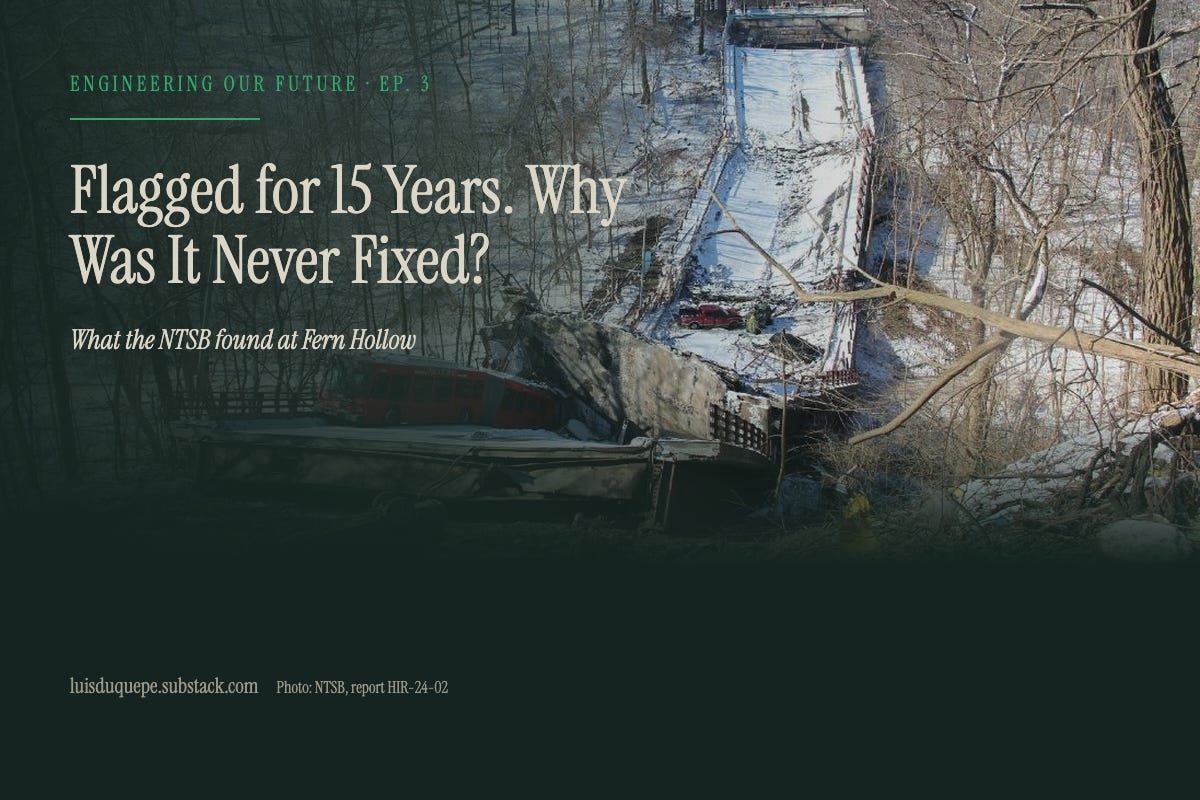
Caltrans is closing the Vincent Thomas Bridge for 16 months to replace a deck on a bridge it calls structurally sound. On the Lifford Bridge between Ireland and Northern Ireland, corrosion sensors went inside the half-joints, where inspectors can't see.Then the NTSB report on the 2022 Fern Hollow Bridge collapse in Pittsburgh. A transverse tie plate corroded to about 12.5% of its as-built thickness, and the repair recommendations were never acted on.NTSB also found that the 2014 load rating, once corrected, would have required closing the bridge. Plus a career note on what changes when you get licensed.Chapters0:00 Flagged for 15 years at Fern Hollow0:56 Caltrans closes the Vincent Thomas Bridge for 16 months2:05 Lifford Bridge sensors inside the half-joints3:26 Lessons from a report: Fern Hollow9:33 Career note: don't just hope it will be fine10:51 Sign-offRead the full issue with sources and photos: https://luisduquepe.substack.com/p/flagged-for-15-years-why-was-it-never-fixedSourcesCaltrans District 7, Vincent Thomas Bridge closure: https://dot.ca.gov/DOT/caltrans-near-me/district-7/district-7-projects/d7vtbmarch26openhouse/VTB-Full-Closure-Announcement-102226New Civil Engineer, Lifford Bridge half-joint monitoring: https://www.newcivilengineer.com/in-depth/lifford-bridge-hosts-trial-of-system-offering-continuous-half-joint-corrosion-monitoring-21-10-2026/NTSB, report HIR-24-02: https://www.ntsb.gov/investigations/AccidentReports/Reports/HIR2402.pdfFrom the archive, Engineering Growth: From Feedback to Promotion: https://luisduquepe.substack.com/p/engineering-growth-from-feedback-fd8 This is a public episode. If you would like to discuss this with other subscribers or get access to bonus episodes, visit luisduquepe.substack.com
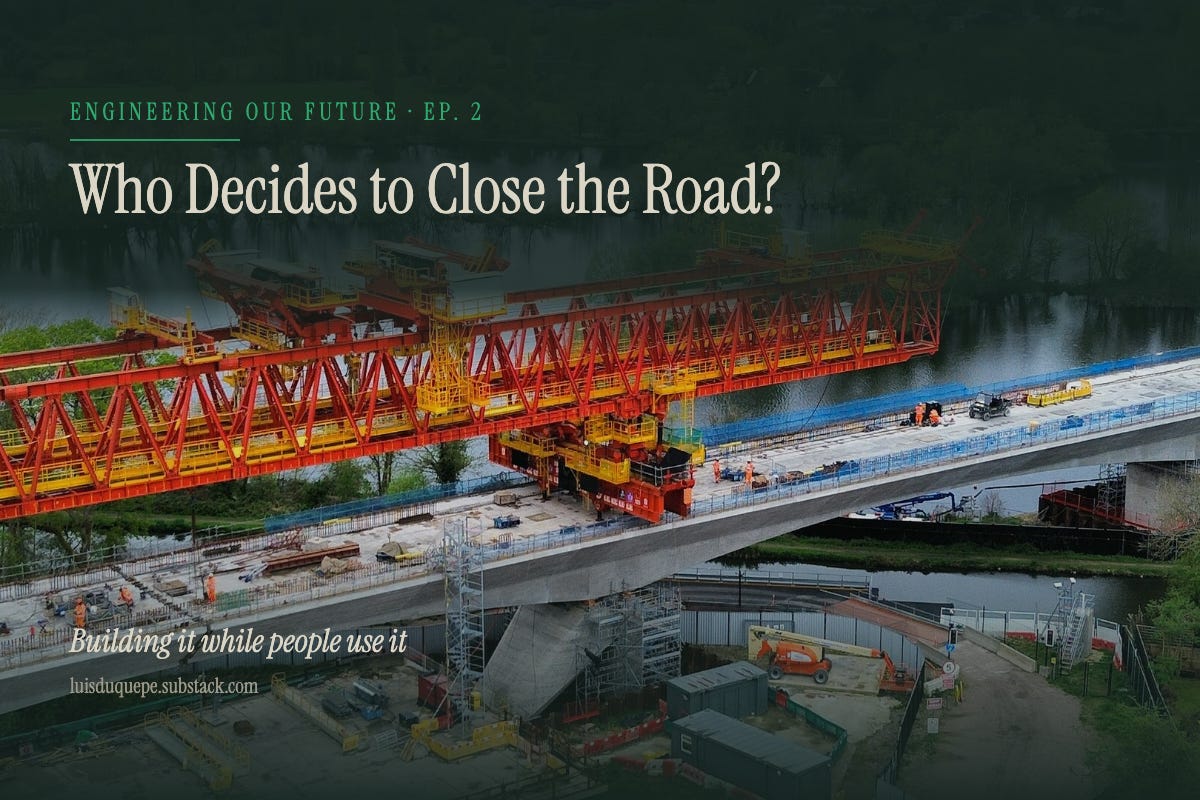
Three projects that kept traffic moving under the work, and $1.6 billion in relief for crossings that couldn't stay open.Then the NTSB report on the 2018 FIU bridge collapse in Miami, where the road stayed open under a structure that was already cracking. Plus a career note on speaking up when you see a mistake.Chapters0:00 Welcome back0:58 HS2 launches a deck over the open M61:38 Colorado replaces the I-270 bridges2:26 Manhattan decks over the Lincoln Tunnel approach3:12 $1.6 billion in emergency relief3:43 Lessons from a report: the FIU bridge collapse5:46 Career note: see something, say something7:25 Sign-offRead the full issue with sources and photos: https://luisduquepe.substack.com/p/who-decides-to-close-the-roadSourcesNew Civil Engineer, HS2 M6 viaduct: https://www.newcivilengineer.com/latest/engineers-complete-installation-of-second-hs2-viaduct-over-m6-26-10-2026/ENR, I-270 reconstruction: https://www.enr.com/articles/64022-colorado-breaks-ground-on-806m-i-270-reconstructionENR, Port Authority Bus Terminal deck: https://www.enr.com/articles/64082-10b-makeover-of-manhattan-bus-terminal-advances-with-concrete-deck-installationUSDOT, Emergency Relief funding: https://www.transportation.gov/briefing-room/trumps-department-transportation-secretary-sean-p-duffy-announces-over-16-billionNTSB, report HAR-19/02: https://www.ntsb.gov/investigations/AccidentReports/Reports/HAR1902.pdf This is a public episode. If you would like to discuss this with other subscribers or get access to bonus episodes, visit luisduquepe.substack.com

We’re back! After a bit of a hiatus to focus on some major engineering projects, we are sitting down to talk about something we all struggle with: the art of saying no.We often talk about work-life balance like it’s a constant state of control, but let’s be real—life happens in seasons. Sometimes work needs that extra 20%, and sometimes your family or hobbies need to take the front seat.In this episode, we dive into:* The 80/20 Rule of Boundaries: Nicolai breaks down how to respect team boundaries while identifying those critical moments when you truly need to rely on one another.* Earning the “No”: Why saying “yes” to the random tasks early in your career builds the trust and capital you need to set firm boundaries later on.* The “Too Much Info” Trap: Why you don’t need to over-share personal details when declining a request—less is often more!* Career Evolution: Luis shares how moving from “yes-man” volunteering to lead roles on major bridge projects has changed his perspective on managing timelines.Key Timestamps:* [00:00:33] The reality of “business stretches” and why the podcast took a backseat.* [00:01:33] Why work-life balance isn’t a balance board, but a series of seasons.* [00:03:07] Nicolai’s framework for respecting boundaries 80% of the time.* [00:05:22] Luis on how saying “yes” early on leads to better project opportunities.Whether you’re a junior engineer looking to prove yourself or a senior lead trying to protect your team’s burnout levels, this conversation is all about finding that seasonal rhythm. Get full access to Planning Engineered at newsletter.planningengineered.com/subscribe This is a public episode. If you would like to discuss this with other subscribers or get access to bonus episodes, visit luisduquepe.substack.com

In this episode of the Engineering Our Future podcast, Nicolai and I deliver a genuine, practical conversation about building real financial security through emergency funds and sinking funds. We draw from personal experience, sharing how our mindsets about money evolved and the crucial role that tailored, “bare bones” emergency funds play in handling life’s curveballs—like sudden car breakdowns or medical bills. Our stories underscore that financial mistakes happen to everyone but can be great teachers, reinforcing the benefits of incremental progress and making informed, individualized choices based on one’s comfort zone and risk tolerance.[15]“Financial peace isn’t about having the perfect system—it’s about building habits that give you confidence to handle both emergencies and expected expenses without fear or debt.”A central theme of our discussion is the distinction between emergency funds, meant for unexpected crises, and sinking funds, designed for predictable but irregular expenses such as holidays, birthdays, and home repairs. We provide actionable tips on setting up high-yield savings accounts, tracking various fund categories, and managing the psychological hurdle of using savings when needed. By emphasizing adaptable systems like customizable sinking funds and a strategic use of HSAs, this episode empowers listeners to start small, build habits, and gradually cultivate lasting peace of mind around money—the goal being to respond to both the expected and the unpredictable without fear or debt.Lessons and Takeaways* Build a tailored emergency fund - Calculate your personal “bare bones” monthly expenses and save 3-6 months’ worth in a high-yield savings account to handle unexpected crises without going into debt.* Create separate sinking funds - Set up dedicated savings categories for predictable irregular expenses like holidays, birthdays, car maintenance, and home repairs to avoid financial stress when these costs arise.* Start small and build gradually - Begin with manageable savings goals ($500-1000) for your emergency fund, then consistently add to it over time rather than feeling overwhelmed by trying to save everything at once.* Optimize your health savings - Consider using HSAs strategically not just for medical expenses but as potential long-term investment vehicles with unique tax advantages.* Develop systems that match your psychology - Create financial tracking methods that work with your personality and habits, making it easier to maintain good money management practices consistently.Links and References* Remit Sethi Podcast* Psychology of Money* Episode on Paying Debt Get full access to Planning Engineered at newsletter.planningengineered.com/subscribe This is a public episode. If you would like to discuss this with other subscribers or get access to bonus episodes, visit luisduquepe.substack.com

Comments

Download from Google Play

Download from App Store
 United States