


 Claim Ownership
CELab: The Customer Education Lab
Subscribed: 32Played: 1,114
Subscribe

© 2021 CELab
Description
CELab is the Customer Education Lab for Innovative Customer Success, Enablement, and Marketing Teams. Our mission is to explore how to build Customer Education programs, experiment with new approaches, and exterminate the myths and bad advice that stop growth dead in its tracks.
188 Episodes
Reverse

At most B2B SaaS companies, the customer comes last. Product announces, internal enablement scrambles, marketing drafts, documentation piles on — and the customer-facing material gets slapped together at the end by whoever’s left. Anna-Lena Kress, Senior Learning Experience Designer at quantilope, decided that order was exactly backwards. She pitched leadership on building the polished, customer-facing asset first and letting marketing and internal training derive from it — and got an immediate yes. The result: a help center rebuild scoped at six months shipped in two, a team that trained itself just by using the customer content, and a one-person education function that now runs like a system instead of a cleanup crew.In this episode, Anna-Lena walks through the three pillars that made it work — Customer Education First (create once, publish everywhere), Capture at the Source (SMEs recording asynchronously in Camtasia Online instead of being interviewed), and Amplify with AI (Clueso for step-by-step articles, Claude for finished Zendesk HTML). Then the conversation turns to attention itself: how her family farm’s social channel went from 1,000 followers in March to 50,000 by recording day with strictly educational soil-health videos, and what hook–arc–payoff can teach Customer Education about getting people through the front door. If you’re in Customer Education or Customer Success, this is the playbook for going first. If you’re in Enablement, Marketing, L&D, or Support, it’s a look at what you get when the customer asset already exists on day one.Highlights from this episode:“Who actually sends our content to the customer? Our team.” — Why Anna-Lena treats internal colleagues as her first customer, and how that reframes the whole launch sequence.The waiter effect — When the team trains on customer-facing material, they recommend it like a server who’s already tasted tonight’s special. Confident referrals, zero extra enablement lift.The “it’s not baked yet” objection, answered — Last-minute product tweaks are cheaper to patch on a finished customer asset than to rebuild from internal drafts. The fear is legit; the conclusion is backwards.Six months to two — 100+ help center articles rebuilt by one person: SMEs record in Camtasia Online, Clueso turns video into screenshots and steps, Claude assembles the final Zendesk HTML — and the leftover video library later powered an unplanned course update.Fix the front door, not just the interior — We obsess over the inside of our academies while the entrance is off its hinges. Why 30-second, one-lesson, myth-buster videos are a scroll-stopping way in — and how Dave’s viral Atlassian short-form program got killed anyway.Connect with Anna-Lena Kress on LinkedIn, explore the quantilope Academy to see the modular, customer-first model in action, and find her farm, Better Together Acres, on Facebook for the soil-health videos that stopped the scroll.
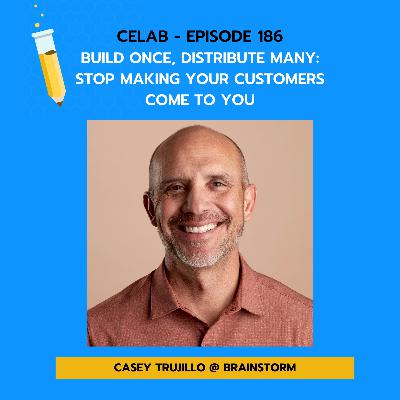
Every Customer Education team eventually hits the same wall: you build something genuinely good, and it quietly dies behind a portal your customers never log into. We call that an engagement problem. It isn't. It's a distribution problem — and most of us are still solving it one channel at a time. In this crossover episode, Dave replays a July 2026 webinar recorded with Casey Trujillo of BrainStorm, a digital transformation coach who has spent 20+ years helping Fortune 100 and Fortune 500 companies get their people to actually use the software they bought. The topic is content syndication, and the argument is blunt: "come to my site, create an account, take my course" is a losing pattern, and everybody in the chain knows it.
The through-line is build once, distribute many — build a genericized version of the material once, then split it two ways: one copy inside for enablement, one copy outside for customers, delivered where they already work and shaped to the slice of your product they actually own. Casey and Dave walk the two-sided standoff that keeps this from happening — vendors terrified of losing control of their content, customers exhausted by asking permission for every change — and land on the mechanism that resolves both at once. You'll leave with a way to think about shared reporting, a churn signal you're probably already ignoring, and a low-risk experiment you can run with a single existing customer this quarter. Primary audience here is Customer Education and Customer Success, but if you sit in Enablement, L&D, Support, or Marketing and you build content for people who don't work for you, this is your problem too.
Highlights from this episode:
"Why are you rebuilding this?" — Dave on watching enablement teams reconstruct fundamentals for content that already exists, in excellent form, out in the world.
It was never an LMS problem. Why the LMS mental model — completions, seats, box-checking — quietly caps what your education program can ever do.
The two-sided standoff. The vendor's fear of losing content control versus the customer's fear of asking permission forever — and why private portals resolve both at the same time.
Shared reporting, both directions. What changes when the vendor and the customer see the same engagement data, and nobody has to play reporting concierge at 7am on a Monday.
The signal you're throwing away. If a customer isn't touching the training, they're probably not touching the product — and that's a proactive play for your CSM, not a lagging metric.

Most companies handed the internal AI rollout to whoever sits closest to revenue — Sales Enablement or RevOps — and adoption promptly stalled at the login screen. In this episode, Dave reunites with his old Gainsight colleague Eve Kedar, EdD — Revenue Execution Architect at EK Consulting, author of Build a KickA$$ Sales Team, and creator of the Four Faces of AI Resistance — to make the case most org charts get wrong: the team that should own internal AI adoption is the one nobody put in the room. Customer Education.Eve brings a combination almost nobody else in this conversation has: a doctorate in Education and Leadership for Change plus 15+ years inside revenue teams at Apple, Seagate, PayPal, Cisco, Gainsight, and copy.ai. Whether you sit in Customer Education, Customer Success, L&D, Enablement, Marketing, or Support — if your job is helping people genuinely change how they work, this episode hands you a diagnostic for the resistance you’re up against and two plays you can run on Monday, no platform purchase required.Highlights from this episode:The Four Faces of AI Resistance — status fear, displacement fear, change aversion, and rollout fatigue — and why naming which face you’re looking at tells you exactly which intervention to run.Why not Enablement or RevOps? Neither function is chartered to own learning — and real “adoption” means use-in-workflow, not logins.Attendance is a vanity metric. If all you can show is headcount and quiz clicks, your team may be next to get cut — bring KPI movement instead.The master glossary play: become the anchor for canonical learning with two-minute mini-trainings — without critiquing Enablement’s content and losing them forever.The cheapest AI enablement in the world: prompt-based roleplay with Claude or ChatGPT — twenty minutes per rep, no purchase order.Learn more: get the Four Faces of AI Resistance framework — plus Eve’s speaking and workshops — at evekedar.com, explore EK Consulting’s revenue-execution work at ekconsulting.io, read her book Build a KickA$$ Sales Team, and ask her about the AI roleplay prompt workbook. And connect with Eve on LinkedIn!

In this kickoff to Season 8 of the CELab podcast, host Dave Derington sits down with Anya Eydman to explore a provocative idea: our biggest AI problem in Customer Education isn’t a skills gap or a technology gap - it’s a belief gap. Anya draws on her background in corporate finance, small business and startup operations, coaching, municipal and nonprofit work, and energy/civic tech to show how AI is becoming a new learning style and a genuine learning partner, not just another productivity tool. Anya connects the dots between AI, underserved communities, workforce shifts, and what it means to design learning experiences that people actually want to engage with.
Across the conversation, they unpack the role of prompt engineering as a core literacy, not just a niche technical skill, and examine how AI can level the playing field while also exposing new inequities. Anya shares how she’s using AI with interns, cities, and universities (including a forthcoming “AI Without Hype” course at Vassar College) to build trust infrastructure, redesign workflows, and bring more people into complex conversations about energy, affordability, and technology. If you’re in Customer Education or Customer Success and wrestling with how AI changes your strategy, your stakeholders, and your learners, this episode will challenge how you think about outcomes, belief systems, and what “meeting learners where they are” really means in 2026.
Key Topics:
The “belief gap” vs. skills gap
Why resistance to AI is often about belief systems, not capability.
How this parallels learner motivation and adoption challenges in CE/CS.
AI as a new learning style and learning partner
Treating AI like a sharp intern or co-worker rather than a magic answer machine.
Designing learning journeys that assume AI is in the loop.
Prompt engineering as a core literacy
Why prompt engineering should be taught like a fundamental communication skill.
How better questions drive better learning outcomes and better customer outcomes.
Non-linear, outcome-focused learning journeys
Moving beyond “I took a course” to “we changed a workflow and a behavior.”
Aligning CE programs with measurable participation and impact, not just completions.
Cross-pollination beyond SaaS/B2B silos
Lessons from civic tech, energy, and community engagement that apply directly to CE/CS.
How to bring community-style thinking into customer communities and academies.
Underserved learners and access to AI
What “underserved” means when AI accelerates knowledge but not everyone can use it well.
How CE can help customers navigate fear, overload, and trust issues with AI.
Trust infrastructure and stakeholder mapping
Building trust frameworks inside organizations and with customer stakeholders.
Rethinking stakeholder mapping now that decision-making paths and gatekeepers are changing.
Team dynamics, titles, and shared ownership of knowledge
Shifting from heavy titles to everyone as a “lead” owning a slice of the missio...

In this episode of the Customer Education Lab, Georg Gottschalk, VP of Global Education at Acumatica, to unpack what it really takes to build a skill infrastructure around a highly complex ERP platform. Georg traces his journey from early work with SAP and manufacturing optimization, through leadership roles at IBM, Salesforce, and MuleSoft, to his current mandate: Enabling a fast-growing, partner-led ecosystem in the small and mid-sized business ERP space. Georg shares why ERP is one of the ultimate “stress tests” for Customer Education and why the old excuse of “our product is too complex for AI” no longer holds up.
The conversation dives deep into AI-assisted learning, micro-vertical partner strategies, and what it means to certify companies instead of just individuals. Georg explains how Acumatica leverages tools like LearnExperts’ LEAi to transform rich but dense documentation into fun, engaging, and increasingly personalized education at scale—without tripling headcount. You’ll hear how his team thinks about partner enablement, customer onboarding that massively exceeded adoption targets, weaving education into the product workflow, and even “teaching machines” by producing content optimized for LLMs. If you work in Customer Education or Customer Success and are wrestling with complexity, scale, or AI, this is an episode you won’t want to miss.
Here are some of the key insights from this episode!
AI works for complex products too — the "too technical for AI" excuse no longer holds; AI acts as a force multiplier, handling grunt work (first-pass quizzes, structuring, transformations) so SMEs can focus on quality.
Skill infrastructure at ecosystem scale — enabling customers, partners, consultants, and developers across a complex ERP, with tools like Leah powering engaging, personalized education.
Certifying companies, not just individuals — partner-level certification builds trust and signals capability, supporting a partner-led growth and micro-vertical strategy.
Closing the value gap — bridging what the platform can do and what users actually achieve through in-workflow, contextual guidance rather than course-based learning alone.
Hyper-personalization with telemetry — using product usage data to spot skill gaps and deliver "what users need tomorrow, not today."
Teaching machines and fostering experimentation — writing content readable by LLMs and skill files for AI agents, while leaders create psychological safety for teams to experiment, keeping humans in the loop.

Comments

Download from Google Play

Download from App Store
 United States