


 Claim Ownership
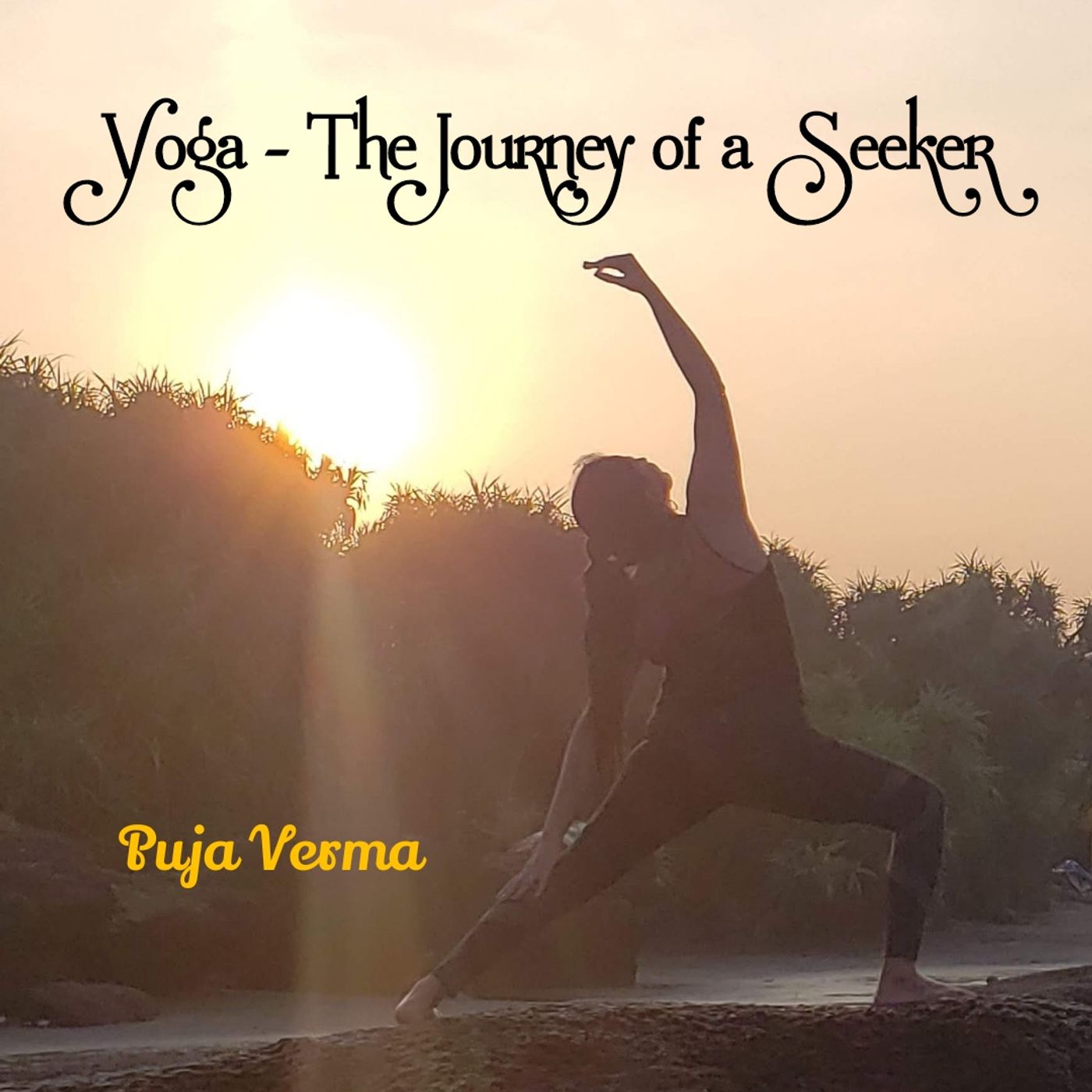
Yoga - The Journey of a Seeker
Subscribed: 0Played: 25
Subscribe

© Copyright Puja Verma
Description
Yoga asanas are like a few drops in the ocean of Yoga. In this podcast, I, Puja Verma, an IT Professional, a Certified Yoga Teacher and more important than anything, a seeker, aim to take you through the deeper aspects of yogic practices and concepts beyond the commonly known aspects, generally taught in classrooms. The podcast aims to raise your consciousness and help you proceed on the path of spirituality.
You need not be a yoga practitioner to understand and enjoy this podcast. If you are a person who feels there is more to this life than what meets the eye, this content is for you.
If you want to drop a message/feedback related to the content of the podcast, please write to puja.theseeker@gmail.com
You need not be a yoga practitioner to understand and enjoy this podcast. If you are a person who feels there is more to this life than what meets the eye, this content is for you.
If you want to drop a message/feedback related to the content of the podcast, please write to puja.theseeker@gmail.com
38 Episodes
Reverse
नाड़ियाँ वे माध्यम हैं जिनके माध्यम से प्राणिक ऊर्जा हमारे शरीर में प्रवाहित होती है। कई बार लोग इन्हें नसें समझ लेते हैं जो मस्तिष्क और इंद्रियों के बीच विद्युत संकेतों की वाहक होती हैं। इसी तरह, चक्र तंत्रिका जाल के साथ भ्रमित होते हैं। आइए दोनों के बीच अंतर को स्पष्ट करें और नाड़ियों के साथ-साथ हमारी भारतीय परंपराओं में शामिल आध्यात्मिक ज्ञान के बारे में कुछ दिलचस्प तथ्य भी जानें।Nadis are the channels through which the pranic energy flows in our body. Many a times, people confuse them to be nerves which are the carriers of the electric signals between the brain and the sense organs. Simialry, chakras are confused with nervous plexuses. Let us clear the differentiation between the two and also know some interesting facts about nadis as well as the spiritual knowledge our Indian traditions include.
इस एपिसोड में हम बात करेंगे चक्रों के कुछ ऐसे तथ्यों के बारे में जिन्हें आमतौर पर हम नहीं जानते | हम जानेंगे कि स्वर्ग और नर्क क्या हैं और इनका हमारे चक्रों से क्या संबंध है |In this Episode, we will talk about some interesting facts about chakras, which are usually not known. We will tak about heaven and hell and how they are related to our chakras.
Chakras are the distribution centers of our pranic energy which is the source of life. In this episode, you will know about these centers, the subtle energy channels called Nadis, and the significance of the number 108 in the Hindu System of spirituality. You will also know what the term "Kundalini Jagran" or awakening of the Kundalini means.
Do you exist only as a body or there are more dimensions to your existence? Explore your five layers of existence with this episode.
Understand the concept of developing a balanced personality from inside out. Please note, this is not a typical personality development lecture about how you look and dress up to create an impression, rather how you balance your masculine and feminine aspects, to bring about a natural and lasting change from inside.
Consciousness is a much talked about term these day, but do we really understand what it is? In this episode, we will dive deep into human and supreme consciousness with a simple analogy and also understand the levels of human consciousness - Jagrit Awastha - wakefulness, Swapna Awastha - the dream state, Supta Awastha - state of deep sleep and Turiya Awastha - the hightest state or super-consciousness.
Explore 'yoga' beyond yoga asanas and beyond just health. Learn about the two fundamental aspects of life - consciousness and energy or Shiva and Shakti. Know who is the omnipresent GOD, in this episode.
The purpose of this podcast is to remind the listeners that yoga is not limited to contemporary classroom practice. Though you can certainly ensure good health by doing the physical practices of hatha yoga, saying that yoga is for health management or weight loss is a gross understatement. The sole purpose of yoga is to raise our consciousness and the hatha yoga practices are tools for the same. Even the physical aspect of yoga is only to make the body conducive for a higher experience, but unfortunately we get entangled in petty benefits once we start any such practice. Let us remind ourselves of the power and purpose of yoga and rise beyond our body and mind.
Surya Namaskar or Sun Salutation is one of the most attractive, beneficial and commonly followed practices of classical hatha yoga. However, contemporarily, it has more or less become a cardiac exercise because our goal has become limited to achieving weight loss, attractive bodies and to certain extent, show off. Nothing wrong in this, but it should not be done like a race, because once it is a race, you tend to do modifications without realising that by doing so you are limiting the benefits and effectiveness of the practice.In this episode, I’ll be talking about a few things to help correct my listeners if they are also unknowingly doing some of those modifications. And very importantly, what does going fast mean in surya namaskar? If you want to go fast, how you should go and what all you should take care of?
I am sure, sometime or the other, you would have heard the advice to drink more and more water, at least some prescribed quality a day. We definitely need water, but is this prescription aligned with everyone’s needs? Is it beneficial to keep drinking water even if we are not thirsty? Why can’t “we” ourselves be conscious about our need to drink water? Listen to this episode if you do or do not think that it's us who should decide how much to eat and how much to drink, not because it’s our right, but because this decision should come from our consciousness.
In this episode, we will see how a clean colon can help you develop consciousness towards what and how much should we eat. I have described the proess of deep colon cleansing, Shankh-prakshalana - one of the shuddhi kriyas prescribed in classical Hatha Yoga practice, and how we can make use of a lighter version of this process on a regular basis to keep ingestion, acidity, constipation, diabetes and related complications away.
Why is it that we need a consultant or google to tell us what and how much we should eat? Why do we need an app to remind us hey it’s time for you to drink water, it's time for a snack. Why have we become so unconscious that we cannot recognize our most basic need? The idea of this episode is to remind you that you need to become conscious of your own self so that you yourself make the right food choice. Be conscious enough to decide what, when and how much to eat.I’ll also cover a few general rules as per ayurveda:Should we eat every 2 hours as suggested by many dieticians?Is it good to calculate your diet in terms of carbs, proteins and fats?Why not mix a variety of food as per ayurveda?And how we can develop consciousness towards our need for food..
Many people think talking about death is inauspicious and depressive. Well, thinking and talking about suicide is depressive, talking about death is not. Because no matter who we think we are, this is where we are destined to go one day. So why to avoid talking about death? So here we go..What happens when we die? Do we die in a moment or it takes a significant time for our "panch prana" to leave the body? How do some people rise from their death bed? Why in India, do we have so many rituals after the death of an individual? Listen to "The Process of Death" to get the answers.
In the previous episode, I explained how mudras work and talked about some specific mudras that work based on Panch Tattva. In this episode, I am continuing to describe some more mudras that work on enhancing the Panch Prana - Prana, Apana, Samana, Vyana and Udana. You will also know some interesting facts about mudras and how they are seamlessly a part of Indian customs.
Mudras - I am sure you know something or the other about them. You can be a novice or a pro, this episode will be useful for you to know or recall about how mudras work and some of those mudras which work based on the principle of Panch Tattva. I also have an episode on Panch Tattva if you want to recap quickly.Not only you will get to know how they work but also what impacts they have on health issues like digestion, gastric, constipation, arthritis, osteoporosis, bloating of the stomach etc.
The memory of your phone is its greatest asset. Your phone won't be smart enough without the memory. So why is it that we consider our memory as an obstacle and not an asset?In the last episode I covered the vastness of memory. Now we will see whether memory and the thoughts generated because of our memory are an issue on the path of spirituality or in our daily life, as most people believe. Unfortunately many people suffer from their bad memories for years which is completely unnecessary. Listen to this episode to understand how memory is an asset not an issue. The need is to keep a distance from it.
Do you think your memory is an obstacle in your spiritual growth or even in leading a peaceful life? Do you wish you could forget your past? If you knew the vastness of memory, you won't wish that again. Even if you think you cannot meditate because of your thoughts which originate from memory, then before you wish you could get rid of it, understand what exactly memory is, in this episode. In the next one, we will see why and how memory is not an issue, the issue is something else.
In this episode, you will know about the "antah karan" (loosely translated as mind) and the 3 out of the 4 main parts of it - Buddhi - the intellect, Manas (memory and its by products) and Chitta (consciousness). I had covered the 4th part - Ahamkara in the previous episode.
In general people think all which is bad is tamas and all which is good is sattva. I won’t say it is an incorrect understanding, but is it the complete explanation of these characteristics? Have we understood them as to what they are in their basic form before adding adjectives to them?Let’s do it today. Today let us understand the 3 gunas, Sattva, Rajas and Tamas, as plain characteristics, in their very crude form. And then we will also see when and why they are termed as positive or negative.
Let's explore the true meaning of Ahamkara in this episode. We all have heard that we need to rise above our Ahamkara to reach god, but do we really know what is it that we need to rise above? Is it simply the ego or something else? Is simply being humble, weak, not standing against anything makes us spiritual? If that's so, why do we worship Ram, Krishna, Kali and Shiva who are fierce warriors?

Comments

Download from Google Play

Download from App Store
 United States