



 Claim Ownership
Radio Marc Bloch
Subscribed: 20Played: 193
Subscribe

© Sebastien Vannier
Description
Radio Marc Bloch est un podcast produit par le Centre Marc Bloch (https://cmb.hu-berlin.de/fr/), le centre franco-allemand de sciences humaines et sociales situé à Berlin. Au travers de deux rubriques (Dialogues, et Partenaires), enregistrées en français, en allemand ou en anglais, Radio Marc Bloch vous permet de retrouver l'actualité de nos 250 chercheuses et chercheurs et de nos nombreux partenaires. Des conflits politiques à l’écologie en passant par les migrations, la globalisation ou la philosophie, nous aborderons sur cette chaîne une large palette de sujets pour examiner ensemble l’évolution de nos sociétés européennes. Bonne écoute, en espérant vous retrouver à la Friedrichstraße, au cœur de Berlin pour l'une de nos nombreuses manifestations!
Pour toute question, suggestion, commentaire, écrivez-nous à: [email protected]
Hébergé par Ausha. Visitez ausha.co/fr/politique-de-confidentialite pour plus d'informations.
102 Episodes
Reverse

„Klimapolitik kann nur erfolgreich sein, wenn sie die weltpolitische Lage berücksichtigt und kreativ damit umgeht.“Wie verändert der Klimawandel außenpolitisches Handeln? Welche Rolle spielen Sicherheit, Geopolitik und internationale Zusammenarbeit in Zeiten multipler Krisen?In dieser Folge von Radio Marc Bloch sprechen Dr. Judith Nora Hardt und Sébastien Vannier mit Dr. Holger Klitzing, Referatsleiter für Klima & Sicherheit, Umwelt- und Wasserdiplomatie im Auswärtigen Amt. Im Mittelpunkt des Gesprächs steht die Frage, wie die deutsche Klimaaußenpolitik auf eine zunehmend konfliktreiche Weltlage reagiert, welche Schwerpunkte das Auswärtige Amt setzt und warum Klimapolitik heute stärker denn je als Teil strategischer Außenpolitik verstanden werden muss.Das Gespräch wurde am 3. Juni 2026 im Auswärtigen Amt in Berlin aufgezeichnet.Das Interview wird zusätzlich zu diesem Podcasts in dem Buch mit dem Titel „Die deutsche Klimapolitik in Zeiten multipler Krisen“ veröffentlicht.Hébergé par Ausha. Visitez ausha.co/politique-de-confidentialite pour plus d'informations.

Douze ans après le début du génocide perpétré par Daech contre les Yézidis dans la région du Sinjar, au nord de l’Irak, comment préserver et transmettre la mémoire d’une communauté victime d’une tentative d’anéantissement, marquée par les massacres, l’enrôlement forcé d’enfants et la réduction de femmes à l’esclavage sexuel ? Quelle place occupent le chant et les pratiques musicales dans la transmission de son histoire et de sa culture ? Et comment les survivantes et les survivants font-ils entendre leur voix dans une quête de reconnaissance et de justice toujours en cours ?Du 16 au 18 octobre 2026, le festival Haizebegi – Art, Science, Société, à Bayonne, au Pays basque, consacrait une large partie de sa 13ᵉ édition au peuple yézidi, à son histoire et à sa culture.Partenaire du festival, le Centre Marc Bloch s'est rendu à Bayonne avec Radio Marc Bloch pour recueillir les témoignages et les réflexions de survivant·es, d'artistes, de chercheur·euses et d'acteurs de la justice internationale.Entre chants, témoignages et rencontres, cet épisode explore les pratiques musicales comme formes de mémoire, de transmission et de résistance, mais aussi le combat toujours en cours pour la reconnaissance du génocide et la justice pour ses victimes.Avec, par ordre d'apparition : Hussein Lawand, Denis Laborde, Estelle Amy de la Bretèque, Liqaa Marooki, Farhad Shamo-Roto, Jean-Pierre Massias, Natia Navrouzov, Clémence Bectarte.Musique : Hussein Lawand, Ilyes Amri.Voix off, écriture : Camille ColleuÉcriture, son, montage, réalisation: Sarah MunroPour aller plus loin:ONG YazdaVoice Of Ezidis© Komina Filma Rojava – Love in the Face of Genocide (2020), Şero Hindê.Hébergé par Ausha. Visitez ausha.co/politique-de-confidentialite pour plus d'informations.

Enregistré deux jours après la panthéonisation de Marc Bloch, cet épisode réunit deux élus engagés dans la politique de recherche et la coopération scientifique pour un échange sur l'avenir du partenariat franco-allemand : Frédéric Petit, député de la 7e circonscription des Français établis hors de France (Allemagne, Europe centrale et Balkans), ingénieur de formation et membre de la Commission des affaires étrangères de l'Assemblée nationale, et Roland Theis, juriste franco-allemand, député au Bundestag depuis 2025, élu dans la circonscription de St. Wendel (Sarre), et membre de la Commission des affaires européennes et des affaires internationales. Tous deux sont membres de l’Assemblée parlementaire franco-allemande. Dans le contexte actuel des tensions transatlantiques et de la guerre d'agression de la Russie contre l'Ukraine qui se poursuit pour la quatrième année, le partenariat franco-allemand apparaît plus indispensable que jamais dans la dynamique de la construction européenne. En même temps, les contraintes budgétaires le mettent à l’épreuve et affectent les politiques de coopération dans des domaines moins visibles, mais essentiels, comme l'enseignement, la recherche, les échanges universitaires ou encore les programmes culturels franco-allemands. Face à ces défis, les députés débattent de la question : le couple franco-allemand est-il encore un moteur, un laboratoire ou simplement un réflexe historique ?Animé par Jay Rowell et Fabien Théofilakis, directeur et directeur adjoint du CMB, la discussion aborde plus précisément le rôle et la contribution des sciences humaines et sociales pour répondre aux défis actuels et géopolitiques de nos sociétés.Hébergé par Ausha. Visitez ausha.co/politique-de-confidentialite pour plus d'informations.
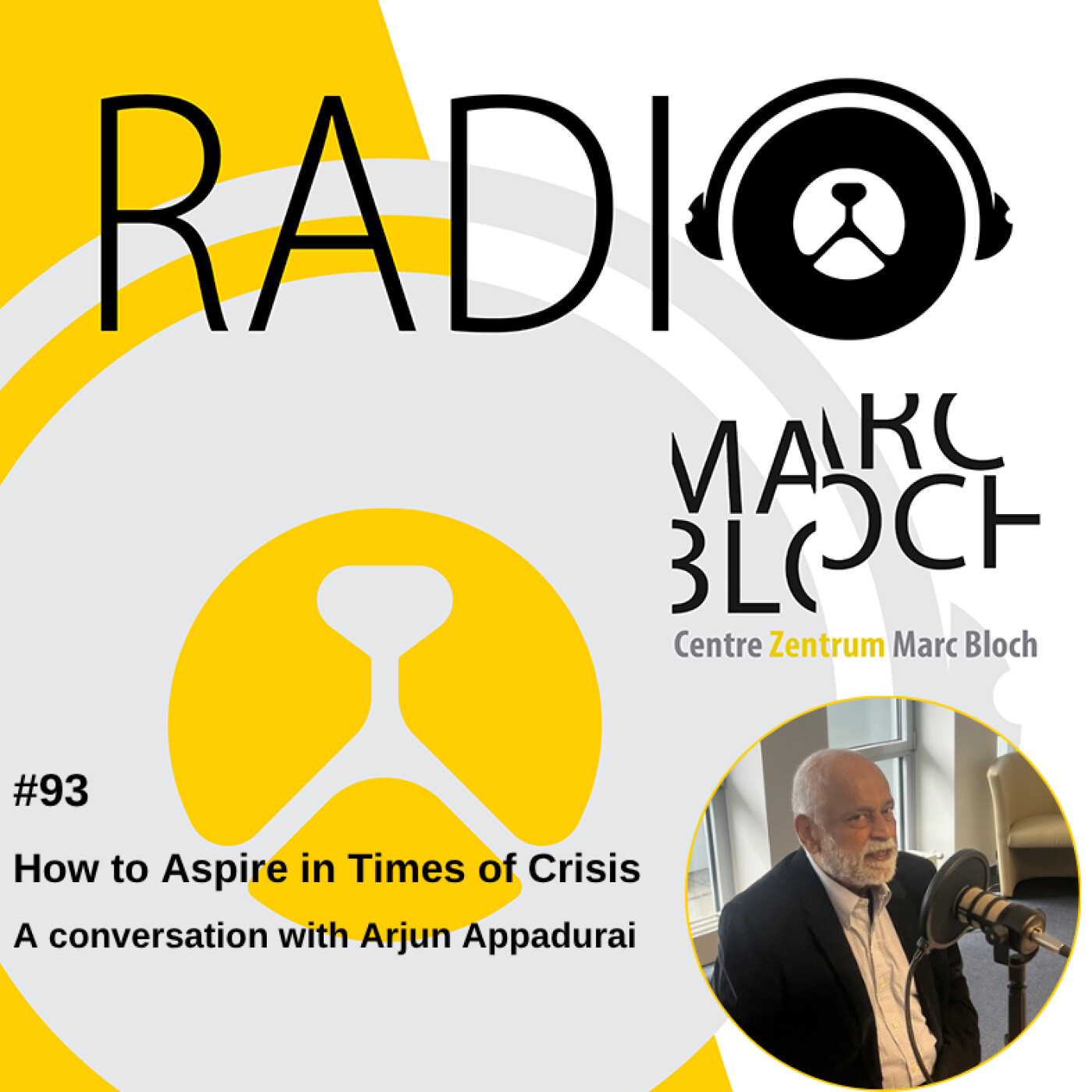
In this new episode of Radio Marc Bloch, we welcome Arjun Appadurai, who recently visited the Centre Marc Bloch to deliver the keynote lecture at the Centre's Séminaire central.Interviewed by Sanja Beronja, sociologist and postdoctoral researcher at the Centre Marc Bloch, Arjun Appadurai, one of the most influential anthropologists and social theorists of our time, reflects on some of the central ideas that have shaped his intellectual journey, from globalization and financialization to imagination, the future, and the capacity to aspire.At a moment marked by geopolitical tensions, economic uncertainty, democratic challenges, and growing inequalities, what can Appadurai's work still teach us about the world we live in? How should we think about globalization more than thirty years after Modernity at Large? Has the world become more fragmented than interconnected? How do finance, social media, and new forms of communication reshape our social and political lives? What does it mean to aspire when the future itself seems increasingly uncertain? And finally, might imagination itself be one of the most important political resources we have?The conversation explores some of Appadurai's most influential concepts, from global cultural flows and predatory dividuation to the capacity to aspire as a profoundly human capacity that is nevertheless cultivated unequally across societies. We discuss why mismatches between aspirations and opportunities are no longer confined to marginalized populations, but increasingly characterize broader middle classes confronted with economic insecurity and uncertain futures.Drawing on a lifetime of thinking across India, the United States, and Europe, Arjun Appadurai offers a uniquely comparative perspective on globalization and the futures that societies can imagine. Rather than stopping at a diagnosis of contemporary crises, the conversation gradually turns toward the possibilities that remain open to us. Together, we reflect on how globalization, finance, social media, and inequality shape not only the world we inhabit but also the futures we can imagine. Ultimately, this conversation invites us to rethink hope—not as passive optimism, but as a practice of imagining, negotiating, and patiently building futures that are still worth striving for.To go further:Appadurai, A. (Ed.). (1986). The Social Life of Things: Commodities in Cultural Perspective. Cambridge University Press.Appadurai, A. (1996). Modernity at Large: Cultural Dimensions of Globalization. University of Minnesota Press.Appadurai, A. (2004). The Capacity to Aspire: Culture and the Terms of Recognition. In V. Rao & M. Walton (Eds.), Culture and Public Action (pp. 59–84). Stanford University Press.Appadurai, A. (2006). Fear of Small Numbers: An Essay on the Geography of Anger. Duke University Press.Appadurai, A. (2013). The Future as Cultural Fact: Essays on the Global Condition. Verso.Appadurai, A. (2015). Banking on Words: The Failure of Language in the Age of Derivative Finance. University of Chicago Press.Hébergé par Ausha. Visitez ausha.co/politique-de-confidentialite pour plus d'informations.

In dieser Folge sprechen wir mit der Historikerin Kornelia Kończal über die Beziehung von Geschichtspolitik, Erinnerungskultur und Rechtspopulismus in Polen. Im Zentrum von Kończals Analysen steht der von ihr geprägte Begriff des “Erinnerungspopulismus”, mit dem sie beschreibt, wie im Zusammenspiel von staatlichen Akteuren und rechten Grassroots-Aktivisten reduktionistische und ethnonationalistische historische Narrative hergestellt und popularisiert werden. An Beispielen wie dem polnischen Holocaust-Gesetz von 2018 oder dem Mythos von den “verfluchten Soldaten” verdeutlicht Kończal, dass derartige Geschichtsbilder längst keine Nischenangelegenheit der extremen oder populistischen Rechten, sondern für das Gros der politischen Akteure in Polen anschlussfähig sind. Als Konsequenz stellt die Historikerin u.a. die Stärkung der Public History als Fach an Universitäten als eine Möglichkeit in den Raum, auf Geschichtsbildern fußenden Hegemoniegewinnen der extremen Rechten entgegenzutreten. Kornelia Kończal ist Juniorprofessorin für Public History an der Universität Bielefeld und leitet dort das von der VolkswagenStiftung geförderte Freigeist-Projekt Mnemonic Populism in Contemporary Europe. Nach der Promotion am Europäischen Hochschulinstitut in Florenz (2017) war sie am Max-Weber-Kolleg in Erfurt, am Hannah-Arendt-Institut in Dresden und an der LMU München tätig. Ihre Forschungsschwerpunkte sind die Sozialgeschichte des Eigentums und des Kulturerbes nach 1945, die transnationale Geschichte der Geistes- und Sozialwissenschaften seit dem späten 19. Jahrhundert sowie die Wechselbeziehungen zwischen Politik, Gesellschaft und Erinnerung.Rechtsruck und HegemonieIn dieser Serie werfen wir einen hegemonietheoretisch und kulturwissenschaftlich inspirierten Blick auf den europaweiten Aufstieg des Rechtsextremismus. Mit unseren Gästen rücken wir dabei verschiedene europäische Länder, ihre Rechtsaußen-Parteien und deren Wähler:innen in den Fokus. Vor dem Hintergrund der multiplen Krisen der letzten Jahrzehnte fragen wir danach, an welche sozialen Erfahrungen die extreme Rechte in der Konstruktion politischer Bedeutungen anschließt, um Führung und Gefolgschaft zu organisieren. Schließlich diskutieren wir die daraus erwachsenden Herausforderungen für die Demokratie und die Strategien, mit denen dieser Situation begegnet werden kann.Konzeption und Entwicklung: Kolja Lindner (Associate Professor für politische Theorie an der Universität Paris 8; 2025/26 Gastdozent des Deutschen Akademischen Auslandsdienstes an der Freien Universität Berlin) und Josephine Starke (Doktorandin in der Soziologie an der Universität Leipzig; wissenschaftliche Mitarbeiterin am Centre Marc Bloch) BibliographieKornelia Kończal: The Invention of the “Cursed Soldiers” and its Opponents: Post-war Partisan Struggle in Contemporary Poland. In: East European Politics and Societies, 34(1). 67-95. Kornelia Kończal: Politics of Innocence: Holocaust Memory in Poland. In: Journal of Genocide Research, 24(2). 250-263. Kornelia Kończal: Persistent Legacies of Communism, or the Ongoing Purification of Public Space in post-1989 Poland. In: European Review, 30(4). 490-504. Hébergé par Ausha. Visitez ausha.co/politique-de-confidentialite pour plus d'informations.

Comments

Download from Google Play

Download from App Store
 United States