


 Claim Ownership
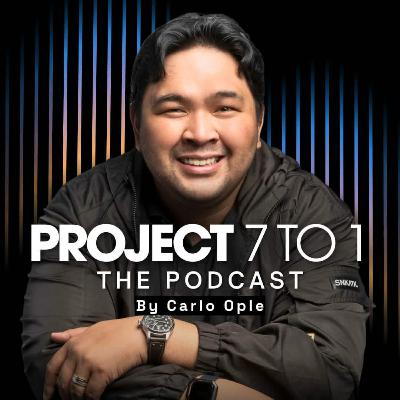
Project 7 to 1 by Carlo Ople
Subscribed: 4Played: 9
Subscribe

© Project 7 to 1 by Carlo Ople
Description
Welcome to Project 7 to 1, the podcast that aims to inspire and motivate entrepreneurs, creators, and professionals to achieve their goals and reach their full potential. In each episode, we feature guests who have succeeded in their respective fields.
8:00AM to 5:00PM, Build Your Career. 7:00PM to 1:00AM, Build Your Dreams.
For Those Who Hustle.
8:00AM to 5:00PM, Build Your Career. 7:00PM to 1:00AM, Build Your Dreams.
For Those Who Hustle.
56 Episodes
Reverse
In this episode of the Project 7 to 1 Podcast, Carlo Ople sits down with former Associate Justice Antonio T. Carpio for a candid discussion on political dynasties, government accountability, and the future of the Philippines.Justice Carpio explains how political dynasties, in his view, have used public funds to strengthen their hold on power. He discusses the push for a genuine Anti-Political Dynasty Law through the Dapat Isa Lang people’s initiative, including how ordinary Filipinos can participate and help make it happen.The conversation also tackles the country’s economic challenges, the need to defend Philippine rights in the West Philippine Sea, and why Justice Carpio believes peaceful, constitutional action is essential to changing the system.It’s a powerful conversation about accountability, national sovereignty, and taking the country’s future into our own hands. Because real change begins when people choose to take action.
In this episode of the Project 7 to 1 Podcast, Carlo Ople sits down with Emil Javier, co-founder of Filipino streetwear brand Don’t Blame The Kids (DBTK), to look back on the journey of building one of the country’s most recognizable local fashion labels.Emil shares how he and his brother Vince turned ₱80,000 and 100 blank shirts into a thriving streetwear brand. He talks about the early struggles, growing the business together, and the lessons that helped DBTK stay relevant for over a decade.The conversation also explores the realities of running a family business, staying relevant in a fast-changing streetwear scene, dealing with counterfeit products, and the dream of bringing a proudly Filipino brand to the global stage.It’s a story of brotherhood, patience, creativity, and building something that lasts. Because a great brand is more than what you wear—it’s the story behind it.
n this episode of the Project 7 to 1 Podcast, Carlo Ople sits down with Congressman Toby Tiangco to discuss the ongoing fight for transparency and accountability in government.Cong. Tiangco explains why he believes the national budget should clearly show how much is allocated to every congressional district, who requested each project, and where public funds are going. He shares how he made Navotas’ proposed infrastructure projects publicly accessible, complete with budgets, locations, and explanations, so constituents can hold their representatives accountable.The conversation also tackles questionable budget amendments, the rising cost of living, struggling small businesses, declining online sales, and the challenges facing Filipino entrepreneurs. They also discuss why more Filipinos are considering leaving the country and what meaningful political reform could look like heading into 2028.It’s a candid discussion about public money, government responsibility, and the economic realities Filipinos face every day. Because transparency should be the standard, not the exception.
In this episode of the Project 7 to 1 Podcast, Carlo Ople sits down with Billy dela Fuente, USANA’s first and highest-ranked 11-Star Diamond Director in the Philippines, to talk about his journey from struggling entrepreneur to becoming one of the country’s most successful leaders in direct selling.Billy shares how he started with part-time jobs, failed businesses, and financial struggles before discovering USANA in 2009. He opens up about the decade of hard work, sacrifices, and persistence that eventually allowed him and his wife to achieve financial freedom.The conversation explores the realities of entrepreneurship, from handling rejection and mastering sales to overcoming the negative stigma surrounding network marketing. Billy also shares his approach to mentorship, building multiple income streams, investing in real estate, and creating generational wealth.Beyond business, Billy talks about the important role his wife played in his success, raising children with the right values, and teaching the next generation to embrace challenges rather than avoid them.Success doesn’t happen overnight. This episode is a reminder that the right mindset, consistent effort, and lessons learned from failure can make all the difference—not just in building wealth, but in building a meaningful life.
In this episode of the Project 7 to 1 Podcast, Carlo Ople sits down with Dr. Karol Mark Yee, Executive Director of the Second Congressional Commission on Education (EDCOM 2), for an eye-opening conversation about one of the Philippines’ most urgent challenges: the state of our education system.How can we talk about artificial intelligence, future-ready careers, and competing with our neighbors when so many Filipino students are still struggling with the basics of reading, comprehension, and mathematics? Drawing from EDCOM 2’s research and the latest assessments discussed in the episode, Dr. Yee explains the scale of the learning crisis, why students can advance through school without mastering foundational skills, and how these gaps eventually affect their ability to think critically, find employment, and thrive in the real world.The conversation explores the reforms being pursued to address these problems, including literacy and numeracy assessments, structured reading remediation, teacher support, and efforts to accelerate classroom construction. Dr. Yee also explains why early childhood education matters, why children need access to affordable books, and how the country’s curriculum and school incentives must better reflect what students actually need to learn. The goal is simple but fundamental: every child should be able to read with understanding before moving on to more complex learning.But education does not end at graduation. Carlo and Dr. Yee discuss the challenges faced by college graduates and the existing workforce, including functional illiteracy, declining returns on some college degrees, and the need to give greater attention to technical-vocational education and training. They also explore the Philippines’ enormous potential in creative work, digital services, and other industries—and how better education, strategic investment, and stronger employment opportunities could help Filipinos succeed without having to leave the country to build a better life.Beyond classrooms and policy, the conversation gets personal. Dr. Yee shares how his experiences working with the late Senator Edgardo J. Angara helped shape his commitment to education reform, the importance of mentorship, and why the work must continue beyond any single administration. They also discuss the challenges young people face today, from social isolation and bullying to changing family dynamics, and why children need not only better learning opportunities but also supportive adults who listen and help them build confidence.And despite the difficult realities, this episode ends on a hopeful note. Through initiatives such as Buksan ang Kinabukasan, communities, schools, churches, and ordinary Filipinos can help bring books to children who lack access to them. Dr. Yee shares how people can support local schools, contribute reading materials, and use EDCOM 2’s publicly available data to identify where help is most needed.The Philippines has no shortage of talented, creative, and capable people. The challenge is making sure every child has the opportunity to develop that potential.Because fixing education is not just about improving test scores. It is about building a generation that can think critically, make informed decisions, contribute meaningfully to society, and help shape a better future for the country.

Comments

Download from Google Play

Download from App Store
 United States