


 Claim Ownership
Economics Happy Hour Podcast
Subscribed: 12Played: 65
Subscribe

© Economics Happy Hour
Description
Economics Happy Hour is a podcast where two economics educators talk through current events, teaching, and research over a drink. Conversations are unscripted and focused on how economists actually think about the world and the classroom.
www.econhappyhour.com
www.econhappyhour.com
102 Episodes
Reverse
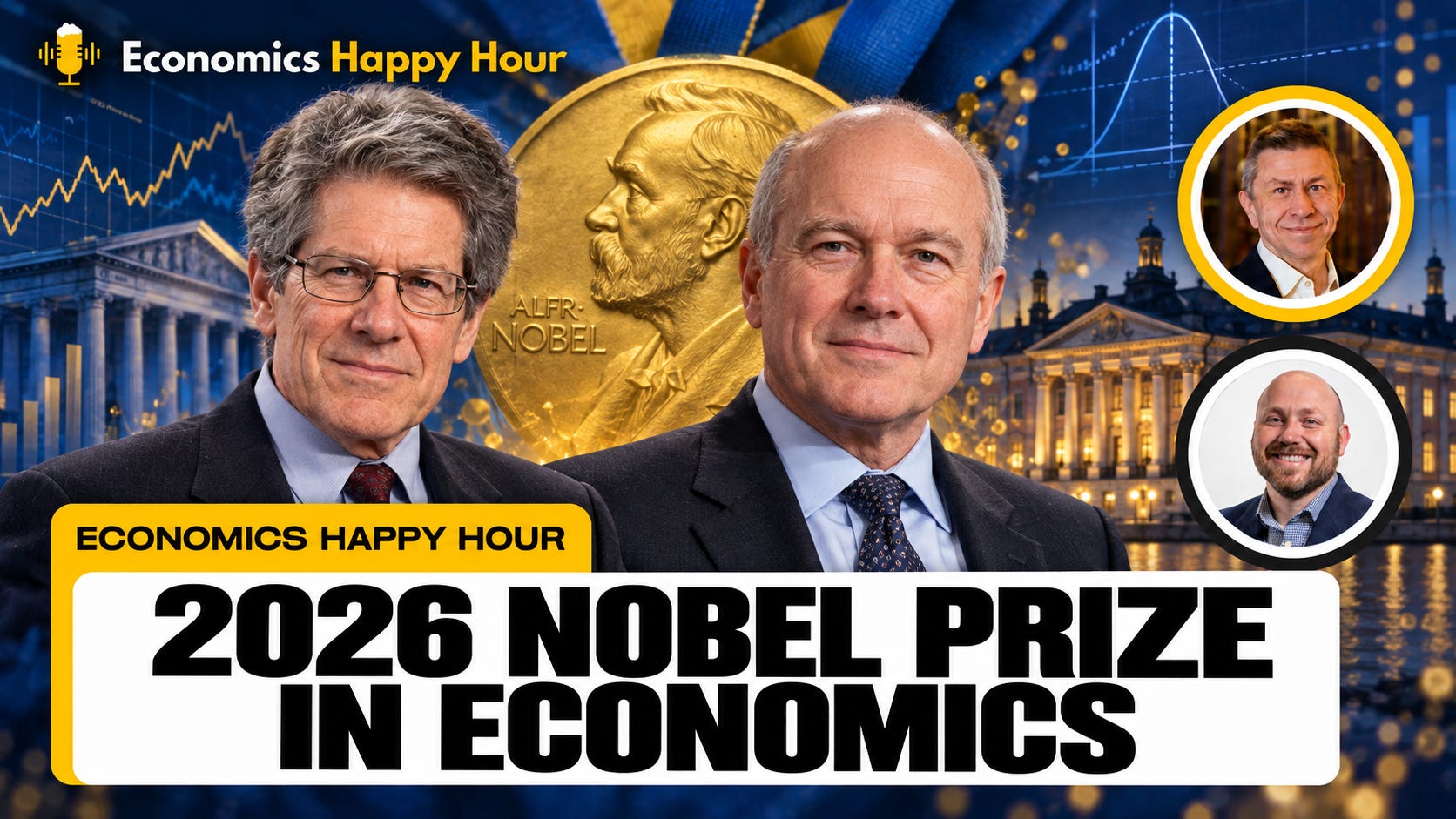
What does this year’s economics Nobel have to do with your savings account or your next big purchase? We unpack Robert Hall and Michael Woodford’s contributions to understanding how expectations shape spending and economic policy. Along the way, we discuss consumption smoothing, why central banks explain their plans, and whether people really think as far ahead as economic models suggest. We also look at what prediction markets can tell us about Nobel favorites and why a quieter, more stable economy can be an achievement that’s easy to overlook.In this episode, we talk about:* What prediction markets did, and didn’t, tell us about the Nobel winners.* Why expected lifetime income matters for spending today.* How central banks use communication to influence expectations.* Whether everyday financial decisions match economists’ models.* Why better tools for stabilizing the economy matter beyond academia.If you liked this conversation, you might also enjoyThis Week’s Drinks 🍻Jadrian grabbed a Richmond Lager from Hardywood Park Craft Brewery after a hectic day and had already started pouring before we hit record. Matt went seasonal with Saranac’s Festival Pils from its Oktoberfest variety pack, a departure from his usual IPA. We also caught up on fall break activities and upcoming presentations. Between everything going on, a little time off (and a good beer) was certainly welcome.Name That Stat 📊We initially skipped the guessing game, but we realized partway through the episode would be a good chance to talk about citations for our laureates. Each of them has garnered more than 70,000 citations for their work over their careers:Show NotesThis year’s economics Nobel went to Robert Hall and Michael Woodford for their work on the microeconomic foundations of macroeconomic stabilization. That’s a pretty technical way of saying that individual households' and businesses' decisions help policymakers respond to recessions, inflation, and economic shocks. Speaking of expectations, we actually had the chance to see the people prediction markets thought had the best odds of winning the prize the day before the awards were announced. Neither had an especially clear favorite. Woodford appeared near the top of Polymarket’s predictions, while Hall wasn’t among the leading names.Neither of us would describe ourselves as macroeconomists, but we wanted to take a closer look at what made their research so important. Hall’s work gives us a way to think about why spending doesn’t simply rise and fall with every paycheck. Building on the permanent income hypothesis, the idea is that people consider their longer-term resources when deciding how much to consume. New information can change that plan immediately. If you learn today that you’ll lose your job in six months, you probably won’t wait six months to adjust your spending. The important distinction is between a temporary change and news that changes what you expect to earn over the long run. One of Woodford’s main contributions looked at why central banks spend so much time explaining their decisions. Monetary policy works partly through what people expect interest rates and economic conditions to look like in the future. That makes credible communication part of the policy itself. A change in interest rates won’t affect every household in the same way, but it can make a big difference for someone buying a home or a business deciding whether to borrow and invest. The natural question then is how far ahead do people actually think? We both have personal experiences where we’ve made poor financial decisions that affect our futures, but there are also plenty of people saving for a down payment, borrowing while in college, or creating an emergency fund. It all involves thinking about the future. Expectations matter, even when people have limited attention, limited borrowing options, or habits that are hard to change.The biggest payoff from their research has been a more stable economy than most of us truly appreciate, but we did want to consider what their work means for someone who isn’t building economic models. It helps if people slow down and try to distinguish a temporary financial bump from a lasting change before completing changing spending habits. That’s not to imply that every shock will disappear or that every household can easily absorb one, but it does help explain why the duration of a change matters. We’d love to hear your thoughts! When has something you expected to happen in the future changed how you spent or saved today? Leave a comment with your example. We’d also love our macroeconomist listeners to help sharpen the connections between those everyday decisions and the bigger policy picture.Pop Culture Corner 🍿A former Virginia Tech graduate student sent Jadrian a scene from Emily in Paris in which the main character learns that being fired doesn’t necessarily mean immediate dismissal. Her coworkers explain that completing the termination process could take months. It’s a useful example to talk about differences across labor markets. Matt shared a scene from Schitt’s Creek, where the Rose family loses its fortune, but one member finds an active credit card and uses it to buy expensive eye cream. Matt connected the scene to consumption smoothing since David is trying to preserve a piece of his old lifestyle despite a dramatic change in his circumstances. Maybe he’s expecting the family’s financial situation to improve, or maybe he just really wants that eye cream?Have a question or topic idea? Reply to this email or drop it in the comments! This is a public episode. If you would like to discuss this with other subscribers or get access to bonus episodes, visit www.econhappyhour.com
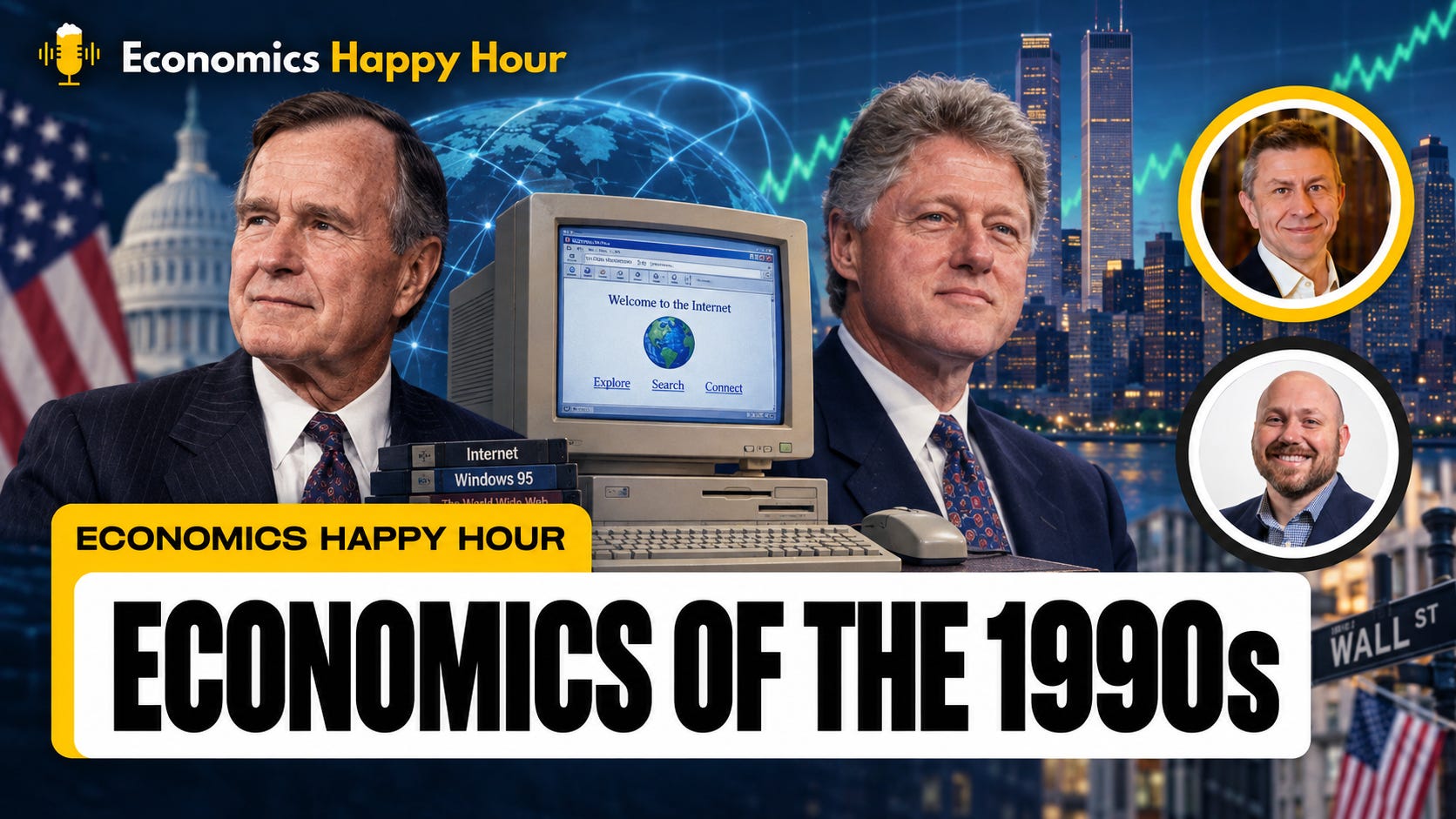
The 1990s began with a recession that helped make the economy central to the 1992 presidential election. What followed was a long expansion, falling unemployment, and eventually federal budget surpluses. We weigh NAFTA against the rise of the internet as the decade’s most consequential economic change. Along the way, we look at what the dot-com boom built, even after its most famous companies disappeared.In this episode, we talk about:* How the early recession shaped the 1992 election* Why falling unemployment challenged economists’ expectations* NAFTA, budget surpluses, and the internet as contenders for the decade’s defining change* What survived the dot-com boom after companies like Pets.com did not* How new technology changed everyday life and the way people thought about investingIf you liked this conversation, you might also enjoyThis Week’s Drinks 🍻Matt went with his trusty Centennial IPA: tasty, reasonably priced, and, by his account, an economist’s dream. Jadrian’s first choice was a cider that had been placed a little too close to the ice maker. A quick trip back upstairs led to a Sam Adams Cold Snap substitute. The replacement was much easier to drink; the plan for the cider was to let it thaw and mix it back together.Name That Stat 📊We both stayed on theme for this week’s stat, but we went in two wildly different directions. Matt chipped in the market capitalization for one of the dot-com boom’s most famous companies. Jadrian stuck with the 90s, but went in a completely different direction by highlighting recent survey results showing that Millennials and Gen Z picked the 1990s as the most fashionable decade.Show NotesThe U.S. entered the 1990s after a long expansion, with inflation and unemployment well below the painful levels of the early 1980s. Then came a recession. Despite George H. W. Bush’s popularity after the Gulf War, unemployment was on the rise and the economy became a central issue in the 1992 election. “It’s the economy, stupid” captured the political moment.After that rough start, the picture changed. Unemployment kept falling through the decade, reaching roughly 4% by its end while inflation stayed low. That combination pushed economists to reconsider an assumption many had learned in class: that unemployment could not remain much below 6% without causing trouble. So what best defines the decade economically? We put three candidates on the table: NAFTA, federal budget surpluses, and the dot-com boom. NAFTA mattered, though its effects extended beyond the 1990s. The surpluses were striking, especially looking back from today. But the internet felt like the strongest answer for its lasting effect on how we live, work, and build businesses.The boom gave us new companies that would eventually vanish (like Pets.com), but the bigger impact was the money poured into internet companies that far exceeded expectations. The investment helped build infrastructure that later businesses could use. The future felt so uncertain at the time: dial-up connections, a household phone line tied up by the computer, and serious predictions that we might all browse the web through our televisions. The stock market had a long climb throughout the 1990s, and reinvesting dividends would have made people a fortune. A lot changed for people living in the 90s, from buying CDs and writing checks to getting a second phone line. There’s more to unpack, so we’ll return in a few weeks with a fresh episode that looks more closely at labor market shifts, how Americans saved and spent, and the decade’s policy choices.What change from the 1990s most reshaped your everyday life? Leave us a comment with the thing you remember noticing at the time.Pop Culture Corner 🍿Jadrian brought back a favorite Today Show clip where the presenters are trying to make sense of an email address by asking, “What is the internet?” It’s a charming reminder of how unfamiliar something so ordinary now felt in the mid-1990s. Matt gave a shout-out to Linda and Alan’s Yada Yada Yada Econ collection of Seinfeld clips. His favorite clip comes from the Soup Nazi episode to show how a distinctive product can give a seller some room to charge more. Jadrian’s favorite is the bottle-deposit scheme, where Kramer and Newman discover that a price difference only looks profitable until you account for the cost of getting the bottles to Michigan. Have a question or topic idea? Reply to this email or drop it in the comments! This is a public episode. If you would like to discuss this with other subscribers or get access to bonus episodes, visit www.econhappyhour.com
Twenty-five years after the September 11 attacks, we look at a difficult question: can economics help us understand terrorism? We start with Gary Becker’s rational model of crime and Alan Krueger's research to consider the incentives, opportunity costs, and motivations behind terrorist activity. From there, we consider whether 9/11 was a “small” or “large” economic shock, looking at everything from financial markets and travel to government spending, immigration, and consumer behavior. In this episode, we talk about:* Whether the rational-choice framework economists use to study crime can tell us anything useful about terrorism* The case for viewing 9/11 as a relatively small short-run macroeconomic shock, and why that framing needs important context* How fear and uncertainty changed travel, spending, investment, and everyday behavior after the attacks* The longer-run economic consequences, including security and defense spending, immigration policy, health effects, and changes in governmentIf you liked this conversation, you might also enjoyThis Week’s Drinks 🍻Jadrian took a chance on a Boardwalk Orange Creamsicle that looked promising in the can and became much less promising as soon as it hit the glass. The smell was...not great. Fortunately, it tasted better than it smelled. Matt kept things simple with a light Moscow Mule. The drinks arrived amid the usual beginning-of-semester chaos combined with a short week thanks to Labor Day. Name That Stat 📊We kept both stats tied to this week’s topic. Jadrian offered up the total amount of money the Transportation Security Administration spent in the most recent fiscal year. What started as a fairly crude response to the attacks has become part of an enormous security infrastructure that is now a normal part of flying in the United States.We then turned to financial markets. Matt offered up a measure of how much the Dow Jones fell during the first week of trading after September 11. The markets were initially closed for several days after the attacks, but investors had to process an extraordinary amount of fear and uncertainty all at once when they reopened.Show NotesBefore getting into a summary of this week’s episode, we want to be clear about what this episode is and what it isn’t. September 11 was first and foremost a tragedy. Thousands of people were killed, families lost loved ones, first responders made extraordinary sacrifices, and the effects of that day continue to be felt 25 years later. Talking about the attacks through an economic lens isn’t meant to reduce those lives to statistics or suggest that GDP is the measure that matters most. We believe looking at this event through an economics lense gives us one additional way to ask questions about why terrorism happens and how an event like this can reshape the economy.We started with Gary Becker’s rational model of crime. The basic idea is surprisingly intuitive: people respond to incentives even when they’re deciding whether to do something illegal. Someone considering a crime weighs potential benefits against the probability of getting caught and the consequences if they do. Terrorism pushes that framework to an extreme. If someone is willing to die for a cause, the usual idea of increasing the punishment suddenly doesn’t work very well. Some of Alan Krueger’s past work used economics to explain who participates in terrorism. We didn’t get to talk about it much on the episode, but one of the important takeaways is that the familiar story connecting terrorism simply to poverty doesn’t hold up particularly well.From there, we turned to the economic impact of 9/11 itself and an interesting challenge of determining whether it had a small or big shock on the economy. The argument for “small shock” focuses on the loss relative to the overall size of the U.S. economy. Businesses relocated, damaged physical capital could eventually be rebuilt, and some of the decline in industries like travel was offset by growing demand elsewhere, particularly in security and counterterrorism. The economy was also already in a recession that had begun months earlier, making it especially difficult to separate a distinct 9/11 effect from everything else happening in 2001. Zooming out makes the “big effect” argument much stronger, especially with the benefit of twenty-five years of hindsight. Travel and conventions were hit especially hard, government spending on defense and security expanded, the Department of Homeland Security was created, and new security policies became part of everyday life. Fear itself also mattered economically. People pulled back from travel and other activities because they understandably perceived the risk of another attack as much higher. Some substituted driving for flying, even though driving carries greater accident risk. Immigration restrictions may also have reduced an important source of long-run economic growth. These are harder effects to capture with a single GDP number because they show up over many years.And then there have also been consequences that don’t fully show up in the economic data immediately after the attacks. Research documented sharp increases in stress and alcohol consumption, with psychological effects lasting well beyond the first few weeks. Those effects matter on their own, but they can also spill into the economy through health care use, productivity, and people’s ability to work. It’s a useful reminder of the limits of trying to put one number on an event this enormous. A short-run GDP estimate can tell us something, but it can’t tell us everything. It certainly can’t measure the grief and human cost experienced by the people directly affected. We ended the episode trying to determine whether the terrorists were successful. In many ways, our own behavior changed because of September 11, even if we don’t notice it often. Airport security, travel habits, government spending, privacy, and perceptions of risk all look different today. What is one change in everyday American life after 9/11 that you think has had the biggest lasting economic impact? Leave a comment and keep the conversation going.Pop Culture Corner 🍿Jadrian’s pick was hinted at early in the episode, but now he can share that a lot of this episode’s conversation was based on Alan Krueger’s book, What Makes a Terrorist?. The book grew out of a series of lectures Krueger gave at the London School of Economics. If today’s conversation made you want to go deeper into the economics behind it, this is the natural next stop.Matt went slightly more pop-culture-y with a Game of Thrones scene involving Doran Martell and the costs of choosing war over peace. The connection is the broken window fallacy that argues destroying useful things doesn’t make an economy wealthier just because rebuilding them later generates spending. The scene also connects nicely to the classic guns-versus-butter tradeoffm where resources devoted to war and military goods are resources that can’t simultaneously be used elsewhere.Have a question or topic idea? Reply to this email or drop it in the comments! This is a public episode. If you would like to discuss this with other subscribers or get access to bonus episodes, visit www.econhappyhour.com
Price controls have traditionally been a policy that economists love to use as an example of unintended consequences, but new survey data suggests voters across the political spectrum increasingly support them. We dig into why both Republicans and Democrats are warming to the idea after years of frustration with higher prices. We also walk through what economic theory and history tell us about shortages, production incentives, and the longer-run effects of price ceilings. Finally, we wrestle with a harder question for economics teachers: if students understand the model but still support the policy, what exactly should we be trying to teach?In this episode, we talk about:* Why support for price controls now crosses party lines* How years of higher grocery, housing, and energy prices may be creating “inflation fatigue”* Why price ceilings can create shortages and change producers’ behavior over time* Why understanding the economics of price controls doesn’t necessarily mean opposing them* What economics teachers can do when students understand the model but reach a different policy conclusionIf you liked this conversation, you might also enjoyThis Week’s Drinks 🍻Jadrian typically joins with a beer, but this time he’s gone with a Cuba Libre Zero. He’s finally taking advantage of the bar cart he was inspired to assemble by friend-of-the-show Brian O’Rourke. Matt went with a Trash Talk IPA from Yards Brewing, served in some appropriately celebratory business-school glassware.Name That Stat 📊In what may be a first for the show, we somehow both managed to get our stats this week! Matt shared the stat that drove our episode: the share of Republicans who now say they support government price controls. Jadrian went with a back-to-school theme and shared the percentage of college students who say they have changed their major or concentration because of job market worries.Show NotesPrice controls are one of those topics that can feel almost automatic in an introductory economics class. Draw supply and demand, put a binding price ceiling below equilibrium, show the shortage, and move on to price floors. New polling data might make this topic a lot more interesting. A CBS News/YouGov poll found a majority support for price controls among Republicans, independents, and Democrats. That caught our attention because the partisan differences are still there, but opposition to price controls is no longer something you can neatly map onto the usual limited-government versus government-intervention divide.So what changed? Our best guess was fatigue. Consumers have spent years watching grocery bills, housing costs, gasoline, and plenty of everyday purchases get more expensive. Even when inflation slows, that doesn’t mean the price level goes back to where it was before. We talked about the disconnect that creates when economists can say inflation has come down, but consumers continue to see their grocery bill is still much higher than it used to be. After enough years of that, “the government should do something about prices” starts sounding pretty appealing.From there, we went back to the basic economics of a price ceiling. If the government caps a price below the market equilibrium, consumers want to buy more while producers have less incentive to supply the product. In the short run, that creates a shortage. But the longer-run response may be even more important. Farmers plant less next year. Landlords invest less in maintaining apartments. Developers decide not to build. These aren’t just predictions. The U.S. has a history of wage and price controls in the 1970s and rent control in modern days. That brought us to the part of the conversation we found most interesting: what if people understand all of that and still support the policy? Jadrian admits to seeing this in his class. Students can predict the shortage and explain how producers will respond, but then continue to support price controls on tuition or rent. It’s possible people aren’t thinking about the market-wide outcome, or they may be thinking probabilistically about themselves: “I can’t afford it now, so if the government lowers the price, maybe I’ll be one of the people who gets it.” A shortage is a cost, but it can feel like a chance at an affordable product that otherwise seems completely out of reach.That creates an important challenge for economics teachers. Hearing an economic argument once isn’t necessarily enough to overturn years of prior beliefs or personal experience. Maybe our goal shouldn’t simply be getting students to repeat that “price controls are bad.” The more interesting teaching opportunity is helping them recognize the tradeoffs, think about who actually gets the lower-priced good, and compare price controls with policies that attack the supply side of the problem. We’d love to hear how you think about this one, especially if you teach economics: if students understand why a price control creates shortages but still support the policy, what should we want them to take away from the lesson? Leave a comment and keep the conversation going.Pop Culture Corner 🍿Jadrian’s entry comes with a Not Safe for the Classroom warning. Chris Rock has a stand-up bit that offers his own version of gun control: instead of focusing on guns, make bullets wildly expensive. If ammunition costs enough, people are going to think a lot harder about using it. It may not be the example you want to lead with in your 8 a.m. principles class, but it’s certainly a memorable way to think about how prices change behavior.Matt brought two clips this week. The first comes from the final episode of Friends, when the group is saying goodbye to Monica and Chandler’s apartment. Chandler reflects on what a beautiful place it was and all the great memories they made there before adding the economist-friendly punchline: because of rent control, the place was a “frigging steal.” Matt’s second pick shifts from price controls specifically to the broader affordability problem. In the opening number from his favorite movie musical, everyone is dealing with the frustrations of trying to make it in Southern California. But, hey, at least there’s another day of sun. Of course, there’s an economics angle to that sunshine: lots of people want to live in Southern California, and all that demand shows up in housing prices. Have a question or topic idea? Reply to this email or drop it in the comments! This is a public episode. If you would like to discuss this with other subscribers or get access to bonus episodes, visit www.econhappyhour.com
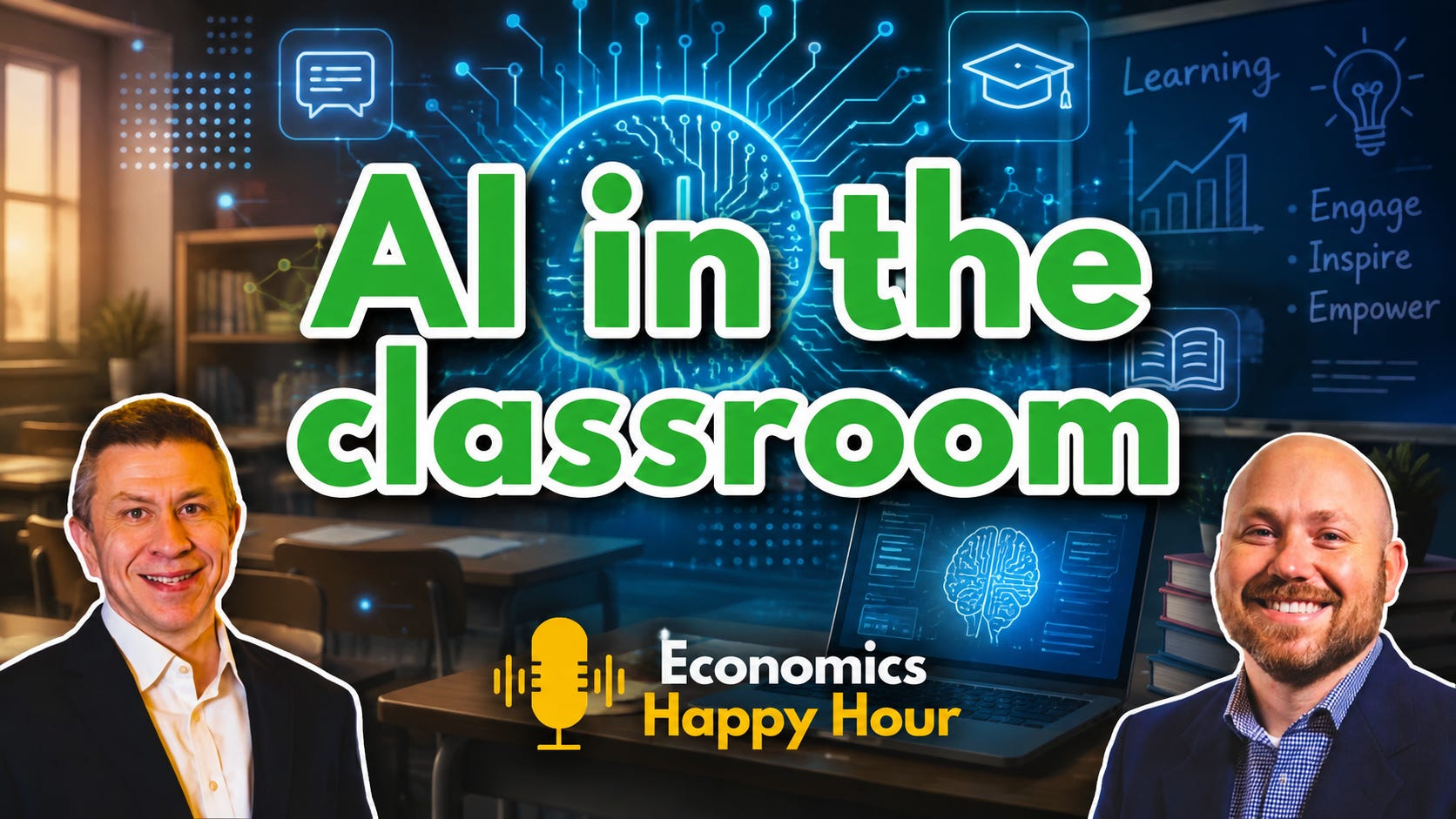
Artificial intelligence is quickly becoming part of the college classroom, whether instructors are ready for it or not. We talk about how we’re using AI to save time as teachers, from writing better quiz questions to helping us prepare course materials, and how we’ve experimented with bringing it directly into class. But the bigger question is what happens when students use these tools to replace the struggle that’s supposed to lead to learning. We dig into where AI can make students stronger, where it might create shortcuts that hurt them, and how all of this is changing the way we think about teaching.In this episode, we talk about:* How LLMs can save instructors time on quiz questions, distractors, announcements, and other teaching prep* Bringing AI into class to work through game theory and other economics problems alongside students* The growing divide between students who use AI to build skills and those who use it to avoid building them* Why struggling with a problem is often part of learning, not an obstacle to it* How AI is forcing us to rethink assignments, assessments, and what we actually want students to get out of collegeIf you liked this conversation, you might also enjoyThis Week’s Drinks 🍻We recorded this one in the morning, so the drinks looked a little different than usual. Jadrian had coffee with a splash of Buffalo Trace Bourbon Cream, but only because he wasn’t heading straight to work after recording. Matt kept things technically non-alcoholic with Diet American Dew, served in a Michelob Ultra FIFA World Cup cup for a little extra flair. Name That Stat 📊Since we’re talking AI in the classroom, Jadrian shared a stat that looked at how common artificial intelligence use was among college instructors. We know the students are using it to help in the classroom, but what about the professors? Matt went in an entirely different direction, with a focus on Broadway revenue. Despite concerns about ticket prices and struggling shows, Broadway is still generating a pretty remarkable amount of money.Show NotesAI is already in the classroom, but “using AI in the classroom” can mean a lot of different things. We’re both using LLMs as part of our jobs, especially for the repetitive work surrounding teaching. They’re great for cleaning up clicker questions, generating new versions of questions, suggesting plausible wrong answers for multiple-choice questions, and helping draft announcements. Anyone who has spent too much time trying to invent a fourth believable distractor knows how useful that can be. The important distinction is that much of this happens outside the classroom. But Matt has actually experimented with putting LLMs in front of students. One example came from his game theory course, when he introduced the classic beauty contest game. Everyone chooses a number, and the winner is the person closest to a fraction of the group’s average. After playing the game with students, he asks the LLM to play along, too. What makes the response interesting isn’t simply whether it lands on the “right” answer. It can explain the equilibrium, recognize that choosing the equilibrium probably won’t actually win against a room full of humans, and reason through how many steps ahead the other players are likely to think. Matt has also done a similar in-class experiment with a coordination game, showing how an LLM could distinguish between the factually correct answer and the answer most likely to be chosen by everyone else. The harder part of this conversation is what we’re seeing from students. There’s a potentially huge difference between using AI to help you learn and using AI to avoid learning. Strong students can use these tools to go further than they could before. They are asking more questions, exploring new ideas, improving projects, and getting feedback almost instantly. But we’re also seeing students turn to an LLM the second they encounter friction. Give them an ungraded practice problem, and some will immediately ask AI for the answer. Ask them to recall an elasticity formula and, instead of thinking through which version applies, the first instinct can be to ask a chatbot. The answer might be correct, but the thinking that was supposed to happen along the way disappears.That’s what makes the idea of productive struggle so important. We’ve always had technology that can do things students are supposed to learn to do. Calculators didn’t eliminate the value of knowing multiplication tables. The fact that a tool can produce an answer doesn’t necessarily mean there’s no value in learning how to reach that answer yourself. With LLMs, though, that substitution can happen across a much wider range of tasks. Jadrian has already adjusted some in his small class by only allowing handwritten notes and assigning in-person quizzes. But if students can hand a reading to an LLM and ask for a summary, then we have to think much more carefully about what the reading assignment was supposed to accomplish in the first place.The part we’re still wrestling with is what this means five or ten years from now. We may end up with students who become dramatically more capable because AI lets them build on an already strong foundation, while others become increasingly dependent on a tool because they never built that foundation at all. That makes this more than a conversation about cheating or whether ChatGPT should be allowed on an assignment. It’s really a question about what learning looks like when getting an answer has become incredibly cheap.So we’re curious how this is playing out for you. Where have you found AI genuinely helps someone learn, and where have you seen it become a substitute for learning? Leave a comment and tell us what you’re seeing in your own classroom, workplace, or experience with these tools.Pop Culture Corner 🍿Matt went back to Fiddler on the Roof and the song “Dear Sweet Sewing Machine,” which celebrates a piece of technology that seems pretty ordinary today. But for a tailor in early-20th-century Russia, a sewing machine represented a major productivity boost: suddenly, you could produce substantially more in the same amount of time.Jadrian has been rewatching Superstore and highlighted an episode where the fictional retailer rolls out an app that lets customers find products, scan their items, and pay without ever interacting with an employee. Naturally, the workers start wondering: if customers can do all of that themselves, why are we here?Have a question or topic idea? Reply to this email or drop it in the comments! This is a public episode. If you would like to discuss this with other subscribers or get access to bonus episodes, visit www.econhappyhour.com

Comments

Download from Google Play

Download from App Store
 United States