


 Claim Ownership
Foojay.io | Friends of OpenJDK and Java Programming
Subscribed: 31Played: 809
Subscribe

© Foojay.io | Java and Programming Community
Description
Foojay.io is your go-to programming community podcast, connecting developers with the latest in Java, OpenJDK, JVM, and open source tools. We bring together Java professionals worldwide to share insights, tools, and news in the vibrant Java programming ecosystem.
103 Episodes
Reverse
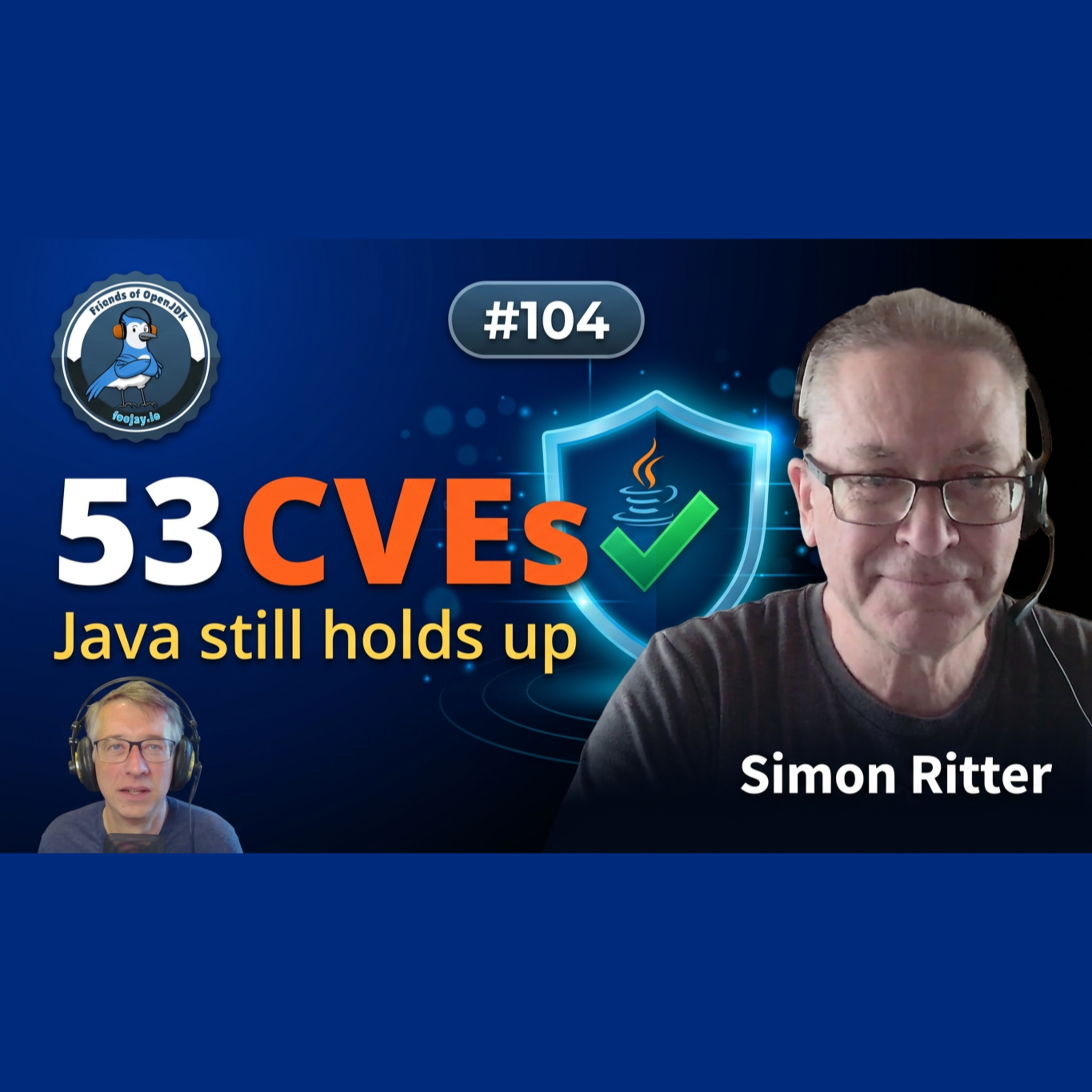
A record 53 CVEs in one Java update, followed by two emergency releases within days. Yes, a lot of issues are being found, but Java is still strong: a whole community and the commercial distributors are behind every fix.In this episode, Simon Ritter, Deputy CTO at Azul, Java Champion and member of the OpenJDK Vulnerability Group, explains what happened over the past weeks and what it means for your applications. We cover how a vulnerability travels from a report to a patch, why AI is changing the number of fixes, and why you should be ready to update at any moment. If you want to understand how CVEs are handled behind the scenes and what the different types of security updates mean, this episode explains it.Topics include:What a CVE and a CVSS score really tell you, and why low scores can be chained into serious attacksHow vulnerabilities are kept secret and encrypted in the OpenJDK Vulnerability Group until a patch existsWhy the average of 7.6 CVEs per quarter jumped to 53, and the move toward monthly security updatesThe eMudhra certificate problem and the two out-of-cycle releases that followedThe backporting workload behind every supported Java version, from 27 down to 6CPU, PSU and CSPU explained, and what free versus paid OpenJDK builds mean for your patchingGuest: Simon RitterDeputy CTO at Azul and Java ChampionSimon on LinkedInLinks:Full show notes with all linksFree Java, Real Risk: Why Unsupported OpenJDK Is Now a Security GambleAzul Zulu October 2026 Quarterly Update and Out-of-Cycle ReleaseTimestamps:00:00 Introduction of topic and guest01:59 What is a CVE and how are they reported and handled?08:45 How the Java security release cycle is changing and each have more CVEs11:48 How AI impacts the discovery of CVEs14:09 What was the eMudhra problem causing two out-of-cycle security updates?21:49 The impact of creating an out-of-cycle update (and backports)26:05 How safe will OpenJDK builds be in the future? And dependencies?29:06 Free versus paid versions of OpenJDK builds32:40 CPU vs PSU vs CSPU: the names used for different types of security updates (security only versus including patches)35:52 What will happen with old Java versions like 6, 7, 837:05 Why would you pay for a supported OpenJDK build?41:50 Conclusion: check your Java version and be ready to update at any moment!

Runtime reflection is a quiet tax on the JVM. It is flexible, it is everywhere, and it is easy to stop noticing it until you go looking for where your CPU is actually going. Two teams did exactly that, in completely different corners of the ecosystem, and arrived at the same answer: move the work to build time.In this episode, Dmitry Moskalyuk explains the model layer behind his Foojay article on reflection-free serialization, where JSON, XML, YAML and TOML all end up as Avro. Shai Almog explains the build-time codegen pipeline of Codename One, which aims for no reflection, no service loader and no Class.forName. We compare the two and ask whether generated code is really something to avoid.Topics include:Where Jackson's reflection cost really lives, and what Blackbird does about itJackson versus kotlinx.serialization, and why a missing feature sent the team back to JacksonWhy a UI framework bans reflection, and how that differs from the backendIs generated code bad? Lombok, Manifold and jOOQWhat Records and Project Leyden change for reflectionBuild time cost versus runtime cost, and a single source of truth for your data modelShould you still use reflection in a new project?Guests:Dmitry Moskalyuk, Senior Backend EngineerDmitry on LinkedInShai Almog, Author, DevRel and open source developer working on Codename OneShai on LinkedInLinks:Dmitry's article on FoojayShai's article on FoojayJackson BlackbirdApache AvroProject LeydenFull show notes with every linkTimestamps:00:00 Introduction of topic and guests01:50 About the new Foojay, contributing with GitHub pull requests03:17 What is Apache Avro04:26 What is Codename One06:31 What is Blackbird in Jackson and compared to kotlinx mechanisms for different content parsers10:01 Why Codename One focuses on "no reflection, no service loader, no Class.forName"14:23 Is automatically generated code bad (Lombok, Manifold, JOOQ)?17:47 Java evolutions that bring improvements into the system (Records, Project Leyden)21:31 Is reflection changing through Java versions?24:29 Build time cost versus runtime, Project Leyden28:41 Use of reflection in UI versus backend32:16 Benefit of your data model in a (Java) object, having one source of truth, good debugging35:35 Should you worry about serialization in a small project37:38 Serialization and security38:57 Should I still use reflection/serialization in a new project?43:22 Conclusion

Foojay.io quietly moved off WordPress and onto Hugo. No more CMS login, no database, no admin panel — just Markdown and AsciiDoc files, built and deployed straight from GitHub. So is a traditional CMS still the right way to run a content site in 2026, or has static tooling caught up?In this episode, Andy Damevin and Holly Cummins from the Red Hat Quarkus team join to talk through it. Andy created code.quarkus.io and Roq, Quarkus's own Java-based static site framework; Holly led the migration of quarkus.io itself from Jekyll to Roq. We go through the real security numbers behind WordPress's plugin ecosystem, and put very different static site generators head to head: Hugo and Jekyll, the veterans, versus Roq, the newcomer.Topics include:Why WordPress core is usually fine, and the plugins are where the trouble is — over 10,000 plugin vulnerabilities found since 2025What "recovery" means for a static site versus a CMS after a hack or defacementJekyll, Hugo, Roq and JBake compared, and why staying in Java matters (or doesn't)How to extend Roq as a Java developer, from a small PR to writing your own pluginWhat an actual WordPress-to-Roq migration looks like in practiceWhere a CMS still earns its keep despite all of thisGuests:Andy Damevin on LinkedIn - Principal Software Engineer at Red Hat, Quarkus core team, creator of code.quarkus.io and RoqHolly Cummins on LinkedIn - Senior Principal Software Engineer, Red Hat Quarkus team, led the quarkus.io migration from Jekyll to RoqLinks:Migrate from WordPress to RoqRoqHugoFull show notesTimestamps:00:00 Introduction of topic and guests03:29 Why WordPress is not the best choice for most sites04:36 Difference between CMS-driven websites and static websites07:02 Jekyll versus Roq and other systems11:04 How to extend Roq12:59 Moving from WordPress to Roq14:43 Pulling data with JBang or Roq from external sources into your publication process16:09 Why should I use Roq instead of Jekyll or Hugo?24:33 Static websites can be created with a small team and are much cheaper (or even free) to host26:52 How many WordPress websites have a backup to recover after getting hacked? And the advantage of having your content sources on Git.33:04 Is there still a use case for WordPress-like systems?37:09 Conclusions

Episode 101 of the Foojay Podcast.JDK 27 arrives on 15 September 2026 without finalising a single new piece of language syntax. It is still worth the upgrade: object headers shrink from 64 bits to 32, which the JEP measures at 22% less heap and 8% less CPU on SPECjbb2015, and G1 becomes the default garbage collector on every machine. Both changes live inside the JVM, so an application you compiled years ago picks them up with no code change at all.Simon Ritter, Deputy CTO at Azul and Java Champion, takes us through all nine JEPs in the release, explains why a non-LTS version is still worth testing against, and makes the point that "long-term support" describes the binary you download rather than anything in OpenJDK itself. We also cover the move from quarterly to monthly security updates that started in August 2026, and then look ahead to March 2027, when Project Valhalla reaches its first preview after roughly twelve years of work.Topics include:Compact object headers by default, and what 22% less heap actually buys you in productionPost-quantum key exchange in TLS 1.3, and the harvest-now-decrypt-later attack it defends againstJFR redaction: keeping access tokens and passwords out of flight recordings you shareStructured concurrency in its seventh preview, and why an evolving API stays in previewThe Vector API's twelfth incubation, and what it is waiting forValue Objects in Java 28: a new value keyword, 179,000 lines, 1,800 files, and why it will not be final in JDK 29Whether a Simple JSON API in the JDK will survive its previews, or go the way of string templatesGuest: Simon RitterDeputy CTO at Azul, Java ChampionSimon on LinkedInSimon on FoojayLinks:Full show notes, with every JEP linkedJDK 27What CSPUs Mean for Your Release PipelineWhat to Know About Garbage Collection as a Java Developer!Project ValhallaTimestamps:00:00 Introduction of the topic and guest01:27 How long Simon has been doing Java01:54 Why release 27 is important, even when not being a Long Term Support release04:55 Quarterly and monthly security updates between new version releases08:07 Which JVM versions are most used in companies09:23 JEP 534: Compact Object Headers by Default14:51 JEP 523: Make G1 the Default Garbage Collector in All Environments18:59 JEP 527: Post-Quantum Hybrid Key Exchange for TLS 1.322:55 JEP 538: PEM Encodings of Cryptographic Objects (Third Preview)25:35 JEP 536: JFR In-Process Data Redaction28:02 JEP 531: Lazy Constants (Third Preview)29:55 JEP 532: Primitive Types in Patterns, instanceof, and switch (Fifth Preview)33:13 JEP 533: Structured Concurrency (Seventh Preview)38:21 JEP 537: Vector API (Twelfth Incubator)40:28 Looking forward to Java 28 and Project Valhalla42:31 JEP 401: Value Objects and JEP 539: Strict Field Initialization47:36 Can we expect this to be finalized in Java 29?48:26 LTS releases every 1, 2, or 3 years?49:55 JEP 541: Deprecate macOS/x6451:53 JEP 540: Simple JSON API (Incubator)55:30 Conclusion, what to remember from this release

Episode 100 of the Foojay Podcast. No grand plan. It just happened.To mark the milestone, Frank turned the microphone around and invited other podcasters: Adam Bien (airhacks.fm), Jennifer Reif (Breaktime Tech Talks), Kadi McKean and Steve Pool (10xInsights), and Oumaima Zerouali (JCast). Same questions for each: why did you start, what broke, and what did you learn?Along the way: why a no-prep podcast works when you have 20 years of experience, the difference between writing a blog and recording a podcast, burnout from editing, AI tools that changed someone's voice into Batman, and why a Dutch Java podcast about the human side of development got its first episode from a calendar invite that became a recording.Guests:Adam Bien — airhacks.fmJennifer Reif — Breaktime Tech TalksKadi McKean and Steve Pool — 10xInsightsOumaima Zerouali — JCastLinks:airhacks.fm on SpotifyBreaktime Tech Talks on Spotify10xInsights | 10xInsights on SpotifyJCastFoojay Podcast #67: Writing a book. Does it make you rich and famous?Foojay Podcast #71: 30 Years of Java with James GoslingFoojay Podcast #99: Testing the Untestable: LLM Security for Java Developers with TiberiusFrank on JCastOther podcasts mentioned:Spring DocumentaryContent:00:00 Introduction01:00 Adam Bien (airhacks.fm)12:52 Jennifer Reif (Breaktime Tech Talks)26:25 Kadi McKean and Steve Pool (10xInsights)38:43 Quote by James Gosling39:46 Oumaima Zerouali (JCast)48:01 ConclusionHosted by Frank Delporte | foojay.io

Comments

Download from Google Play

Download from App Store
 United States