


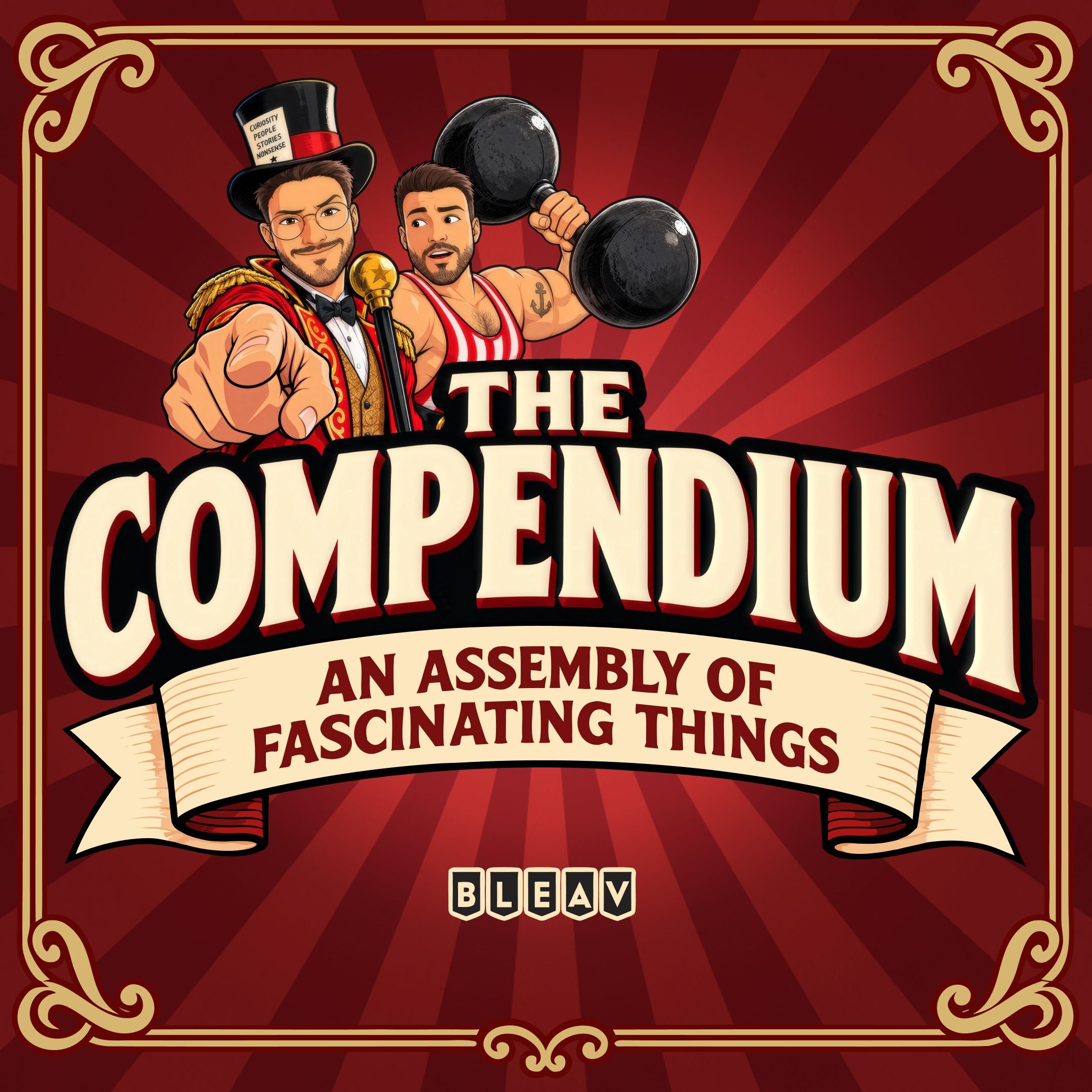
The Compendium: An Assembly of Fascinating Things
Subscribed: 67Played: 3,100
Subscribe


© 2025 The Compendium: An Assembly of Fascinating Things
Description
True crime, weird history and incredible people. The podcast that gives you strange true stories to impress your friends at any social gathering.
156 Episodes
Reverse
Two sisters made a pact to stop speaking to the world, together they build a private language, wrote strange fiction, and ventured out into a life crime spree that ended with them being locked inside Broadmoor, Britains most notorious psychiatric hospital. Now to the world as The Silent Twins, June and Jennifer Gibbons, became one of Britain’s strangest and saddest true stories. Born to Barbadian parents and raised in Wales, the girls withdrew after years of speech difficulties, bullying, racism, and a bond so intense it became impossible to escape. They spoke only to each other, moved almost as one. Isolated from the world the twins poured their real personalities into plays, diaries, poems and novels, including June’s cult outsider book The Pepsi-Cola Addict. But the world outside their bedroom eventually came calling. Alcohol, boys, vandalism and arson led to court, psychiatric evaluation, and a sentence to Broadmoor Hospital that the twins badly misunderstood. What followed was more than a strange true story. It was a dark history of selective mutism, institutional failure, media sensationalism, and a final pact that seemed to end only when Jennifer Gibbons died. Topics IncludedJune and Jennifer Gibbonswhy the Silent Twins stopped speakingselective mutism and twin languagebullying, racism and isolation in WalesKathy Arthur and the attempt to separate the twinsThe Pepsi-Cola Addict and the twins’ writingthe 1981 crime spree and arson chargesBroadmoor Hospital and institutional failureMarjorie Wallace and the campaign to help themJennifer Gibbons’ death and June’s life afterwardsResources and Further ReadingThe Silent Twins - Book by Marjorie WallaceThe Pepsi-Cola Addict - Novel by June-Alison GibbonsSilent Twin: Without My Shadow - BBC documentary recordThe Silent Twins - 1986 BBC Screen Two dramaJune: Voice of a Silent Twin - BBC Sounds podcast via SpotifyWe Two Made One - The New Yorker article by Hilton Als
Thanks for listening, Freaks. The best free way to help the show: follow The Compendium in the app you are using right now, and give us a star rating. It takes ten seconds and helps new listeners find us. Black Friday: your first month as a Certified Freak on Patreon is half price, until 4 December 2026. Hear episodes early and without adverts, plus an extra episode every month you will not hear anywhere else: https://www.patreon.com/thecompendiumpodcast Suggest a story for us to cover:https://thecompendiumpodcast.com/suggestions See our posts on Instagram:https://www.instagram.com/thecompendiumpodcast Find all our links here:https://thecompendiumpodcast.com/links Hosts: Kyle Risi and Adam CoxEditor: Giordanno Bottezini https://www.instagram.com/giordbtt/Intro music: "Alice in Dark Wonderland" from Pixabay Hosted by Simplecast, an AdsWizz company. See pcm.adswizz.com for information about our collection and use of personal data for advertising.
On the morning of 31 October 1938, a sleepless 23-year-old walked into a room full of reporters who all wanted the same answer: had Orson Welles deliberately terrified America? The night before, his Mercury Theatre on the Air had performed The War of the Worlds as a string of fake news bulletins, and by morning the newspapers claimed the country had come apart. Families fleeing their homes. Switchboards jammed. People begging for gas masks as Martians supposedly wiped out New Jersey.
But the panic might be the biggest illusion of all. Kyle takes Adam through Welles's rise from child prodigy to radio wonder, the frantic last-minute rewrite that almost nobody behind the scenes believed in, and the missing station break that let listeners think it was real. Then comes the twist: the ratings suggesting hardly anyone tuned in, the study that quietly falls apart under scrutiny, and the newspapers with every reason to make radio look dangerous.
This is the strange true story of how a broadcast everyone expected to flop became the most famous in radio history, and how a nation talked itself into believing it had been fooled.
Topics Included
what actually happened during the 1938 war of the worlds broadcast
how orson welles went from child prodigy to radio star
the last-minute rewrite the cast thought would flop
why the missing station break made listeners think it was real
the fake news bulletins and the Grovers Mill landing
the reports of gas masks, fleeing families and jammed switchboards
the ratings and the study that undercut the mass hysteria
how newspapers amplified the panic to attack radio
how the broadcast made Orson Welles more famous, not less
Resources and Further Reading
The War of the Worlds - Novel by H.G. Wells
The War of the Worlds (1938 Mercury Theatre on the Air broadcast) - Internet Archive -
'War of the Worlds' guide: Script, audio and recollections - Wellesnet
The Myth of the War of the Worlds Panic - Article by Jefferson Pooley
The legend of the War of the Worlds - PBS NewsHour
Broadcast Hysteria: - by A. Brad Schwartz
Thanks for listening, Freaks. The best free way to help the show: follow The Compendium in the app you are using right now, and give us a star rating. It takes ten seconds and helps new listeners find us. Black Friday: your first month as a Certified Freak on Patreon is half price, until 4 December 2026. Hear episodes early and without adverts, plus an extra episode every month you will not hear anywhere else: https://www.patreon.com/thecompendiumpodcast Suggest a story for us to cover:https://thecompendiumpodcast.com/suggestions See our posts on Instagram:https://www.instagram.com/thecompendiumpodcast Find all our links here:https://thecompendiumpodcast.com/links Hosts: Kyle Risi and Adam CoxEditor: Giordanno Bottezini https://www.instagram.com/giordbtt/Intro music: "Alice in Dark Wonderland" from Pixabay Hosted by Simplecast, an AdsWizz company. See pcm.adswizz.com for information about our collection and use of personal data for advertising.
An entire colony of 117 men, women and children vanished without leaving behind a single body. There was no blood, no sign of an attack and no ruined settlement. Their homes had been carefully dismantled and taken away. All they left behind was one word carved into a wooden post: CROATOAN.
In 1587, the colonists were stranded on Roanoke Island instead of reaching their intended home in Chesapeake Bay. Governor John White sailed back to England for supplies, leaving behind his daughter Eleanor and newborn granddaughter Virginia Dare. War, privateering and disaster kept him away for three years. By the time he returned, everyone was gone.
What did Croatoan mean and where did the settlers go? Did they move inland, reach the Indigenous communities around Chesapeake, survive through trade and assimilation, or meet a more violent end? From Sir Walter Raleigh’s collapsing colonial scheme and England’s brutal relationship with local communities to hidden map symbols, hammerscale, Jamestown accounts and the infamous Dare Stones, this is the strange history behind one of America’s most enduring unsolved mysteries and the possibility that the colonists were never truly lost at all.
Topics Included
What happened to the Lost Colony of Roanoke
The real meaning of the Croatoan carving
John White’s three-year delay and return
Virginia Dare and the 117 settlers
English conflict with the Roanoac and Croatoan communities
The planned move to Chesapeake Bay
Archaeological evidence at Croatoan and Salmon Creek
Jamestown accounts of surviving colonists
The Lumbee connection and assimilation theory
The Dare Stones and the hoax that followed
Thanks for listening, Freaks. The best free way to help the show: follow The Compendium in the app you are using right now, and give us a star rating. It takes ten seconds and helps new listeners find us. Black Friday: your first month as a Certified Freak on Patreon is half price, until 4 December 2026. Hear episodes early and without adverts, plus an extra episode every month you will not hear anywhere else: https://www.patreon.com/thecompendiumpodcast Suggest a story for us to cover:https://thecompendiumpodcast.com/suggestions See our posts on Instagram:https://www.instagram.com/thecompendiumpodcast Find all our links here:https://thecompendiumpodcast.com/links Hosts: Kyle Risi and Adam CoxEditor: Giordanno Bottezini https://www.instagram.com/giordbtt/Intro music: "Alice in Dark Wonderland" from Pixabay Hosted by Simplecast, an AdsWizz company. See pcm.adswizz.com for information about our collection and use of personal data for advertising.
In 1692, an enslaved woman named Tituba told a Salem courtroom that the Devil had come to her and bid her serve him. Her confession lit the fuse that would become known as the infamous Salem witch trials, the deadliest witch hunt in American history.
Within months, more than a third of Salem Village had been accused, imprisoned and were awaiting trial. Nineteen people were hanged. One man was pressed to death under stones for refusing to plead. And a four-year-old girl sat in custom-made shackles while her accusers watched.
But this is not really a story about witches. It is a story about mass hysteria, and how a Puritan community primed by centuries of European witch hunting, religious paranoia and moral surveillance convinced itself to kill its own neighbours on the strength of spectral evidence: testimony that someone's ghost attacked you in the night.
We trace the strange true story from Cotton Mather's witchcraft playbook to the witch cake, the Devil's book, the confessions that saved lives, and the moment the accusations reached the governor's wife and the whole thing collapsed. Plus the surprising link between Salem and our home town of Norwich.
Topics Included
what caused the Salem witch trials
Tituba's confession and why it changed everything
spectral evidence and why no alibi could save you
the witch cake ritual and the first three accused
the arrest of four-year-old Dorothy Good
Giles Corey's death by pressing and his final strategy
how the accusations reached the governor's wife and ended the trials
the 330-year fight to clear every victim's name
the Norwich connection to Bridget Bishop
Resources and Further Reading
Memorable Providences, Relating to Witchcrafts and Possessions - Cotton Mather, 1689,
Salem Witch Trials Memorial, Salem, Massachusetts - Memorial site opened 1992
Salem witch trials - Encyclopaedia Britannica
The last Salem witch has been exonerated - CNN
Thanks for listening, Freaks. The best free way to help the show: follow The Compendium in the app you are using right now, and give us a star rating. It takes ten seconds and helps new listeners find us. Black Friday: your first month as a Certified Freak on Patreon is half price, until 4 December 2026. Hear episodes early and without adverts, plus an extra episode every month you will not hear anywhere else: https://www.patreon.com/thecompendiumpodcast Suggest a story for us to cover:https://thecompendiumpodcast.com/suggestions See our posts on Instagram:https://www.instagram.com/thecompendiumpodcast Find all our links here:https://thecompendiumpodcast.com/links Hosts: Kyle Risi and Adam CoxEditor: Giordanno Bottezini https://www.instagram.com/giordbtt/Intro music: "Alice in Dark Wonderland" from Pixabay Hosted by Simplecast, an AdsWizz company. See pcm.adswizz.com for information about our collection and use of personal data for advertising.
On the last morning before half term, 240 children walked into Pantglas Junior School beneath a mountain of coal waste. Minutes after lessons began, Tip 7 collapsed above Aberfan, sending liquefied spoil through homes and classrooms and killing 116 children and 28 adults.
But the Aberfan disaster did not begin with the slide, and it did not end when the rescue stopped. The warning signs had been there: natural springs beneath the tip, earlier slips on the mountainside and concerns that failed to produce action. The tribunal later placed responsibility on the National Coal Board and concluded that the disaster could and should have been prevented.
Told through the experiences of survivors including Phil Thomas, Karen Thomas, Jeff Edwards and Gerald Tarr, this is a story of rescue, grief, institutional failure and the lives shaped by what happened on 21 October 1966. It also follows the fight to remove the remaining tips, the controversy surrounding the disaster fund and the long silence that made healing even harder.
Topics Included
The final morning at Pantglas Junior School
Why water beneath Tip 7 triggered the collapse
The warnings and earlier slides on Mynydd Merthyr
The children and teachers trapped inside the school
The rescue effort and its system of whistles and silence
The tribunal's findings against the National Coal Board
The compensation and disaster-fund controversies
The lasting trauma carried by survivors and families
Resources
The Aberfan Tribunal — Glamorgan Archives
Aberfan Disaster 1966 — National Library of Wales digital archive
The Aberfan Disaster, 1966 — British Geological Survey case study
Aberfan Disaster: Lessons Learned — Institution of Civil Engineers explainer
Aberfan: No End of a Lesson — History & Policy research paper
Aberfan Disaster Debate, 26 October 1967 — UK Parliament Hansard
Death of a Black Mountain: How the Aberfan Disaster Unfolded — HistoryExtra survivor history
The Psychological Effects of the Aberfan Disaster — 33-year follow-up study
Guidance to the Disused Tips Authority for Wales — Welsh Government consultation
This Year Marks the 60th Anniversary of the Aberfan Disaster — Merthyr Tydfil County Borough Council
Thanks for listening, Freaks. The best free way to help the show: follow The Compendium in the app you are using right now, and give us a star rating. It takes ten seconds and helps new listeners find us. Black Friday: your first month as a Certified Freak on Patreon is half price, until 4 December 2026. Hear episodes early and without adverts, plus an extra episode every month you will not hear anywhere else: https://www.patreon.com/thecompendiumpodcast Suggest a story for us to cover:https://thecompendiumpodcast.com/suggestions See our posts on Instagram:https://www.instagram.com/thecompendiumpodcast Find all our links here:https://thecompendiumpodcast.com/links Hosts: Kyle Risi and Adam CoxEditor: Giordanno Bottezini https://www.instagram.com/giordbtt/Intro music: "Alice in Dark Wonderland" from Pixabay Hosted by Simplecast, an AdsWizz company. See pcm.adswizz.com for information about our collection and use of personal data for advertising.

Comments

Download from Google Play

Download from App Store
 United States