


Ultimate Partner®
Subscribed: 37Played: 947
Subscribe

Description
Empowering partners to achieve their greatest results through successful partnering.
224 Episodes
Reverse
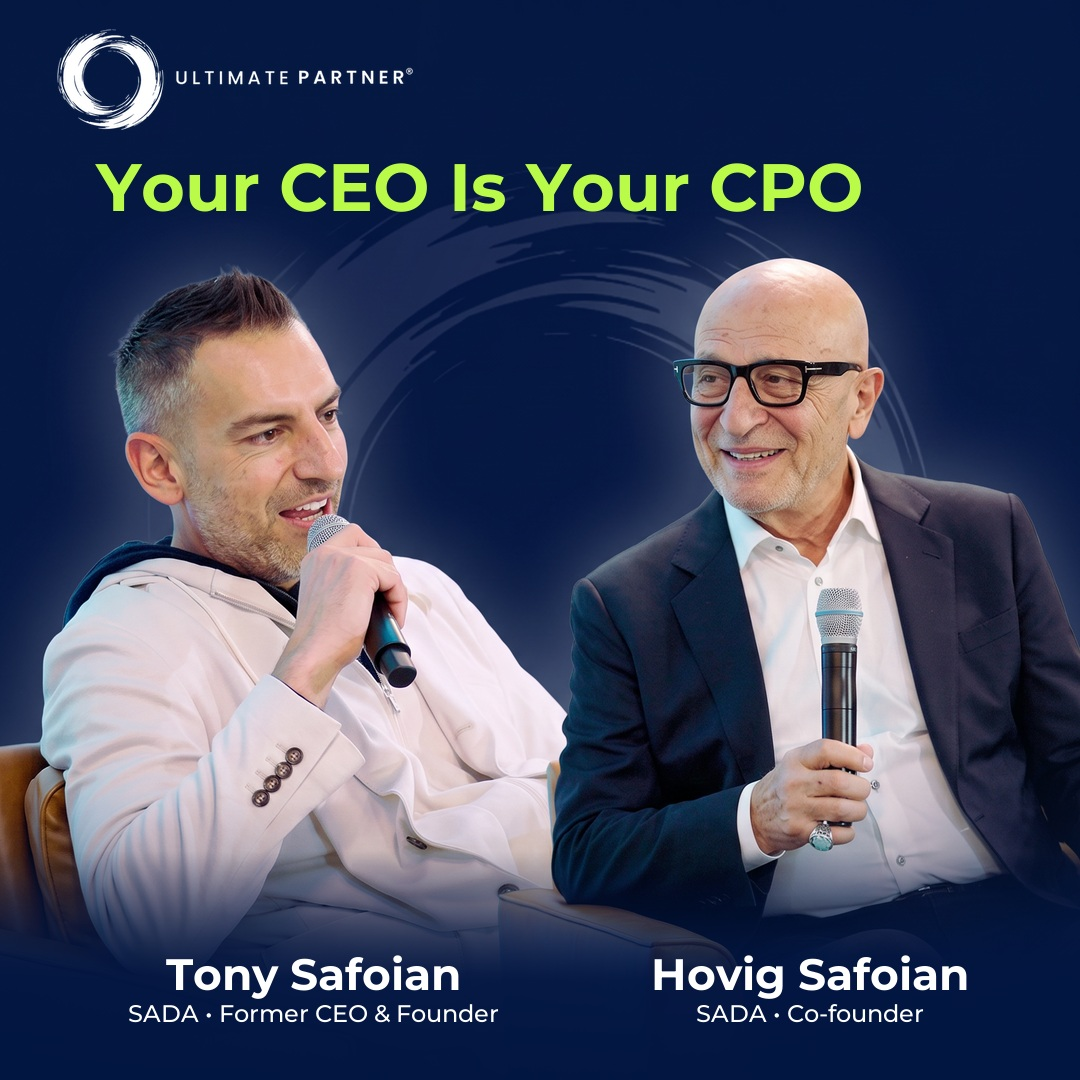
Your top salespeople should make way more than you do.
Subscribe to our Newsletter: https://theultimatepartner.com/ebook-subscribe/ Check Out UPX: https://theultimatepartner.com/experience/
In the rapidly shifting cloud and AI landscape, the most successful partners are those whose leaders treat strategic alliances not as a side department, but as the core driver of business growth. In this session, recorded live at Ultimate Partner LIVE in Reston, host Vince Menzione sits down with Tony Safoian, Former CEO and Founder of SADA, and Hovig Safoian, Co-founder of SADA, to explore the journey of building one of the most successful born-in-the-cloud channel partners in history. Tony and Hovig share how they scaled SADA from a local family-run MSP into Google Cloud’s top global partner, culminating in a landmark acquisition by Insight. The co-founders discuss the critical decision to spin off their Microsoft practice to double down on Google, the necessity of the CEO acting as the Chief Partner Officer to drive rapid resource allocation, and the art of recruiting top-tier talent by paying key hires more than the founders. The conversation wraps up with Hovig’s reflections on maintaining a customer-obsessed culture, Tony’s perspective on managing failure through small portfolio bets, and a forward-looking call for partners to disrupt traditional services by adopting outcome-based pricing models.
https://www.youtube.com/watch?v=FlPbwdF3ll0
YOUTUBE: [add link]
Key Takeaways
A CEO must act as the Chief Partner Officer because direct executive involvement allows for instant resource allocation and strategic pivots without the bureaucratic delays of traditional partner management.
SADA achieved hyper-specialization and became Google’s top global partner for eight consecutive years by making the difficult strategic decision to spin off its successful Microsoft practice.
To build a best-in-class organization, founders must be willing to recruit elite talent and pay top performers—such as SADA’s lead cloud engineers and salespeople—more than the CEO.
Maintaining trust with competing hyperscalers requires strict operational firewalls, specialized engineering teams, and transparent, one-page rules of engagement for customer pursuits.
SADA scaled its global footprint and met enterprise demands by expanding operations to Armenia and India, while giving 20% of the company to employees to drive alignment and retention.
As AI disrupts traditional delivery timelines, partners must innovate their business models by shifting from billable hours to outcome-based pricing that aligns directly with customer value.
If you’re ready to lead through change, elevate your business, and achieve extraordinary outcomes through the power of partnership—this is your community. At Ultimate Partner we want leaders like you to join us in the Ultimate Partner Experience – where transformation begins.
Keywords
SADA, Google Cloud, Microsoft ecosystem, co-selling, hyperscalers, born-in-the-cloud, Chief Partner Officer, business model innovation, outcome-based pricing, talent acquisition, global expansion, Insight acquisition, family business, partner trust, hyper-specialization, customer obsession.
Transcript
[00:00:00] Tony Safoian: And I think that’s the hard part founders can’t get over like, oh my god. Like, how can somebody at the company make more than I make? It’s like, no, they should. Like, your top salespeople should make way more than you make.
[00:00:13] Vince Menzione: You can feel it happening. The ground is shifting beneath us. The way we partner, how AI is remaking the channel, and what it takes to win as a partner right now. I’m Vince Menzione, and welcome to the Ultimate Partner Podcast, where the leaders shaping the ecosystem tell you what’s really happening. Get ready to go deeper. The insights, the frameworks, the real moves in the market. Because being in the room changes everything, and we’re bringing the room to you now.
[00:00:55] Vince Menzione: I am incredibly blessed. You heard me talk about this morning a little bit. Those of you who’ve read the book or listened to the book or know a little bit about my story know I’ve been around this business for a long time. When we were at Microsoft, we were trying to figure out the cloud. We knew we were way behind. We didn’t have born-in-the-cloud partners. And then there was this company I kept hearing about in Southern California in the LA Basin area that was a born-of-the-cloud partner, and they were willing to work with us.
[00:01:28] Vince Menzione: You need to go out there and meet with them in person. And so I got on a plane, and I flew out to Los Angeles. And I got to sit down with the founder, the co-founders of this organization, this organization which was small and mighty at the time. They were an MSP, and their story is in the book. And… But rather than me bore you with any of the details, it turned out to be an incredible day together, incredible evening and dinner. They exuded trust from day one, and I learned a lot from this gentleman.
[00:02:01] Vince Menzione: He’s been a great friend of mine. And, sorry. And when I started the podcast, I called Tony up and I said, hey, I’m thinking about doing this thing. What do you think? And he said, absolutely. You need to go do this. You need to go do it now. And he was my first guest on Ultimate… The Ultimate Partner. He is a five-time. We used to talk about the robe. I think I gave away the robe. What am I gonna do? I’m gonna get you a better robe.
[00:02:29] Vince Menzione: He flew in from Los Angeles today just to be here today with us, and I wanna thank you for joining us. Tony, get up here. Get up here, man. Give me a hug. Oh my goodness. No. You don’t… No shit. No hand. Thank you, brother. So good to see you. So good to see you.
[00:02:47] Tony Safoian: This thing is on.
[00:02:47] Hovig Safoian: Yeah. You get a hand mic. How was the flight in?
[00:02:52] Vince Menzione: Get one of these guys.
[00:02:53] Tony Safoian: It was great because I knew I was gonna come and see you. Oh, my goodness. You’re the only person in the world that could get me out of retirement for one day.
[00:03:02] Vince Menzione: I’m still shocked you’re here. I am still shocked you’re here. I kept thinking he was gonna get a phone call. I’m a little
[00:03:08] Tony Safoian: rusty. I haven’t done this in a long time. I need to stretch a little bit. It’s been so long since I’ve been on stage, man.
[00:03:16] Vince Menzione: It has. Has it been a couple of years now?
[00:03:18] Tony Safoian: Yeah. Yeah. At least, at least…
[00:03:19] Vince Menzione: So we did a podcast. The last podcast we did together was you and Dee Burger at the Insight event. We rented out that little space and we did a podcast. We brought people in to do the podcast recording there.
[00:03:31] Tony Safoian: Yeah.
[00:03:32] Vince Menzione: And that was sort of the last time I think we’ve been together. Yeah. We spent a lot of time together over the years, by the way.
[00:03:37] Hovig Safoian: Yeah.
[00:03:38] Vince Menzione: I was running the public sector partner business. You won Education Partner of the Year. Yes. And the business really took off. And we’ll talk… I wanna talk about… I don’t mind to rob the mic, but you had a very strong Google practice. We were concerned about trust. Yes. You firewalled your organization. You set up an entire separate team to demonstrate trust to Microsoft
[00:04:03] Tony Safoian: Yes.
[00:04:03] Vince Menzione: At that time, which is pretty significant.
[00:04:05] Tony Safoian: And the man who led that team is sitting, I think, right there filming me right now. Hey, Roman. Now he has his own great firm. But, yes, that was a very necessary step for us. It just sort of… If you had kind of our ethos and our strategy, that just… That was just an obvious thing that we had to do. You know? It wasn’t a difficult decision.
[00:04:34] Tony Safoian: It just… It made so much sense. I think the technology itself was different enough that we felt we required highly specialized teams both in sales and go-to-market, but certainly in engineering. It was just a different stack, different code, different infrastructure, different architecture. And… But most importantly, not only did we separate the teams, we wrote this one-pager about rules of engagement. We’re very transparent about when we would engage or not engage, yes,
[00:05:07] Tony Safoian: with certain customers because that was everyone’s, you know…
[00:05:11] Vince Menzione: Like, LA Unified… Yeah. Like, if we’re
[00:05:15] Tony Safoian: in LA Unified with Microsoft, we’re not gonna ever sell Google into that account. That was kind of how we framed it; people were very comfortable with that. But, yeah, it was a complex time. I mean, it was weird to be under that degree of scrutiny given the size that we were. We’re quite small. We’re like, ‘Don’t your GSIs do everything? Like, you know, don’t… You know, you let them sell everything,’ but yeah. Not that you weren’t letting us, but it was like this… I think because we were so at the tip of the spear, there was a lot of concern about how we would treat the confidentiality of all the things going on and the pursuits and everything else.
[00:05:51] Vince Menzione: And the culture was odd at that point too. Everybody was a competitor in one form or another to the…
[00:05:56] Tony Safoian: Yeah. It was before
[00:05:58] Vince Menzione: Satya really took hold and
[00:05:59] Tony Safoian: Yes.
[00:06:00] Vince Menzione: started to embrace and things like that.
[00:06:03] Tony Safoian: Yeah. I mean, it’s a completely different world now. Yeah. Everyone is… Everyone’s partner and potential competitor, you know, as well. So it’s a very different world. I think hyper-specialization is something that I would always do and I always believed in. And that, I think, is still very relevant today. But, yeah, it was a very tense time for Microsoft because they were d
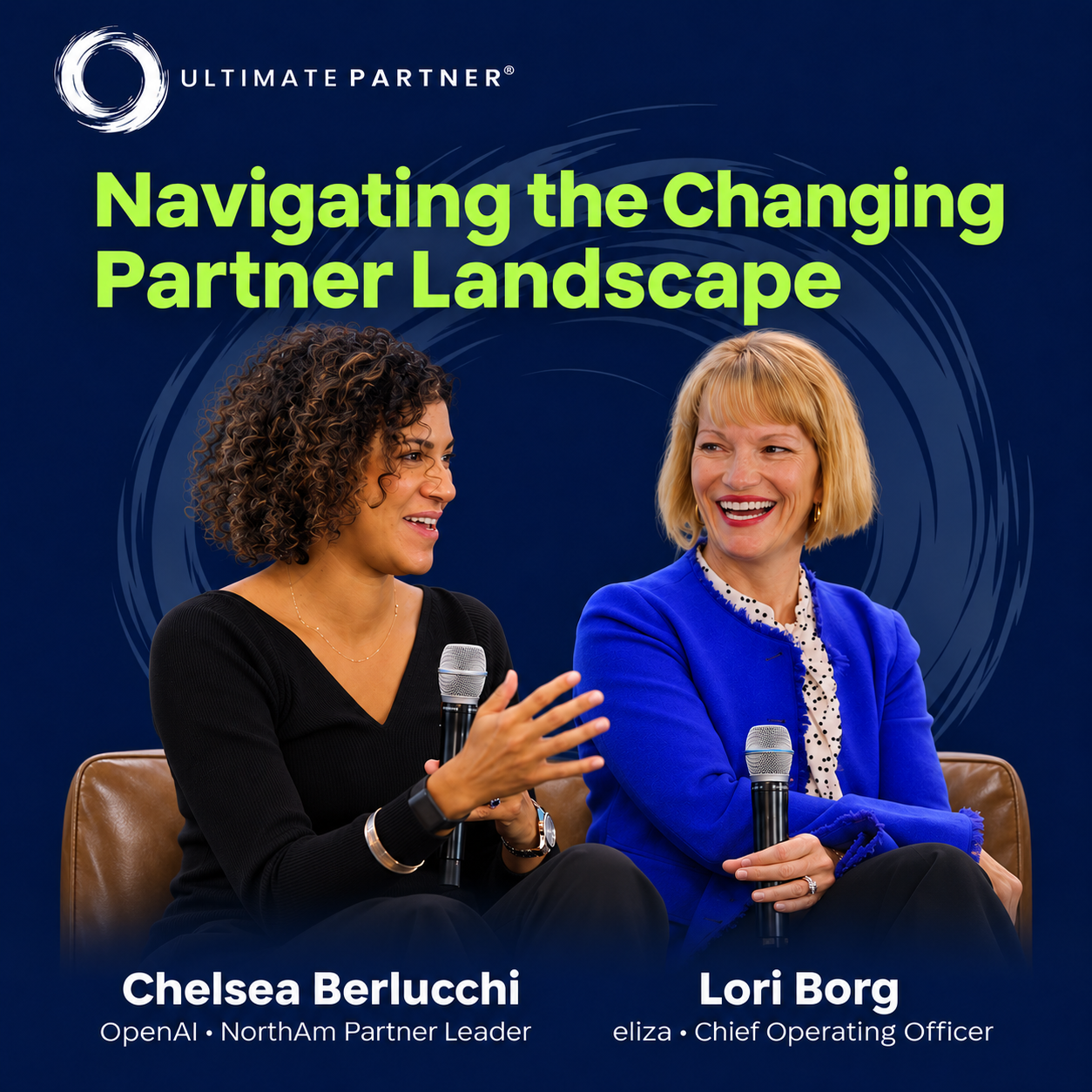
OpenAI is building its partner ecosystem at a pace where a week feels like a month.
Subscribe to our Newsletter: https://theultimatepartner.com/ebook-subscribe/ Check Out UPX: https://theultimatepartner.com/experience/
Frontier AI labs are becoming the newest hyperscaler-class partners, and the organizations that win with them are moving at a speed the channel has not seen before. In this session, recorded live at Ultimate Partner Live in Reston, host Vince Menzione sits down with Chelsea Berlucchi, who leads OpenAI’s North America partner ecosystem after eight years at Google and ten at Cisco, and Lori Borg, Chief Operating Officer of Eliza, a services firm built from scratch this year and focused entirely on OpenAI.
Chelsea describes an OpenAI partner network that has grown to more than 12,000 registered partners in a few months, a team organized around partner sales and partner management rather than tiers, and a co-sell motion built on direct-sales instincts: partners in the room with the account director, covering the whole customer organization, and pitching in five minutes rather than forty slides.
Lori explains why going all in on a single platform has paid off across her career, how Eliza structures itself around build-with, sell-with and market-with motions, and how industry depth and persona-led use cases let a small, nimble partner bring value faster than larger multi-cloud firms. The conversation closes with practical advice for partners who want a relationship with a frontier lab, the opportunity for MSPs on the day-two side of the business, and an audience question on how a Microsoft-only partner can add OpenAI through model choice and digital-native customers.
https://youtu.be/BLKTlQIoxzw?si=_bGfEMsHKrHAXNVF
YOUTUBE: [add link]
Key Takeaways
OpenAI’s partner network grew to more than 12,000 registered partners within months, almost entirely self-serve, and the North America team now aligns partners directly with account directors and sales engineers to co-sell.
OpenAI does not tier its partners; the expectation is self-sufficiency fast, with the first meeting feeling like the third and the first month like the first year.
Co-selling with a consumption-based AI business means revenue arrives only when workloads are delivered, so partners must be in the customer meetings, cover the whole organization, and plan the implementation jointly.
Partners who succeed with OpenAI dedicate accountable people to the practice, invest in badging and forward deployed engineer training alongside OpenAI’s own teams, and bring a clear five-minute point of view on why customers choose them.
A partnership built on trust runs on three motions at once: build with, sell with and market with. Eliza’s all-in focus on OpenAI accelerated that trust and earned grassroots champions inside OpenAI’s sales organization.
Microsoft-centric partners can add OpenAI through model choice conversations and fast-growing digital-native customers, while MSPs have a natural opening in the day-two managed side of AI deployments.
If you’re ready to lead through change, elevate your business, and achieve extraordinary outcomes through the power of partnership—this is your community. At Ultimate Partner we want leaders like you to join us in the Ultimate Partner Experience – where transformation begins.
Keywords
OpenAI, partner ecosystem, frontier model, co-selling, account directors, partner network, forward deployed engineers, badging, all-in partner, build with, sell with, market with, consumption model, model choice, MSPs, digital natives, Eliza, Microsoft ecosystem.
Transcript
Chelsea Berlucchi – Lori Borg AUDIO PODCAST
[00:00:00] Chelsea Berlucchi: I want the first meeting to feel like the third meeting. And I want the end of the first month in a partnership to feel like the end of the first year. And to really think this business should be different.
[00:00:17] Vince Menzione: You can feel it happening. The ground is shifting beneath us. The way we partner, how AI is remaking the channel, and what it takes to win as a partner right now. I’m Vince Menzione, and welcome to the Ultimate Partner Podcast, where the leaders shaping the ecosystem tell you what’s really happening. Get ready to go deeper: the insights, the frameworks, the real moves in the market. Because being in the room changes everything, and we’re bringing the room to you now.
[00:00:48] Vince Menzione: I am thrilled to welcome our first guests up to the stage today. Both of these incredible leaders I’ve gotten to interview before in various forms, and I’m so thrilled to welcome them both. Chelsea Berlucchi, come join us. And Lori Borg, why don’t you come join us as well so we don’t have to do this twice? But so good to see you. So great to see you. Oh my goodness. And Lori, so great to see you.
[00:01:31] Lori Borg: You too. Great to be here.
[00:01:33] Vince Menzione: So I thought we’d start with introductions. I’ll let you introduce yourselves. I know you both well and your career, but I think maybe take us through your background, and Lori as well.
[00:01:38] Chelsea Berlucchi: Okay. Great. Hi, everyone. Chelsea Berlucchi. So I recently joined OpenAI to lead their North America partner ecosystem a little over 60 days ago. Just counting in days. Each day is kind of like a week. Each week is kind of like a month.
[00:01:54] Vince Menzione: I can imagine. The fire hose must be incredible.
[00:01:57] Chelsea Berlucchi: A lot going on. Prior to that, I was at Google for eight years, both in direct sales as well in the partner ecosystem. And then prior to that, I was at Cisco for 10 years, starting out my career in IT.
[00:02:08] Vince Menzione: So I love this just to visualize this because Cisco, we talked about Cisco, Jay talked about Cisco, like the quintessential channel company. And then you go to GCP, which is the quintessential hyperscaler company, and now OpenAI 60 days. And so really the quintessential AI company.
[00:02:24] Chelsea Berlucchi: Yeah, I’ve taken a lot of the foundations from Cisco, brought those over to Google. And then as I went into the channel at Google, I was able to then also transform that into what I’m bringing over to OpenAI and also what I’m learning there as well. So it’s been a fun journey.
[00:02:39] Vince Menzione: We’ll have an adaptability conversation in a moment. Lori, so good to welcome you.
[00:02:46] Lori Borg: Yeah, great to be here. So good to see so many faces. Good morning, everyone. I’m Lori Borg. I’m the Chief Operating Officer at Eliza. My background is a little bit different. I spent most of my career building Microsoft partner businesses in the Microsoft ecosystem. Having built and sold a few businesses, I then found myself at Microsoft as the Vice President for Go-To-Market for the Americas. And while I was inside of Microsoft, oh, I was just itching to get back out there and build another business, but a different kind of business. I left Microsoft a couple of months ago to join Eliza as Chief Operating Officer. And Eliza is a very, very focused OpenAI partner. So I have the privilege of working with Chelsea and the broader OpenAI team and can concur with everything that Chelsea said. We talk about it at Eliza: one week feels like a month, so I feel like I’ve been there already a couple of years.
[00:03:42] Vince Menzione: And it’s just been a couple of months. We’re moving really fast. But that’s a little bit about my background. It feels like Jay kind of teed up this conversation in a way. He really did in terms of FTEs, and we’ll talk more about your organization as well. But I thought we’d start with you. Everybody wants to know about what’s happening at OpenAI, and after 60 days, I’m sure you’re an expert in all areas of the company. Take us through what you’re doing. I mean, your remit is a pretty significant remit, North America.
[00:04:07] Chelsea Berlucchi: It is. It’s quite a bit. So I joined, again, over 60 days ago and was brought in by a former Google leader, Colleen Kapase, who is our global partner ecosystem leader. Colleen is best in the business. So if you’ve worked with her, if you haven’t, you should, absolutely should. She’s just been in the industries and understands, one, how to build out a business like this, how to build out a partner-first organization, how to meet with the right people to do it as well. So she brought me on. We had worked a bit together at Google, so she knew a little bit about my background. She was a great sponsor of mine. And as I came into the business, so much had already been done, which was great. There is this massive foundation. They built out a partner network. How do we get partners to join and to register? And they did that in around, I think, June or so of this year. And since then, over 12,000 partners have registered to become—yes, and counting. Literally, like I go in every day and I’m checking.
[00:05:10] Chelsea Berlucchi: The cool thing is they did that without calling and saying, “Hey, how do I do this?” They were just able to really self-serve. So that is one massive thing.
[00:05:18] Vince Menzione: All AI-generated, right? Because it’s all—
[00:05:20] Chelsea Berlucchi: Thousand percent. And then for me in particular, covering North America is really the remit of, okay, how do we align to the field sales team? So I have my team that does partner sales and really working with all of our account directors, which is what we call our account executives, and our AAAs, which is essentially what we call our systems engineers or sales engineers, to make sure that as they’re working with their customers, they have started that co-sell motion too. And it’s newer for OpenAI, but it may not be new for a lot of the individuals that are there already in go-to-market, the sellers and the engineers. So that’s good. At least they have brought that piece in from other businesses that they’ve worked at and said, “Yeah, I’ve worked with partners before. I have familia
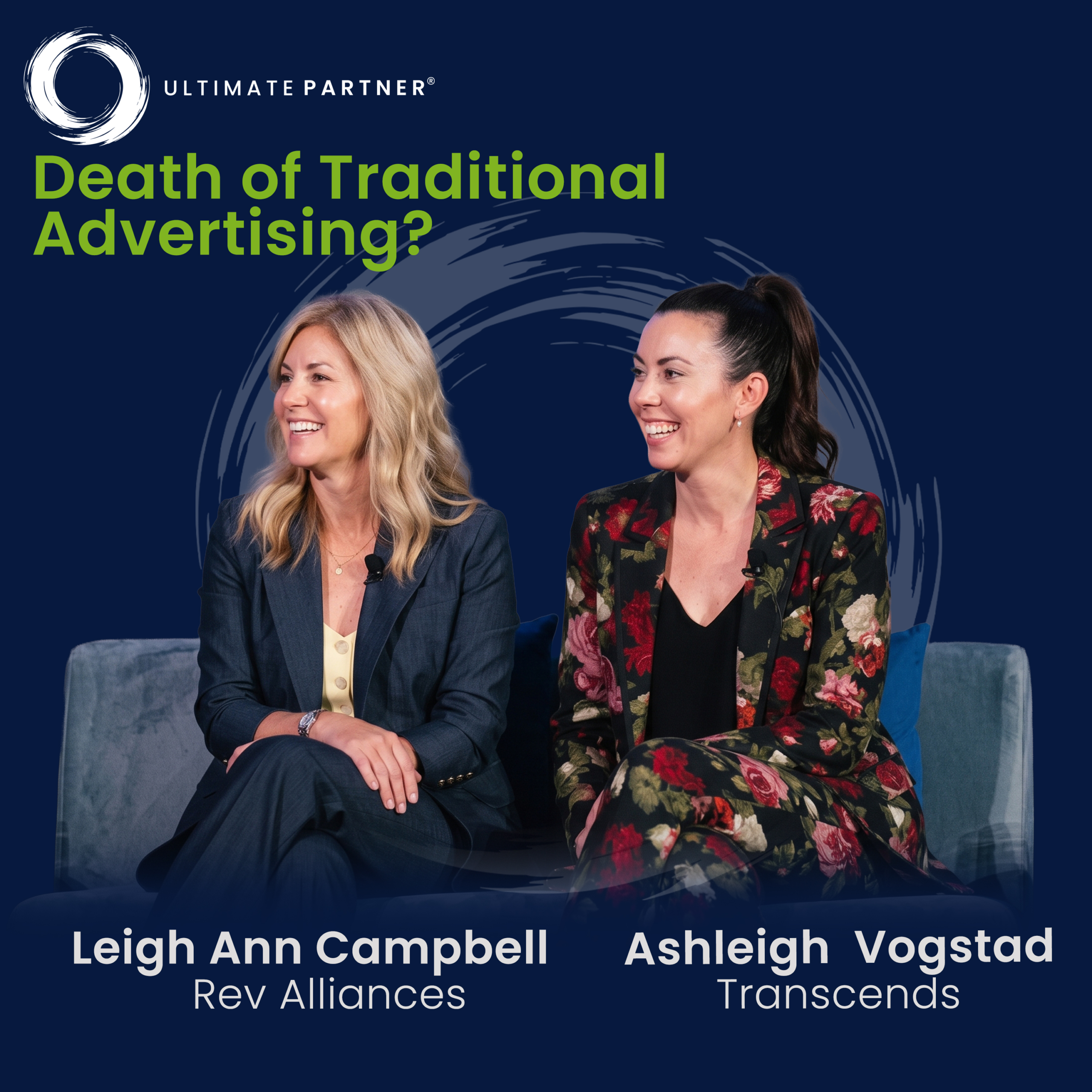
The end of advertising is here.
Subscribe to our Newsletter:
https://theultimatepartner.com/ebook-subscribe/Check Out UPX:https://theultimatepartner.com/experience/
In this insightful discussion, AshleighVogstad and Leigh Ann Campbell dive into the fundamental shift from an attention economy to a trust economy driven by artificial intelligence. They explore how the sunsetting of traditional advertising forces go-to-market leaders to pivot towards product creation, humanized storytelling, and outcome-based hyperscaler partnerships.
https://youtu.be/qeV3wgnnr7Q
YOUTUBE LINK: https://youtu.be/qeV3wgnnr7Q
Key Takeaways
The go-to-market industry is transitioning from an attention-based model to a trust-based economy where machines and AI agents act as buyers.
With content and product creation becoming commoditized, marketers must deeply integrate with product development to drive business impact.
Small, niche in-person community events and executive roundtables are emerging as the most effective marketing tactics over massive conferences.
Direct-to-fan platforms and individual thought leadership are thriving because algorithms now prioritize deep engagement and dwell time over vanity metrics.
For hyperscaler partnerships, delivering 100% of the specific outcomes a customer needs is the ultimate currency of trust for field sellers.
AI is changing the co-sell process by requiring partners to optimize their materials into a searchable, FAQ format for Answer Engine Optimization (AEO).
If you’re ready to lead through change, elevate your business, and achieve extraordinary outcomes through the power of partnership—this is your community.
At Ultimate Partner® we want leaders like you to join us in the Ultimate Partner Experience – where transformation begins.
Key Tags:
attention economy, trust economy, artificial intelligence marketing, agentic intelligence, product marketing disruption, in-person community events, direct-to-fan platforms, humanized storytelling, answer engine optimization, AEO, hyperscaler alliances, ISV co-sell pipeline, Microsoft Azure specialist, partner center optimization, outcome-based selling
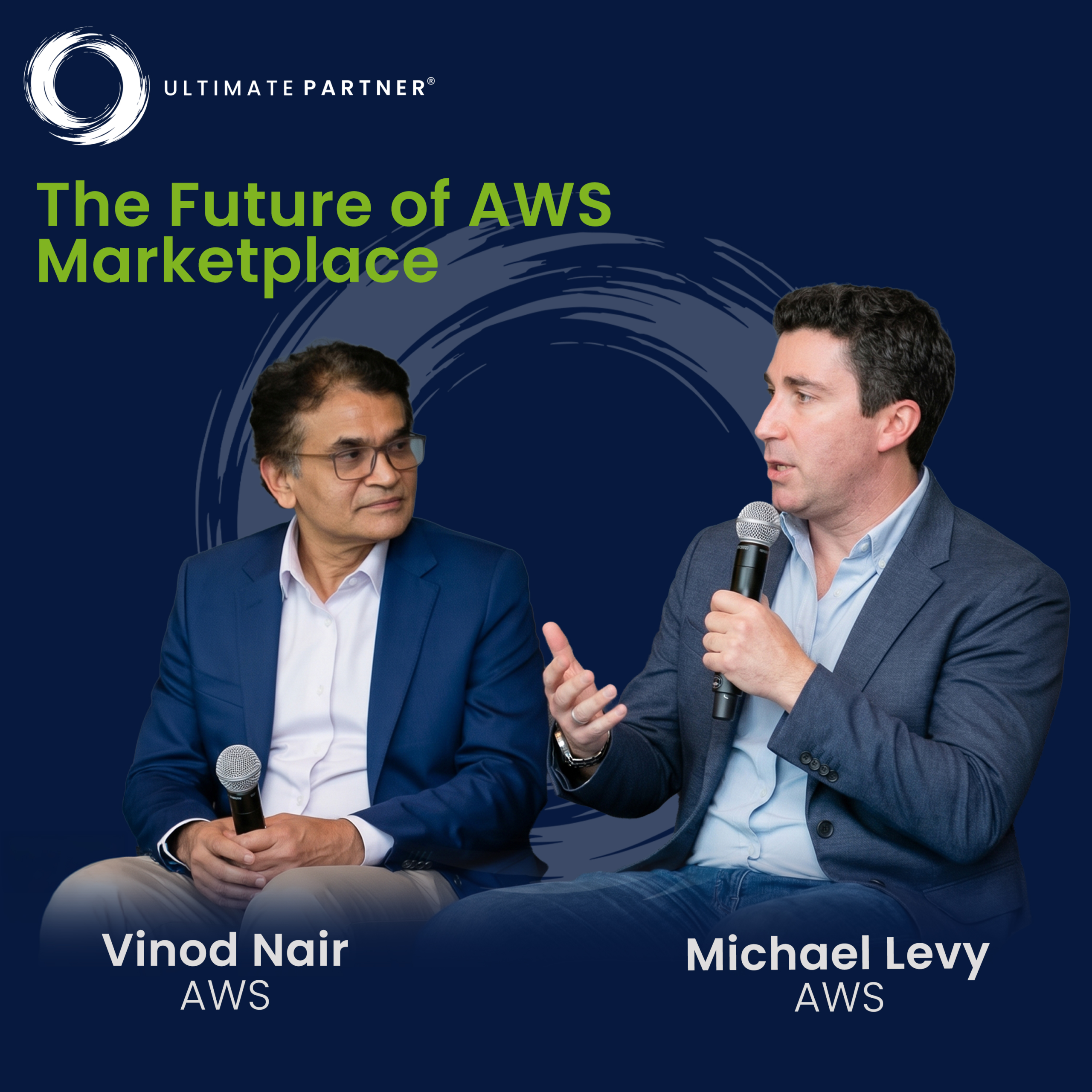
Will AI buy your software next?
Subscribe to our Newsletter:https://theultimatepartner.com/ebook-subscribe/ Check Out UPX:https://theultimatepartner.com/experience/
In this discussion, Vinod Nair and Michael Levy explore how product-led growth (PLG) and agentic AI are fundamentally reshaping the AWS Marketplace. They detail why relying on traditional sales-led motions is becoming obsolete as AI agents increasingly take over software discovery and procurement. The conversation provides actionable insights on auditing API strategies, adopting outcome-based commercial models, and removing setup friction to capture the growing wave of machine-driven B2B buying.
https://youtu.be/enLOuppFYq0?si=A1uPSJ9ioXO7zbTS
Key Takeaways
Product-led growth (PLG) allows users to discover, try, and buy solutions without relying on direct sales interactions.
A successful free trial must deliver immediate value rather than forcing customers to spend time on complex setup processes.
AI agents prioritize technical availability, structured metadata, and API access over traditional brand identity during procurement.
The Marketplace MCP server acts as an official connector for Claude, driving a significant increase in AI-based search and evaluation traffic.
Sellers looking to monetize agentic AI should transition their commercial models toward usage and outcome-based billing.
Over 90% of surveyed global sellers are expected to transition to product-led growth within the next three years.
If you’re ready to lead through change, elevate your business, and achieve extraordinary outcomes through the power of partnership—this is your community. At Ultimate Partner® we want leaders like you to join us in the Ultimate Partner Experience – where transformation begins.
Key Tags
product-led growth, AWS marketplace, agentic AI, software procurement, Claude connector, API strategy, outcome-based billing, SaaS transformation, technical availability, structured metadata, AWS seller prime, agent core payments
Transcript
Vinod Nair and Michael Levy AUDIO Podcast
[00:00:00] Michael Levy: Humans, for the most part, care about brand and brand identity and all of that. Agents don’t care about that, right? It’s about the technical availability. It’s about the structured metadata. It’s about evaluating whether it’s the right tool to accomplish that task.
[00:00:15] Vince Menzione: You can feel it happening. The ecosystem is shifting beneath us, the way Hyperscalers are partnering, how AI is remaking the channel and what it means to win in 2026.
[00:00:26] Vince Menzione: Welcome to the Ultimate Partner Podcast. I’m Vince Menzi. Own your host. And each week I sit down with leaders at the
[00:00:33] Vince Menzione: intersection of technology, partnerships and outcomes. The voices shaping how ecosystems actually work. We talk about what’s real, what’s changing, and what it takes to lead in this era where the partner channel isn’t just part of the strategy.
[00:00:48] Vince Menzione: It is the strategy because being in the room changes everything. Let’s start.
[00:00:57] Vince Menzione: All right. Thank you. All right,
[00:01:01] Vince Menzione: so we talked about product led earlier today with that, um. Agent powered. And then marketplace growth is, uh, is part, part of your, your mandate. You’ve got a lot of mandates though, from what I remember. Um, why don’t we just go through like introductions and tell, take us through your mandate, your individual mandates and roles at AWS.
[00:01:20] Vinod Nair: Okay, thank you. Uh, my name’s Vinod Nier. I’ve been with AWS marketplace close to eight years now. Uh, I started off as a category lead and worked with. Elastic, uh, MongoDB Databricks. Uh, and that’s where I kind of learned that one of the big missed opportunities in marketplace is helping ISVs grow through product led growth.
[00:01:43] Vinod Nair: So, literally wrote a paper, got it approved, and this launched AWS marketplace Sell a Prime about three and a half years ago.
[00:01:51] Vince Menzione: Nice.
[00:01:52] Vinod Nair: Elastic was one of our founding partners. Grateful for their support and it’s. It’s grown, and that’s kind of my charter. How do I help ISVs activate product-led growth in marketplace?
[00:02:03] Vince Menzione: I love it. I wanna dive in.
[00:02:04] Vince Menzione: Vinod is the godfather of product led growth. I love it on marketplace.
[00:02:08] Michael Levy: Um, I’m, uh, Mike Levy. Uh, I’m from our marketplace business development team. So my team focuses on feature launch and go to market. So for across the features, uh, in Matt Wise org. For partners and for customers.
[00:02:21] Michael Levy: And I’m also, I’ve also been the BD lead for our AI agents and tools category within Marketplace. So we formally launched that as a category last year and we’ve seen tremendous growth. And along with the category, we’ve also launched like new deployment mechanisms that many of our partners and customers are taking advantage of.
[00:02:37] Michael Levy: Basically to make it easier for partners to go to market with ag agentic solutions specifically, uh, and for customers to procure those solutions on marketplace.
[00:02:46] Michael Levy: Unbelievable. So I think a lot of people get PLG wrong and we’ll start there. And you, you’ve had, you mentioned some market leaders
[00:02:53] Vinod Nair: Yeah.
[00:02:54] Vince Menzione: Like outstanding organizations.
[00:02:55] Vince Menzione: So take, take us through, I mean, I’m not expecting you to go through all six pages Sure. Of the document you wrote, but we know it’s a six pager usually. Right. Uh, but with the pen. But take us through the thesis of what, what you had to solve. Why, why partners need to get this right.
[00:03:09] Vinod Nair: Yeah. Yeah. So I’ll start with just kind of defining product led growth because it’s.
[00:03:13] Vinod Nair: It’s, it’s, it’s still ambiguous to a lot. Yeah. And so have a product that basically a user can discover, try and buy without talking to a salesperson. So that’s kind of the key element that it looks, sounds simple, but it is incredibly complex behind the scenes. So there’s a, like the duck swimming very fast.
[00:03:36] Vinod Nair: You think everything is fine. So. It incorporates free trial. That same, because that’s how a customer actually sees the value, but the free trial needs to have some value. It’s delivering. Otherwise, if the customer is just spending most of their time trying to start your product, then free trial’s a waste.
[00:03:56] Vince Menzione: Yeah.
[00:03:57] Vinod Nair: Then, then it is kind of monitoring them through their journey. And so this includes support from marketing. It includes support from sales because sales needs to, sales can now become more of a customer success because they can, they have a very qualified lead. Here’s a customer that’s actually using my product.
[00:04:16] Vinod Nair: They’ve seen the value. So I, when I have that conversation with the CTO, it’s like I’ve already won the technical battle. I need to do now is show you the commercials for a, for a bigger deal.
[00:04:28] Vince Menzione: What are you doing to help them? Are you helping them embed any technology into their solutions so that you can get the real time feedback you need to on their usage?
[00:04:38] Vince Menzione: And
[00:04:38] Vinod Nair: so
[00:04:39] Vince Menzione: where they’re
[00:04:39] Vinod Nair: seeing what, what AWS marketplace has done is a few things. One, we have, uh. Like currently we have, IM delegation and quick, uh, it used to be called moonwalk. What that does is it removes the friction of setting things up. That’s a complex task. So that’s, that’s where we are trying to bring that down to as close to one click as possible.
[00:05:02] Vinod Nair: Databricks is a great example where we started off and that hockey stick analogy, they saw a tremendous growth in conversion. Once they did that,
[00:05:11] Vince Menzione: yeah.
[00:05:11] Vinod Nair: Another one is buy with AWS. So free trial has ended. Don’t let them disappear. Hey, you can continue and buy with AWS so they stay within your product.
[00:05:24] Vinod Nair: Complete the free trial and start going down the paid journey.
[00:05:30] Vince Menzione: So Mike, 2,700 agent.
[00:05:33] Michael Levy: Uh,
[00:05:33] Michael Levy: no, I think that’s when we spoke in, uh
[00:05:35] Vince Menzione: oh, it’s, oh, okay.
[00:05:36] Vince Menzione: I think it’s over 4,000.
[00:05:37] Vince Menzione: Wow. It’s over four. Okay.
[00:05:38] Michael Levy: And let, let’s be clear, I think Matt cleared this up a little bit, but it’s AG agentic solutions, right? Right. So a lot of that is professional services, uh, which have you tuned in recently.
[00:05:47] Michael Levy: There there’s, uh, much more economic incentives to transacting professional services, including agentic professional services, um, and SaaS solutions that have agents embedded within it. So there’s a couple different models with ISVs that we’ve seen on. How they’re going to market with agentic solutions.
[00:06:04] Michael Levy: Um, and it’s kind of a, a, a spectrum that I can get into detail, if that’s helpful.
[00:06:07] Vince Menzione: Yeah. Well, um, I’m, I’m interested in how your two, uh, wheelhouses your remits, uh, kind of, they, they converge and they diverge, right? In many respects.
[00:06:18] Vince Menzione: Definitely.
[00:06:18] Vince Menzione: Yeah.
[00:06:18] Michael Levy: Um, I think product-led growth has been a story of how humans can procure something, a product without friction and without talking to another human.
[00:06:28] Michael Levy: I think agent led growth maybe is the the next evolution of that, where
[00:06:31] Michael Levy: sounds like it
[00:06:32] Michael Levy: today. If a human can’t come to your product page or come to your product page on marketplace and seamlessly execute the entire funnel from discovery to procurement. I’m sure as hell that an agent can’t, an agent can
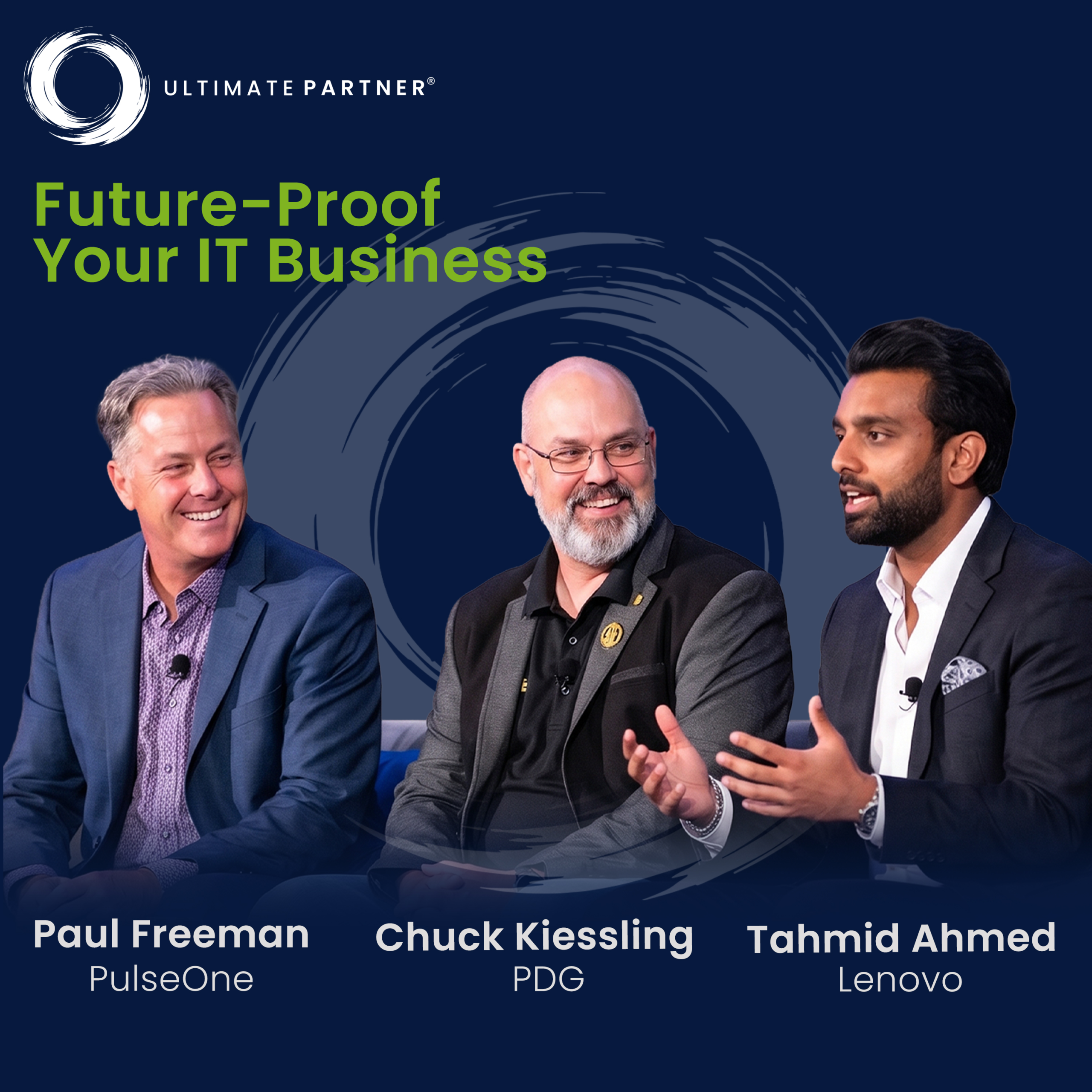
Stop Begging Microsoft for Leads: The Proven Playbook Top MSPs Actually Use
Subscribe to our Newsletter:
https://theultimatepartner.com/ebook-subscribe/
Check Out UPX:
https://theultimatepartner.com/experience/
In this insightful episode, Vince Menzione sits down with Chuck Kiessling of Partner Development Group (PDG), Tahmid Ahmed of Lenovo, and Paul Freeman of Pulse One to decode the complexities of the Microsoft partner ecosystem. The panel explores the transition of traditional MSPs into technology integration companies, the importance of operationalizing your Microsoft practice across all internal departments, and the critical need to adapt to generative AI. They also unpack the strategic collaboration between hardware giants, partner development experts, and integration companies to unlock co-sell referrals, optimize licensing, and leverage the Microsoft Marketplace for scalable mid-market growth.
https://youtu.be/MHqENEk64S4
Key Takeaways
MSPs should evolve into technology integration companies to stay relevant in the changing ecosystem.
Success in the Microsoft channel relies on strategic behavior and engaging around the sale, not just asking for direct leads.
A Microsoft practice should not be siloed but integrated across marketing, finance, and operations.
Partners must focus on solving specific customer problems, such as providing automation and security, rather than just selling technology for its own sake.
Optimizing enterprise licensing and moving customers to CSP can create stickiness and immediate ROI.
Engaging with end users like HR and marketing provides better feedback on tools like Copilot than stopping at the IT manager level.
Chapters
00:00 Intro
00:50 Meet the panel: PDG, Lenovo, and Pulse One
03:12 From MSP to technology integration company
04:39 Stop asking Microsoft for leads
07:32 The old days of the Microsoft channel
09:05 How PDG, Lenovo, and Pulse One work together
12:32 The PDG playbook: structured, not scripted
15:46 Orchestrating the partnership
17:21 Partner Center is a beast: the value left on the table
19:27 Outcomes and Microsoft Marketplace strategy
21:49 Advice for MSPs
25:05 Customers buy from people they trust
If you’re ready to lead through change, elevate your business, and achieve extraordinary outcomes through the power of partnership, this is your community.
At Ultimate Partner® we want leaders like you to join us in the Ultimate Partner Experience, where transformation begins.
Tags
Microsoft partner, Microsoft channel, MSP, Microsoft CSP, co-sell referral, Microsoft Marketplace, Microsoft Partner Center, solution designations, generative AI, Copilot, Lenovo, Partner Development Group, Pulse One, technology integration company, EA to CSP, mid-market, hyperscalers, Ultimate Partner Podcast, Vince Menzione
Transcript
Chuck Kiessling, Tahmid Ahmed, and Paul Freeman on the Ultimate Partner Podcast
[00:00:00] Paul Freeman: You know, when, uh, generative AI came out a couple years ago, we kind of saw the writing on the wall like, this is the direction we have to get ready for.
[00:00:08] Vince Menzione: You can feel it happening. The ecosystem is shifting beneath us, the way hyperscalers are partnering, how AI is remaking the channel and what it means to win in 2026.
[00:00:19] Vince Menzione: Welcome to the Ultimate Partner Podcast. I’m Vince Menzione, your host. And each week I sit down with leaders at the intersection of technology, partnerships and outcomes. The voices shaping how ecosystems actually work. We talk about what’s real, what’s changing, and what it takes to lead in this era where the partner channel isn’t just part of the strategy.
[00:00:42] Vince Menzione: It is the strategy, because being in the room changes everything. Let’s start.
[00:00:50] Vince Menzione: So we actually have, I’m gonna invite them up here and have ’em introduce themselves. We went from two to three, so there’s gonna be four of us up on stage. Uh, this is gonna be a great conversation on how to get more practical about driving your success on partnership strategy. And so Chuck and team, come on up and then we’ll have you introduce yourselves.
[00:01:10] Vince Menzione: Chuck, great to have you.
[00:01:11] Chuck Kiessling: Thank you.
[00:01:12] Vince Menzione: Partner Development Group. We have Lenovo, Pulse One. Thank you. Good to see you. Awesome. And we’re gonna, we’re gonna start and I’m gonna have everybody introduce yourself, your role and, and, uh, and your company. So, awesome.
[00:01:24] Chuck Kiessling: Alright. I guess I’ll jump in. Uh, so I’m Chuck Kiessling, uh, CEO and Founder of Partner Development Group.
[00:01:32] Chuck Kiessling: Uh, short version is, I’ve been in the Microsoft ecosystem in some way, shape, or form for the past 25 years. Uh, I am a former Microsoft employee. Like, like some of the other players that are around here today. Yeah. Couple of us. Right. And, and, uh, you know, what really brought me to build PDG was ultimately while I was at Microsoft, I found myself spending a lot of time helping partners help me.
[00:01:56] Chuck Kiessling: By helping them. And so I realized there was a bit of a gap in that space. And then over about 15 years, um, I built our operational framework that, uh, allows us to be structured but not scripted. And, um, our goal is really to enhance Microsoft partners in really any way, shape, or form that they need to. So, perfect.
[00:02:18] Tahmid Ahmed: Uh, my name’s Tahmid. I’m from Lenovo. My responsibility at Lenovo is managing our Microsoft partners around the globe. Um, we’ve kind of come into the CSP world with Microsoft over the last five years. Um, started off in APAC, in EMEA, and now we’re really looking at, you know, helping our partners and all of our partners from our distributors in that Microsoft space, really seeing how we can accelerate their journeys.
[00:02:45] Paul Freeman: Great. Uh, I love being the surprise guest. So, hi, I’m Paul Freeman. I’m, uh, Chief Marketing Officer for, uh, an integration company called Pulse One. Uh, we’re based outta California. Uh, I would’ve described us a couple years ago as an MSP, but I think with all the changes that are happening, I would describe us now more as a technology integration company.
[00:03:06] Paul Freeman: So, uh, I’m really happy to be up here, uh, able to hang out with you guys.
[00:03:09] Vince Menzione: I like the new term, technology integration company.
[00:03:12] Paul Freeman: Ooh, thank you.
[00:03:12] Vince Menzione: And I think what’s really kind of, from a grounding perspective for this conversation too, because when people hear Lenovo, uh, I automatically go to hardware.
[00:03:23] Tahmid Ahmed: I think it’s really important, right? We are a hardware company. I think most people have used the laptop with the little red dot in the middle. You know, there’s loads of memes flying around saying if you get given one of these devices, you’re gonna work for the rest of your life. Um, we do do the infrastructure, but.
[00:03:39] Tahmid Ahmed: Probably you’ve seen recently, we’ve, you know, we’re in the FIFA World Cup, we’re in Formula One. We are really starting to change that shift with hybrid cloud and AI. Um, and our Microsoft partnership is much broader than just Windows Server and, you know, a platform. We want to help our customers really.
[00:03:58] Tahmid Ahmed: Find solutions, not just with AI, but with all forms of technology. The goal is how can we help that customer with our partners, really find technology that fits around their business? You know, I’ve had lots of conversations this week around AI. How does AI actually fit into a business, not just buying technology for the sake of buying it, but lots of CTOs that you speak to.
[00:04:20] Tahmid Ahmed: They want an ROI, and I really like what Vince went through yesterday about having five or six partners to actually work through. We’re a very channel-focused company, so we’re never gonna go to a customer directly and start spinning up solutions, and that’s where Pulse One and PDG come in. So we can really create that environment.
[00:04:39] Vince Menzione: Yeah. Chuck, you’ve been around the Microsoft ecosystem, as I have, for a number of years. Um, it’s complex, right? What, um, so we miss a lot, but partners often miss, what do they often miss working with Microsoft and the Microsoft ecosystem? What do you see?
[00:04:53] Chuck Kiessling: Yeah, I think a majority of the partners that we work with, um, and I’ll say like probably one of the first things that we hear is how do we get referrals and leads from Microsoft?
[00:05:02] Chuck Kiessling: Right? Exactly. And, and the reality is, it’s about behavior, right? So this is one of those key items that gets missed. A lot of times, you know, historically, if you’ve been a Microsoft partner more than three to five years, it, it used to be more about, let me get certified, I’m gonna get my gold or silver competency.
[00:05:18] Chuck Kiessling: But Microsoft spent a lot of time, um, trying to make sure that they could really determine who were true partners and who were just strictly vendors. So, um, that’s where the solution designations came in. So that is algorithm driven, it’s behavior driven. It’s, it’s about focusing on things like, um, everything that is around the sale.
[00:05:39] Chuck Kiessling: Right. Because I think everybody in this room that, that is, um, ISV, SI, MSP, they know how to sell what they do. It’s about engaging Microsoft the right way. So it’s everything around that sale, right? Submitting the co-sell referral, making sure that you’re attaching the services, making sure that you’re utilizing the marketplace, reaching out to Microsoft and making sure that you are easy to present in essentially one, one line.
[00:06:03] Chuck Kiessling: Yeah. And, and so being easy to work with and everything around the sale, I think is the most critical component. Anything to add to that?
[00:06:11] Tahmid Ahme

Comments

Download from Google Play

Download from App Store
 United States