


 Claim Ownership
The Ultimate Homeschool Community Podcast
Subscribed: 4Played: 2
Subscribe

© Copyright 2023 All rights reserved.
Description
Welcome to The Ultimate Homeschool Community Podcast where you will learn about all things homeschool! You will enjoy interviews with new and veteran homeschool moms as well as coaches, artists, authors, non-profits and other co-op founders and creators. We will be sharing what it takes to start your own homeschool community group as well as, tips and tricks for your own family homeschool journey. Homeschooling is tough but when you have a village to support you, it enriches your entire family experience.
66 Episodes
Reverse
Join me as we learn all about how a Micro Highschool operates with Elisa Hernandez. She was a public-school teacher turned microschool Founder. Running a successful microschool takes, sacrifice and dedication.
About The Ultimate Homeschool Community Podcast:
https://linktr.ee/ultimatehomeschool
If you are interested in learning more about how to start your own microschool, check out our book:
Education Unleashed: People and Ideas Changing How We Teach, Learn, and Lead
Clair shares about Blazing Star Microschool and how she started as a founder.
About Claire:
Claire has worked as a high school art teacher, opened two recreational art schools as the Director of Education, run summer camp and job training/youth leadership programs, and taught art classes to every age from pre-K to adult. Youth empowerment and personalized learning are central to Claire’s philosophy as an educator.
Claire has a B.A. in Visual Arts and Environmental Studies from Marlboro College, a self-directed liberal arts college, where she developed her own curriculum to study natural building and discovered the existence of non-coercive education. She has also studied education at American College of Education. Her public artwork can be seen throughout Chicago.
In addition to teaching and making art, Claire likes to ride her bike, putter in her garden, read about child development, and wrangle two small, inquisitive humans.
Blazing Star School:
Blazing Star’s mission is to provide a joyful learning community, where children are given the freedom to explore the world.
Hear more about our origin story and educational philosophy on the Out of Line podcast!
We offer an academic year program, as well as a robust schedule of summer camps and day off camps.
All About The Ultimate Homeschool Community:
https://linktr.ee/ultimatehomeschool
https://stan.store/ultimatehomeschool
In this episode, Tiffany sits down with Charlotte, creator of The Cultured Box, to explore how families can bring global learning into their homes. Through curated cultural boxes, cooking classes, and hands-on experiences, Charlotte is helping children understand, appreciate, and connect with cultures around the world in a meaningful way.
Episode Discussion Topics
Charlotte’s journey creating The Cultured Box and its global education mission
How curated boxes provide immersive cultural experiences for kids
What’s inside the boxes: recipes, spices, fabrics, art, and stories from real communities
The importance of authentic cultural representation through local artisans and businesses
Why cultural education should go beyond tourism and surface-level learning
How learning about other cultures builds empathy, appreciation, and identity
A self-paced, standards-aligned curriculum for homeschool families
How cultural exploration can deepen a child’s understanding of their own heritage
Hands-on learning through global cooking classes (including Nigerian cuisine)
Montessori-inspired learning through real-life skills like cooking
How families and homeschool groups can participate in live cultural experiences
Additional resources like educational coloring books and themed content
The vision for expanding global education opportunities for children
About Charlotte and Culture Box :
https://iamcultured.co/
https://www.linkedin.com/in/charlottesika/
Charlotte designs global learning experiences that help children understand the world and their place in it. She is the founder of CULTURED, a learning company that partners with K–12 schools, homeschool communities, and educational organizations to bring global culture into classrooms in meaningful and engaging ways.
Through hands-on materials, story-driven learning, and virtual connections with people around the world, Charlotte creates experiences that go beyond surface-level exposure. Her work is rooted in helping students develop curiosity, empathy, and cultural awareness through real human stories and authentic perspectives.
Charlotte believes that learning doesn’t just happen through textbooks—it happens through stories, questions, food, artifacts, and conversation, creating deeper connections to both the world and ourselves.
About The Ultimate Homeschool:
https://linktr.ee/ultimatehomeschool
The Ultimate Homeschool Community Podcast connects families and educators with the tools, resources, and conversations they need to thrive in homeschooling and alternative education. We highlight experts, programs, and real stories to help you build meaningful learning experiences and supportive communities

In this episode, Tiffany sits down with nonprofit expert Becky to break down the real process of starting and running a nonprofit for educational programs. From 501(c)(3) status and board requirements to common mistakes founders make, this conversation gives you the clarity you need before choosing your business structure.
Episode Discussion Topics
The difference between a nonprofit corporation and 501(c)(3) tax-exempt status
Why forming a nonprofit does not automatically make you tax-exempt
Key reasons founders choose a nonprofit: grants, tax benefits, and mission-driven work
Common misconceptions—yes, nonprofits can still generate profit
Nonprofit vs. LLC: which structure is best for your microschool or program
How some founders successfully operate both a nonprofit and a for-profit entity
IRS considerations when money flows between entities (and why it must be limited)
The importance of clean bookkeeping and financial transparency
Board requirements: why you need at least 3 unconflicted members
Avoiding conflicts of interest (family, business relationships, etc.)
Creating strong bylaws to guide your organization
Step-by-step overview of incorporation and the 501(c)(3) application process
Differences between the 1023EZ and full 501(c)(3) application
Legal distinctions between a school vs. homeschool program
Payroll, staffing, and following labor laws as a nonprofit
What happens if you dissolve a nonprofit (and where the money goes)
Leadership transition strategies to build a sustainable organization beyond the founder
The importance of founder health, boundaries, and avoiding burnout
About Becky :
Becky Abrams Wilmoth is a homeschool mom and lifelong entrepreneur living in beautiful southern Oregon. Becky is married to Joshua and has 5 children with ages ranging from 9 to 24. Becky is the founder of Arrows Christian Homeschool Community initially started to provide a once weekly homeschool co-op to local families. Arrows expanded in 2019 with the addition of a 2-day hybrid program and currently serves over 300 students in two locations. Becky shifted her focus in 2021 to supporting homeschool, hybrid, and microschool program founders. She apprenticed under Carol Topp, the HomeschoolCPA, in 2021-2022 and continues to serve founders and educators nationwide through her consulting work at Nonprofit Education Solutions where she offers guidance and support through the program start-up process, 501c3 application, and ongoing program support.
Website: www.nonprofitedsolutions.com
www.facebook.com/nonprofitedsolutions
www.instagram.com/nonprofitedsoltuions
About The Ultimate Homeschool Podcast:
https://linktr.ee/ultimatehomeschool
https://stan.store/UltimateHomeschool
Short Episode Description
In this honest conversation, Tiffany sits down with Heather to share the real journey behind launching and evolving Hope Grove Microschool. From starting in a garage during COVID to navigating burnout, community expectations, and business challenges, Heather shares powerful lessons every microschool founder needs to hear.
Episode Discussion Topics
How Hope Grove Microschool began in a garage during COVID and grew into a K–6 program
The realities of running a microschool with limited space, fire codes, and overhead costs
Why Heather pivoted from a full-time private school model to a smaller part-time program
The importance of protecting your mission and vision as a founder
Setting healthy boundaries with parents and families
How excessive parent involvement can unintentionally harm a program
Balancing student emotional well-being vs. academic pressure
Pricing strategies and why microschool founders must charge sustainably
Marketing through community relationships and word-of-mouth growth
Lessons learned about burnout and leadership in small education programs
Why different microschool models (SEL-focused, academic, STEM, etc.) can all succeed
The power of staying flexible and adapting your model over time
Heather’s new tool for founders: Microschool in a Box, an app designed to help educators manage compliance, systems, and operations
How technology and shared resources can help more founders start sustainable programs
In This Episode, We Discuss:
Why connection should come before correction when guiding children's behavior
How acts of service help build trust and cooperation with kids
Strategies for reducing power struggles in homeschool environments
The importance of giving children choices to build independence and ownership
Modeling the behaviors we want children to develop
Empowering older children to mentor and assist younger learners
Building leadership skills within homeschool groups and nature schools
Using practical life skills like cooking as a teaching tool
How cooking can naturally incorporate math, science, and problem-solving into homeschooling
Encouraging curiosity and hands-on learning through everyday activities
Creating learning environments where children feel valued and capable
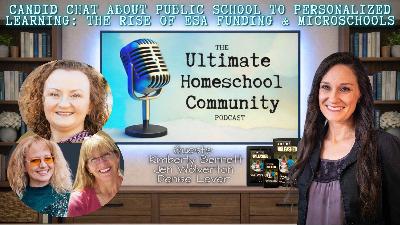
This is the Candid conversation after the panel interview- ESP 1. where we discussed the changing landscape of alternative learning and the introduction of ESA funds to the homeschooling community. Join us as we further discuss issues from the microschool and homeschool community.
In this episode of The Ultimate Homeschool Community Podcast, Tiffany sits down with Denise from Trailblaze Ed, Jen from Mars Microschool, and Kimberly from the Homeschool Counseling Network to unpack the rapidly evolving landscape of education—and what it means for families.
Together, they explore why traditional school systems are struggling to meet the needs of modern learners, especially neurodivergent students and families seeking flexibility, personalization, and stronger community support.
Short Description
Education is shifting—and families are leading the charge. In this powerful panel discussion, we break down how ESA funds, microschools, and community-based learning models are giving parents more control, flexibility, and support than ever before.
Full Episode Summary
In this episode of The Ultimate Homeschool Community Podcast, Tiffany sits down with Denise from Trailblaze Ed, Jen from Mars Microschool, and Kimberly from the Homeschool Counseling Network to unpack the rapidly evolving landscape of education—and what it means for families.
Together, they explore why traditional school systems are struggling to meet the needs of modern learners, especially neurodivergent students and families seeking flexibility, personalization, and stronger community support.
The conversation dives deep into:
What Education Savings Accounts (ESAs) really are—and how they work in states like Texas, Arizona, and Alabama
The differences between public schools, charter schools, microschools, and homeschools
How Arizona’s ESA program distributes approximately 90% of state per-student funding (averaging $7,400 per student)
Texas’s three-tier ESA structure—including up to $30,000 for medically complex students
Why fraud rates in ESA programs are significantly lower than media narratives suggest
The explosive growth of microschools and learning pods
The role of AI in microschool innovation
How community pressure and enrollment shifts can influence traditional school systems
The need for advocacy, terminology awareness, and research in the homeschool ecosystem
The panel also shares exciting next steps, including plans for a “Microschool Week at Space Camp,” open house events, provider network expansion, and new research initiatives to better understand homeschool family needs.
This episode is both informative and empowering—reminding parents that education doesn’t have to fit inside a single system. As funding options expand and alternative models grow, families have more opportunity than ever to design education around their values, their children, and their vision for the future.
about the Panelists:
Denise Lever: founder of TrailBlazED
Jen Wolverton: Founder of MARS Microschool
Kimberly Bennett: Founder of Homeschooling Counseling Network
In this candid conversation, Tiffany sits down with Meagan to unpack the realities of insurance for homeschool programs and microschools. They discuss the important differences between operating as a childcare facility versus an educational program, and why every owner/operator must understand their state regulations before launching. The episode also explores the growing shift toward smaller learning environments—and how these models not only support children more effectively but strengthen families and local communities as well.
In This Episode, We Discuss:
The difference between operating as a childcare facility vs. an educational program
Why checking your state regulations is critical before opening
Common insurance misunderstandings among homeschool and microschool founders
The types of coverage programs may need to protect families and staff
How proper structure builds credibility and parent trust
The risks of operating without clarity on legal classification
Why smaller learning environments benefit children academically and emotionally
How micro-environments strengthen local communities
The opportunity for homeschool programs to operate responsibly and sustainably
About The Ultimate Homeschool Community:
https://linktr.ee/ultimatehomeschool

Short Episode Description
In this episode, Tiffany sits down with former RN and homeschool mom Darcy, founder of Body Literacy Lab, to talk about teaching kids and teens how their bodies actually work. From blood sugar and gut health to puberty and hormones, this conversation explores why body literacy matters—and how interactive online classes are helping families raise confident, informed kids.
Episode Overview
Why are kids learning algebra—but not how their hormones work?
In this conversation, Darcy shares how her personal health struggles led her from nursing into functional medicine and ultimately to creating Body Literacy Lab. After years in the homeschool community, she recognized a major gap: children weren’t being taught how to understand their own bodies.
Through interactive live classes and pre-recorded modules, Darcy now teaches students ages 6–17 about nutrition, hormones, metabolism, and overall health—using hands-on challenges instead of tests.
This episode dives into why body literacy should start young, how to navigate puberty (especially for boys), and why parents need education too.
In This Episode, You’ll Learn About:
Darcy’s journey from RN to functional nutrition educator
Why traditional education overlooks body literacy and functional health
How Body Literacy Lab teaches kids through games, challenges, and engagement
Topics covered: blood sugar, gut health, circadian rhythm, hormones, and metabolism
Why application matters more than memorization
The structure of her 14-month signature course and monthly membership model
Why boys need intentional education during puberty
How hormonal changes affect mood, growth, and emotional development
The connection between nutrition, extreme dieting, and menstrual health
Helping teens develop a balanced view of food and body image
Why parents should learn alongside their children
The importance of separating boys and girls for open hormone discussions
About Darcy and Body Literacy 4 Kids https://bodyliteracylab4kids.com/
IG: https://www.instagram.com/bodyliteracylab4kids/
Darcy Haas began her journey in functional nutrition working with women, but after a few years, she realized her true passion was in prevention, specifically teaching kids about their bodies before health issues ever begin. As a Registered Nurse, Functional Nutritionist, and longtime homeschool mom of five, Darcy has spent the last 21 years immersed in raising and teaching her own kids, which inspired her to create Body Literacy Lab 4 Kids, a fun, science-based program that helps homeschool families understand how their bodies work from a root-cause perspective and how to best take care of them. Her mission is to help the next generation to become confident, body-literate kids who understand how to care for themselves for life.
About Ultimate Homeschool:
Check out the YOUTUBE channel for the most recent recordings! Make sure to subscribe!
@ultimatehomeschoolcommunity
https://linktr.ee/ultimatehomeschool
In this episode, Tiffany sits down with Kelly from Tennessee Home Education Association (THEA) to discuss her homeschooling journey and the importance of understanding state laws. They unpack umbrella schools, legal compliance, insurance coverage, and how advocacy organizations protect homeschool freedoms in Tennessee.
Episode Overview
Homeschooling offers incredible freedom—but it also comes with legal responsibilities many families don’t fully understand. In this conversation, Kelly shares how she transitioned from public school to homeschooling, overcame doubt and criticism, and eventually became an area coordinator for THEA, Tennessee’s statewide homeschool advocacy organization.
This episode dives into the practical and legal side of homeschooling—what families need to know, how to stay compliant, and why joining a state organization can make a major difference.
In This Episode, You’ll Learn About:
Kelly’s journey from public school parent to veteran homeschool mom
The challenges of choosing curriculum and building confidence
The importance of local homeschool community and support groups
What THEA (Tennessee Home Education Association) does for families
How state advocacy organizations protect homeschool rights
The 2020 welfare check controversy and parental rights advocacy
Understanding Tennessee’s homeschool registration requirements
The difference between independent homeschooling and public at-home options
What umbrella schools are—and how to choose a legitimate one
Why the cheapest umbrella option isn’t always the best
Record-keeping best practices for legal protection
Insurance options for co-ops and homeschool events
How co-ops can access liability coverage through THEA
The role of organizations like Home School Legal Defense Association in protecting homeschool freedoms
Why every homeschool family should understand their state laws
Download the Tennessee Homeschool law and other freebies:
https://stan.store/ultimatehomeschool
Find out more about The Ultimate Homeschool Community:
https://linktr.ee/ultimatehomeschool
About Kelly Klaus:
In addition to serving the last seven years as Mid-East THEA Chapter Area Coordinators with her husband, Randy, of 28 years, Kelly Kaus stays busy as a homemaker on their 2-acre homestead, “Tail Feather Farm,” in Athens, TN raising Miniature Jerseys, Nigerian Dwarf Goats, and chickens. When not at home tending to kids, pets, and shenanigans, Kelly can be found chauffeuring her children to church functions, bowling league games and tournaments, dance or music lessons, karate practices, field trips, or to the grocery store for the third time each week. Kelly’s leadership experience includes high school cheerleading captain; high school yearbook editor; Sunday School teacher; Sunday School Superintendent; VBS Director and VBS curriculum writer and producer; Living Nativity writer, producer, and director; Passion Play writer, producer, and director; homeschool 4-H club leader; Mid-East THEA Area Coordinator; and most recently serving on the McMinn County Republican Party Executive Board as Vice-Chairman. Kelly is a 19-year homeschooling veteran of eight children, two of which are very successful adults serving in law enforcement careers and in the Tennessee Army National Guard, with six more kiddos still at home. Kelly’s hobbies include crocheting, baking, reading, traveling, homesteading activities, and spending any free time with her family.
About The Ultimate Homeschool Community:
The Ultimate Homeschool Community is a supportive space for homeschool families and education-minded entrepreneurs. We share practical resources, free downloads, and tools to help you confidently homeschool and build thriving learning communities. Grab our free resources in our Stan Store and join the conversation inside our online Facebook group!
In this episode, Tiffany sits down with veteran camp entrepreneur JoAnn, who has run 60–70 camps annually for over a decade, serving hundreds to thousands of students each year. She shares how educators and microschool founders can launch profitable summer camps through community partnerships, smart pricing, and simple systems—without needing their own facility.
Episode Overview:
Summer camps can be a powerful income stream for microschools, homeschool leaders, and educational entrepreneurs—but only when they’re built with clarity, strategy, and strong systems. In this conversation, JoAnn shares how she built six-figure camp programs, the mistakes to avoid, and how educators can start small while building long-term profitability and trust with families.
From partnerships with churches and rec centers to pricing strategies and safety protocols, this episode gives a practical roadmap for launching camps that serve families well and sustain your business.
In This Episode, You’ll Learn About:
• How to launch a summer camp without owning a physical building
• Partnering with churches, rec centers, and community organizations
• Why camps can be a game-changer revenue stream for microschools
• The importance of understanding gross revenue vs. true profit
• How to price camps properly (without undercharging)
• Offering scholarships and discounts while maintaining profitability
• Identifying underserved camp niches (tech, nature, creative media, etc.)
• Simplifying curriculum and reusing materials across themes
• Building trust with parents through clear communication and procedures
• Safety protocols, liability considerations, and staff expectations
• Check-in/check-out systems that reduce complaints and build credibility
• Creating a proof of concept before scaling
• Starting small and building momentum with consistent systems
• JoAnn’s mentorship program and 90-minute Profitable Summer Camp Workshop
• Marketing camps to both homeschool families and the broader community
Learn more about Camp Mentor: https://campmentor.com
About The Ultimate Homeschool Community: The Ultimate Homeschool Community is a supportive space for homeschool families and education-minded entrepreneurs. We share practical resources, free downloads, and tools to help you confidently homeschool and build thriving learning communities.
Grab our free resources in our Stan Store and join the conversation inside our online Facebook group! https://stan.store/UltimateHomeschool
https://linktr.ee/ultimatehomeschool
In this episode, Tiffany sits down with Kimberly Bennett, founder of the Homeschool Counseling Network, to explore how homeschool families can access trusted mental health and educational support. They discuss the challenges homeschool parents face, how HCN connects families with culturally competent providers, and the growing need for community, resources, and specialized care within the homeschool world.
Episode Overview:
Homeschooling brings freedom and flexibility—but it can also come with unique challenges that require specialized support. In this conversation, Tiffany and Kimberly Bennett dive into the mission behind the Homeschool Counseling Network and how it provides free resources, vetted providers, and culturally informed care designed specifically for homeschool families. From neurodivergence and burnout to building stronger support systems, this episode highlights practical pathways for families seeking guidance and connection.
In This Episode, You’ll Learn About:
~The vision and mission behind the Homeschool Counseling Network (HCN)
~Common challenges homeschool families face, including isolation, anxiety, burnout, and neurodivergence
~Why homeschoolers benefit from providers trained in homeschool cultural competency
~How HCN vets and trains counselors, therapists, and educational professionals
~The required CEU training for providers serving homeschool families
~Free resources available through HCN, including interviews, expert guidance, and a college planning guide
~Supporting children with learning differences and developmental challenges
~Self-care strategies and support systems for homeschooling parents
~Upcoming discussions on school choice programs, ESAs, and vouchers
~Building community through expert panels and collaborative conversations
~Insights into structuring and marketing an online course for homeschool-related businesses
Learn about The Homeschool Counseling Network:
Website: https://www.homeschoolcounselingnetwork.com/home
Facebook Group for Resources:
https://www.facebook.com/groups/935707694836042 Facebook
Group for The Educator's Exit Plan Course: https://www.facebook.com/groups/1929695937959726 Facebook
Group for Homeschool Co-Ops, Hybrid/University-Model Programs, and Micro-Schools: https://www.facebook.com/groups/1412961696771052
Learn more about The Ultimate Homeschool Community:
https://linktr.ee/ultimatehomeschool

In this follow-up conversation, Tiffany sits down with Kam Knight to explore the brain’s “wanting mechanism” and how it impacts children, parenting, and homeschooling. Learn why endless wants and overstimulation create resistance, meltdowns, and distraction—and how parents can reduce overwhelm by meeting core emotional needs and simplifying daily life.
Episode Overview Why do children constantly want more—and why does it sometimes feel impossible to keep up? In this episode, Tiffany and Kam Knight continue their conversation on internal resistance by diving into the brain’s powerful wanting mechanism. They explore how modern stimuli, emotional needs, and unconscious patterns influence behavior, especially for neurodivergent learners and homeschooling families. This discussion offers practical strategies for reducing overwhelm, strengthening connection, and creating calmer learning environments at home.
In This Episode, You’ll Learn About:
~The brain’s wanting mechanism and why children develop endless desires
~How overstimulation and media exposure increase resistance and emotional overwhelm
~The connection between wants, needs, and internal resistance
~Why neurodivergent children may experience intensified triggers
~Strategies for reducing external stimuli to help children focus and regulate
~Meeting children’s core needs for attention, affection, approval, and connection
~Helping children engage through inclusion in daily tasks and responsibilities
~Parenting approaches that balance structure, playfulness, and emotional safety
~The impact of diet, environment, and routine on behavior and regulation
~The role of emotional release and how unresolved feelings affect physical and mental health
~Kam’s emotional release technique (“Kam Method”) and its purpose
~Understanding de-schooling during the transition from traditional school to homeschooling
~Supporting burnt-out homeschool parents and simplifying expectations Learn more about Kam Knight @ https://kamknight.com/

In this episode, Tiffany sits down with Tiffany Parsons, The Homeschool OT and founder of Agape Love OT, to explore how occupational therapy supports homeschool and microschool students. They unpack primitive reflexes, learning challenges, and practical resources parents can use to better support their children’s development.
Episode Overview
Many homeschool parents don’t realize occupational therapy can play a powerful role in learning success—especially when children struggle with attention, handwriting, emotional regulation, or sensory processing. In this conversation, Tiffany Parsons explains how primitive reflexes impact development and why reflex integration therapy addresses the root causes of learning challenges rather than just surface behaviors. The episode also highlights practical resources, funding options, and encouragement for families navigating developmental concerns at home.
In This Episode, You’ll Learn About:
~What a homeschool occupational therapist does and how OT supports homeschool and microschool students
~Why learning challenges can be overlooked in homeschool settings
~What primitive reflexes are and how they affect learning and behavior
~How reflex integration therapy supports attention, handwriting, reading, and sensory processing
~The difference between treating symptoms vs. addressing root developmental issues
~Specific reflexes linked to speech delays, picky eating, attention issues, dyslexia, and dysgraphia
~The role of crawling and developmental milestones in brain and motor development
~How skipped milestones can impact learning later on
~Private-pay OT services and what parents should know about cost and access
~Alternative funding options like HOPE scholarships and health savings accounts
~Helpful parent resources, including Harkla courses and All Things Sensory
~Simple ways parents can support development through everyday routines
~Upcoming episode topics: dyslexia, dysgraphia, emotional regulation, and picky eating
Connect with Tiffany Parsons:
Tiffany Parsons is a pastor’s wife, twin mom and a bonus mom. She is homeschooling/micro-schooling her twin boys as well as working as a private pay pediatric occupational therapist. She is passionate about using her God-given knowledge to help others and educate them on God’s design of primitive reflexes, guiding growth through faith and occupational therapy. She can be found on Facebook @The Homeschool OT, Tiffany Parsons.
Facebook: https://www.facebook.com/share/1Bow94JtSw/?mibextid=wwXIfr
Website: www.agapeloveot.com
Harkla (an affiliate link for Tiffany- She would love your support!): https://harkla.co/?rfsn=8716597.365cfae
Harkla Podcast: https://youtube.com/@harklafamily?si=otCa2tzxek8ObVQd
The Homeschool OT, Sarah Collins podcast: https://youtube.com/@homeschoolot?si=NxIuHCVcHTpn9tUx

In this episode, Tiffany sits down with Todd Sparrow to break down recent changes to high school math requirements in Tennessee. They explore new computer science credit options, homeschooling flexibility, and alternative graduation pathways that support students who need more time, support, or customized learning plans.
Episode Overview
High school education doesn’t have to follow a rigid timeline. In this conversation, Tiffany and Todd Sparrow unpack Tennessee’s updated graduation requirements and what they mean for homeschool and alternative-education families. From computer science credits and hands-on learning to five-year high school plans and GED options, this episode offers clarity, encouragement, and practical guidance for supporting students academically and emotionally.
In This Episode, You’ll Learn About:
~Updates to Tennessee high school math requirements
~How computer science credits now fit into graduation pathways
~Options for meeting the CS requirement through courses or tech-focused electives
~Hands-on computer science learning, including robotics and live instruction
~Why some families may prefer instructor-led learning over online-only options
~How homeschooling can support students who are behind, burned out, or overwhelmed
~The benefits of a 5-year high school plan for confidence and long-term success
~Reducing pressure around early graduation and college readiness
~Supporting students navigating trauma, bullying, or mental health challenges
~Flexible education models with reduced credit loads and year-round scheduling
~When a GED may be a healthy and valid alternative to traditional graduation
~Help with transcripts, diplomas, and academic paperwork
~Using local co-ops and tutorials instead of parent-led teaching
~Preparing students for dual enrollment courses and understanding GPA risks
~College course access through co-ops and Access Academy
Connect with Todd at Axis Academy:
https://www.axisacademy.org/
Who is Axis Academy:
We are advocates of parent-led education. We believe that parents are best equipped to direct their children's education. Whether you are looking for a well-rounded online education, or would prefer a more hands-on approach to education, we have the resources to help you accomplish your goals. Sometimes, it can be difficult to figure out where to begin. We would love the opportunity to partner with and guide you. You know your children and we know education, and together we can ensure your children receive the best there is to offer.

In this episode, Tiffany sits down with songwriter and educator Kim Yarson to explore how music can transform the way children learn to read. Discover how her Learn to Read with Music program helps children ages 3–9 build phonics skills, confidence, and joy—especially for struggling readers, children with ADHD, or dyslexia.
Episode Overview
Reading doesn’t have to be a battle. In this conversation, Tiffany and Kim Yarson dive into a music-based approach to phonics that engages the brain, supports emotional well-being, and helps children thrive—without pressure or shame. Kim shares her five-step method, her journey creating hundreds of phonics songs, and practical encouragement for parents who feel stuck or discouraged in the reading journey.
In This Episode, You’ll Learn About:
~Kim’s 5-step Learn to Read with Music method for children ages 3–9
~How music activates multiple areas of the brain and improves retention
~Why music-based learning is especially effective for ADHD and dyslexic learners
~The power of repetition, rhyme, movement, and celebration in reading instruction
~Unique program features like muted practice tracks, games, and growth-mindset messaging
~How to balance different phonics philosophies (letter names vs. sounds)
~A real success story of a child with dyslexia making rapid progress
~Kim’s plans to expand the program for educators, preschools, and microschools ~Encouragement and practical advice for parents who feel overwhelmed teaching reading
~Creative ways music and play can strengthen parent-child connection
Connect with Kim: (Copy and paste link in browser) Youtube refuses to verify me! Linkedin - https://www.linkedin.com/company/learn-to-read-with-music/ Instagram - https://www.instagram.com/learntoreadwithmusic/ Facebook - https://www.facebook.com/learntoreadwithmusic/ Tiktok - https://www.tiktok.com/@learntoreadwithmusic Youtube - https://www.youtube.com/@learntoreadwithmusic Website - https://learntoreadwithmusic.com/
Want to connect with The Ultimate Homeschool Podcast: https://linktr.ee/ultimatehomeschool https://stan.store/UltimateHomeschool Want to schedule a podcast interview: always looking for educational based services. send us a message on Facebook!

Why do we resist the very things we want most? Tiffany sits down with Kam Knight, an Award-winning author, to explore internal resistance, authority dynamics, PDA, and how unconscious patterns affect parenting and homeschooling—especially in neurodivergent families.
Episode Overview:
In this episode, Tiffany sits down with Kam Knight to unpack the deeper reasons behind internal resistance—why growth, peace, and progress can feel so hard even when we truly want them. This conversation goes beyond mindset and discipline, exploring how unconscious patterns, authority dynamics, and emotional needs impact parenting and homeschooling, especially in neurodivergent families.
In This Episode, You’ll Learn About:
What internal resistance really is and why knowledge and motivation alone aren’t enough
How the brain and body can block progress despite conscious desire
Pathological Demand Avoidance (PDA) and how it shows up in neurodivergent children
The role of authority dynamics in parenting and homeschooling challenges
How generational trauma and unresolved patterns affect parent-child relationships
Why homeschooling often requires deep inner work, not just academic planning
How unmet needs for attention, affection, and connection can lead to resistance in children
Practical insights for creating calmer, healthier family dynamics
Learn more about Kam Knight:
Kam Knight is a mentor, international speaker, and bestselling author of a dozen books in the area of mental, emotional, and physical performance. He is known for bringing fresh solutions and insights that are a rare departure from traditional ideas. Because of his fresh perspective, his books have become the gold standard for their respective topics, which have helped over 500,000 people. When he is not coaching or writing, he is traveling, having traveled to over 100 countries around the world. copy and paste into browser: www.KamKnight.com
Join me as we listen to the heartfelt story of Jenna Ditsch. The trials, testimony and redemption of a dream. Stay tuned in for the creation of a school like no other!
in this episode:
Listen to Jenna's Story
Connect with her Learning Studio Approach to microschool
Learn about her multi-age classroom and how she utilizes her volunteer parents
About Jenna:
Jenna Ditsch is a pioneer, educator, and microschool director whose life exemplifies the transformative power of faith. In 2019, she faced immense loss—her marriage, home, job, and loved ones—yet God used this season to plant seeds for a new beginning. Through forgiveness and healing, Jenna experienced miracles and found renewed purpose in her calling.
As the director of a Christ-centered microschool, Jenna combines her expertise in K-8 education and curriculum development to nurture students academically, spiritually, and emotionally. Her mission is to equip young learners to discover their God-given purpose and impact the world. Pioneering this work as a single mom has been both fulfilling and challenging, requiring reliance on God’s provision and collaboration with others. Jenna’s journey, rooted in faith and perseverance, continues to inspire as she helps others find beauty from ashes and transform trials into purpose.
Have questions for Jenna?
Connect with Jenna
JennaDitsch@gmail.com
About The Ultimate Homeschool Community:
Freebies
connect with us
Looking to Launch your own Microschool or Learning Center?
Get the Launch Roadmap free!
Join me while I'll interview Vandana from EJ Classes. She shares her expansion of their education services, and the benefits of using an abacus for mental calculations. She also emphasizes the importance of making learning fun and engaging for children. Listen in to learn about the benefits of teaching cursive, and how it impacts a child's behavior and character development.
About Vandana:
Vandana is a dedicated teacher who helps children master math through Abacus techniques, making calculations quicker and easier. With a background in accounting and finance, she has spent nearly a decade in education. As the second-generation leader of a business established by her mother 20 years ago, Vandana has expanded its reach globally through online teaching. She believes every child should have access to quality learning and is committed to helping them build confidence in math. Visit ejclasses.com to learn more!
Connect with EJ Classes:
• Website - https://www.ejclasses.com/
• Facebook Page - https://www.facebook.com/share/14keL7dCUv/?mibextid=LQQJ4d
• Instagram Page - https://www.instagram.com/ejclasses/profilecard/?igsh=c2Y5bXZpaTQxemox
• Calendly - https://calendly.com/ejclasses/30min
• Email Id - ejclasses@gmail.com
• WhatsApp - +91 7439470595
Connect with The Ultimate Homeschool Community:
Homeschool Freebies
Free Microschool Launch Roadmap
Website
Connect with our Socials

Comments

Download from Google Play

Download from App Store
 United States