DiscoverThe Backyard Bouquet Podcast: Cut Flower Farming Podcast for Flower Farmers & Backyard Gardeners
The Backyard Bouquet Podcast: Cut Flower Farming Podcast for Flower Farmers & Backyard Gardeners
Claim Ownership

The Backyard Bouquet Podcast: Cut Flower Farming Podcast for Flower Farmers & Backyard Gardeners

Author: Jennifer Gulizia of The Flowering Farmhouse

Subscribed: 137Played: 3,991
Share

Description

A podcast for flower farmers, gardeners, and cut flower growers who are growing more than just flowers.

Hosted by Jennifer Gulizia of The Flowering Farmhouse, The Backyard Bouquet shares inspiring conversations and expert tips from the fields and gardens of cut flower farmers and home growers.

Whether you're planting your first backyard bed or running a thriving flower farm, each episode offers practical growing advice, heartfelt stories, and the encouragement to cultivate beauty, joy, and connection—both in your garden and in your life.

From backyard plots to blooming fields, this podcast celebrates the people behind the petals and the lessons we learn when we grow with intention. Discover how locally grown flowers can enrich your days, root you in the present, and remind you that every flower—and every season—has a purpose.

Join us on this flourishing journey—where growing flowers is just the beginning.

For Show Notes And More Podcast Details: https://thefloweringfarmhouse.com/the-backyard-bouquet-podcast/

Sign up for our newsletter: https://thefloweringfarmhouse.myflodesk.com/backyardbouquetpodcast

The Flowering Farmhouse: Instagram | Facebook  | Website

109 Episodes
Reverse
Fall is the season most of us treat as cleanup. Pull the spent plants, rake the beds, stop thinking about the ground until spring. Matt Powers makes the case that those months are the most important soil window you get all year, and the one most growers hand back without realizing it. In this episode he walks through what to actually do with your beds between frost and spring planting. Why bare ground costs you. What the sun and the wind pull out of compost you leave uncovered. Why leaves beat wood chips. How to treat a compost pile before you spread it so the nutrients stay where you put them. What a cover crop can still do for you this late in the season. And what soil microbes have to do with how long a cut flower holds in the vase. Much of what he recommends costs very little. Some of it is free and already sitting in your yard. What you'll hear in this episode: * Why covering bare ground is the first thing to change this fall, and the cheapest way to do it * The case for leaves over wood chips, and why leaves are still feeding your soil four years later * How to treat compost before you spread it so you keep what you paid for * What's happening underground that decides how long your flowers hold in the vase * Whether you farm twenty acres or tend one raised bed in the backyard, there is something here you can do this week. About our guest Matt Powers has written more than twenty books about soil and regenerative growing. They include The Permaculture Student, a classroom curriculum he gives away free to anyone who cannot pay, and Regenerative Soil. He was a touring bass player in New York and then a high school English teacher in the Sierra foothills of California before any of this, and he came to soil looking for the healthiest food he could grow for his family. Today he teaches soil science and soil microscopy to growers around the world. Where to find Matt * https://regenerativesoil.com [https://regenerativesoil.com/] * https://regenerativesoilscience.com [https://regenerativesoilscience.com/] * https://www.thepermaculturestudent.com [https://www.thepermaculturestudent.com/] * https://www.instagram.com/mattpowerssoil * https://www.youtube.com/@MattPowersSoil Stay Connected With The Podcast * Web: https://thefloweringfarmhouse.com/the-backyard-bouquet-podcast/ * Instagram: https://www.instagram.com/thebackyardbouquetpodcast * Newsletter: https://thefloweringfarmhouse.myflodesk.com/backyardbouquetpodcast
Most of us think of tulips as a spring flower. Emily von Trapp and Linda D'Arco built their businesses on proving otherwise. Emily grows 200,000 tulips a year in Waitsfield, Vermont, all of them in crates, in soil, blooming in the dead of a Vermont winter. Her first stems come around January 7th. Linda grows in Jay, New York, up in the Adirondacks. She forces hers hydroponically, and she started in the basement of a little farmhouse. They met in a Facebook group. Linda saw Emily's photo of tulips blooming in January and asked what the magic was. Then she talked Emily into teaching it. Today they run The Tulip Workshop together. In this episode we get into: * What forcing actually is, explained for farmers and backyard gardeners both * What 5C and 9C mean, and why the variety matters as much as the number * Soil versus hydroponic, from two growers who each chose differently * The three mistakes that cost people their crop * Why your bulb order got canceled this fall, from someone who imports them If you have bulbs showing up at your door this month, this episode is for you. ABOUT OUR GUESTS Emily von Trapp grows flowers in Waitsfield, Vermont, on land her family has farmed for three generations. Her grandparents bought it as a dairy farm in the late 1950s, and her parents ran a retail nursery there for 42 years. She was selling bouquets at the local farmers market by the time she was twelve. Today she grows around 200,000 tulips a year for a winter CSA with 350 members across 13 pickup sites, plus up to 15 markets and shops throughout Central Vermont. Her tulips run January through June. Her lilies run April through January. Connect with Emily: * Website: https://vontrappflowers.com [https://vontrappflowers.com/] · * Instagram https://instagram.com/vontrappflowers Linda D'Arco grows on two and a half acres in Jay, New York, inside the six million acre Adirondack Park. She spent fourteen years in independent schools as an art and design teacher and a faculty dean before flowers took over. She learned forcing at one of Emily's first workshops in 2018, went hydroponic after a research trip to the Netherlands, and now runs Ampersand Bulb Co, a wholesale bulb import company. Connect with Linda: * Website: https://littlefarmhouseflowers.com [https://littlefarmhouseflowers.com/] · https://ampersandbulbco.com [https://ampersandbulbco.com/] · * Instagram: https://instagram.com/littlefarmhouseflowers Find them together: * Website https://thetulipworkshop.com [https://thetulipworkshop.com/] * Instagram https://instagram.com/thetulipworkshop Connect with Jennifer, Host of The Backyard Bouquet Podcast: * Website: https://thefloweringfarmhouse.com/ * Instagram: https://www.instagram.com/thefloweringfarmhousehttps://www.instagram.com/thefloweringfarmhouse/ * Follow the Podcast: https://www.instagram.com/thebackyardbouquetpodcast/ * Sign up for our newsletter: https://bit.ly/thefloweringfarmhousenewsletter
Everyone says dahlias need cool nights, and Robin Blood grows them in Godley, Texas, where the summer hits 105 and the grasshoppers came in like a plague her second year. When Robin sent off her first soil sample, the lab wrote back that they did not recommend growing there, with no organic matter, no phosphorus, and a pH of 7.9. She and her husband Jeff had already stood up old telephone poles for a fence, so they stayed and built the soil instead. Today B.Blumen is a flower farm and wedding design studio serving Dallas Fort Worth, with a team of designers Robin trained herself. In this episode you'll hear: * How Robin shades her dahlias through a Texas summer with no trees on the property, why she lets them rest in July, and why ball varieties hold up when dinnerplates struggle * The rabbit manure that rebuilt her soil, and how she traded labor to get it * The second season she lost nearly every dahlia, and what it taught her about stressed plants and pests * How a well shed turned into a design studio once she realized design made every stem she grew worth more If you've ever been told your climate or your soil makes dahlias impossible, this conversation is for you. Subscribe so you don't miss an episode, and send this one to a grower who needs it. About Robin Robin Blood is the founder and creative director of B.Blumen, a flower farm and floral design studio in Godley, Texas. Her German mother called her Blumen, the German word for flowers, when she was a girl. Robin grew up in a German household with a lot of gardening, and one of her first jobs was picking snails off her mother's plants for a penny apiece. She spent her early career in small businesses, became a director of sales at twenty, and left it all in 2020 to farm eleven acres of limestone and sand. Today B.Blumen grows without pesticides, no-till, and serves weddings across Dallas Fort Worth with a team of designers Robin trained herself. CONNECT WITH ROBIN * Instagram: https://instagram.com/b.blumenflowerfarm * Personal: https://instagram.com/thebloomboss * Website: https://bblumenflowerfarm.com [https://bblumenflowerfarm.com/] Connect with Jennifer, Host of The Backyard Bouquet Podcast: * Website: https://thefloweringfarmhouse.com/ * Instagram: https://www.instagram.com/thefloweringfarmhousehttps://www.instagram.com/thefloweringfarmhouse/ * Follow the Podcast: https://www.instagram.com/thebackyardbouquetpodcast/ * Sign up for our newsletter: https://bit.ly/thefloweringfarmhousenewsletter Robin and I talked about the Dahlia Design Summit in this episode. If you missed it live, All-Access Replay Tickets are still available here: https://thefloweringfarmhouse.mykajabi.com/dahlia-design-summit  [https://thefloweringfarmhouse.mykajabi.com/dahlia-design-summit]
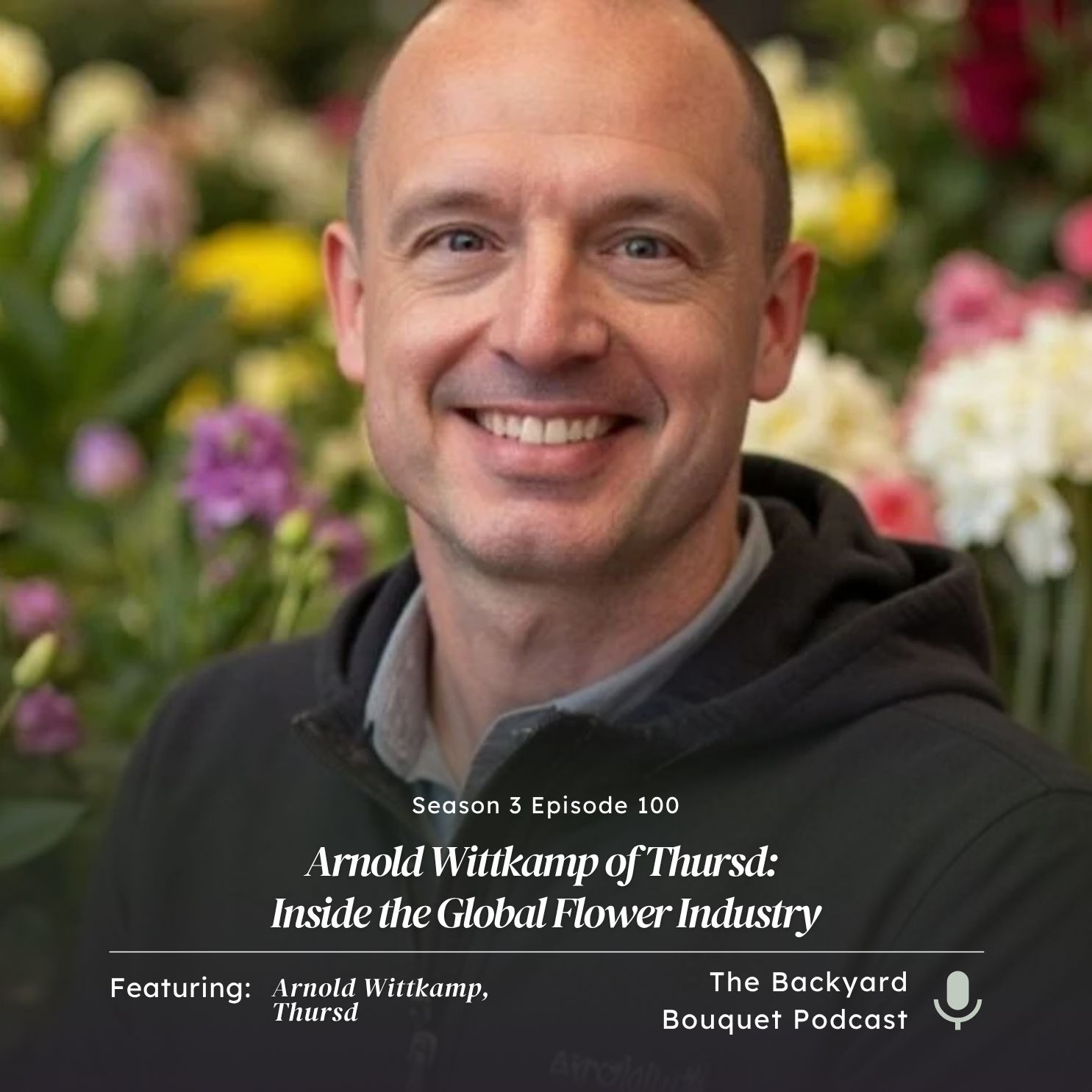
About eighty percent of the flowers sold in this country are imported, and I have said for years that local growers are not competing with each other, we are competing with that eighty percent. So this week I wanted to understand it better, from someone who knows it from the inside. Arnold Wittkamp is the founder of Thursd, the global online magazine for the flower and plant industry, and he came to it after thirty five years in the trade that started on the floating flower market in Amsterdam when he was fifteen. This is a different kind of episode for this show. On this podcast we typically focus on local flowers and the growers who grow local flowers, and this episode looks into the whole global system instead, into imports and exports and what a flower farm actually builds in a village in Kenya. I asked him the hard questions and he answered all of them. Some of what we get into: * Why Arnold believes our industry told the wrong story about sustainability, and what he thinks we should have said instead * What the flower trade has built for families in Kenya, Ethiopia, Colombia and Ecuador, told through one farm he watched change over ten years * Why he says anyone handling imported flowers every day should be wearing gloves * The oldest flower shop in Amsterdam, and the four words its owner said to every stem he unwrapped This podcast still believes wholeheartedly in local flowers, and nothing in this hour changed that. We believe that they matter for our communities, they matter for the environment, and they matter for the people growing them. Keep asking where your flowers came from, find your local flower farmer, and support them. About Arnold Wittkamp Arnold Wittkamp is the founder of Thursd, the global online magazine for the flower and plant industry, which he launched in September 2019 around the line Thursd is good for you. Thirty five years in the trade took him from the Amsterdam floating flower market to his own export company to importing scented garden roses into a European market that did not want them. Thursd works with growers, breeders and industry organizations including the Kenya Flower Council, the Ethiopian producers' organization, Asocolflores and Fairtrade. He is building Thursd Shop, a direct to florist sourcing platform that will be partly owned by the growers themselves. He also hosts a Dutch language podcast with more than sixty episodes on how people really feel about flowers. Connect with Arnold: * Thursd: https://thursd.com [https://thursd.com/] * Thursd author program: https://join.thursd.com/solutions/author-program * Arnold on LinkedIn: https://www.linkedin.com/in/arnoldwittkamp/ * Arnold's personal site: https://arnoldwittkamp.nl [https://arnoldwittkamp.nl/] * Email Arnold: [email protected] Connect with Jennifer, Host of The Backyard Bouquet Podcast: Website: https://thefloweringfarmhouse.com/ Instagram: https://www.instagram.com/thefloweringfarmhousehttps://www.instagram.com/thefloweringfarmhouse/ Follow the Podcast: https://www.instagram.com/thebackyardbouquetpodcast/ Sign up for our newsletter: https://bit.ly/thefloweringfarmhousenewsletter
T.J. McGrath spent years in advertising, marketing, and retail before he ever touched a flower professionally. He was one of nine kids and never had a garden growing up. Then his partner told him he was miserable, pointed him toward a little shop with a flower cooler two towns over, and everything changed. Today T.J. runs an entirely foam free studio in New Jersey, grows his own flowers at a cutting garden called Jardin de Buis, and teaches designers around the world how to work without single use plastic. In this conversation he is honest about all of it, including the part where he was the one who brought floral foam into the shop in the first place. In this episode: * Why T.J. walked away from a job offer with medical benefits in the middle of a pandemic, and what his partner said that made the decision for him * The real reason floral foam is only a small piece of the sustainability picture, and what the industry keeps missing * What he tells students who freeze at the design bench because they are afraid of doing it wrong * The single most powerful thing a flower lover can do to change the floral industry, and it takes about thirty seconds If this conversation moves something in you, share it with a friend who needs to hear it. And if you have not yet, follow The Backyard Bouquet Podcast wherever you listen so you never miss an episode. About T.J. McGrath T.J. McGrath is the founder of T.J. McGrath Design, a sustainable floral studio in Long Valley, New Jersey. One of nine children and raised without a garden, T.J. came to flowers by an unlikely route: a literature and philosophy degree from Rutgers, followed by years in advertising, marketing, and retail. In 2015 he quit a job that was making him miserable and took a part time position at a flower shop to learn the trade from the inside. He helped grow that shop into a sought after event studio. In 2020, with $700 in savings and a pandemic underway, he opened his own business. Today T.J.'s studio is entirely foam free and built on locally and American grown flowers. He grows his own at Jardin de Buis, a micro flower farm on a friend's property in New Jersey. Teaching is now the largest part of his business, and he leads workshops across the country and internationally, from Colorado to Brazil to Costa Rica. Connect with T.J.: tjmcgrathdesign.com [http://tjmcgrathdesign.com/] | Instagram @t.j._mcgrath_design  [https://www.instagram.com/t.j._mcgrath_design/] T.J. heads to Costa Rica the first week of September to teach at Iberiata 2026, held at Hotel Los Lagos in the La Fortuna region. It is a celebration of forty years of a Latin American floral school, and his session is on designing a dinner table. ***Grab Your Dahlia Design Summit Ticket. Join us September 13 through 18. Six days of dahlia design taught by fourteen farmer florists and floral designers. Whether you're growing your first row or you're already selling to florists, every session is about doing more with the dahlias you already have in the ground. Live Pass is $147. All Access is $247 and you keep every session for life. Come join us: https://thefloweringfarmhouse.com/summit  ***
loading
Comments