


 Claim Ownership
The Transfer Files: Inside the World of Federal Innovation
Subscribed: 2Played: 52
Subscribe

© All rights reserved.
Description
The Transfer Files: Inside the World of Federal Innovation features engaging and thought-provoking conversations about a range of topics related to federal technology transfer. Each episode reveals insights, expertise and experiences from a professional in the technology transfer ecosystem – including researchers, T2 professionals, entrepreneurs and more.
51 Episodes
Reverse
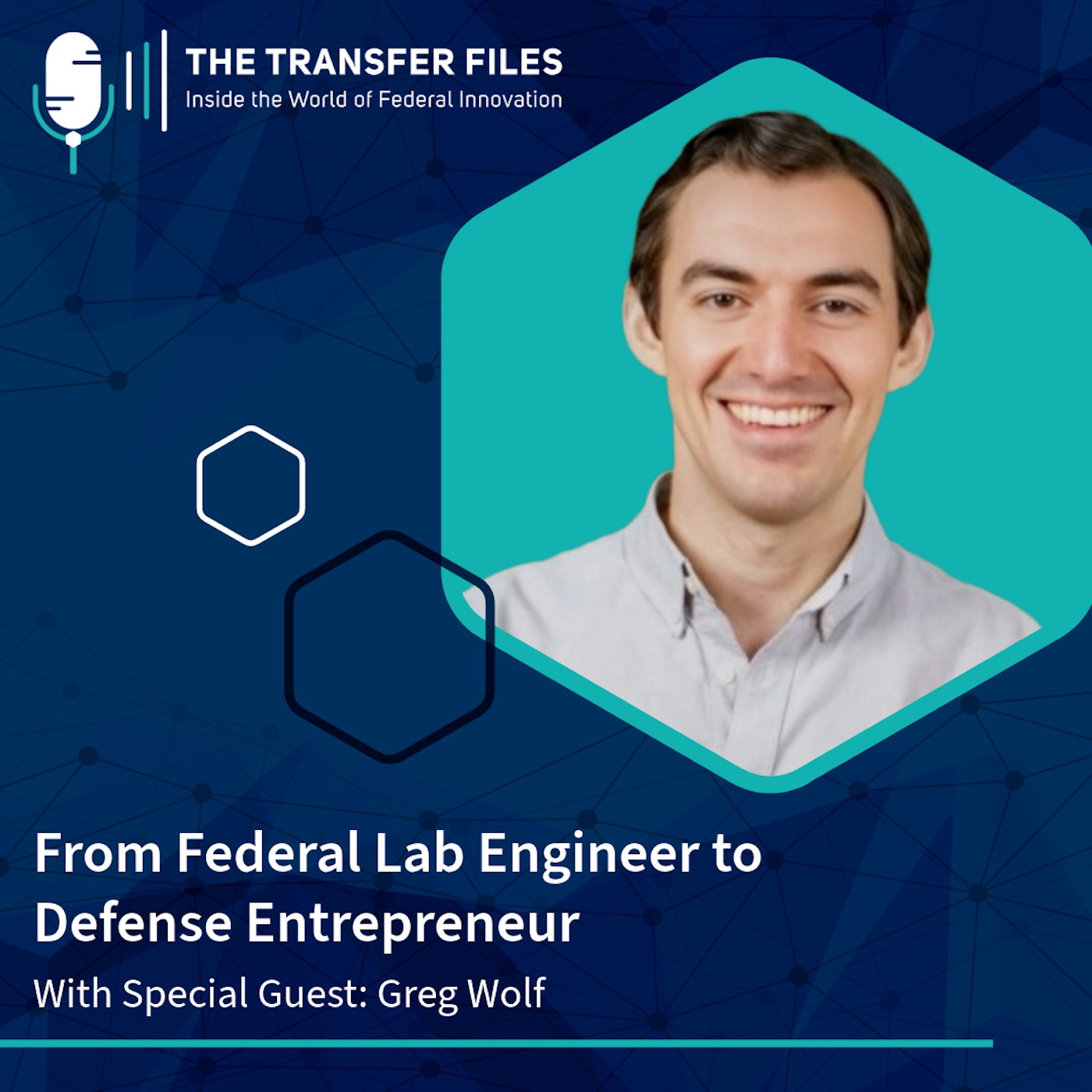
Federal labs spend years developing new technologies, but what happens when the research is finished and there's no clear path to getting those innovations into use? Sometimes a promising invention gets patented and then sits on a shelf because nobody knows what to do with it next. It's a frustrating situation for the researchers who developed it, and it raises some important questions about how government and industry can work together to make better use of federally funded research.For this episode, I'm handing the microphone over to FLC Vice Chair David Lee, who sits down with Greg Wolf, a former federal engineer who has since moved into the world of defense entrepreneurship. Greg began his career at Picatinny Arsenal's Armament Center, where he worked on remote weapon systems and robotic combat vehicles. After leaving federal service, he joined Firefly Aerospace and later Street Smarts VR, a company developing virtual reality training for military and law enforcement. He's now the founder of Cambrai Systems, a defense technology company focused on helping the government identify and acquire the capabilities it needs.David starts by asking Greg why he left federal service, even though he enjoyed the engineering work. Greg talks about the frustration of trying to move projects along when even something as simple as buying parts could become a bureaucratic headache. They also get into his experience with startups and a problem that doesn't get nearly enough attention. A company can receive federal funding to develop a technology and then be left on its own to figure out how to sell it to the government. David and Greg look at where that process breaks down and what federal labs might be able to do differently to help those inventions actually get used.In This Episode:[02:58] Greg Wolf discusses his engineering background, his education at Stevens Institute of Technology, and how he began his career at Picatinny Arsenal.[05:03] How a cooperative education program at Stevens Institute of Technology led to a career at Picatinny Arsenal and opportunities to pursue advanced engineering degrees.[07:29] Developing government-owned remote weapon systems at the Armament Center and testing concepts for robotic combat vehicles before the technology became widely used.[10:06] The importance of communicating technical requirements across federal labs and acquisition teams, particularly when developing safety-critical, remotely controlled weapons systems.[12:42] What made working as a federal engineer rewarding, including the freedom to experiment, build prototypes, and conduct early live-fire testing with unmanned vehicles.[15:56] The frustration of navigating government purchasing procedures when even obtaining basic parts could delay important research and development projects.[18:07] How bureaucracy affects large organizations and why private companies sometimes have more flexibility to work around obstacles than federal agencies.[20:36] The combination of career limitations, personal circumstances, and government bureaucracy that eventually prompted a move into private industry.[23:22] Working at Firefly Aerospace in Austin, Texas, and discovering that developing rockets wasn't nearly as appealing as working in defense technology.[25:08] How joining the Defense Entrepreneurs Forum led to new career opportunities, including work developing virtual reality training for military and law enforcement.[26:50] The Defense Entrepreneurs Forum's free membership and how its chapters connect government employees, entrepreneurs, and others working in national security.[29:16] Founding Cambrai Systems to help the government identify needed defense capabilities and improve the process of acquiring and deploying new technologies.[32:48] Why leaving federal service for private industry may not be as intimidating as government engineers and scientists sometimes expect.[34:49] The need to improve government acquisition procedures through changes within the workforce rather than relying entirely on reforms directed from the top.[37:01] How identifying specific defense needs and working backward from those requirements could help the government make better purchasing and development decisions.[39:56] Ways federal laboratories could support startups by clearly communicating the problems they need solved and helping entrepreneurs understand what the government is looking for.[42:15] An example of a university spinout developing new drone sensing technology and the difficulties of finding a government customer even after receiving federal research funding.[44:30] Why companies sometimes receive government funding and encouragement to develop technologies but struggle to find support when they're ready to move forward.[46:05] The problem of researchers having to find new funding or a customer for inventions that are ready to leave the lab, and how potentially valuable technologies can end up sitting unused.[48:01] The opportunities and risks associated with licensing federal patents, particularly when entrepreneurs have no guarantee the government will purchase the finished product.[50:14] What's driving the work at Cambrai Systems and how better acquisition tools, improved communication, and artificial intelligence could help move defense innovations into use.[53:00] The historical inspiration behind the name Cambrai Systems and what the early use of tanks can teach us about adapting military operations to new technologies.[55:38] Why successful technology transfer requires more than developing an invention, with clear government needs, industry partnerships, and acquisition pathways helping promising technologies reach the people who need them.Resources: FLCThe Transfer FilesDavid Lee - FLCGreg Wolf - LinkedInDefense Entrepreneurs ForumStreet Smarts VR

Every time the Coast Guard sends a crew out, it's making a decision about where to put limited people, boats, and resources. And sometimes that decision starts with an alert that turns out to be nothing. What if an uncrewed boat or aircraft could take a closer look first, gather information, and help determine whether a crew needs to respond? That's one of the possibilities the Coast Guard is exploring as it looks for better ways to carry out its missions.My guests today are Shelly Wyman and Derek Meier from the U.S. Coast Guard Research and Development Center. Shelly is a research scientist who graduated from the Coast Guard Academy in 2006 with a background in civil engineering. She's worked in Coast Guard sector operations and at headquarters, taught engineering at the Academy, and later moved into aviation research at the R&D Center. Derek is a research engineer who earned his mechanical engineering degree from UConn and worked in submarine construction at Electric Boat before joining the Center in 2019. Much of his work has focused on uncrewed surface vessels and finding ways to put that technology to use in Coast Guard operations.We talk about their work on RIPTIDE, a research initiative exploring how uncrewed aircraft and boats can work together, share information, and help operators make better decisions. Shelly and Derek share what they've learned from field demonstrations, the challenges of adapting technology to the maritime environment, and how partnerships with other military branches and research organizations are helping move the work forward. We also get into what it takes to move a technology from testing into the hands of the people who will actually use it. And throughout our conversation, there's a common theme: the goal isn't to replace Coast Guard crews, but to give them better information and help them focus their time and resources where they're needed most.In This Episode:[02:14] Shelly Wyman shares her path from the Coast Guard Academy through civil engineering, teaching, and aviation research before moving into autonomy.[05:17] Derek Meier discusses early research into maritime domain awareness, uncrewed surface vessels, and a demonstration in Hawaii that helped identify new Coast Guard applications.[08:34] How uncrewed aircraft and surface vessels can work together, with lessons from a demonstration off the coast of Puerto Rico.[11:32] Testing autonomous technology along the Maine-Canada border to improve maritime awareness and help Coast Guard personnel focus their enforcement efforts.[14:21] Using AI and automated target recognition to reduce information overload, identify potential threats, and ease the workload on Coast Guard watchstanders.[17:25] Adapting technology developed for defense applications to support Coast Guard missions, including search and rescue and maritime law enforcement.[20:32] Why reliable sensor data, automated analysis, and reducing the need for constant operator supervision are central to autonomy research.[24:02] Introducing RIPTIDE and its focus on collaborative autonomy, connecting uncrewed systems, and developing capabilities the Coast Guard can put to use.[27:36] Testing autonomous technology under realistic conditions to identify limitations, evaluate performance, and guide further development.[30:15] Building a framework that allows the Coast Guard to integrate autonomous systems, share information, and move research into operational use.[33:02] How AI could learn from mission data, recognize changing patterns, and improve decisions based on conditions in different operational areas.[36:01] Partnering with the Navy, Marine Corps, and other research organizations to share expertise, coordinate technology development, and avoid duplicating efforts.[39:32] Moving autonomy into the field through secure systems and tools such as the Tactical Awareness Kit, which can deliver information directly to responding crews.[42:48] Involving Coast Guard operators in research and testing to make sure new technology addresses practical needs and can be used aboard cutters.[45:39] How RIPTIDE has adapted to funding and procurement challenges, and why flexibility and persistence matter when developing new technology.[48:20] Lessons from earlier demonstrations in Brownsville, Texas, and the importance of making sure successful research can transition into Coast Guard operations.[50:53] How industry partners can connect with the Coast Guard Research and Development Center through research inquiries, technology solicitations, and procurement opportunities.Resources: FLCThe Transfer FilesShelly Wyman, PE - LinkedInDerek Meier - LInkedInTech Transfer Stars: Derek Meier’s RDC Work Helps Accelerate Acceptance of Autonomous Technology for USCG MissionsUnited States Coast Guard - RDT&E
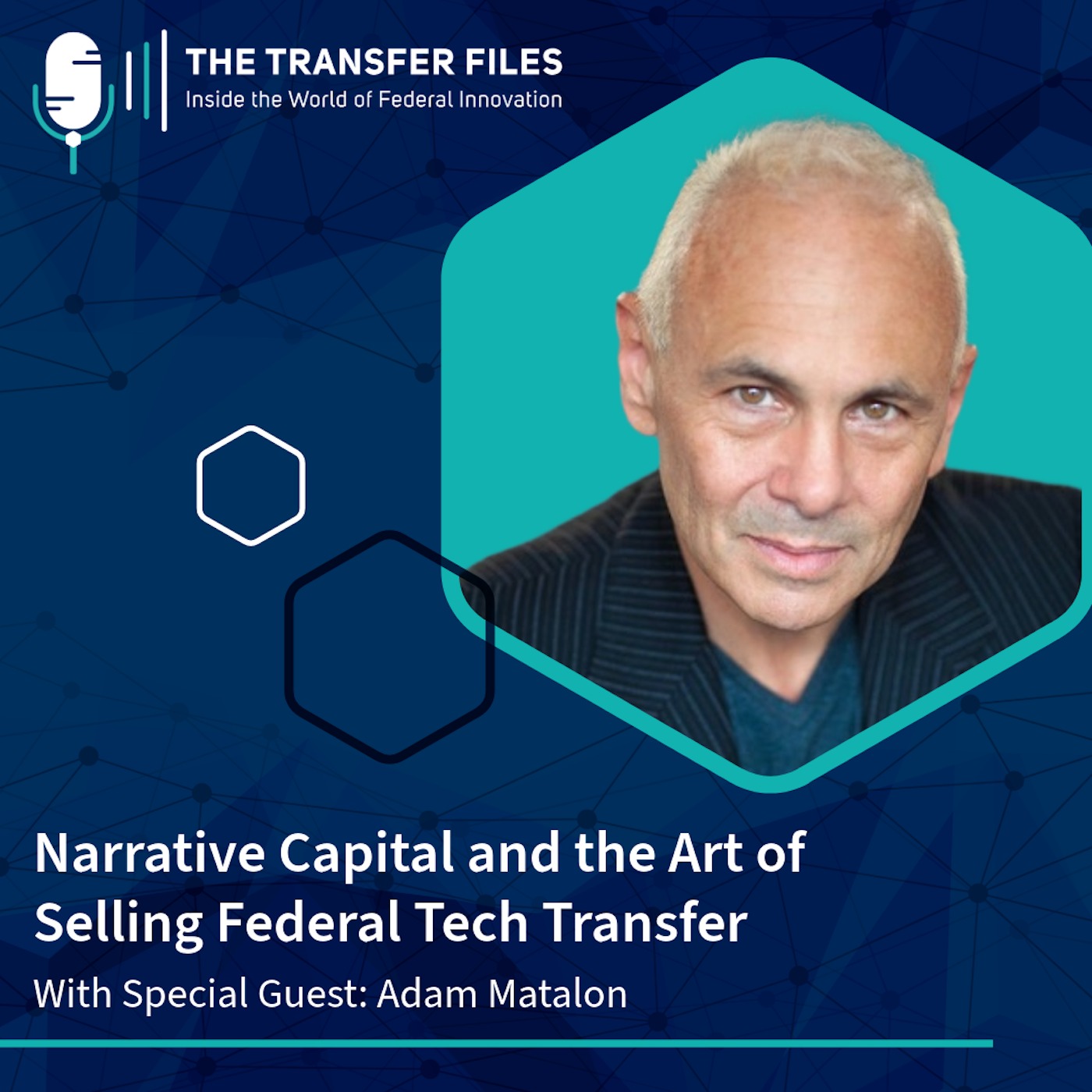
The way we tell the story of a technology can be just as important as the technology itself. That idea is at the heart of what our guest calls “narrative capital,” the accumulated value of a founder’s experience, reputation, choices, and story. In the world of tech transfer, where complex science has to connect with investors, industry partners, and customers, that narrative can help determine whether an innovation gains traction or gets lost in translation.Adam Matalan is here to bring an unusual perspective to that challenge. Before moving into the innovation economy, Adam spent decades working in theater and television, eventually producing and running television series and working alongside prominent business leaders. Today, as the founder of Message HQ, he works with startups, scientists, and innovators to turn complex ideas into clear, compelling stories. His concept of narrative capital reflects the idea that a founder’s past experiences, including the detours and setbacks, can strengthen credibility rather than diminish it.We discuss why great science does not always become a great company and why scientists and investors often hear the same technology very differently. We also talk about identifying real market pain points, looking beyond a technology’s original application to ask “where else?” it might create value, and gather meaningful customer feedback before a formal licensing conversation begins. Adam also shares why understanding the buyer’s perspective, listening closely, and communicating like a real person remain essential parts of successful commercialization.In This Episode:[02:00] Adam Matalan shares how his early career in theater and television taught him to understand audiences, shape stories, and communicate complex ideas clearly.[07:13] The concept of narrative capital shows how a founder’s experiences, choices, setbacks, and reputation can build credibility and strengthen the story behind a company.[09:50] Storytelling connects with commercialization strategy by helping companies understand where their technology can create real value in the market.[11:37] Scientifically strong technologies can still stall when companies hesitate to test them in the marketplace or assume the science alone will drive adoption.[15:43] Three important signs that a technology may be ready for industry engagement are that it is proven, scalable, and capable of solving a meaningful problem.[18:49] Developing and commercializing new technology requires persistence, and innovators sometimes need to stay committed even when progress is slow.[21:23] Scientists and investors often hear the same technology differently because investors are focused on outcomes, adoption, and potential returns.[24:16] Different types of investors have different goals, making it important for founders to understand the perspective of the person hearing their pitch.[28:07] Companies should focus less on technical details and more on how a product can help customers save money, increase revenue, or solve an expensive problem.[30:25] Giving potential buyers the right context helps them understand why technology matters in the market right now.[32:29] Tech transfer offices can begin gathering customer feedback by identifying real pain points before entering a formal licensing or partnership conversation.[34:46] Conversations outside a company’s usual industry can reveal unexpected applications and new commercial opportunities for a technology.[37:36] Approaching potential industry contacts by asking for insight and advice can be more effective than immediately trying to sell them something.[39:20] Authentic human communication is becoming even more important, and AI generated outreach still needs a personal voice and thoughtful editing.[41:28] Customer discovery should extend beyond an innovator’s immediate industry to include the people and organizations affected further downstream.[42:12] There are no simple shortcuts or universal formulas for commercialization, and market development requires the same kind of discipline as scientific research.[45:03] Curiosity, listening, and observation are habits that help innovators better understand markets, customers, and new opportunities.[46:25] Understanding the buyer’s perspective can make it easier for internal champions to explain the value of a technology to decision makers.[48:41] Every company, founder, and technology must ultimately develop its own commercialization approach rather than rely on a single blueprint.Resources: FLCThe Transfer FilesAdam MatalonAdam Matalon - LinkedInMessageHQAdam Matalon - Substack

The Department of War is sitting on a massive portfolio of federally developed technology, including more than 6,000 active patents. The challenge is making sure those inventions don’t just stay in a catalog, but actually find their way into the hands of companies that can turn them into useful products. That’s the thinking behind the Defense Patent Holiday, a new pilot program designed to make government-owned intellectual property easier for industry to explore.In this episode, I talk with Stephen Luckowski, Director of Technology Transfer, Transition, and Commercial Partnerships for the Department of War, about how the Patent Holiday came together and why removing upfront fees can make such a difference for startups and small businesses. Stephen explains how commercial evaluation licenses give companies room to test the market potential of federal technologies, work with government laboratories, and decide whether an invention fits into their product plans.We also discuss how the program is growing beyond patent licensing itself, with manufacturing resources, funding opportunities, and other support intended to help companies move promising technologies toward commercialization. Stephen shares what the department is learning from the pilot, why success means more than simply counting licenses, and how a more intentional approach to commercialization could strengthen both the industrial base and the technologies available to the warfighter.In This Episode:[01:11] Stephen Luckowski introduces his role leading Technology Transfer, Transition, and Commercial Partnerships for the Department of War and explains his responsibilities for patent licensing and intellectual property reporting.[04:13] The department is creating a strategic view of federally funded intellectual property and strengthening commercialization opportunities across its research portfolio.[05:08] Conversations with Undersecretary Emil Michael led to the creation of the Defense Patent Holiday and the idea of making government patents more accessible to industry.[07:52] The first Patent Holiday offered hundreds of curated patents in critical technology areas with no upfront fees to encourage participation from startups and small businesses.[11:00] The program changes the way the department views billions of dollars in research investment by treating patents as dynamic assets with commercialization potential.[13:02] Commercial evaluation licenses allow companies to assess government-owned technology, work with federal laboratories, and determine whether an invention fits their market and product plans.[15:44] The department is learning from the Patent Holiday pilot, and feedback from participating companies could influence future technology transfer policies.[17:13] The NextFlex Industry Day connected companies with curated microelectronics patents, advanced manufacturing capabilities, and additional resources to support commercialization.[22:15] Companies exploring the Patent Holiday portfolio can use curated patent lists, TechLink assistance, and other federal resources to evaluate opportunities.[25:11] Success for the Patent Holiday means moving federally developed technologies into commercial products that can also meet the needs of the warfighter.[28:39] Future Patent Holidays could involve other government agencies while expanding the economic and national security benefits of commercializing federally funded innovation.[31:31] The Innovation for Impact forum provides an opportunity to focus on national security technology transfer, connect with industry, and showcase the department’s evolving commercialization strategy.Resources: FLCThe Transfer FilesStephen Luckowski - Department of WarDefense Patent HolidayInnovation for Impact: A National Security Technology Transfer Forum

A career in federal technology transfer can take unexpected turns, but for Paige George, stepping into the role of executive director of the Federal Laboratory Consortium felt like the natural next step. After beginning her Navy career as a high school intern, Paige went on to become a mechanical engineer, technology transfer manager and longtime FLC leader.Paige shares how the relationships she built throughout the federal laboratory community prepared her for this new chapter. She also discusses the leadership lessons she learned from Paul Zielinski, the opportunities ahead for the FLC and why connecting people, laboratories and resources remains essential to moving federally funded innovation into the world.In This Episode:[02:00] Paige George explains how a high school internship at the Navy base introduced her to engineering, military technology and the career possibilities available within the federal laboratory system.[05:00] Attending her first FLC national meeting revealed the remarkable range of backgrounds within technology transfer and helped Paige recognize that she had found the professional community where she belonged.[08:25] Stepping into the executive director role felt like a natural progression after years of serving as a regional coordinator, committee chair, board member and technology transfer leader.[11:32] A closer look at the organization’s daily operations has deepened Paige’s appreciation for the staff members who work behind the scenes to deliver programs, resources and major events for federal laboratories.[12:55] New strategic priorities create opportunities for the FLC to expand access to federal laboratory expertise, strengthen partnerships and help federally funded research produce practical benefits for the nation.[15:33] Looking ahead, Paige wants the FLC to remain the leading resource for federal technology transfer while connecting more laboratories, new professionals and national partners to its network.[17:28] Federal laboratory professionals are encouraged to get involved with the FLC because strong relationships can provide career support, institutional knowledge and valuable connections across agencies and regions.[18:51] The conversation closes with a reminder that successful technology transfer depends on connecting people, laboratories, resources, partners and ideas to move innovation into real-world use.Resources: Federal Labs ConsortiumFederal Labs Consortium - FacebookInside T2 at the Navy With Paige GeorgeFederal Laboratory Consortium Names Paige George Executive DirectorPaige George - LinkedIn

Comments

Download from Google Play

Download from App Store
 United States