


New Wave.
Subscribed: 7Played: 108
Subscribe

© Hugo Rauch
Description
144 Episodes
Reverse
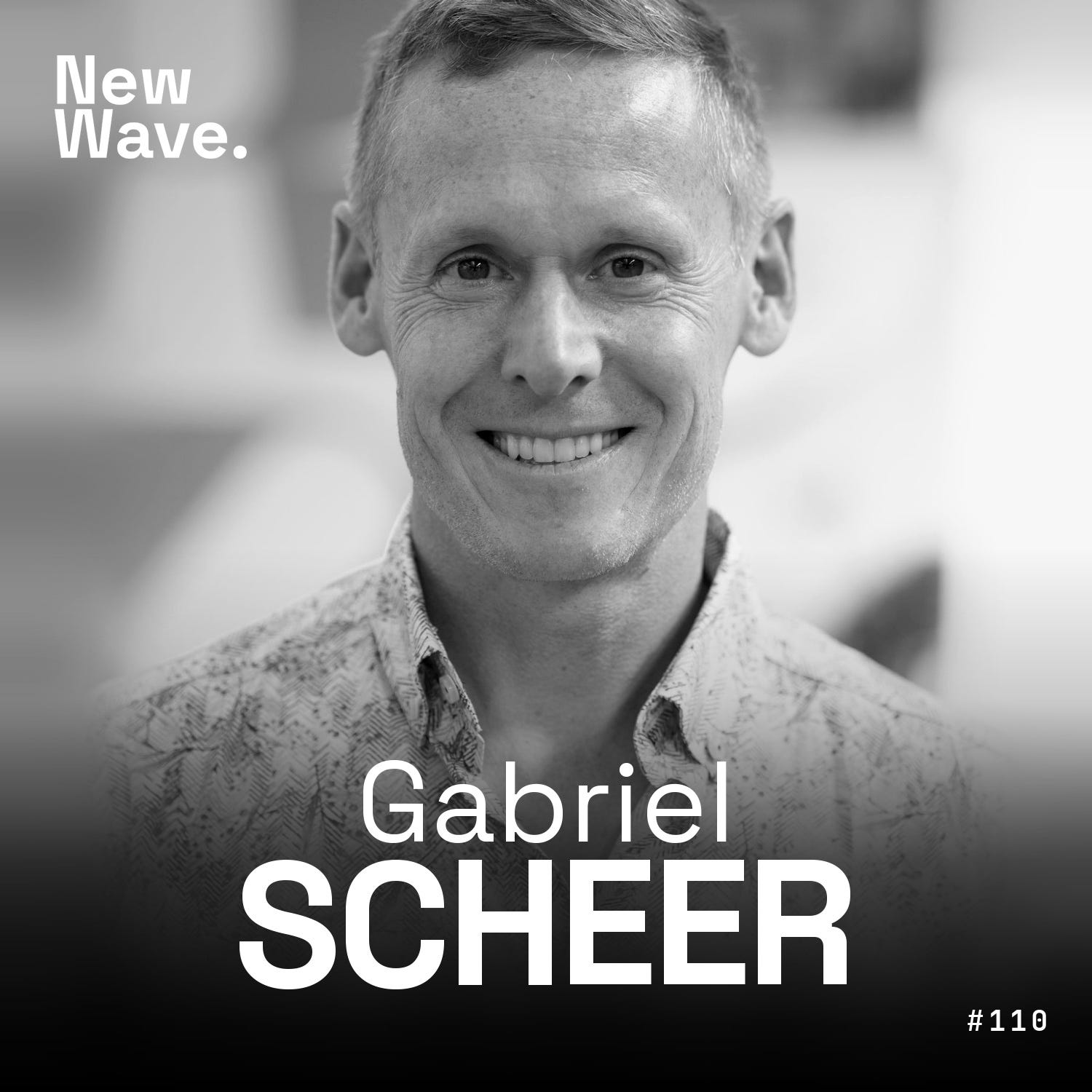
We’re joined by Gabriel Scheer, who leads energy, built environment, transport and water investments at Elemental Impact. Before that, he was on the founding team at Lime, one of the few billion-dollar companies to come out of climate tech.Elemental is an unusual investor. It’s a nonprofit. Instead of LPs expecting a financial return, it raises philanthropic and corporate capital, invests it, and recycles any exit proceeds into the next company. Around 165 companies in 16–17 years.That structure lets it play where venture often struggles.A startup has built the thing once. Later-stage capital wants to see it built five more times, in different places and conditions. In between sits a gap that is hard to fund, and that is exactly where first-of-a-kind climate hardware gets stuck.We recorded this one in a restaurant at Hello Tomorrow in Amsterdam, and covered a lot of ground: from convincing cities to let Lime onto their streets, to a new financing instrument, to getting Microsoft, Meta, Google and Amazon to learn from the same pilots.In our conversation, we covered:→ What operating at Lime teaches you that investors underestimate, and why culture mattered so much in a company scaling into new cities fast→ Why Lime was as much B2G as B2C: if a city wasn’t happy, there was no business→ Why policy may be one of climate’s biggest levers, and why you probably shouldn’t build a company on policy alone→ How US climate policy has whiplashed, and why state and local policies keep moving anyway→ How Elemental works: a nonprofit, evergreen model with a strategy track ($250–500k plus coaching) and a project track for first-of-a-kind deployments→ Whether venture capital is built for climate hardware, from closed-loop geothermal to venture money pouring into nuclear→ Whether Europe and the US can learn to build as fast as China again→ What 165 investments taught Elemental about founder communities and choosing aligned investors→ The deSAFE: a callable SAFE note for early project development, and how Fervo and Nitricity used it→ The Data Center Innovation Initiative: one pot of capital, one set of pilots, and shared results across four hyperscalers→ Which technologies the hyperscalers want: green cement, long-duration storage, cooling, materials and grid optimisationAsked what he wants listeners to remember, Gabriel’s answer was simple: “It takes a village.”Pick your team and your investors carefully, and find the people who will support you along the way.****Reach out to Gabriel Scheer:Gabriel Scheer → Gabriel Scheer on LinkedInElemental Impact → elementalimpact.com****Subscribe to the newsletter:New Wave | Hugo Rauch | Substack****New Wave is supported by:Evertrace: the leading founder detection engine for VCs. It traces signals across the digital landscape to uncover emerging founders earlier than anyone else, so you meet tomorrow’s founders today.I use it myself to source more deals at Climate Club, and I LOVE it. See what Evertrace can do for you here, or ask me for an intro and get a little something from the team ;) This is a public episode. If you would like to discuss this with other subscribers or get access to bonus episodes, visit newwavenewsletter.substack.com

Subscribe to the newsletter:New Wave | Hugo Rauch | Substack****New Wave is supported by:Evertrace: the leading founder detection engine for VCs. It traces signals across the digital landscape to uncover emerging founders earlier than anyone else, so you meet tomorrow’s founders today.I use it myself to source more deals at Climate Club, and I LOVE it. See what Evertrace can do for you here, or ask me for an intro and get a little something from the team ;)****🌊 When Does Fusion Actually Become a Business?Fusion is getting closer to producing net energy. The harder question is whether it can ever produce cheap electricity.We’re joined by Dan Brunner, co-founder and former CTO of Commonwealth Fusion Systems, one of the companies at the forefront of the race to commercial fusion.CFS has raised billions of dollars, signed power agreements with customers including Google, and is building SPARC, its machine designed to demonstrate net fusion energy.But proving fusion works is only one step.As Dan puts it, there’s ultimately another Q that matters: the dollar Q.Can a fusion plant produce more money than it costs to build, operate, maintain, and continuously repair?In this episode, we go from the basic physics of fusion all the way to the economics of a commercial power plant.In our conversation, we covered:→ What Q actually means — scientific Q, engineering Q and ultimately dollar Q→ Why tokamaks may be the first fusion technology to put electricity on the grid→ How high-temperature superconductors changed the economics of fusion→ Why tritium supply and breeding could become a critical constraint→ The overlooked problem of materials being bombarded by fusion neutrons→ Why component lifetime and plant availability may determine whether fusion is economical→ Whether fusion can ever compete with fission on cost→ Why the first customers are likely to be Google, Microsoft and other power-hungry companies→ Where early-stage investors can still play through fusion picks and shovels→ Why SPARC achieving net energy could trigger a new wave of investment into the industry✨ Leave a review: Apple Podcasts // Spotify This is a public episode. If you would like to discuss this with other subscribers or get access to bonus episodes, visit newwavenewsletter.substack.com

Subscribe to the newsletter:New Wave | Hugo Rauch | Substack****🌊 Manufacturing in SpaceWhy the next generation of advanced materials might be made 500 km above Earth.We’re joined by Josh Western, co-founder and CEO of Space Forge, a UK company building spacecraft to manufacture advanced materials in space — and bring them back to Earth.The idea sounds almost absurd at first.Why launch something into orbit just to manufacture a few grams of material?Because space gives manufacturers something Earth can’t: microgravity, ultra-high vacuum, and extreme temperatures. For certain advanced materials, especially compound semiconductors, those conditions could produce dramatically higher-quality crystals.And Space Forge doesn’t need to manufacture an entire chip in orbit.The company wants to produce the seed crystal in space, return it to Earth, then use conventional semiconductor infrastructure to scale it. Josh says one seed crystal could ultimately support the production of more than one million chips on Earth.In our conversation, we covered:→ Why Earth is actually a difficult place to manufacture ultra-pure materials→ How a few grams produced in space could enable millions of semiconductor chips→ Why Space Forge built both its own semiconductor reactor and reusable spacecraft→ Whether launch costs actually break the economics of in-space manufacturing→ Why regulation and customs may be a bigger bottleneck than technology→ How better semiconductors could reduce energy consumption→ Why Space Forge sees space manufacturing as part of Europe’s reindustrialisation→ What could come after semiconductors: solar cells, metals, graphene and batteriesPerhaps the most interesting idea is that space doesn’t need to replace terrestrial manufacturing. It could simply become another industrial environment, used for the handful of manufacturing steps where Earth’s atmosphere and gravity become constraints.Josh’s ambition is for that idea to eventually become boring.Because by then, manufacturing materials in space would simply be another part of the industrial toolkit.✨ Leave a review: Apple Podcasts // Spotify This is a public episode. If you would like to discuss this with other subscribers or get access to bonus episodes, visit newwavenewsletter.substack.com

Subscribe to the newsletter:New Wave | Hugo Rauch | Substack****New Wave is supported by:Evertrace: the leading founder detection engine for VCs. It traces signals across the digital landscape to uncover emerging founders earlier than anyone else, so you meet tomorrow’s founders today.I use it myself to source more deals at Climate Club, and I LOVE it. See what Evertrace can do for you here, or ask me for an intro and get a little something from the team ;)***🌊 Orchestrating the Energy TransitionWhy the biggest opportunity in energy may not be inventing new technology, but making the entire system work better.We’re joined by Julia Padberg, Partner at SET Ventures, one of Europe’s longest-standing specialist energytech investors. SET has been investing in the energy transition since 2007 — long before power became one of venture capital’s hottest markets.In this episode, we unpack what nearly two decades of energy investing teaches you about building enduring venture returns — and why Julia believes the energy transition is increasingly an integration challenge, not a technology challenge.As more investors rush into power, SET is taking a different approach: staying disciplined on valuations, backing companies that own critical customer interfaces, and looking for the orchestrators capable of connecting software, hardware, assets and capital.We also dive into one of the most interesting emerging models in climate venture: blended capital. Companies such as Decade Energy and Enrise can use infrastructure financing for physical assets while venture capital funds the technology and operating company — potentially allowing them to scale physical infrastructure without destroying venture-level returns.In our conversation, we covered:→ How do you build a venture firm that lasts? Why SET’s longevity comes down to specialization, network, discipline and becoming a trusted partner to both founders and LPs.→ Why everyone suddenly wants to invest in power. Energy security, electrification and sustainability are converging — but more capital also means higher valuations and more competition.→ Why SET doesn’t chase the hype. Entry valuation still matters in a European energy market where unicorn exits remain relatively rare.→ The real bottleneck in the energy transition. Julia argues that we already know how to make solar panels, batteries and EVs cheaper. The next challenge is coordinating millions of distributed energy assets.→ Why orchestration could create the biggest companies. The winners may be businesses that combine software, hardware, financing and services into one simple customer proposition.→ Can flexibility markets become overcrowded? Julia explains why the absolute volume of flexibility needed could continue increasing as intermittent renewable generation grows.→ The rise of blended capital models. How venture-backed companies can separate their technology stack from their capital stack using SPVs and infrastructure financing.→ Why infrastructure capital can actually increase venture returns. Rather than forcing VCs to fund batteries, solar or charging infrastructure, asset financing can remove one of the biggest constraints on scaling.→ Where AI fits into energy. From biodiversity monitoring around wind farms to infrastructure operations, Julia sees opportunities for AI to replace expensive legacy systems with cheaper, more intelligent solutions.→ Energy security is becoming an investment category. Cybersecurity, physical infrastructure monitoring and decentralised energy systems are moving higher on the agenda.→ Europe’s fragmentation is both a problem and a moat. Different regulations, grids and market structures make expansion harder — but companies that learn to navigate that complexity can build powerful competitive advantages.→ Why European startups don’t always need to internationalise immediately. In enormous energy markets such as Germany, owning a large portion of the value chain can create very large businesses without expanding into ten countries from day one.And Julia leaves us with three lessons from a decade of investing:1. The energy transition is an integration challenge.System integration and great business models can matter more than another silver-bullet technology.2. Value capture matters as much as value creation.Creating value for the energy system isn’t enough — the best businesses position themselves at critical interfaces where they can actually capture it.3. The best founders make complexity feel simple.Customers don’t want to understand every layer of the energy system. They want a solution that saves money, removes friction and makes saying yes obvious.***✨ Leave a review on Apple Podcast and Spotify to support the show. This is a public episode. If you would like to discuss this with other subscribers or get access to bonus episodes, visit newwavenewsletter.substack.com

Subscribe to the newsletter:New Wave | Hugo Rauch | Substack****🌊 Financing the Hardware EraWhy climate founders need to stop treating equity as the default way to pay for CapEx.We’re joined by William Godfrey of Tangible, who has spent the past few years developing a thesis around how climate and hardtech founders should combine equity, debt, equipment finance, asset-backed lending, project finance, and other forms of capital.Because one thing is becoming increasingly clear:We’re not going to solve climate change through software alone.Climate companies need factories. Equipment. Batteries. Robots. Infrastructure. Physical assets.And financing all of that with venture equity can become an extraordinarily expensive mistake.In this episode, we go deep on how founders should actually finance capital-intensive growth — and why the best climate companies may increasingly need to become as sophisticated at financial engineering as they are at technical engineering.One framework from William stuck with me:Equity is for uncertainty. Debt is for repeatability.Equity makes sense when you’re funding something that has never been done before: R&D, prototypes, first-of-a-kind technology, new teams and markets.But once you’re repeatedly deploying an asset with increasingly predictable economics, a different pool of capital becomes available.And learning how to access it can fundamentally change the economics of the company. Listen to this episode to learn more or read this guide by Tangible. ✨ Leave a review and share the episode if this conversation challenged the way you think about growth, innovation, and sustainability. This is a public episode. If you would like to discuss this with other subscribers or get access to bonus episodes, visit newwavenewsletter.substack.com

Comments

Download from Google Play

Download from App Store
 United States