


 Claim Ownership
FIKA Friday At the Office
Subscribed: 0Played: 3
Subscribe

© Ram Puranam
Description
Welcome to FIKA Friday At the Office. I'm your host, Ram Puranam, and I'm thrilled to host this Season2 for you. Every fortnight, I'll be catching up Workplace Leaders & Thought Leaders on the Future of Work from around the globe and share stories, insights, and perspectives aimed at enhancing our work lives. From fostering collaboration to boosting employee engagement, we'll cover all the intricacies of workplace experience.
But here's the twist, we're not just diving into the nitty-gritty of corporate jargon. Instead, we escape the daily grind and appreciate a small break called FIKA. Because, let's face it, the best conversations at office happen over coffee.
ramtherocket.substack.com
But here's the twist, we're not just diving into the nitty-gritty of corporate jargon. Instead, we escape the daily grind and appreciate a small break called FIKA. Because, let's face it, the best conversations at office happen over coffee.
ramtherocket.substack.com
43 Episodes
Reverse
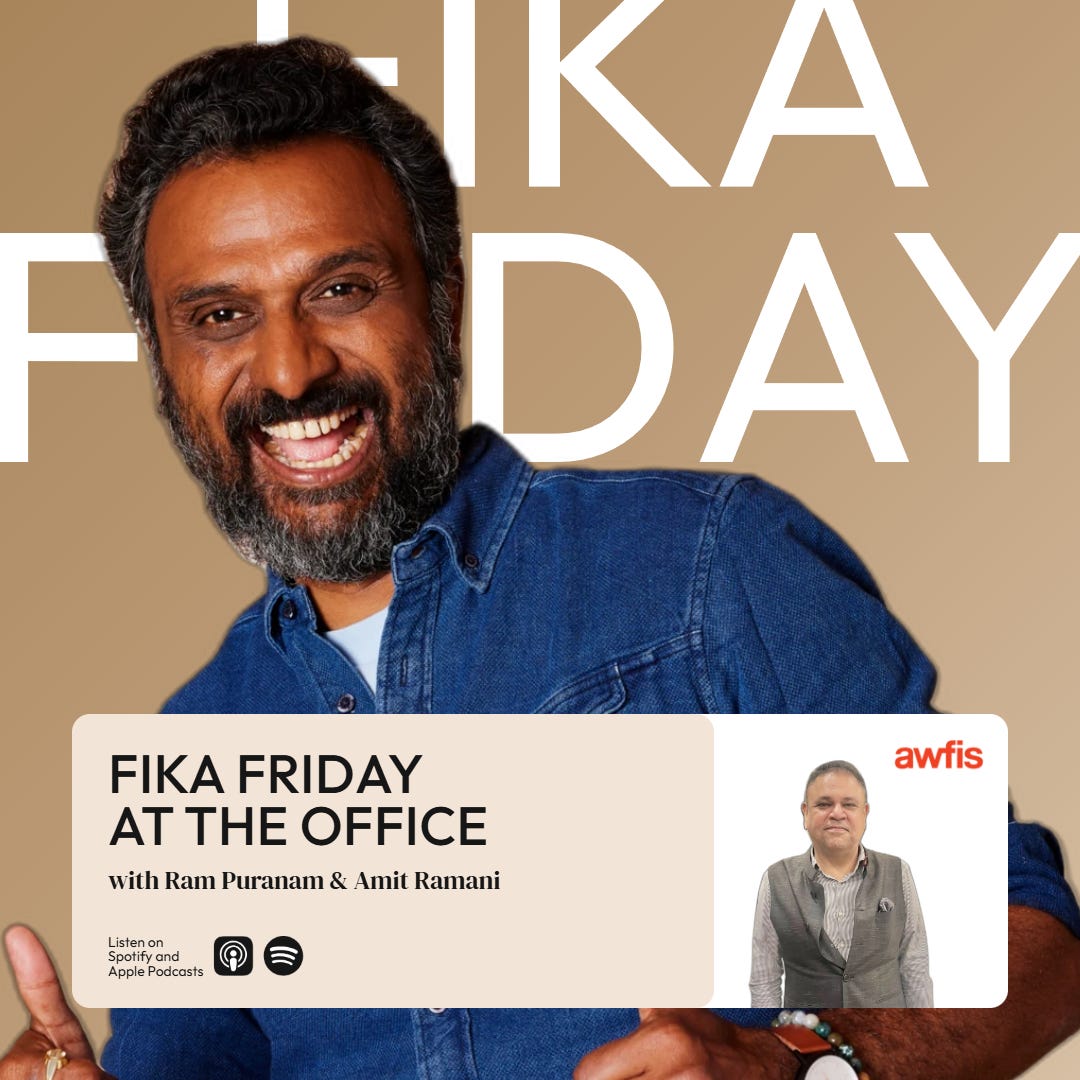
Hello friends,Good to be back here during the peak festive season here in India. On this week’s Fika Friday at the Office, I sat down over a lemon iced tea in Bengaluru with Amit Ramani, Founder, Chairman & MD of Awfis. He built India’s flex category before most of us knew the word.'India leads the world in flexible workspaces. Not the US. Not the UK. India…’5 things that stayed with me:1️⃣ India has the highest flex penetration in the world. About 12% of India’s billion sq ft of office space is flex, growing 20–25% a year. Amit expects the sector to double in five years. In his words, “This is a Zomato moment. The behavior has changed forever.”2️⃣ Hybrid work is 25 years old. After 9/11, Amit’s team at HOK was designing hybrid, hoteling and work-from-home programs for AmEx and Bank of America. COVID didn’t invent hybrid. It made it mainstream.3️⃣ GCCs follow a three-step path. Start in co-working at about 50 seats, move to a managed office at about 500, then build your own campus at 2,500+. Bengaluru, Hyderabad and Chennai take about 75% of the growth, and Tier-2 cities like Coimbatore, Kochi and Indore are next.4️⃣ Design is 20% aesthetics. The rest is how people actually use the space. Widen a corridor from 6 to 12 feet, add a few touchpoints, and you get conversations no office policy can mandate.5️⃣ Robots will redesign the office. “When the physical AI comes in, as early as 3–4 years from now, the physical workplace will need to adapt.” A robot that works 24 hours and a human who works 8–10 need very different spaces.And his closing line: “There are two things you can’t choose in life: your parents and the country you’re born in. We are extremely fortunate.”Enjoyed this episode? Subscribe to Fika Friday at the Office and share it with someone who still thinks office is just a place to go to!Cheers, RamThanks for reading FIKA Friday At the Office! Subscribe for free to receive new posts and support my work.Thanks for reading FIKA Friday At the Office! This post is public so feel free to share it. This is a public episode. If you would like to discuss this with other subscribers or get access to bonus episodes, visit ramtherocket.substack.com

Hello friends,It’s been a while since the last episode & happy to announce that I’m back after European summer with a wonderful set of thought leaders as guests on my podcast - ‘‘Fika Friday at the Office’’.In this episode I caught up with Surabhi Sharma, Senior Director, Site Leader India & APAC HR Head at Backbase Hyderabad. She has 18+ years of experience across Tata Motors, BMW India, Ericsson, Deloitte and six plus years at Google India. Recorded at the Backbase Hyderabad office, the conversation covers the site leader’s role, the office as a source of energy, Backbase’s flexible two-day in-office model, disagreeing respectfully, and why human judgment still matters in an AI-native workplace.“Make the employee experience more authentic and more positive in nature. If I have to oversimplify — that is the job of the site leader.”Top 3 Highlights1. The office as a social hub, not more desks. Backbase Hyderabad used one corner for a multipurpose lounge instead of adding desks or meeting rooms. It has couches, plants and board games, and it hosts rewards programs, trainings, town halls and daily coffee conversations.2. A daily non-work conversation, every day. For over a year, Surabhi has started each morning at the coffee corner talking with whoever is there about their life, not their work. Her goal is to know every one of the roughly 500 people in the India office.3. Presence is not productivity. Backbase sets a minimum of two office days a week, but each team chooses which days. There is no attendance tracking. What matters is real collaboration with managers and teammates, not hours at a desk.Presence is not productivity. What we care about is whether people are coming and working with their teams, collaborating — not the number of days and the number of hours.”Enjoyed this episode? Subscribe to Fika Friday at the Office and share it with someone who still thinks office is just a place to go to!Until the next one…Cheers, RamThanks for reading FIKA Friday At the Office! Subscribe for free to receive new posts and support my work. This is a public episode. If you would like to discuss this with other subscribers or get access to bonus episodes, visit ramtherocket.substack.com

G’day mates,Winter time in Australia, End of Summer in Europe and delighted to be back with yet another awesome episode this time with Preeti Verma, Strategic Initiatives & Transformation Lead at Atlassian.This is a conversation with her about why workforce planning is breaking, what most companies get wrong after buying AI tools, and why the answer keeps coming back to how teams coordinate in person.89% of executives say AI has made work faster. Only 6% can point to organization wide ROI.A few things worth pondering:* Headcount is breaking as a unit of measure. The question shifts from how many people, to what output and what combination of human plus AI plus workflow gets you there.* Individual productivity gains go nowhere if the rest of the value chain cannot keep pace.* Overlaying AI on workflows built for a human-only paradigm is patchwork. Redesign end to end instead.* And Preeti’s own version of Fika: the intentional walk to grab a coffee with a colleague. AI clearing the grunt work is what makes those ten minutes possible again.Enjoyed this episode? Subscribe to Fika Friday at the Office and share it with someone who still thinks the office is just a place to sit.Also check out Atlassian’s The State of Teams 2026 Report : https://www.atlassian.com/blog/state-of-teams-2026Connect with us on LinkedIn:* Preeti Verma : https://www.linkedin.com/in/preetiv/* Ram Puranam : https://www.linkedin.com/in/puranamram/Cheers, RamThanks for reading FIKA Friday At the Office! Subscribe for free to receive new posts and support my work.Thanks for reading FIKA Friday At the Office! This post is public so feel free to share it. This is a public episode. If you would like to discuss this with other subscribers or get access to bonus episodes, visit ramtherocket.substack.com

Hello friends,If you want to understand what it actually takes to build a workplace people choose to show up for, you want to talk to someone who has done it at scale, with data, inside some of the fastest-growing tech companies on the planet. That person is Daaf Serné.Daaf Serné is the Founder of Placeworks Advisory, based in Amsterdam. His career spans nearly two decades in corporate real estate and workplace strategy, including a decade at ServiceNow as Director, Global Real Estate and Workplace Services, overseeing a global portfolio across three continents, and more than four years as Global Head of Workplace at Miro, where he built the company's entire real estate function from scratch and launched what became one of the most talked-about workplace experiments in the industry: the Living Lab. I sat down with Daaf for a conversation that covered baristas, Alaska glaciers, sustainable design and why real estate is a product and should be treated like one.What stood outThe barista beats the machine. Every time.At Miro’s Amsterdam HQ, Daaf’s team added a barista to a space that already had coffee machines throughout. The barista became the most popular option almost immediately, with most employees skipping the machines entirely. The lesson was not really about coffee.The Living Lab was a hypothesis.When Daaf joined Miro in 2022, the company had grown from a few hundred to 1,700 people entirely through the pandemic, with 13 office locations built during a period when nobody was going into them. His pitch to leadership was simple: if we work closer with employees, we can drive better workplace outcomes. Higher experience scores. Better occupancy. Lower attrition. He ran work style studies, workshops and experiments across six locations before feeding all the data into the new HQ project. When the results came in, occupancy was up, experience scores were above four on a five-point scale, and attrition had dropped in locations with active workplace communities.Sustainability came from watching glaciers melt.One of the more unexpected origin stories on this show. Daaf was on parental leave with his family in Alaska when he stood in front of retreating glacier fields and decided he needed to do something about it from within his industry. He came back, kept his global real estate role at ServiceNow, and added corporate sustainability on top of it. That work eventually led to ServiceNow’s commitment to Net Zero by 2030.Footprints are shrinking but building quality needs to rise.On the future of the office, Daaf was measured. Companies are not walking away from real estate, but they now have the post-COVID data to make meaningful decisions about how much they actually need. Smaller footprints, better buildings. The challenge, he noted, is that there are simply not enough high-quality, sustainable buildings to meet that demand yet.Ask for help!His advice to young professionals starting out in facilities management and workplace was direct: stop trying to figure everything out with AI tools alone. The industry is still a people business. Relationships, mentorship and human judgment are things no model can replicate. Ask around. Let people help.One thing I’ll keep thinking aboutDaaf described a shift he kept running into at ServiceNow: whenever the business added headcount, the reflex was to add square meters. He started questioning that reflex out loud. His core belief, backed by four years of Living Lab data at Miro, is that the answer is rarely more space. It is almost always better use of the space you already have.Enjoyed this episode? Subscribe to Fika Friday at the Office and share it with someone still measuring workplace success in square meters and don’t forget to Connect with us on LinkedIn:* Daaf Serne : https://www.linkedin.com/in/daaf-sern%C3%A9-mcr-slcr-3664079/* Ram Puranam : https://www.linkedin.com/in/puranamram/Cheers, RamThanks for reading FIKA Friday At the Office! Subscribe for free to receive new posts and support my work.Thanks for reading FIKA Friday At the Office! This post is public so feel free to share it. This is a public episode. If you would like to discuss this with other subscribers or get access to bonus episodes, visit ramtherocket.substack.com

Hello friends,Some guests come to this show with frameworks and theory. Ravi Nanduri comes with parking complaints, cold coffee and a story about getting lost on his first week in a new role.Ravi Nanduri is Vice President, Real Estate Services at HSBC GSC, based in Hyderabad. With over 15 years of experience across corporate real estate and workplace services in Asia Pacific and India, he brings a perspective that is rare in this field: he started in hospitality, working in food & beverages and hotels before moving into the corporate world. That background, it turns out, is exactly what workplace experience needs more of. I finally got him on the show after months of trying, and the conversation did not disappoint.What stood out!Getting lost on the way to the coffee machine led to his best onboarding moment. Ravi had just joined HSBC and was still finding his feet on a new floor. He asked a colleague for directions to the pantry. That colleague locked their system, walked with him, introduced themselves, told him what they did at the company, and picked up a coffee along the way.“That encapsulates everything that an office stands for. The collisions that happen, the experiences that are created. People go out of their way to walk along with you. That speaks a lot.”Every touchpoint matters, even the ones you can’t control. Ravi’s hospitality lens comes through most clearly here. The workplace experience begins the moment an employee enters the campus and ends when they leave. Parking. The lift. The monitor connecting to the laptop. The walk to the coffee point. None of these feel like strategic decisions, but all of them shape how someone shows up to do their work.“Imagine driving 45 minutes into the office and not getting a parking spot. That triggers a negative thing and it rolls into your work. Your interactions change. The way you respond changes. In the end, your entire day is gone.”Intentionality is the word that has changed everything. Pre-pandemic, offices were designed for presence. Post-pandemic, the question has flipped: what is the actual reason for coming in? Ravi described the shift from assigned desks with family photos and soft boards full of personal touches, to activity-based spaces where the sense of ownership has gone. The familiarity that made offices feel safe has had to be rebuilt from scratch.Purpose-driven offices, not presence-driven ones. On the future of work, Ravi was direct: if someone is coming into the office to spend eight hours on Zoom calls, they could do that from home, from a coffee shop, from anywhere. The office has to earn its place.“Looking busy is not being productive. Just because you come into the office and sit in front of a screen from 9 to 5 doesn’t mean you’re being productive. That should never come back.”Hyper-personalization is coming to the workplace. Ravi pointed to the latest Mercedes UX system as an analogy — a car that learns your driving style, temperature preferences and music choices over time and has everything ready the moment you get in. His prediction for the office of the near future: workplace apps acting as digital concierges, understanding your habits, your preferred desk zone, your coffee order, and getting things ready before you arrive.One thing I’ll keep thinking about:Ravi mentioned that the most vocal feedback corporate real estate teams receive is not about strategy or culture. It is about parking, cold coffee and food. The gap between what leaders think matters and what employees actually experience in the building is wider than most organizations want to admit. Closing that gap, touchpoint by touchpoint, is the whole job.Enjoyed this episode? Subscribe to Fika Friday at the Office and share it with someone who still thinks the office is just a place to sit.Connect with us on LinkedIn:* Ravi Nanduri : https://www.linkedin.com/in/ravinanduri/* Ram Puranam : https://www.linkedin.com/in/puranamram/Cheers, RamThanks for reading FIKA Friday At the Office! Subscribe for free to receive new posts and support my work. This is a public episode. If you would like to discuss this with other subscribers or get access to bonus episodes, visit ramtherocket.substack.com

Comments

Download from Google Play

Download from App Store
 United States