


 Claim Ownership
Beyond the CMS - A Content Management Podcast
Subscribed: 1Played: 37
Subscribe

© 2026 Dotfusion
Description
Beyond the CMS is about content operations and the future of content: how enterprises create it, scale it, and get it found by people and AI. Hosted by Chris Bryce, Partner at Dotfusion, the show has just passed 50 episodes of conversations with the people building that future.
It started as a show about CMS platforms, and that conversation never stopped. Guests have come from Contentful, Storyblok, Agility CMS, Squiz, Bloomreach, ButterCMS, StreamX, BILDIT, CrafterCMS, React Bricks, and Magnolia, talking through what headless and composable architecture actually gets you. But the range has grown well beyond platform comparisons. Recent episodes cover Answer Engine Optimization (AEO) and how AI search engines decide what to cite, MCP (Model Context Protocol) servers that connect AI agents directly to a CMS, agentic content operations workflows, accessibility, and what it takes to govern content at the scale of a university managing tens of thousands of edits a week. Episode 50 brought on Olivier Dobberkau of the dkd/TYPO3 Association to dig into semantic search and retrieval-augmented generation (RAG).
The CMS is still the hub. It's just not the whole story anymore. If you're a CMO, IT Director, or Chief Digital Officer trying to figure out how your content gets made, published, and found, by people and by AI, this is where those conversations happen.
#contentoperations #answerengineoptimization #aeo #aisearch #headlesscms #contentful #storyblok #agilitycms
It started as a show about CMS platforms, and that conversation never stopped. Guests have come from Contentful, Storyblok, Agility CMS, Squiz, Bloomreach, ButterCMS, StreamX, BILDIT, CrafterCMS, React Bricks, and Magnolia, talking through what headless and composable architecture actually gets you. But the range has grown well beyond platform comparisons. Recent episodes cover Answer Engine Optimization (AEO) and how AI search engines decide what to cite, MCP (Model Context Protocol) servers that connect AI agents directly to a CMS, agentic content operations workflows, accessibility, and what it takes to govern content at the scale of a university managing tens of thousands of edits a week. Episode 50 brought on Olivier Dobberkau of the dkd/TYPO3 Association to dig into semantic search and retrieval-augmented generation (RAG).
The CMS is still the hub. It's just not the whole story anymore. If you're a CMO, IT Director, or Chief Digital Officer trying to figure out how your content gets made, published, and found, by people and by AI, this is where those conversations happen.
#contentoperations #answerengineoptimization #aeo #aisearch #headlesscms #contentful #storyblok #agilitycms
50 Episodes
Reverse
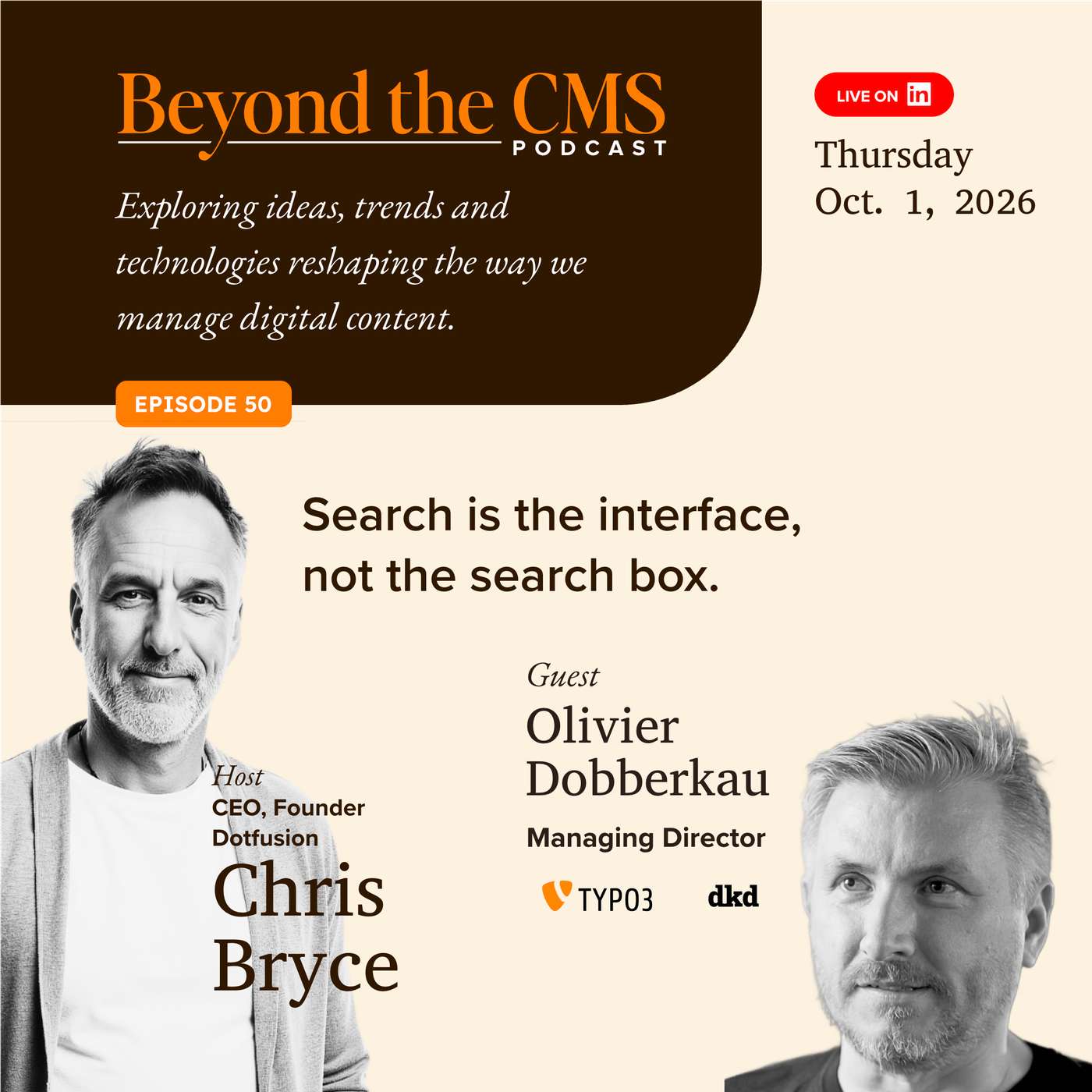
What happens when website search evolves from a keyword box into an intelligent interface?In Episode 50 of Beyond the CMS, Chris Bryce speaks with Olivier Dobberkau, CEO and founder of dkd Internet Service GmbH and president of the TYPO3 Association, about how enterprise search is moving from keyword matching toward semantic search, retrieval-augmented generation (RAG), conversational experiences and agent-readable interfaces.Olivier explains why AI search begins with content quality, metadata and retrieval. They discuss Apache Solr for TYPO3, embeddings, document chunking, grounding, hallucination risks, search feedback and the difference between a generic chatbot and specialized search capabilities routed by user intent.In this episode:Why search is becoming an interface rather than only a search boxHow keyword search differs from semantic search and RAGHow Apache Solr supports TYPO3 searchWhy poor content creates poor AI-search resultsHow chunking can remove important contextWhy specialized search capabilities can outperform generic chatbotsHow real questions, zero-result searches and user feedback improve retrievalWhy organizations should repair content before adding generated answersChapters0:00 Welcome to Beyond the CMS Episode 502:06 Olivier Dobberkau, dkd and the TYPO3 ecosystem5:32 Apache Solr search for TYPO37:23 Why search is becoming the interface11:21 From keywords to conversational and agentic search13:47 Content quality, grounding and search quality19:46 Why chatbots are not always the right experience22:37 Specialized search capabilities and intent routing24:02 Question-based website search in practice26:19 Repairing content before adding RAG28:33 Retrieval, metadata, feedback and supervision31:25 RAG explained: indexing, embeddings and retrieval34:16 Chunking, context and grounded answers36:39 Open source, access and the TYPO3 communityAbout Olivier DobberkauOlivier Dobberkau is CEO and founder of dkd Internet Service GmbH and president of the TYPO3 Association. His work spans open-source CMS development, TYPO3 search, Apache Solr and the transition from keyword search toward intelligent content discovery.Connect with Olivier on LinkedInLearn about dkd's TYPO3 workLearn about Dotfusion
Most accessibility tools tell you what is broken. Limena helps teams understand which accessibility barriers are disrupting valuable customer journeys, what those failures may be costing the business, and who owns the fix.Ryan Short, founder of Limena, joins Chris Bryce to explain how accessibility intelligence turns a long list of WCAG failures into business priorities. Limena connects accessibility barriers to customer journeys, conversion points, organizational ownership, and continuous verification.They discuss:Why accessibility work keeps losing to the product backlogHow to connect accessibility barriers to customer journeys and revenueHow Limena prioritizes issues by business impactWhy closing a development ticket does not prove the barrier is goneWhy widgets and point-in-time audits are not enoughWhere accessibility overlaps with SEO, AEO, and content qualityHow Limena fits into Git-based and composable delivery workflowsWatch the episode: YouTubeLearn more about Limena: limena.appConnect with Ryan: LinkedInLearn more about Dotfusion: dotfusion.com
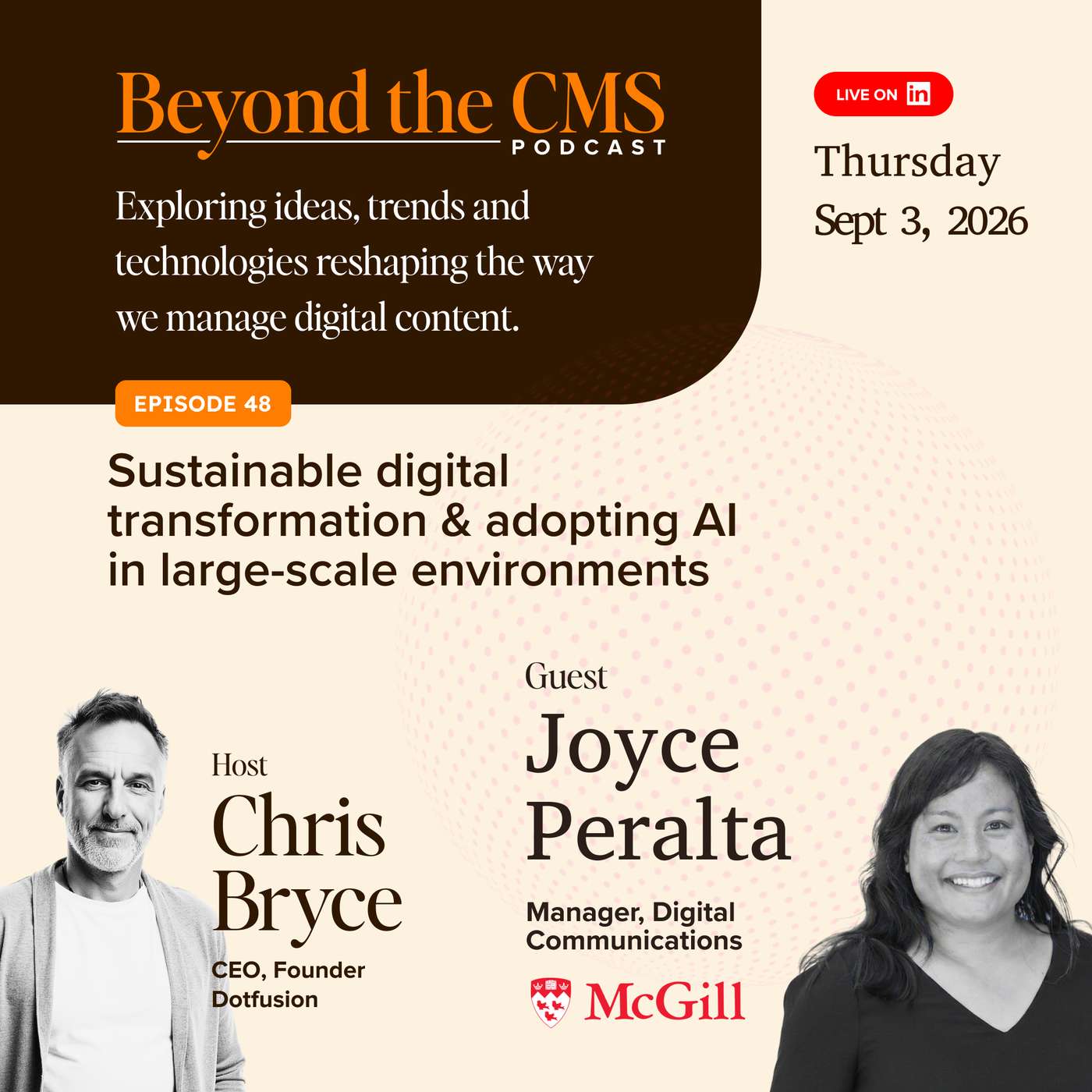
McGill University runs a thousand sites on its central platform, 500 more custom builds, and tracks 6,000 to 8,000 content edits a week. Joyce Peralta, Manager of Digital Communications at McGill, joins Chris Bryce to talk about the content model project addressing all of it.The number that anchors this conversation: 61 different terms used across the university for the exact same program component. Joyce's central point is that AI does not cause content inconsistency, it amplifies inconsistency that already exists. The inaccuracy people see in AI answers comes from information presented differently across websites, not from information that is wrong.McGill looked at building a separate content repository just for AI and turned it down, because a second repository means a second governance and synchronization problem. Joyce points to Dries Buytaert's markdown experiment, which found AI bots still hit the website itself the majority of the time.The content model work is federated across about 50 subject matter experts from departments across the university. Rollout runs concept by concept, with a timeline Joyce estimates at five years or more. Her real point on success: this cannot be a Communications project or an IT project alone, it has to be both working as one team, with alignment across the whole institution.Also in this one: the student usability panel that tracks how AI use among students changes year over year, why Drupal and the Drupal EDU Slack group are a real source of leverage, and what a taxonomy problem looks like at university scale.Chapters0:00 Welcome to Episode 48 1:05 Meet Joyce Peralta, McGill University 1:38 The velocity of change since Beyond the CMS launched 2:35 Inside McGill's web services team: comms and IT as one team 4:12 Who owns the university's content model 5:56 The vision behind McGill's content transformation 9:34 Taxonomy at scale: a thousand sites, 500 custom builds, 6,000 to 8,000 edits a week 14:33 Federated with 50 subject matter experts: the 61-term problem 16:19 AI amplifies inconsistency, it does not cause it 17:19 Why McGill rejected a separate AI-only content repository 19:10 How McGill actually uses AI in the content model project 21:35 Concept by concept: a rollout Joyce estimates at five years or more 24:02 Open source, Drupal, and the Drupal EDU Slack group 26:49 Three feedback groups, including the student usability panel 29:50 The human side of technology as AI reshapes expectations 31:32 Lessons for higher ed teams just starting this work 33:38 Where to find higher ed thought leadership 34:52 Wrap-upClick here to watch a video of this episode.
Links Joyce Peralta on LinkedIn Dotfusion headless CMS services Chris Bryce on LinkedInClick here to view the episode transcript.
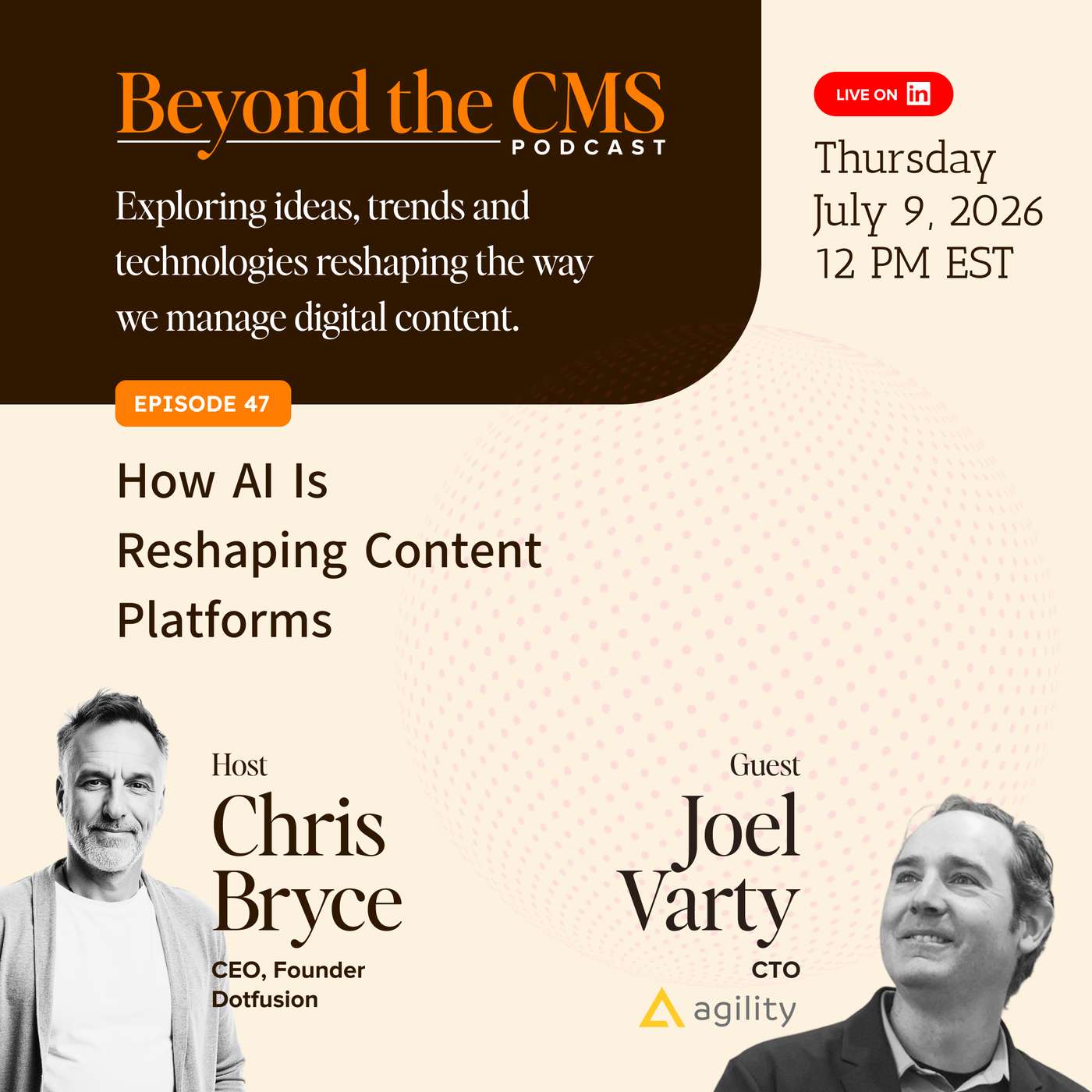
Enterprise content supply chains run 15 to 19 steps. Joel Varty, CTO of Agility CMS, thinks AI can get that down to six, so people are the only bottlenecks left. Chris Bryce and Joel dig into the MCP server that connects Claude directly to your CMS and kills the copy-paste layer of content operations.Joel has spent 21 years building Agility, the Canadian headless CMS behind Cineplex, Scotiabank country sites, school boards, and higher education. He explains why Agility deliberately did not build an AI agent inside the CMS, and instead meets teams inside the AI they already use: Claude, Copilot, or Gemini.The MCP server now runs the full loop: content models for developers, a content pipeline that pushes up to 250 items per batch, and bulk publish, unpublish, and delete. Plus metadata vs JSON-LD schema in plain language, AEO, blogging from a phone with a Claude project, and content ops through a CLI for regulated industries that need sign-off and audit logs.Click here to watch a video of this episode.
Links: Agility CMS: https://agilitycms.com Connect your AI agent to Agility: https://mcp.agilitycms.com Dotfusion (Agility Partner): https://dotfusion.com/services/agility-cms-development-agency Chris on LinkedIn: https://www.linkedin.com/in/cbryce Joel Varty on LinkedIn: https://www.linkedin.com/in/joelvarty/Creators & Guests
Chris Bryce - Host
Joel Varty - Guest
Click here to view the episode transcript.
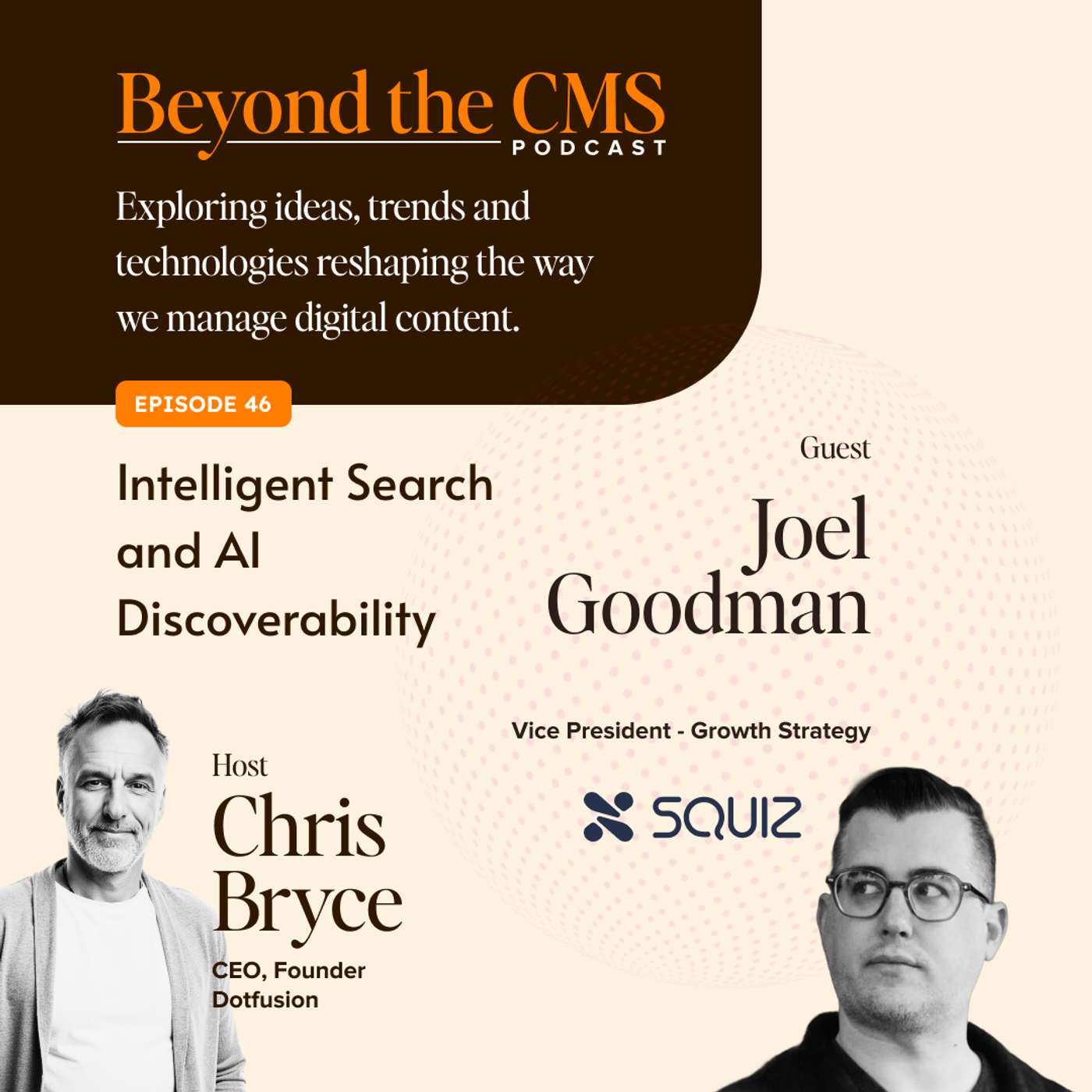
Most enterprise sites are not ready to be found by AI search, and the fix starts before you ever migrate. Chris Bryce talks with Joel Goodman, VP of Growth Strategy at Squiz, about content intelligence, query fanout, and what makes a composable DXP AI-ready.Joel spent 13 years running an agency in higher education before joining Squiz, a 26-year-old Digital Experience Platform built in Australia with a growing North American presence. We get into what makes Squiz different from a traditional headless CMS, why accessibility is now the same problem as AI discoverability, and how Squiz Content Intelligence audits your content the way an AI search engine reads it.The sharpest idea: query fanout. Ask one question in ChatGPT and it breaks into 40, 50, sometimes 60 sub-queries your content has to answer, queries you never see.Click here to watch a video of this episode.
Links: Squiz: https://www.squiz.net Dotfusion (Squiz Partner): https://www.dotfusion.com Chris on LinkedIn: https://www.linkedin.com/in/cbryceJoel Goodman on LinkedIn: [ADD URL]Creators & Guests
Chris Bryce - Host
Click here to view the episode transcript.

Comments

Download from Google Play

Download from App Store
 United States