


 Claim Ownership
Retail Media Therapy
Subscribed: 4Played: 43
Subscribe

© Grace & Co
Description
Join us for a spot of Retail Media Therapy as Viv Craske and Colin Lewis discuss the biggest stories in retail media & commerce media. This podcast is brought to you by Grace & Co the marketing acceleration consultancy.
Hosted on Acast. See acast.com/privacy for more information.
57 Episodes
Reverse
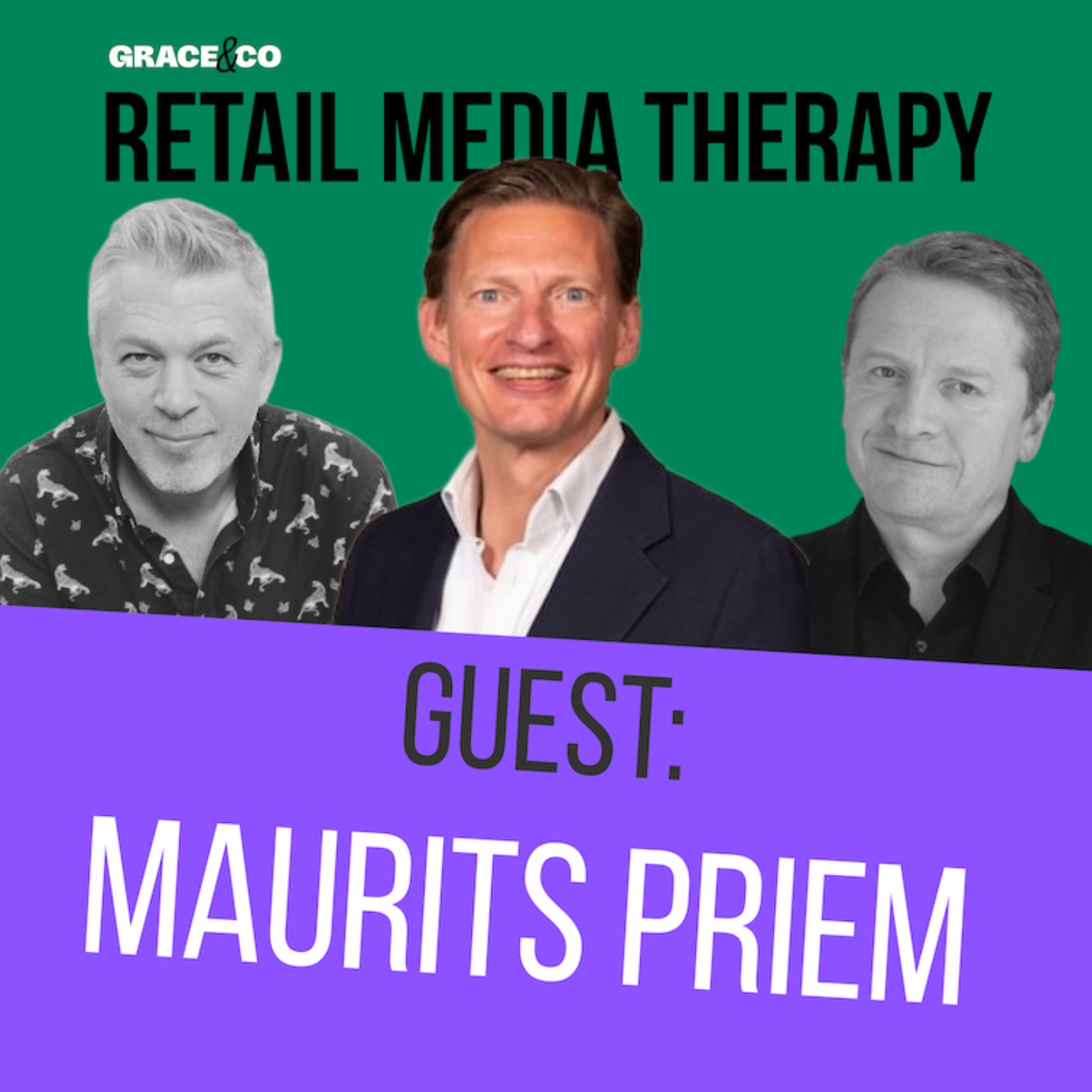
Retail Media Therapy: Maurits Priem on the Future of Retail Media and Responsible AdvertisingWhat does it take to build a successful retail media network, and how can the industry grow without losing sight of its responsibilities?In this episode of Retail Media Therapy, Viv Craske and Colin Lewis welcome retail media heavyweight Maurits Priem, who brings more than 30 years of experience across FMCG, advertising, data platforms and retail media, including seven years leading the retail media network at Ahold Delhaize.Maurits shares his thinking on the three essential ingredients of media success: first-party reach, first-party data and first-party technology. Through his 'Media Cube' framework, he explains why building strength across all three dimensions is capital-intensive, why scale matters, and what strategies smaller and specialist retailers can adopt to compete.He also explores why building a retail media business is fundamentally different from selling bananas. From changing traditional supplier relationships to breaking down organisational silos, Maurits explains why change management is often the biggest challenge facing retail media networks.The conversation turns to the power of in-store media, including the unexpected circumstances that kickstarted Ahold Delhaize's digital screen business during COVID. Maurits explains why physical retail remains such an important media channel, highlighting its mass reach, untapped advertising potential and ability to create experiences that digital channels and television cannot replicate.Finally, Maurits introduces his framework for responsible advertising, built around four dimensions: emissions, data, content and context. He makes the case that responsibility isn't simply a moral obligation but a competitive advantage, showing how better advertising decisions can build trust, improve performance and deliver commercial benefits.In this episode:The Media Cube: reach, data and technology.Why scale could lead to a winner-takes-all retail media market.The banana analogy and the importance of organisational change.Breaking down silos and building the retail media 'golden triangle'.Why in-store media deserves a bigger place in media plans.The four dimensions of responsible advertising.Why retailers and brands can do well by doing good.Plus, a challenge to the industry: who will be first to launch a CPM discount model for sustainable brands?Grace & Co | Retail Media Experts Hosted on Acast. See acast.com/privacy for more information.
EP56: McDonald’s, Best Buy & CitiBank – The Expanding World of Retail MediaViv Craske and Colin Lewis explore three major developments reshaping the industry. From McDonald’s ambitions to build a billion-dollar media business to Best Buy’s move into creative production and Citi’s commerce media network, the message is clear: retail media is becoming much bigger than ever before.McDonald’s enters the retail media gameMcDonald’s has announced plans to launch a media network, targeting $1 billion in revenue. But is there enough detail behind the ambition? Viv and Colin explore the potential of McDonald’s extensive first-party data, global footprint and evolving app strategy, asking whether the real opportunity lies in audience insights as much as advertising inventory.Best Buy becomes a creative production powerhouseBest Buy is positioning itself as more than a media seller, investing in a 70,000-square-foot production facility complete with sound stages, audio suites and influencer capabilities. Could offering creative services help retail media networks capture more value from advertisers? The hosts debate the commercial potential, margins and changing definition of core competencies.Citi makes its commerce media moveWith visibility across spending in travel, dining, entertainment and other categories, Citi is entering the commerce media space with audience insights, paid media and closed-loop measurement. Viv and Colin discuss the value of cross-category transaction data, how it compares with SKU-level insights, and why banks could become powerful media players.Brought to you by Grace & Co the marketing and commerce consultancy.Visit retailmediatherapy.com and follow the podcast for more.Grace & Co | Retail Media Experts Hosted on Acast. See acast.com/privacy for more information.

In this episode of Retail Media Therapy, Dean Harris joins Viv Craske and Colin Lewis for Score My Strategy.Dean assesses six strategic opportunities for a growing retail media network, scoring each out of 10 and explaining where retailers should focus their investment, resources and attention.The central message: build a strong core business before chasing the next big opportunity.Key discussion points:1. Self-serve advertising Self-serve can appeal to large brands and agencies with performance marketing teams, but it is not a guaranteed revenue generator. Retailers must consider their audience scale, competitive advantage, data quality, permissions, governance and technology investment before launching.2. Agency engagement strategyOnce a retail media network has established a stable business and strong relationships with existing brand partners, agency engagement becomes essential. Success requires structured, long-term relationship building, clear differentiation, relevant insights and a compelling value proposition - not simply sending emails or requesting meetings.3. Off-site mediaUsing retailer first-party audiences across platforms such as Meta, Google, TikTok, Pinterest and Reddit can extend campaign reach. However, retailers must understand the margin implications. Off-site activity may increase revenue while reducing net profit, particularly if it cannibalises higher-margin, retailer-owned media.4. In-store digital screensScreens can demand significant upfront capital expenditure, partner investment and long-term commitment. Retailers should assess incremental value, payback periods and the risk of shifting existing revenue between channels. 5. Influencer marketingInfluencer activity is an emerging opportunity, but its relevance depends on the retail category. Health and beauty may benefit significantly, while grocery networks may have more pressing priorities. Dean stresses the importance of saying no to good ideas to protect strategic focus.6. AdTech orchestrationImproving connectivity and simplifying operations across media channels should be a priority. Retailers do not necessarily need a costly, all-in-one orchestration platform; they need to make their channels work together more efficiently for clients.7. Creative solutions Creative strategy is often undervalued in retail media. Dean highlights Co-op's co-creation approach, where dedicated creative and strategic planning can improve campaign performance and brand engagement. As campaigns span in-store, online, apps, CRM and off-site channels, joined-up creative becomes increasingly important.Key takeaway:Retail media growth is not about launching every new product or following industry trends. It is about prioritising opportunities that fit the business model, deliver incremental value and strengthen client relationships. Invest in the core, understand the economics, improve operational connectivity and make creativity a bigger part of the strategy.Grace & Co | Retail Media Experts Hosted on Acast. See acast.com/privacy for more information.

What the Hell Do We Do About Measurement Now? | Retail Media TherapyROAS: the metric everyone wants, but is it really the one marketers and online advertisers should be chasing?In this final episode of our special six-part series, The Retail Media Guide to Everything You Always Wanted to Know About ROAS and Measurement, But Were Afraid to Ask, Viv Craske and Colin Lewis revisit the biggest lessons, challenge some long-held assumptions, and share practical advice for brands and retail media networks trying to make sense of measurement.Why has Return on Ad Spend (ROAS) become the default measure of success? And what happens when the relentless pursuit of efficiency comes at the expense of brand and category growth? Viv and Colin explore why a high ROAS isn't necessarily a sign of success, how the industry became so fixated on the metric, and why it's time to look beyond a single number.They revisit insights from previous episodes, including Andrew Lipsman's case for incremental ROAS (iROAS) and Sky Frontier's argument for brands and retailers to collaborate more closely on measurement. They also unpack why incrementality isn't something you need to measure constantly, and why understanding the methodology behind your numbers matters just as much as the results themselves.So, what should you actually do?Viv and Colin share actionable takeaways for both brands and retail media networks: agree on measurement expectations upfront, align on campaign objectives, understand the limitations of your chosen methodology, and build measurement into joint media planning.They also explore the metrics worth watching beyond ROAS, including share of voice, market share, long-term customer value and, crucially, penetration. Because if your goal is sustainable brand growth, acquiring new customers may tell you far more than the return from a single campaign.The big takeaway? Don't let one metric dictate your marketing strategy. Understand what you're measuring, question the assumptions behind the numbers, and focus on the outcomes that genuinely matter to your business.Join Viv and Colin for the final instalment of this measurement therapy session.Listen now, follow Retail Media Therapy, and visit retailmediatherapy.com.Grace & Co | Retail Media Experts Hosted on Acast. See acast.com/privacy for more information.

Albertson's Media Collective iROAS Measurement SecretsHow much can the methodology behind iROAS change the story your retail media data tells?In this episode of Retail Media Therapy, Viv Craske takes a deep dive into iROAS measurement, exploring research from Albertsons Media Collective and Northwestern University’s Kellogg School of Management. The study examined 42 digital advertising campaigns and compared different approaches to measuring incremental return on ad spend.The results reveal just how much methodology matters. Across the campaigns, the difference between the highest and lowest reported ROAS was 6.5x. Even more strikingly, 83% of campaigns flipped from a positive to a negative incremental return depending solely on the measurement methodology used.Viv breaks down three key approaches to iROAS measurement:Pre/post analysis – simple and accessible, but unable to fully separate advertising impact from other factors influencing sales.Randomized controlled trials (RCTs) – widely regarded as the gold standard for incrementality measurement, but more difficult to implement, particularly for omnichannel retailers.Synthetic controls – a middle ground that uses comparable unexposed audiences or markets to estimate what would have happened without advertising.The episode also explores how audience definitions and revenue calculations can dramatically change reported iROAS. For example, focusing specifically on previous brand buyers reduced one reported result from $2.27 to just $0.22.So what should advertisers do? The key takeaway is transparency. Before comparing iROAS figures, advertisers need to understand how the result was calculated, how test and control groups were constructed, what assumptions influenced the model, and how incremental revenue was determined. And Retail Media Networks need to be transparent about how they are measuring their online media results.Because without understanding the methodology, two iROAS numbers may not actually be measuring the same thing.Grace & Co | Retail Media Experts Hosted on Acast. See acast.com/privacy for more information.

Comments

Download from Google Play

Download from App Store
 United States