


Ignite: Conversations on Startups, Venture Capital, Tech, Future, and Society
Subscribed: 5Played: 327
Subscribe

© Brian Bell
Description
Welcome to Ignite, hosted by Brian Bell of Team Ignite Ventures. Join candid conversations with founders, investors, and thought leaders shaping the future of startups, tech, and venture capital. For informational purposes only, not investment advice or an offer to buy/sell securities.
303 Episodes
Reverse

Big Context abandoned a seven-figure AI platform growing nearly 30% monthly to build an AI-native services business instead.Zac Choi, founder of Big Context, has spent over two decades working in enterprise data, analytics, and AI. His career spans Wharton, General Mills, Clorox, Green Dot's IPO, and McKinsey, where he launched Fuel, a practice serving growth-stage technology companies. He previously founded String AI, an AI-powered messaging platform acquired by a telecommunications company. Today, he is building Big Context and developing Open Pragmatics, an open standard for enterprise AI context.In this episode of the Ignite Podcast, Brian Bell and Zac examine why enterprise AI projects repeatedly fail despite increasingly capable models. Zac argues that the fundamental obstacle is not model intelligence or access to more data. It is the missing business context that allows AI systems to interpret information correctly. A CFO, salesperson, and marketer can all define revenue differently, yet most enterprise systems never capture those distinctions in a form AI can reliably use.Zac challenges another foundational assumption: data gravity. He argues that enterprises remain dependent on their existing systems because the meaning attached to their data is difficult to move, not because moving the data itself is inherently expensive. His solution involves making context portable, opening the underlying standards, and turning complex implementation work into repeatable, AI-powered services.In Today's Episode We Discuss:00:00 - Introduction to Zac Choi and Big Context00:32 - From Wharton and McKinsey to Entrepreneurship04:37 - Building and Selling String AI07:19 - The Origins of Big Context11:21 - Why Enterprise AI Pilots Fail13:00 - The Missing Context in Enterprise Data17:28 - Why Open Pragmatics Is Open Source22:24 - Services as Software and AI-Native Consulting24:51 - Automating Enterprise Data Migrations27:32 - Sovereign Context and Enterprise AI Models29:20 - Building Trust with Fortune 500 Companies31:16 - Why the Modern Data Stack May Collapse33:28 - The Rise of Context Engineering35:41 - Why Data Gravity Is an Illusion37:43 - The Best Advice Zac Ever Received38:31 - Why Net Revenue Retention Matters More Than ARR41:31 - Why Founders Must Learn to Pivot44:04 - The Decision to Abandon a Growing Platform45:52 - Reinventing Enterprise Software Delivery49:57 - Where to Find Zac ChoiZac explains how Big Context compresses enterprise BI migrations that traditionally take months into days, why it paused a platform growing nearly 30% month over month for 15 to 16 months, and how a Fortune 500 procurement process changed after the company adopted a services-led model. He also shares his father's advice about separating work and play and why net revenue retention reveals more about customer value than ARR alone.The enduring advantage in technology may be less about controlling information than understanding what it means.Pull Quotes"I think data gravity is an illusion.""I think ARR is stupid."Subscribe on Spotify: https://open.spotify.com/show/6Ga6v0YUsHotLhjap67uu5Subscribe on Apple Podcasts: https://podcasts.apple.com/us/podcast/ignite-conversations-on-startups-venture-capital-tech/id1709248824Follow Zac Choi on LinkedIn: https://www.linkedin.com/in/isaacchoi/Follow Zac Choi on Twitter: https://x.com/w3bzacFollow Brian on Linkedin: https://www.linkedin.com/in/bblinkedin/Visit Our Website: https://www.teamignite.vc🎧 Watch, listen, and follow on your favorite platform: https://www.teamignite.vc/podcast💬 Join the conversation on your favorite social network: https://linktr.ee/theignitepodcastPre-order my book LP: The Insider's Guide to Investing in Venture Capital Funds (https://www.thelpbook.com/)

A cybersecurity startup raised over $100 million, reached nearly $30 million in revenue, and was sold for $1 after a cash flow crisis.Mahendra Ramsinghani, founder and managing partner of Secure Octane, joins Brian Bell on the Ignite Podcast to examine the uncomfortable realities of venture capital. He leads a San Francisco seed fund focused on AI and cybersecurity, with exits involving Palo Alto Networks and Microsoft, wrote The Business of Venture Capital (now in its fourth edition), and teaches venture capital at UC Berkeley.Mahendra argues that venture capitalists dramatically overstate their ability to predict winners. Behind polished theses and LP presentations, luck, timing, relationships, and access often decide outcomes. His own record includes a 16x return on a $50,000 Demisto investment, an 8x return that began with a chance encounter at the RSA Conference, and a cybersecurity company that collapsed despite raising substantial capital.The conversation challenges several assumptions. Why do managers insist on concentrated portfolios when outcomes follow power-law distributions? Are megafunds keeping companies private too long? And why do institutional LPs sometimes prioritize protecting their careers over backing emerging managers?In Today’s Episode We Discuss:00:01 Introduction to Mahendra Ramsinghani and Secure Octane00:50 Growing Up in India and Entering Venture Capital03:01 Why Venture Capital Is a Slow Path to Wealth05:36 From NVIDIA Employee to Raising a $20 Million Fund06:42 How a Cold Email Led to a Friendship With Brad Feld08:31 Building Secure Octane’s Cybersecurity Investment Thesis10:39 The Chance Encounter That Produced an 8x Investment12:12 How Demisto Generated a 16x Return14:27 Why Venture Capitalists Avoid Discussing Failure16:11 The $100 Million Startup That Sold for $119:37 How Venture Capital Has Changed Over the Decades21:03 Why Megafunds Keep Companies Private Longer28:04 The Psychology of Venture Capital and Open-Heartedness30:43 The Art of Saying No to Founders35:17 What Separates Professional VCs From Angel Investors38:15 Does Geography Still Matter in Venture Capital?40:00 When Does an Emerging Manager Become Established?41:25 Institutional LPs and Solo GP Succession Risk54:12 Why Institutional LPs Avoid Career Risk59:13 Challenging Traditional Portfolio Diversification01:01:42 The Myth of Venture Capitalists Picking Unicorns01:06:25 The Resilient Founder and Mental Health in Startups01:09:19 How Investors Can Support Struggling Founders01:11:57 AI’s Impact on Venture Capital and Entrepreneurship01:15:40 Access to Y Combinator and Competitive Deal Flow01:19:05 Ethics, Management Fees, and Long-Term Relationships01:21:57 Closing Thoughts and Where to Find MahendraMahendra also shares how a cold email to Brad Feld became a lasting friendship and book collaboration, how a single cash flow disruption destroyed a heavily funded company, and a practical approach to rejecting founders respectfully.Ultimately, venture capital remains an exercise in judgment under uncertainty, where humility matters as much as conviction.Pull Quotes:“Nobody knows. Nobody knows.”“you have to be invisible but present and it’s very hard, you know.”Subscribe on Spotify: https://open.spotify.com/show/6Ga6v0YUsHotLhjap67uu5Follow Mahendra Ramsinghani on LinkedIn: https://www.linkedin.com/in/mahendraram/Follow Mahendra Ramsinghani on Twitter: https://x.com/mahendra_grFollow Brian on LinkedIn: https://www.linkedin.com/in/bblinkedin/Visit Our Website: https://www.teamignite.vc🎧 Watch, listen, and follow on your favorite platform: https://www.teamignite.vc/podcast💬 Join the conversation on your favorite social network: https://linktr.ee/theignitepodcastPre-order my book LP: The Insider’s Guide to Investing in Venture Capital Funds (https://www.thelpbook.com/)

Most machine learning models never reach deployment, and Gooder AI co-founder Eric Siegel argues that better algorithms won't fix the problem.Eric Siegel is the co-founder of Gooder AI and author of The AI Playbook and Predictive Analytics. With more than 35 years in machine learning, a PhD from Columbia University, and experience teaching AI at Columbia, Siegel has spent his career connecting predictive technology to business outcomes. His first book has been adopted by hundreds of universities, and he has delivered 180 paid keynote speeches. He also founded Machine Learning Week, a conference series running since 2009.In this episode of the Ignite Podcast, host Brian Bell welcomes Eric back to challenge the industry's obsession with generative AI. Siegel argues that most organizations should invest at least as much in predictive AI as generative AI, particularly when improving existing business operations. While generative AI attracts disproportionate investment and attention, predictive models can deliver substantial returns by improving decisions about customer retention, fraud detection, credit scoring, and other operational processes.The deeper problem isn't model sophistication. It's deployment. Siegel explains why predictive AI projects stall when data scientists report precision, recall, and accuracy instead of translating predictions into financial outcomes. Meanwhile, generative AI faces a different obstacle: reliability. Even a system that performs correctly 95% of the time may be commercially unusable when its remaining errors carry serious consequences.His proposed solution combines both approaches. Predictive reliability layers can identify high-risk interactions and route them to humans, potentially making partially autonomous systems viable where fully autonomous systems fail.In Today's Episode We Discuss:00:00 Eric Siegel's 35 Years in Machine Learning03:09 Decision-Making Models and Predictive AI06:41 Why Better Data Beats Complex Models09:24 The AI Playbook and the Future of Predictive AI14:15 Audiobook Production and the New Paperback Edition17:30 Why Enterprise AI Projects Fail20:25 Reliability Layers and Human-in-the-Loop AI24:14 The Six-Step BizML Framework30:56 Can Foundation Models Replace Predictive AI?35:27 Who Should Read The AI Playbook?37:58 Why AI Benchmarks Fail to Measure Business Value41:40 AI Doom, AGI, and the Intelligence Explosion Narrative46:19 Eric Siegel's Predictive Analytics Rap47:10 The AI Playbook's Central MessageSiegel breaks down his six-step BizML framework, explains why technical model scores fail to communicate business value, and describes how routing risky AI decisions to human reviewers can rescue otherwise undeployable systems. He also challenges AI extinction narratives, recalls building a home sound booth to narrate his audiobook, and reveals the provocative original title MIT Press rejected.Ultimately, the value of intelligence lies not in how impressive its capabilities appear, but in whether those capabilities improve decisions in the real world.Pull Quotes:"The thing that tends to pay off more isn't com in increasing the complexity of the analytical method, but rather improving the data.""my P doom is zero."Subscribe on Spotify: https://open.spotify.com/show/6Ga6v0YUsHotLhjap67uu5Subscribe on Apple Podcasts: https://podcasts.apple.com/us/podcast/ignite-conversations-on-startups-venture-capital-tech/id1709248824Follow Eric Siegel on LinkedIn: https://www.linkedin.com/in/predictiveanalytics/Follow Eric Siegel on Twitter: https://x.com/predictanalyticFollow Brian on Linkedin: https://www.linkedin.com/in/bblinkedin/Visit Our Website: https://www.teamignite.vc🎧 Watch, listen, and follow on your favorite platform: https://www.teamignite.vc/podcast💬 Join the conversation on your favorite social network: https://linktr.ee/theignitepodcastPre-order my book LP: The Insider's Guide to Investing in Venture Capital Funds

VoiceBit discovered that customers would order pizza from an AI agent even when its first attempt failed to capture the toppings.Jay Patel is the co-founder and CTO of VoiceBit, an AI-powered ordering platform helping restaurants reclaim direct orders from third-party delivery apps. Before founding VoiceBit, Jay worked on Azure support AI at Microsoft, where his team used generative AI to deflect thousands of support cases. He previously worked at Visa on loyalty systems and large-scale data processing. VoiceBit emerged from Berkeley SkyDeck and closed an oversubscribed pre-seed round led by 1984 VC.In this episode of the Ignite Podcast, Brian Bell and Jay examine why building a sophisticated voice agent is only a small part of solving restaurant ordering. Jay explains how VoiceBit evolved from answering phone calls into an integrated ordering platform covering payments, delivery dispatch, websites, and ChatGPT ordering.The counterintuitive insight is that restaurant owners do not actually want AI. They want missed orders recovered, customer relationships restored, and commissions eliminated. Jay explains why phone orders remain surprisingly resilient, how AI-powered upselling generates a reported 5% to 8% revenue lift, and why the company's most important engagement metric became misleading after introducing conversational memory.In Today's Episode We Discuss:00:01 Introducing Jay Patel and VoiceBit00:49 From self-taught programmer to Microsoft AI engineer05:40 The idea behind VoiceBit08:33 The first AI pizza order and its unexpected lesson09:46 How VoiceBit automates restaurant phone orders12:10 Reclaiming customers from third-party delivery apps14:28 Why restaurants must own their customer relationships16:00 VoiceBit's pricing and commission-free model16:58 Measuring AI adoption and customer engagement19:14 How conversational memory changes ordering behavior20:41 Convincing restaurants through real-world pilots22:34 AI-powered upselling and revenue growth24:21 Turning restaurant websites into interactive AI experiences25:22 Why phone ordering remains a major revenue channel26:19 Competing in the restaurant voice AI market29:28 Building the infrastructure for direct restaurant ordering31:03 Why VoiceBit launched ChatGPT ordering32:20 The future of restaurant margins and AI productivity34:59 Moving from Microsoft to startup ownership36:21 Why startups should ship before achieving perfection37:24 What changed Jay's mind about customer trust in AI38:31 Why restaurant owners don't want AI for its own sake39:00 Staying curious and being willing to be wrong41:03 Multilingual AI and restaurant accessibility43:27 Why computer science fundamentals still matter44:34 Jay's interest in building an AI-powered hedge fund46:00 Where to find Jay and VoiceBit46:40 AI existential risk and Jay's 10% P(doom) estimate50:39 P versus NP and the future of computationThe most useful technology often succeeds by making itself invisible, leaving customers with a better service rather than another system to manage.Pull Quotes"What they want is a solution that just works, right?""You have to be owner of everything."Subscribe on Spotify: https://open.spotify.com/show/6Ga6v0YUsHotLhjap67uu5Subscribe on Apple Podcasts: https://podcasts.apple.com/us/podcast/ignite-conversations-on-startups-venture-capital-tech/id1709248824Follow Jay Patel on LinkedIn: https://www.linkedin.com/in/imjaypatel12/Follow Brian on Linkedin: https://www.linkedin.com/in/bblinkedin/Visit Our Website: https://www.teamignite.vc🎧 Watch, listen, and follow on your favorite platform: https://www.teamignite.vc/podcast💬 Join the conversation on your favorite social network: https://linktr.ee/theignitepodcast📝 Read the full episode breakdown on our blog: https://www.teamignite.vc/blogPre-order my book LP: The Insider's Guide to Investing in Venture Capital Funds
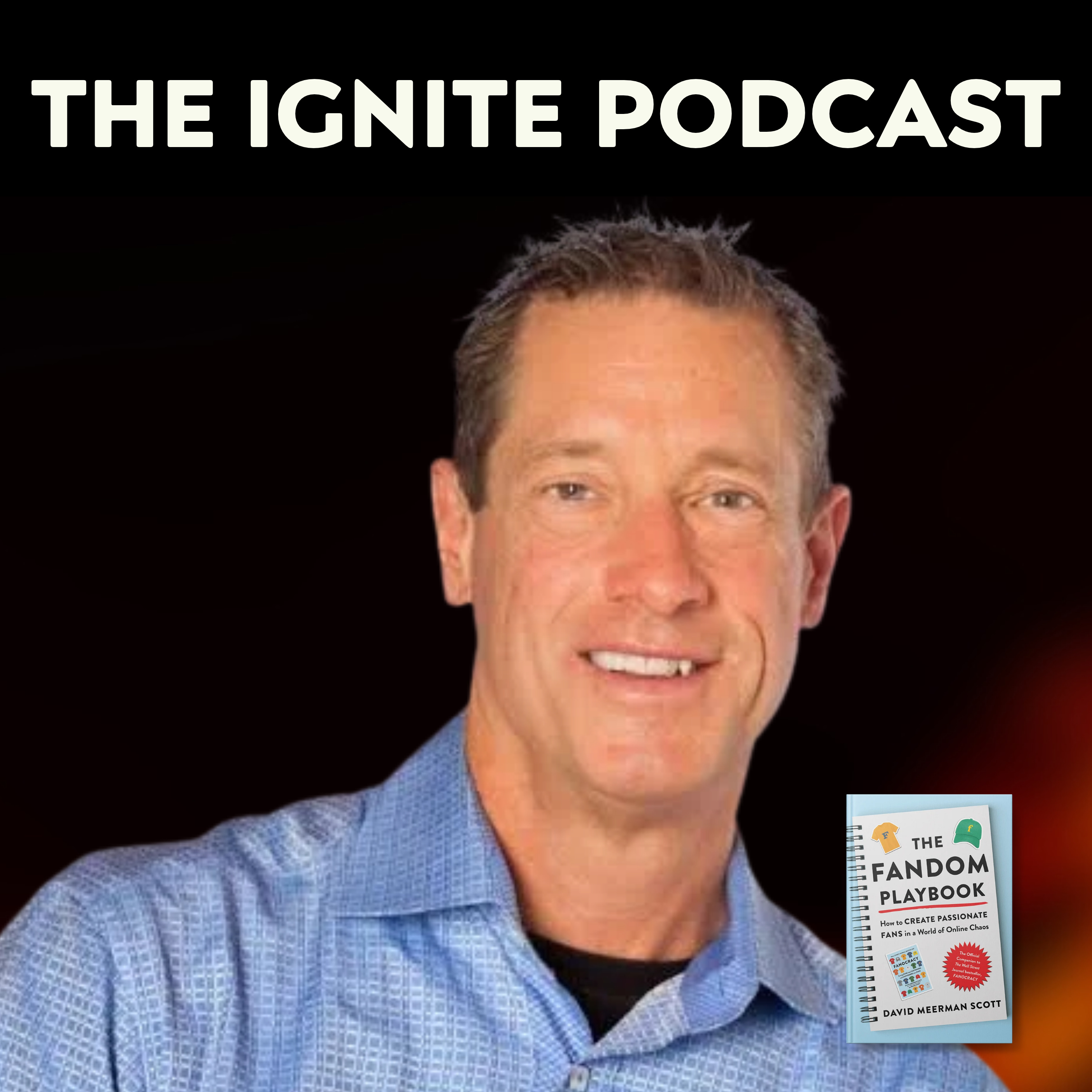
A Los Angeles dentist increased new patients by 33% and revenue by 23% after turning his skateboarding obsession into a marketing strategy.David Meerman Scott joins Brian Bell for this episode of the Ignite Podcast to discuss The Fandom Playbook, his fourteenth book. David is a bestselling author whose books have sold approximately one million copies across 30 languages. A longtime HubSpot advisor, former technology CMO, and creator of the concept of newsjacking, he has spent decades challenging conventional marketing practices. His latest book translates those ideas into nine actionable plays for building passionate customer communities.David argues that founders make a fundamental mistake when they lead with their products instead of giving people reasons to become fans. Customers can be acquired through transactions, but fandom grows through shared identity, personal connection, and experiences people want to repeat. His central argument is that companies should stop trying to control every interaction and start creating conditions for customers to participate, contribute, and advocate voluntarily.That argument becomes more relevant as AI-generated content floods digital channels. David, who helped popularize digital marketing, now believes genuine human connection offers a powerful alternative to algorithm-driven distribution. Rather than chasing reach or paying influencers who may never use a product, founders can create experiences and resources that turn customers into advocates.In Today's Episode We Discuss:00:00 Introduction with David Meerman Scott00:33 Introducing The Fandom Playbook01:23 Why founders struggle to build fandom02:32 The neuroscience behind fandom and belonging04:30 Writing Fanocracy with his daughter07:08 Brian Bell's book-writing experience08:00 Turning books into a global speaking business09:27 How HubSpot builds community through live events13:03 The nine plays for growing fans13:18 Gamification and the Green Shorts Challenge17:17 HubSpot Academy's certification strategy18:21 Letting go of control over your brand21:05 The Grateful Dead's music-sharing strategy22:00 Turning proprietary data into free resources26:25 Why founders should share personal passions28:00 How a skateboarding dentist grew his practice31:03 Human connection in an era of AI-generated content34:46 Using AI and adult-learning expertise to write a playbook38:24 AI training data, copyright, and author compensation41:28 Why David delayed his AI companion chatbot44:58 How AI is changing marketing and fandom46:58 The dangers of chasing social media algorithms50:01 Why genuine fans outperform paid influencers51:40 HubSpot, inbound marketing, and category creation53:05 How traditional PR can influence AI search results56:34 Where to find David and The Fandom PlaybookThe enduring principle is that people have always gathered around shared interests, and the strongest businesses learn how to earn a place in those communities.Pull Quotes:"The biggest mistake I see is founders focus way too much on their product and service.""When the whole world is making artificial stuff, you can stand out if you have a genuine human connection."Subscribe on Spotify: https://open.spotify.com/show/6Ga6v0YUsHotLhjap67uu5Subscribe on Apple Podcasts: https://podcasts.apple.com/us/podcast/ignite-conversations-on-startups-venture-capital-tech/id1709248824Follow David Meerman Scott on LinkedIn: https://www.linkedin.com/in/davidmeermanscott/Website: https://www.davidmeermanscott.com/fandom-marketingPre-order the book: https://www.amazon.com/exec/obidos/ASIN/1613084978/freshspotpubl-20Visit Our Website: https://www.teamignite.vc🎧 Watch, listen, and follow on your favorite platform: https://www.teamignite.vc/podcast💬 Join the conversation on your favorite social network: https://linktr.ee/theignitepodcast📝 Read the full episode breakdown on our blog: https://www.teamignite.vc/blog

Comments

Download from Google Play

Download from App Store
 United States