


 Claim Ownership
61 Episodes
Reverse

We began this week’s edition of the CAPS Unlock podcast with the deaths of 14 Kazakh servicemen during a naval exercise on the Caspian coast. Seventeen men were swept into the sea during an amphibious landing, but only three survived. The Defence Ministry initially attributed the disaster to a sudden deterioration in the weather, but weather forecasters had already issued a warning. President Kassym-Jomart Tokayev later said the servicemen had not been properly equipped with life jackets. Five officers have been detained, Defence Minister Dauren Kosanov has been removed, and two commissions are examining both the incident and the wider condition of Kazakhstan’s armed forces. The tragedy has revived arguments over military safety, compulsory service and whether lessons were learned after a similar fatal exercise in 2015.Also, we considered Kyrgyzstan’s order for 10 freight locomotives from the U.S. company Wabtec. The purchase will renew almost a third of the national operator’s fleet and comes as Kyrgyzstan builds the China-Kyrgyzstan-Uzbekistan railway. Wabtec is American, but its regional manufacturing base is the LKZ factory in Astana, which it now owns outright. We trace that factory’s Kazakh, Russian and American history, and ask how the locomotive order fits alongside Chinese railway construction and Kyrgyzstan’s new transit-trade agreement with Pakistan. These projects reveal an emerging transport system built from American technology, Kazakh industry, Chinese infrastructure and access to South Asian ports.For our interview, recorded during ASIAC Days in Almaty, we spoke to Aleksei Chigadaev, a doctoral candidate in political science at Freie Universität Berlin. His ongoing research treats Chinese e-commerce as a form of infrastructural power. Chinese companies may supply not only a product but also the marketplace, payment system, warehouse, delivery network and data storage behind the purchase. This makes trade more efficient and easier to regulate, but it may also leave Kazakhstan dependent on commercial systems controlled elsewhere.Links* 14 Dead on the Caspian: What Questions Has the Tragedy Posed for Kazakhstan’s Army?, Informburo* Kazakhstan’s Tokayev Dismisses Defence Minister After 14 Die During Naval Exercise, Reuters* Bodies of Two Missing Caspian Servicemen Found; Search Operation Completed, Kazakhstan Ministry of Defence* Kyrgyzstan Will Purchase 10 Mainline Freight Locomotives from the United States, Kabar* How Kazakhstan Is Poised to Drive Wabtec’s Growth in Central Asia, Wabtec* Work Proceeds on Tunnels for the China–Kyrgyzstan–Uzbekistan Railway, Kyrgyz Ministry of Transport and Communications* Joint Statement by the Leaders of Pakistan and Kyrgyzstan, Pakistan Ministry of Foreign Affairs Get full access to Havli - A Central Asia Substack at havli.substack.com/subscribe

This week, after an unplanned delay, we return to the podcast with a discussion of Kazakhstan’s seemingly growing reliance on Russian natural gas for its domestic needs.The country plans to buy around 11 billion cubic metres from Gazprom in 2026, almost three times last year’s volume, with another 9 billion under discussion for 2027. That sounds counterintuitive for a major oil-and-gas producer. The explanation lies less in the size of Kazakhstan’s reserves than in its ability to process the gas it extracts and turn it into marketable fuel. Disruptions at Tengiz, damage to the Russian processing plant serving Karachaganak and repeated delays to new processing capacity at Kashagan have squeezed supply just as household connections and industrial demand have expanded. Russian imports may address the immediate shortage, but the continued high volumes anticipated next year point to a more structural problem.In our other topic of discussion, we turn to the case of Mansur Movlayev, a 31-year-old Chechen dissident detained in Kazakhstan since May 2025. Russia seeks his extradition over an accusation that he financed extremist activity. Movlayev says the case is politically motivated and that Chechen security forces previously abducted and tortured him. Kazakhstan has refused him asylum and approved his extradition, although an interim-measures request from the UN Human Rights Committee calls on Kazakhstan not to remove him while it considers his complaint. After Kazakhstan’s Cassation Court upheld the refusal of asylum, Movlayev attempted to take his own life and reportedly made a second attempt while he received hospital treatment. His case tests Kazakhstan’s obligation not to return anyone to a country where they face a credible risk of torture.For our interview this week, we speak to Zebo Isakova, Doctor of Science in Economics at Kimyo International University in Tashkent. Her paper, “Corridors Without Coordination: Why Uzbekistan’s Digital Trade Reforms Have Not Yet Produced an Integrated Export System,” appears in The Argument, CAPS Unlock’s policy essay series.Isakova argues that Uzbekistan has invested heavily in roads, railways and digital trade procedures without fully connecting the agencies responsible for individual shipments. Exporters must still navigate separate systems, repeat information and wait for sequential approvals. Larger companies can absorb those costs; smaller businesses frequently cannot.Links* Corridors Without Coordination: Why Uzbekistan’s Digital Trade Reforms Have Not Yet Produced an Integrated Export System, by Zebo Isakova* Why Has Kazakhstan Started Deporting Political Activists?, by Temur Umarov* Russian Gas Supplies to Kazakhstan Could Triple to 11 bcm in 2026 — Deputy Minister, Interfax Kazakhstan* Россия захватывает газовую отрасль Казахстана? (Is Russia Taking Control of Kazakhstan’s Gas Industry?), Exclusive.kz* “I’m Tired of Injustice”: Chechen Activist Mansur Movlayev Attempted Suicide After Kazakhstan Denied Him Asylum, Bureau.kz* Остался только страх. Почему Казахстан отказывает в убежище уроженцу Чечни (Only Fear Remains: Why Kazakhstan Is Denying Asylum to a Chechen Native), Caucasus.Realities Get full access to Havli - A Central Asia Substack at havli.substack.com/subscribe
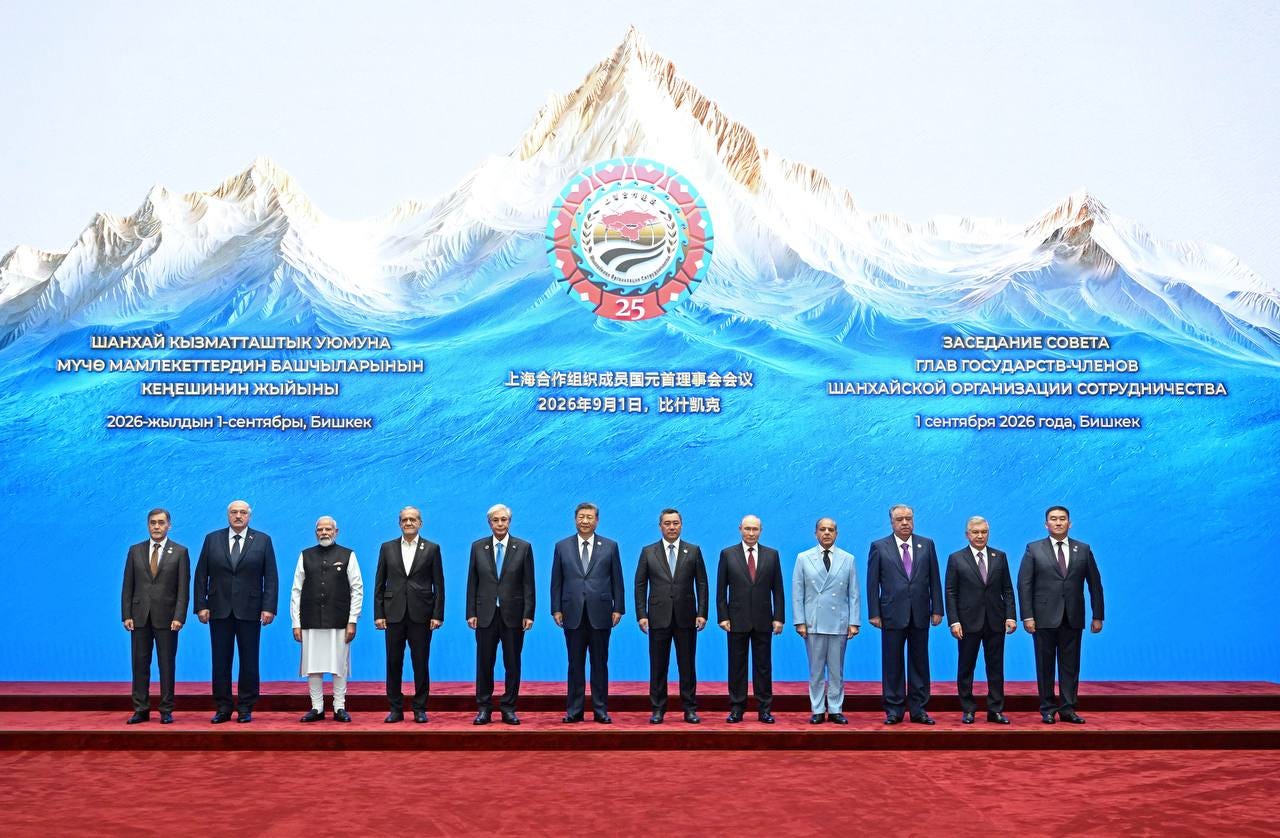
This week, we begin in Bishkek, where leaders have gathered for a Shanghai Cooperation Organisation summit that marks 25 years since the group took its present institutional form. The prestige has come at a considerable cost for the host city, with road closures, commercial restrictions and severe disruption as Kyrgyzstan stages the summit alongside the World Nomad Games.We look back at the SCO’s origins as a forum created to settle borders and reduce tension between China, Russia and the newly independent Central Asian states. We then ask what the organisation has become as its membership and ambitions have expanded. China now dominates regional trade, supplies the manufactured goods Central Asia wants and buys many of its raw materials. Russia remains important through migration, security and inherited economic links, but it cannot match China’s manufacturing capacity. We also examine the China-Kyrgyzstan-Uzbekistan railway and Shavkat Mirziyoyev’s reported praise for “Chinese-style modernisation,” a revealing sign of China’s appeal as an economic, technological and increasingly political model.From Bishkek, we turn to Kazakhstan’s first election for its new 145-seat, single-chamber Kurultai. Adilet won 71.17 percent of the vote and 110 seats after it absorbed the former ruling party, Amanat. International observers said the election was technically well prepared but offered little genuine political choice. We consider whether Kazakhstan’s promised constitutional reset has produced anything substantially new, as well as the appointments of Yerlan Karin as vice president and Aibek Dadebay as speaker. We also look ahead to the new People’s Council and the succession speculation that now surrounds the 2029 presidential election.For our interview this week, we spoke with Ainagul Amatbekova, lead researcher for State of Youth Civic Engagement in Kyrgyzstan’s Shrinking Civic Space. The report challenges the idea that young Kyrgyz people have become apathetic. Civic participation has not disappeared, but has become quieter, safer and more local, with greater emphasis on volunteer work, mutual aid, education and online activity.Amatbekova explains how political pressure intersects with less visible barriers such as poverty, migration, gender and the divide between urban and rural communities. She also sets out what governments, civil society organisations and donors could do to make youth participation safer, more meaningful and more accessible.LinksState of Youth Civic Engagement in Kyrgyzstan’s Shrinking Civic Space — https://capsunlock.org/publications/state-of-youth-civic-engagement-in-kyrgyzstans-shrinking-civic-space/World Nomad Games: Did the Experiment Work? — https://capsunlock.org/world-nomad-games-did-the-experiment-work/Xinhua report on Xi Jinping’s meeting with Shavkat Mirziyoyev and “Chinese-style modernisation” - https://russian.news.cn/20260901/860d5d94ce8d4b43b4af0f52c0ddd52d/c.htmlOSCE/ODIHR, preliminary findings on Kazakhstan’s parliamentary election - https://odihr.osce.org/odihr/667167 Get full access to Havli - A Central Asia Substack at havli.substack.com/subscribe

Central Asia is one of the world’s youngest and fastest-growing regions, but what do the latest demographic trends tell us about its future? This episode begins with new population figures from Kyrgyzstan, where the latest statistics point not only to continued growth but also to accelerating urbanisation. The discussion explores why Bishkek is expanding faster than the country as a whole, what falling fertility means for the region in the longer term, and why demographic change is becoming one of Central Asia’s defining policy challenges.The conversation then turns to Uzbekistan, where the country’s first population census in more than three decades revealed more than 810,000 additional residents compared with previous official estimates. We discuss what this means for measuring economic performance, labour markets and long-term development planning, and why the census may ultimately improve policymaking despite raising new questions about productivity and employment.In our interview section, Hugh McLean, Senior Adviser on Climate Change Education at CAPS Unlock, discusses an upcoming new policy discussion paper arguing that climate change education should become a compulsory element of education systems across Central Asia. Drawing on more than 1,000 contributions from young people through the Turn It Around Central Asia initiative, he explains why climate education should focus not only on environmental knowledge but also on agency, community action and preparing future generations for a changing climate.The episode concludes with a discussion of the World Artificial Intelligence Conference in Shanghai, where China outlined its vision for global AI governance. The hosts examine Kazakhstan’s participation, the creation of a new international AI cooperation organisation, Central Asia’s increasingly important role in global technology diplomacy, and the opportunities and risks that accompany growing dependence on foreign AI ecosystems.LINKSTurn It Around project - https://capsunlock.org/projects/tia-central-asia-cards-eng/Kyrgyzstan population news - https://24.kg/obschestvo/381849_naselenie_kyirgyizstana_prevyisilo_74milliona_chto_pokazala_novaya_statistika/Uzbekistan population surpasses 39 million - https://www.gazeta.uz/ru/2026/06/30/population-uzbekistan/ Get full access to Havli - A Central Asia Substack at havli.substack.com/subscribe

Central Asia’s electricity systems are under growing strain. Kyrgyzstan expects to import more than 4 billion kilowatt-hours of electricity this year as rising demand collides with its heavy dependence on hydropower and low water levels at the Toktogul Reservoir. Tajikistan faces a similar problem: reduced inflows into the Nurek Reservoir have cut power generation and forced the government to curb electricity exports ahead of another difficult winter.Uzbekistan, meanwhile, has set a new record for summer electricity consumption as extreme heat drives greater use of air conditioning. The country has so far managed to match demand with production, helped by rapid growth in solar generation. But the wider regional problem remains unresolved: despite complementary power systems, electricity trade within Central Asia still accounts for only a small share of total demand.This week’s guest is Antoine Magnier, a master’s student in political science at McGill University who recently completed an internship with CAPS Unlock. His new paper, Kazakhstan’s Uranium Bargain: Trading Resources for Technology, examines the deepening nuclear relationship between Kazakhstan and China.China needs secure uranium supplies for its rapidly expanding fleet of nuclear reactors and wants foreign markets for its technology. Kazakhstan wants to move beyond the export of raw uranium and secure a larger role in fuel production, reactor construction and the wider nuclear supply chain. Magnier explains how Astana is attempting to trade access to its resources for technology, while avoiding excessive dependence on either China or Russia.The episode closes with a look at how false copyright complaints and coordinated reporting campaigns can turn social-media moderation systems into tools of extortion and political pressure against journalists, media outlets and election observers in Kazakhstan.LINKS* Antoine Magnier, Kazakhstan’s Uranium Bargain: Trading Resources for Technology - https://capsunlock.org/publications/kazakhstans-uranium-bargain-trading-resources-for-technology-2/* Uzbekistan’s record summer electricity consumption - https://www.spot.uz/ru/2026/07/11/electricity-summer/* Kyrgyzstan’s projected electricity imports for 2026 - https://24.kg/ekonomika/381062_bolee_4milliardov_kilovatt-chasov_elektroenergii_importiruetkr_v2026_godu/* Tajikistan’s winter electricity outlook and Nurek Reservoir levels - https://asiaplus.news/2026/07/13/predstoyashhej-zimoj-sveta-budet-bolshe-ministr-energetiki-tadzhikistana-dal-prognoz-na-otopitelnyj-sezon/ Get full access to Havli - A Central Asia Substack at havli.substack.com/subscribe

Comments

Download from Google Play

Download from App Store
 United States