


 Claim Ownership
The Ruffian
Subscribed: 21Played: 334
Subscribe

© Ian Leslie
Description
19 Episodes
Reverse

Is AI going to kill us all? It sounds like a crazy question, and maybe it is a crazy question. But a lot of serious people are taking it seriously, and since it’s been in the news recently, I thought it would be a good idea to talk to one of them.Dan Williams is an Assistant Professor in Philosophy at the University of Sussex and an Associate Fellow at the Leverhulme Centre for the Future of Intelligence at the University of Cambridge. He is also on Twitter @danwilliamsphil and he has a Substack called Conspicuous Cognition.Among other topics, Dan writes a lot about AI and its possible impacts. In a field with lots of sloppy thinking and hyperbole, he stands out for the calmness, clarity and originality of his thought.In this conversation we talk through the main arguments for and against AI being an existential risk to our species. While Dan is on the sceptical side of this debate, he shows it to us from all sides, identifying the strengths and weaknesses of each argument.If you want to interrogate your own view on this issue, or you just want to work out how to think about it, this is for you.This was a fascinating conversation. It’s in two parts. This one is free for everyone; part two, for paid subscribers only, will be released in a couple of days. This is a public episode. If you'd like to discuss this with other subscribers or get access to bonus episodes, visit www.ian-leslie.com/subscribe

 1
1For this episode I’m delighted to welcome Benedict Evans to discuss AI and jobs and much else besides. Benedict is an independent technology analyst who has spent 25 years thinking about tech-based industries. He’s worked in Britain, Silicon Valley, and New York, where he’s now based. He’s is one of the most respected voices in tech, which is why his newsletter has nearly 200,000 subscribers. In a field dominated by spurious assertions he is distinguished by his deep knowledge and understanding of the history and economics of technology, and his forensic mind.This conversation is in two parts. In part one, free for all, we focus on AI and jobs. There’s a lot of wild hype around this topic. Benedict is the antidote to it. He breaks the question down and provides a framework for thinking about it. Part two, for paid subscribers, will be coming soon. I was recovering from a horrible cold when we recorded this so I was rather groggy, but it’s OK because Benedict was brilliant. I hope you enjoy our conversation. This is a public episode. If you'd like to discuss this with other subscribers or get access to bonus episodes, visit www.ian-leslie.com/subscribe

I'm delighted to say that my guest for this episode is Cass Sunstein, a professor at Harvard Law School and one of America's pre-eminent legal scholars. Cass has been an adviser to President Obama and President Biden. He's also the author or co-author of numerous excellent books on a staggering variety of topics, from behavioural economics to conspiracy theories to fame to climate justice and more.This conversation was sparked by his latest book, On Liberalism, a thought-provoking re-examination of what it means to be a political liberal in an age when liberalism is under attack. Cass is great at making connections between politics and culture, so I naturally wanted to talk to him about the Beatles, and whether they can be said to embody a liberal outlook on life. We start off by talking about his first love, Bob Dylan.Paid subscribers will be able to access the second part of this conversation, published soon, in which we range further afield. Enjoy! This is a public episode. If you'd like to discuss this with other subscribers or get access to bonus episodes, visit www.ian-leslie.com/subscribe

Ever since I wrote a book about the trait of curiosity I’ve taken an interest in the science of learning and education. In the book, I criticised the popular idea that teaching children facts and knowledge somehow gets in the way of their curiosity and creativity. All evidence points in the opposite direction. And yet a thousand Ted Talks have been launched on the idea that we should dispense with fact-based curricula, with instructional teaching, with learning by rote, with classrooms of kids sitting in rows, and so on. Such practices are said to be relics of the industrial age which must to swept away so that kids can follow their curiosity, wherever it takes them.This remarkably seductive narrative is almost completely unsupported by evidence - either the evidence of what works in school systems around the world, or evidence from cognitive science. It persists because it taps into some old and potent myths about learning.I recently read a new book called Instructional Illusions which tackles some of these myths head on. I’m delighted to have one of the book’s authors, Carl Hendrick, on the pod. Carl began his career as an English teacher in an inner city London school, before moving into education research. He is a professor at Academica University of Applied Sciences in Amsterdam where he leads research projects that bridge cognitive science, educational psychology, and classroom practice.We talk about what so many ‘education experts’ get wrong; about why they consistently underestimate the importance of hard work and focused learning; why intrinsic curiosity is overrated; why having fun in the classroom shouldn’t be confused with actual learning, and lots more. I hope you enjoy our conversation (and maybe learn something). This one is for paid subscribers only. This is a public episode. If you'd like to discuss this with other subscribers or get access to bonus episodes, visit www.ian-leslie.com/subscribe
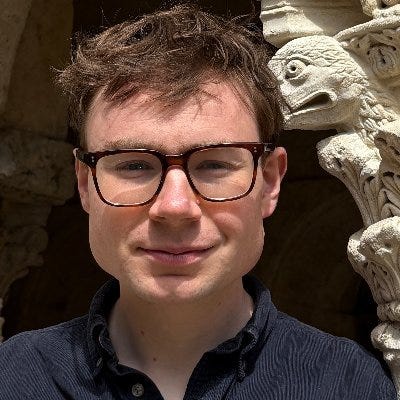
I know what you’ve been thinking: it’s been too long since the last Ruffian pod! Well, it’s back. Earlier this week I sat down with returning guest James Marriott, of The Times, to talk about our year in reading. I published my Top Ten reads of 2025 a few weeks back. You can read James’s list on his excellent Substack, Cultural Capital.James is currently hard at work on a book about the decline of literacy so doing this pod was a welcome break from, er, writing and reading.This is Part I of a two-part conversation. Part II, which will be for paid subscribers only, arrives tomorrow. In that one, we talk about some of the books we didn’t like and discuss what kinds of thing stop us from reading a book.I hope you’ll get some last-minute present ideas here. Enjoy! This is a public episode. If you'd like to discuss this with other subscribers or get access to bonus episodes, visit www.ian-leslie.com/subscribe

Comments

Download from Google Play

Download from App Store
 United States