


 Claim Ownership
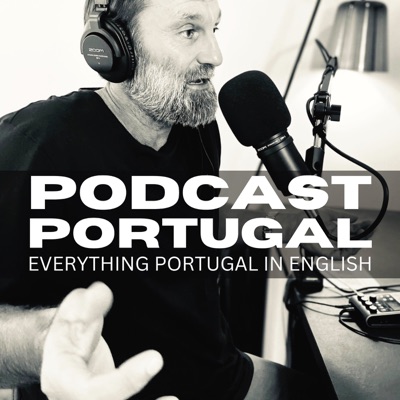
PODCAST PORTUGAL
Subscribed: 13Played: 168
Subscribe

© PODCAST PORTUGAL
Description
A weekly podcast in English about Portugal´s culture, history and daily life with various guests. Living in Portugal, moving to Portugal or visiting Portugal? Podcast Portugal is your essential resource for everything Portugal in English.
98 Episodes
Reverse

António Arnaut of Lycamobile Portugal explains how Simzy travel eSIMs work, how to set one up and how to avoid roaming charges, on Podcast Portugal.Queuing for a SIM card at arrivals, or coming home to an unexpected roaming bill, used to be part of travelling. Whether you are flying home to see family, exploring Europe or travelling for work, staying connected abroad is now far simpler.In this episode, Justin West sits down with António Arnaut, Country Manager of Lycamobile in Portugal, to talk about Simzy, the travel eSIM brand powered by Lycamobile. António explains what an eSIM is, how Simzy’s short-term travel plans differ from Lycamobile’s everyday mobile services, and why it was built for people who want to avoid airport queues and keep their travel data costs under control.They discuss the choice between single-destination plans and regional passes that cover several countries, and between data-only plans and plans that include calls and texts. António explains why your home number stays available for calls and bank verification texts, and why it is still worth checking your own operator’s roaming charges. He also points out that many Portuguese mobile plans already include EU roaming, so a separate travel plan is not always necessary.For first-time users, António walks through the setup step by step: check that your phone supports eSIM and is not locked to a network, choose a plan and confirm the countries it covers, install it on Wi-Fi before you leave, and on arrival switch on data roaming for the Simzy line while turning it off on your home SIM. Simzy is available at simzy.com and in the Simzy app.Along the way, Justin and António reflect on how technology can make travel easier without replacing the human connections that matter most.Podcast Portugal listeners get 25% off any Simzy eSIM with promo code FESTIVE25. Choose your plan and use the code at checkout:Find your Simzy travel eSIM: https://www.simzy.com/?utm_source=podcastportugal&utm_medium=podcast&utm_campaign=pt_podcast_antonio_2026Promo code for 25% off: FESTIVE25

Why you feel stuck learning a language: Dr Esther Gutierrez Eugenio on the neuroscience of fluency, freezing when speaking and how adults really learn.Plenty of intelligent, successful adults have studied a language for years and still freeze halfway through a sentence. In this episode, Justin West sits down with Dr Esther Gutierrez Eugenio, the Switzerland-based language education expert behind Dr Languages. Esther holds a PhD in Language Education, has worked at the United Nations, Procter & Gamble and the University of Cambridge, and trained as a translator and conference interpreter. She has studied nine languages, yet she describes herself not as a natural talent but as a struggling learner who spent twenty years working out what actually works.Esther recalls speaking late in Spanish, her mother tongue, struggling to read at school and being laughed at when reading aloud, experiences that became the emotional fuel for a career at the meeting point of neuroscience and language learning. Her conclusion is simple but demanding: progress comes from doing the right things for long enough, and persistence is the hardest part. Today she combines coaching with largely free online education, aiming to reach some of the world’s estimated 1.5 billion language learners rather than a handful of private clients.Why do some northern European countries speak such strong English? Esther argues that education is only part of the story: everyday exposure, subtitled television, travel and genuine necessity matter just as much, while teaching that stops at vocabulary and grammar leaves learners without enough listening and speaking practice. They also explore why native English speakers have little incentive to learn other languages, and how English as a lingua franca runs on shared meaning rather than native-speaker rules, something Esther learnt first-hand at the UN in Switzerland.At the heart of the conversation is The Fluency Diagnosis, Esther’s Substack and second book in progress, which examines around 100 reasons learners get stuck and separates root causes from symptoms such as freezing when speaking, or following a podcast but not an everyday conversation. She explains why founders, lawyers, doctors and professors often find language learning unusually painful: they expect rapid results and are used to sounding articulate, so the gap between their native and foreign-language selves magnifies every mistake. Realistic expectations, and accepting simpler communication for a while, can unlock real progress.Justin, who has lived in Portugal for fifteen years and still finds Portuguese a struggle, describes how his concentration fades mid-conversation and how school French surfaces without warning. Esther explains why reflecting on how you have learnt anything before is the highest-return activity a learner can do, and why listening difficulties are skills to develop, not permanent limits. They also discuss handwriting versus typing, AI, brain plasticity and why gesture matters more than perfection, and agree to record a follow-up using Justin’s Portuguese as a live case study.Esther is sharing her new book freely, chapter by chapter, as she writes it, and welcomes feedback from learners. Discover why you feel stuck and how to turn effort into fluency:Watch free videos and courses from Dr Languages on YouTube: https://www.youtube.com/@dr_languages Read The Fluency Diagnosis on Substack: https://thefluencydiagnosis.substack.com/ Podcast Portugal only recommends services Justin uses himself.Open a Revolut Business account and get your first month without subscription fees.Join over 80 million people who use Revolut for everyday banking.Podcast Portugal records from the Alentejo, connected by Starlink.

Learn to speak Portuguese in Portugal: Speak Daily founder Mika Naidoo on live daily conversation classes, training your ear and the language of integration.Plenty of people living in Portugal can read a menu, a contract or a letter from the Finanças, yet freeze the moment someone speaks to them. In this episode, Justin West sits down with Mika Naidoo, founder of Lisbon-based Speak Daily, a live language-learning platform built on one simple idea: the fastest way to speak a language is to speak it, every day. Mika brings more than twelve years of experience launching brands, products and campaigns to the venture, which launched just three months ago with three languages already live.Mika explains how Speak Daily grew out of her own life in Lisbon. Having moved from South Africa and produced an acrobatic theatre show in the city, she wanted to build something genuinely useful to the community around her: a place where foreigners could practise languages together. She is also a student on the platform herself.Justin, a visual and kinaesthetic learner who learnt to read Portuguese long before he could speak it, shares his struggle to distinguish European Portuguese words and recall them in real time. Mika describes how Speak Daily classes run on Zoom with fresh, screen-shared visual material each session: a pronunciation warm-up, a new rule or verb drilled through its forms, and then most of the class spent putting it into conversation. There is no homework, but for extra listening practice she recommends playing songs on Spotify while reading the lyrics.The conversation turns to confidence. Mika explains why mixed-ability groups help hesitant beginners take risks, make mistakes and speak up, and why making the effort in Portuguese, long before reaching professional fluency, shows respect, builds goodwill and opens doors to friendships and business. From the vet to an unexpected delivery call, and Justin’s own battles with tax and administrative vocabulary, they explore the everyday moments where conversation practice pays off, as well as how personality, humour, gesture and facial expression carry across languages, something Mika also works on when coaching fluent, non-native English-speaking professionals.Drawing on her marketing career, Mika is candid about starting again in Europe without the network she had built in South Africa, and how she has stood out in competitive markets with distinctive offerings, from a family-friendly fairy-tale aerial show at Christmas to an affordable daily speaking service that complements tutors and grammar courses. She shares practical advice for founders on a limited budget: strong, conversion-focused creative with broad targeting for paid Meta advertising; useful, saveable and shareable reels with search keywords for organic social media; and, above all, authentic community relationships and partnerships, which count for a great deal in Portugal.Speak Daily classes run Monday to Friday, and learners of any level can drop in without booking a specific class. Start speaking the language you are learning:Join a live class at Speak Daily: https://www.speakdaily.co

Podcast Portugal meets Ángel Monzón, founder of KAIS FC, building a football club from scratch in Lisbon and filming every step from Portugal’s seventh tier.Most people who dream of owning a football club never act on it. Ángel did. Originally from Madrid, he built his career in strategy consulting and investment banking before becoming chief of staff at a fast-growing startup that went on to a successful exit. While working in Dubai, he began researching opportunities across sport, media and consumer brands, and KAIS FC emerged from that search: a club reverse-engineered from a storytelling product, rather than a storytelling product bolted on to a club. The name, he explains, is loosely inspired by the Lisbon coast and chosen for its short, international sound.At the heart of KAIS is the KAIS Story Series, a professionally produced, English-language weekly film of around twenty minutes documenting the creation of the club with complete transparency: the finances, the mistakes, the trials and the difficult conversations. Justin and Ángel discuss why human stories can drive deeper engagement than the match itself, drawing on Drive to Survive and Wrexham, and why recurring behind-the-scenes content gives sponsors far more to work with than a shirt or a hoarding.Ángel explains why he chose Portugal over his native Spain. A new club in Lisbon enters at the seventh tier, compared with as low as the twelfth in Spain, making the route to the top flight considerably shorter. Lisbon’s growing international community, drawn by the city’s startup scene and quality of life, also offers a ready-made local audience for matches, events and community building.The conversation covers the club’s €750,000 Founding Owners round, around two-thirds of which is already secured, and Ángel’s plan to bring Portuguese professional footballers nearing or entering retirement on board as equity-owning, hands-on partners rather than paid endorsers. Justin, who is pursuing a similar athlete-ownership model with the Wave Pool Surf League, shares his perspective on the challenges athletes face after their careers end, while Ángel is candid that a venture like KAIS is high risk and should only ever form a small part of a diversified portfolio.Looking ahead, KAIS plans to enter the seventh tier in the 2027–28 season with a squad of fourth- and fifth-tier ability, with the first videos arriving in January 2027 and player trials and recruitment forming a central storyline before the first match in September. Ángel also outlines plans to lease a small, modern ground for the opening seasons, with a longer-term vision of an academy and a purpose-built stadium that doubles as an entertainment venue. The ambition is the Primeira Liga within ten years, with the 2042 Champions League as the club’s North Star, powered by a scalable media business, data-driven recruitment and professional management in the mould of Brighton, Brentford and Bournemouth.Podcast Portugal is proud to be an official fan of KAIS FC, and one of the very first. Follow the journey from the beginning:Watch Episode 0 and subscribe on YouTube: https://www.youtube.com/@kaisfcRead the weekly KAIS FC newsletter: https://kaisfc.substack.com/Follow Ángel’s daily updates on LinkedIn: https://www.linkedin.com/in/angelmonzonmorales/Visit the club and apply to become a Founding Owner: https://kaisfc.com

Solar panels and batteries in Portugal: Solviva founder John Wallace explains system sizing, registration, EV charging and how to cut your electricity bills.With 260 to 300 days of sunshine a year and electricity prices that keep climbing, Portugal is one of Europe’s most compelling places to go solar. Yet many homeowners and businesses end up with systems that are poorly sized, unregistered or impossible to upgrade. In this episode, Justin West sits down with John Wallace, founder of Solviva, who brought his experience from South Africa’s solar industry to Portugal to make the process simpler, more transparent and properly supported.Justin shares his own frustrating experience with one of Portugal’s major energy providers: an oversized system, no backup capability during grid outages, delays with legal registration and a customer service line that offered few answers. John explains why generic “package” solutions so often fall short, and why every installation should begin with a careful analysis of current and future energy needs.The conversation covers the essentials every property owner should understand before signing a contract: why systems above 700W must be registered by the installer, and why payment should be held back until that is complete; how correct sizing maximises self-consumption rather than exporting surplus energy for little return; the importance of choosing a hybrid inverter so batteries can be added later; and how bi-hourly tariffs can be used to charge batteries overnight at lower cost.Looking ahead, John explores the arrival of vehicle-to-home and vehicle-to-grid technology, expected within the next two to three years, which will allow electric vehicles to act as home batteries. He also discusses the realities of going fully off-grid versus staying grid-tied, the role and limits of AI in solar planning, and why experienced human advice still makes the difference.With well-designed systems typically paying for themselves within three to six years, and some clients reducing their electricity bills by more than 80 per cent, this episode is an essential listen for anyone considering solar, batteries or an EV charger in Portugal.To arrange a personalised solar consultation with John Wallace, visit www.solviva.biz, where you can complete the energy needs questionnaire or book a meeting directly.

Comments

Download from Google Play

Download from App Store
 United States