


 Claim Ownership
Emotional Damages: Practical Insights into Forensic Psychiatry for Litigating Attorneys
Subscribed: 5Played: 5
Subscribe

© 2024 fpamed
Description
In Emotional Damages, host and forensic expert Dr. Mark Levy sits down with forensic colleagues, shedding light on their journeys and experiences. Through this podcast, he aims to demystify forensic psychiatry and share practical insights that can aid attorneys in their engagement with forensic experts.
19 Episodes
Reverse
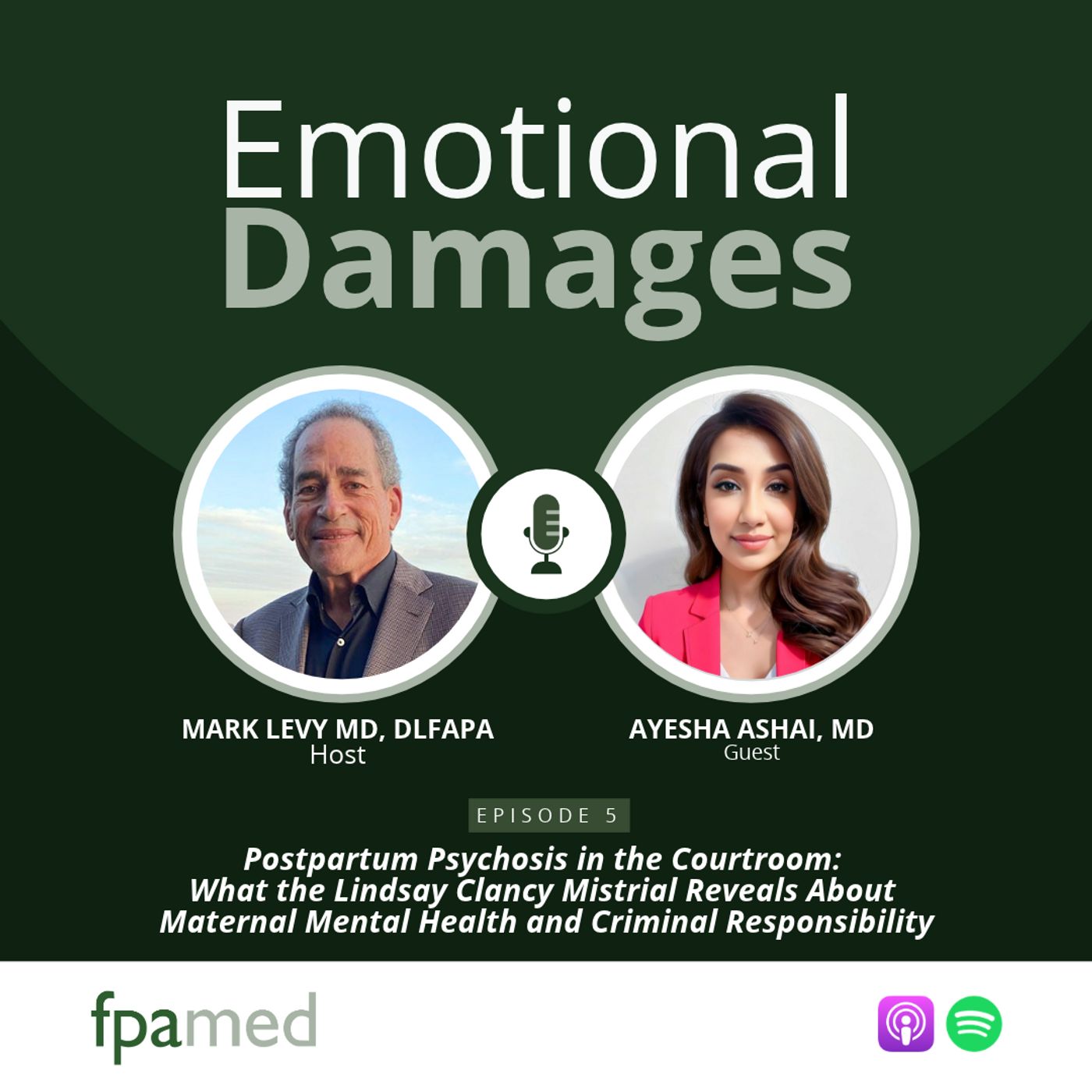
In this episode of Emotional Damages, Dr. Mark Levy sits down with Dr. Ayesha Ashai, forensic psychiatrist and fpamed member, to examine one of the most widely discussed criminal cases at the intersection of maternal mental health and the law. The trial of Lindsay Clancy, the Massachusetts mother charged with the first-degree murder of her three children has become an international news story. Ms Clancy’s defense presented a case of severe postpartum psychosis, resulting in a mistrial after a deadlocked jury could not reach a unanimous verdict due to one holdout juror.Dr. Ashai — who has conducted filicide evaluations and not-guilty-by-reason-of-insanity (NGRI) assessments throughout her career — walks through the competing expert opinions of Dr. Philip Resnick and Dr. Abram Mack, the pivotal role that a potential bipolar disorder diagnosis played in both the criminal trial and the parallel civil malpractice lawsuit against Ms. Clancy’s treating providers, the DSM-5-TR’s contested four-week definition of the postpartum period, and what attorneys handling similar cases need to know about forensic psychiatric evaluation, polypharmacy, altruistic filicide, and building an NGRI defense.
Have a topic you would like covered on the pod? 📧 Email us: [email protected]🔗 Connect with fpamed: 🌐 Visit our website.👋 Follow us on LinkedIn.
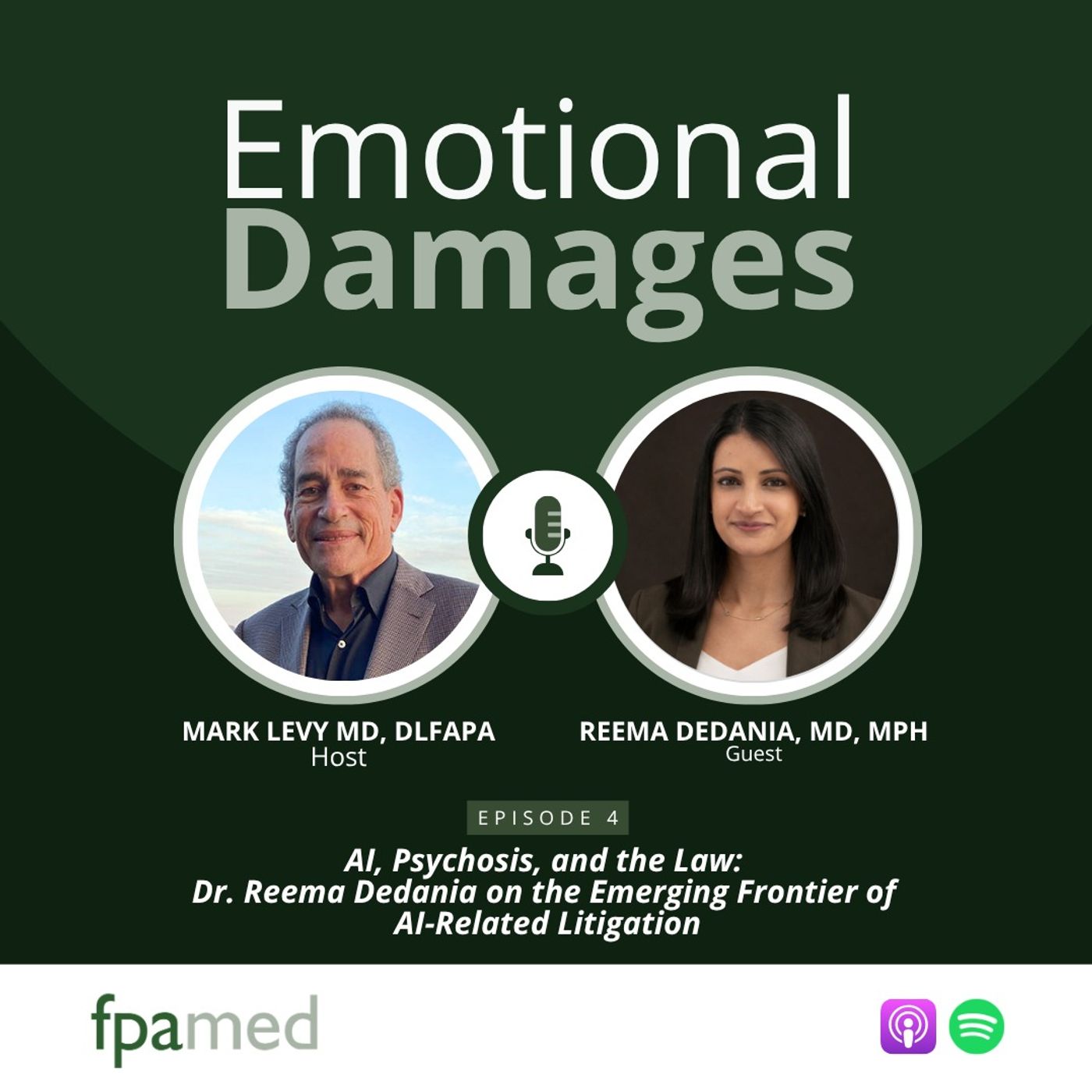
In this episode of Emotional Damages, Dr. Mark Levy speaks with Dr. Reema Dedania, forensic psychiatrist, assistant professor of psychiatry at Emory University School of Medicine, and associate training director of Emory's forensic psychiatry fellowship — where she also serves as medical director of a jail-based competency restoration unit at Fulton County Jail.Dr. Dedania explains how large language models — by design pattern-matching, connection-making, and sycophantic — can mirror and amplify the very cognitive distortions that define psychosis, giving rise to the emerging phenomenon of AI-associated psychosis. She describes the "paranoid echo chamber" that AI creates for vulnerable users, walks through the two major categories of AI-related litigation already appearing in courts (suicide and product liability cases), and offers concrete guidance to attorneys on how to approach these cases: accounting for preexisting psychiatric vulnerability, reading chat logs as collateral rather than literal evidence, and understanding causation as a spectrum rather than a simple cause-and-effect chain.She also shares findings from her own firsthand experiment engaging a chatbot as a paranoid patient — and what the bot's response revealed about the limits of current AI safeguards.
Have a topic you would like covered on the pod? 📧 Email us: [email protected]🔗 Connect with fpamed: 🌐 Visit our website.👋 Follow us on LinkedIn.
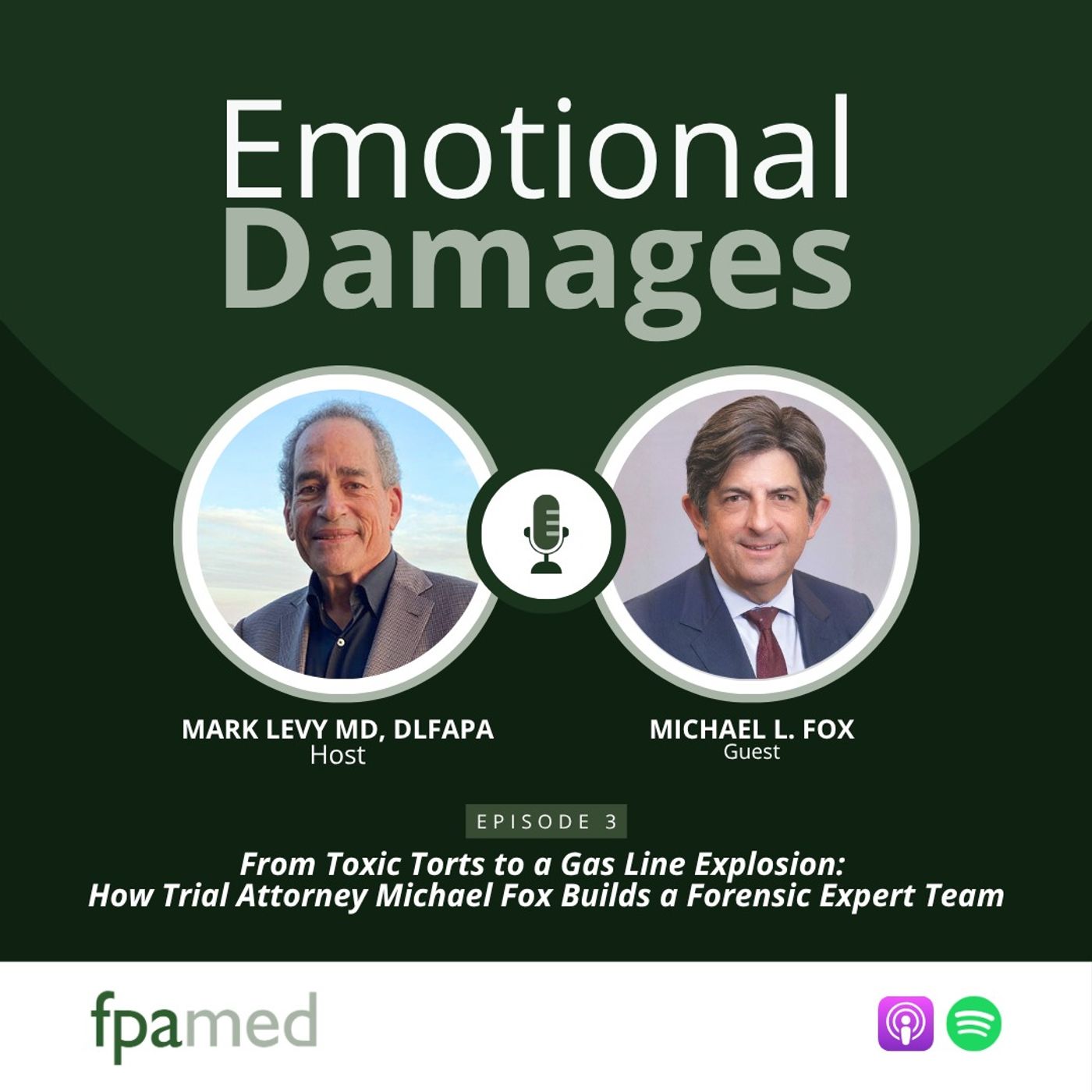
In this episode of Emotional Damages, Dr. Mark Levy speaks with Michael L. Fox, managing partner of Duane Morris' San Francisco office and co-chair of the firm's Products Liability and Toxic Torts Division, whose three-decade career spans toxic tort litigation, mass disaster cases, and complex commercial disputes. Fox traces his path from a Wharton finance student diverted by a legal history course into a litigator who built his practice around the "hourglass" theory of career development — starting broad, specializing deeply, then broadening again as expertise compounds. He and Levy revisit the multi-plaintiff gas line explosion case that first brought them together, using it to unpack how forensic psychiatric experts help separate genuine psychiatric injury from "copycat" or "echo chamber" claims, why the eggshell plaintiff rule makes individual vulnerability assessment essential, and how a bell curve of injury severity (rather than a "barbell" of only the most extreme verdicts) should inform case valuation and settlement strategy. Fox also explains why he deliberately seeks forensically trained experts over treating clinicians, offers concrete advice for expert witnesses on avoiding "canned" testimony, and shares his read on the next wave of mass litigation: digital harm and social media addiction claims among adolescents, and whether the underlying psychiatric science is developed enough to survive Daubert scrutiny.
Have a topic you would like covered on the pod? 📧 Email us: [email protected]🔗 Connect with fpamed: 🌐 Visit our website.👋 Follow us on LinkedIn.

In this episode of Emotional Damages, Dr. Mark Levy speaks with Dr. Charles Scott—triple‑board‑certified in adult, child & adolescent, and forensic psychiatry; past president of AAPL; creator of the UC Davis forensic psychiatry fellowship; and a leading educator and expert in high‑profile cases, including the Parkland school shooter sentencing. Dr. Scott discusses how he trains fellows to think like forensic “psychopathologists,” marshal evidence, integrate structured psychological and malingering tests, and build opinions that withstand cross‑examination in insanity, competency, brain injury, and child trauma cases. He also shares lessons from serving on a criminal jury himself, his ethical reasoning in capital cases, and practical guidance for attorneys on what records and data they should always obtain.
Have a topic you would like covered on the pod? 📧 Email us: [email protected]🔗 Connect with fpamed: 🌐 Visit our website.👋 Follow us on LinkedIn.

In the Season 2 premiere of Emotional Damages, host Dr. Mark Levy speaks with Dr. Joy Stankowski, a dual-trained internal medicine and psychiatry forensic psychiatrist with over 20 years of experience, more than 1,000 evaluations, and deep expertise in hospital systems and standards of care. Dr. Stankowski explains how her medical-psychiatric background informs high-stakes criminal and emotional damages evaluations, why experts must approach records with an open mind, and communicate early and candidly with counsel when opinions diverge from case theories. She also discusses her work as a federal surveyor for CMS and offers attorneys a practical roadmap for collaborating with forensic experts, organizing records, and analyzing system-level problems in standard of care litigation.
Have a topic you would like covered on the pod? 📧 Email us: [email protected]🔗 Connect with fpamed: 🌐 Visit our website.👋 Follow us on LinkedIn.

Comments

Download from Google Play

Download from App Store
 United States