


 Claim Ownership
Energy Thinks with Tisha Schuller
Subscribed: 9Played: 76
Subscribe

© Tisha Schuller
Description
Conversations with thought leaders in and around the oil and gas industry with a focus on ESG, anti-ESG, the energy future, stakeholder engagement, and translating sustainability aspiration into action.
For inquiries regarding the podcast, reach out to Lindsey Slaughter [email protected].
For inquiries regarding the podcast, reach out to Lindsey Slaughter [email protected].
146 Episodes
Reverse

Today, the Arc of Outrage series returns to the forgotten stakeholder in energy infrastructure projects: the future. Evoking the future offers your best bridge to solutions with today’s skeptical communities.What you’ll get in this solo episode of Energy ThinksI have put a lot of Arc of Outrage content out there—from all the ways everything we do is making it worse to why we need to bring the future into the room. You have plenty to work on, and you do not need me to repeat it.But one idea keeps getting stated as fact without being translated into action: the asymmetry of communities’ perceived drawbacks versus perceived benefits from data center development.Communities feel they are being asked to take on the risks and downside of an unknown future—AI, data centers, and the infrastructure buildout around them—while nameless, faceless others receive the benefits. In this episode, I think out loud about what that means for project proponents—and the question we all need to ask: Would I accept this project where I live and raise my family?The company is taking financial and execution risk. But that is not the risk a host community sees. If we are not building communities that kids want to come home to, we are missing the whole opportunity of this endeavor.Both of these things are true:* We need communities to host the infrastructure our future requires.* Those communities experience the concentrated impacts while others receive the broader benefits.From the episode: Before you ask a community to say yesUnderstand the risk you are asking them to take. “Communities feel like they’re taking on all the risks of this unknown future—a future with AI and with data centers and with a bunch of buildouts—and you’re asking them to just take your word for it that it’s going to be better.”Apply the family test. “What are we asking of this community, and would I accept it in my own? Where I live? Where I’m raising my family?”Build something worth saying yes to. “We’re going to have to build a sh*t-ton of stuff, and we’re going to have to build it well. That means bringing a tangible value proposition: jobs, resources, engagement, and a real role in shaping the future the project enables.”A short break—and what’s nextThis will be my last episode for a month as I make room for family responsibilities that need my attention. When I return, I’ll be updating you here monthly on the Arc of Outrage—with a focus on where we are on the Arc, what we are learning, and the nuances emerging from work with my clients.This fall, I’ll also turn this newsletter’s content toward a decade-long passion of mine: energy for development. I want to connect the infrastructure challenges unfolding here at home with the global imperative to give 8 billion people the opportunity to move up the prosperity ladder. The same challenge is at issue: building the energy, industrial, and digital infrastructure that makes a better future possible—and building it well.Bonus content for this episodeMy latest book: The Myth and The MomentMore from my recent Arc of Outrage series:* “The Arc of Outrage Has Come for Data Centers”* “Stop Calling It Data Center Misinformation”* “We Are Nowhere Near Peak Data Center Outrage”* “The Data Center Arc Isn’t Fracking. It’s Worse.”* “The Future Has the Right of Way”* “Everything We Do Is Making it Worse”* “Arc of Outrage: Bring the Future into the Room”Recent podcasts:* “The Ride You Can’t Get Off”* “Persuasion Won’t Shorten the Arc of Outrage” with Lee Beck* “Boardwalk’s Scott Hallam on Lessons from a Past Arc of Outrage”* “The Cost of a No-Build Future”* “Arc of Outrage: Who Speaks for the Future?”* “The Arc of Outrage: Why YIMBY + FOMO Is Your New Formula”Watch on YouTube or listen on Substack.→ Need support navigating the Arc of Outrage? Reach out to schedule a briefing.→ If this episode resonated with you, please review Energy Thinks wherever you listen.→ New here? Subscribe here to receive Both of These Things are True each week.Heart the forgotten stakeholder below!Until we build again,Tisha Get full access to Both of These Things Are True at tishaschuller.substack.com/subscribe

What you’ll get in this episode of Energy ThinksHumans across history have built networks that provide water, energy, food, transportation, and information—the infrastructure that makes modern life possible! Jim Connaughton, an energy, environment, and technology expert (and the former chair of the White House Council on Environmental Quality under George W. Bush), believes we are at the beginning of the next one: an Arc of Enrichment.In the last two installments of the Arc of Outrage series, I argued that the future needs a voice in today’s infrastructure decisions—and offered four questions that can bring the future into the room. But what happens when a community still does not want the future your project would help build?Jim Connaughton’s answer is blunt: Go where the future is wanted.Start with communities prepared to say yes, build there well, and let everyone else see what follows. Not every “no” can—or should—be converted into a “yes.” Jim’s provocation is that leaders should stop spending so much of their time and treasure trying to win over communities locked into opposition. Instead, he says, seek out the places that are prepared to build.In this episode, I speak to Jim about how we can take advantage of the promise of the Arc of Enrichment amid the growing data center outrage. We discuss his case for sweeping permitting reform and his wonderfully memorable formula for getting infrastructure built: YIMBY + FOMO. Listen in to get his optimistic take (and find out why he thinks “FOMO is a really, really powerful force”).Why Jim Connaughton?Jim is the visionary grounded in pragmatic experience whom I’ve been looking for. He has spent his career at the intersection of energy, technology, innovation, policy, and law. He can geek out on the realities of policy and legal frameworks while still articulating a positive, compelling vision for AI, data centers, and the infrastructure that makes our modern lives possible.Some of Jim’s insightsOn what happens during the Arc of Outrage: “Once you’re in the Arc of Outrage and the community is locked into a NIMBY mode, there isn’t a path. My view is: Pick up your bag and get out fast. The community is just not ready, and that’s okay.” On starting with communities that want development: “The only process that actually works is starting with a YIMBY community—starting with a ‘Yes, in my backyard’ community. If you start with a ‘Yes, in my backyard” community, they’re already solving for the natural concerns that come up about this infrastructure.”On building the foundation for a 21st-century future: “What’s coming in the next 20 years is super exciting, but for that to work, it has to sit on top of a 20th-century infrastructure that can make it happen. We cannot enjoy our 21st-century future of a lot more for a lot less unless we build the 20th-century infrastructure that makes it happen.”Bonus contentMore about Jim: James L. Connaughton is an energy, environment, and technology expert with experience spanning the White House and public and private sectors. He served as chairman of the White House Council on Environmental Quality from 2001 to 2009, advising President George W. Bush on energy, environmental, natural resource, and climate policy. He has since held senior leadership roles across the energy and technology sectors and currently serves as CEO of JLC Strategies and a senior advisor to Nautilus Data Technologies.Order your copy of The Myth and The Moment: From Polarization to Progress in the New Energy Landscape.Watch the episode on YouTube or listen to the podcast on Substack.More from my recent Arc of Outrage series:* “The Arc of Outrage Has Come for Data Centers”* “Stop Calling It Data Center Misinformation”* “We Are Nowhere Near Peak Data Center Outrage”* “The Data Center Arc Isn’t Fracking. It’s Worse.”* “The Future Has the Right of Way”* “Everything We Do Is Making It Worse”* “Arc of Outrage: Bring the Future into the Room”Recent podcasts:* “The Ride You Can’t Get Off”* “Persuasion Won’t Shorten the Arc of Outrage” with Lee Beck* “Boardwalk’s Scott Hallam on Lessons from a Past Arc of Outrage”* “The Cost of a No-Build Future”* “Arc of Outrage: Who Speaks for the Future?”What to do next in The Moment* Read The Myth and The Moment? Share your thoughts with a review—it helps others discover the book.* Forward this newsletter to an infrastructure leader navigating their own NIMBYs, YIMBYs, and BANANAs.* Need to prepare your organization for the Arc of Outrage? Reach out to schedule a leadership briefing.* If Jim’s vision resonated with you, heart this post and share it with someone building what comes next!To a little healthy FOMO,Tisha Get full access to Both of These Things Are True at tishaschuller.substack.com/subscribe
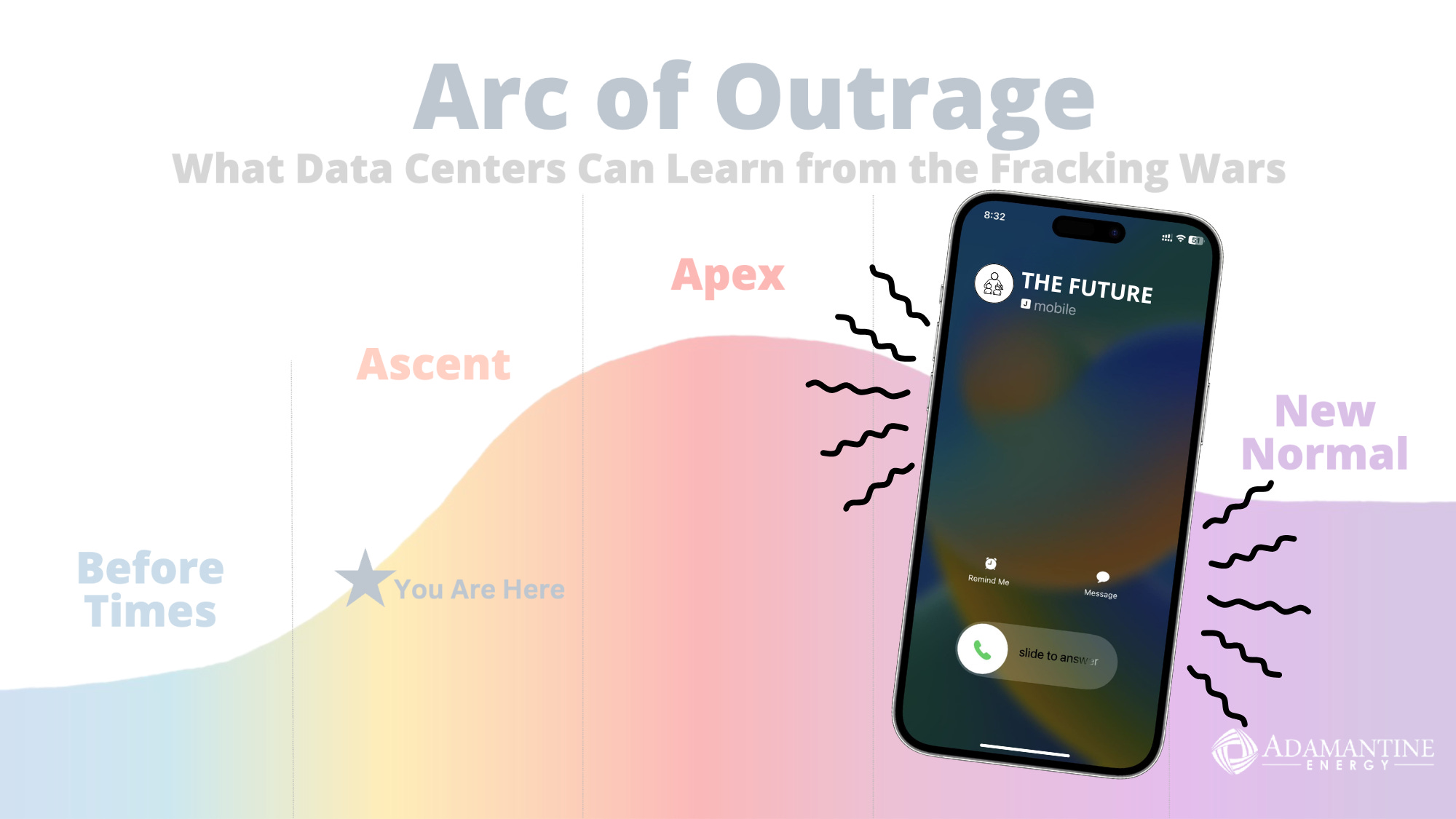
Today, the Arc of Outrage series turns to the forgotten stakeholder in energy infrastructure projects: the future. Evoking the future offers your best bridge to solutions with today’s skeptical communities.What you’ll get in this solo episode of Energy ThinksYour next infrastructure project has a stakeholder who will never attend a public hearing: the future.I have argued that the future has the right of way—and that choosing not to build carries costs of its own. In this episode, I take on a difficult, practical question: How do you represent the future in your engagement with communities without simply invoking it as just another argument for your project?This practical decision—how to invoke the future—matters because the right answer represents the best hope you have to dampen the Arc of Outrage and get to yes with communities. Listen to the episode to learn how.Both of these things are true:* Communities are demanding agency over what gets built around them.* The community members in the room today are not necessarily thinking about what future generations require of them.Four questions to ask yourself before you bring a project to a communityWho represents the future? What would make this a community its children will want to come home to?What does a good future include? You are not entitled to a place in a community’s future simply because your project produces something the country needs.When should the future conversation happen? What matters here? What future does this community already imagine? Could this project contribute to it—or what would have to change for it to do so?How do you discuss the cost of not building without making a threat? If the community’s future looks better without this project, this project is not adequately compelling.Bonus content for this episodeMy latest book: The Myth and The MomentMore from my recent Arc of Outrage series:* “The Arc of Outrage Has Come for Data Centers”* “Stop Calling It Data Center Misinformation”* “We Are Nowhere Near Peak Data Center Outrage”* “The Data Center Arc Isn’t Fracking. It’s Worse.”* “The Future Has the Right of Way”* “Everything We Do Is Making it Worse”Recent podcasts:* “The Ride You Can’t Get Off”* “Persuasion Won’t Shorten the Arc of Outrage” with Lee Beck* “Boardwalk’s Scott Hallam on Lessons from a Past Arc of Outrage”* “The Cost of a No-Build Future”Watch on YouTube or listen on Substack.Get started!→ Need support navigating the Arc of Outrage? Reach out to schedule a briefing.→ If this episode resonated with you, please review Energy Thinks wherever you listen.→ New here? Subscribe here to receive Both of These Things are True each week.Heart the forgotten stakeholder below!To the future,Tisha Get full access to Both of These Things Are True at tishaschuller.substack.com/subscribe

Today, the Arc of Outrage series asks the uncomfortable question: If we demand that energy infrastructure proponents account for the future that they would build, shouldn’t energy infrastructure opponents also account for the future that would result from not building?What you’ll get in this solo episode of Energy ThinksWhen it comes to energy and the future, there is no do-nothing option. Doing nothing is, in fact, doing something—and that something needs to be called out.It’s nonnegotiable: The future has the right of way. So no, energy infrastructure companies cannot impose their preferred future on communities. But neither can communities and opponents pretend that stopping energy infrastructure projects preserves the status quo.Choosing not to build also chooses a future—with costs and trade-offs. Without building, today’s status quo becomes tomorrow’s stagnation. The more I work through this series, the more convinced I am that all parties are often forgetting our most important stakeholder: the future.If we’re serious about building the systems of the future, we must engage communities in shaping the future they want to create.Both of these things are true:* Project proponents must answer: What future are you asking this community to accept?* Project opponents must answer: What future are you creating for your community if this project does not happen?Today’s outrage is understandable—and predicted by the Arc of Outrage. However, as energy infrastructure leaders, we must expect more of our civic leaders and elected officials than outrage served up in the forms of moratoria and projects denied. A responsible “no” must be paired with a feasible alternative and an honest accounting of its consequences.A few key ideas from the episodeOn what the future requires: “The future as a stakeholder is what is going to happen where I live. It means my kids want to come home ... That future requires environmental stewardship. It requires economic stewardship. And it absolutely demands a certain amount of opportunity and growth.”The alternative to “no”: “Be thinking about the future as a stakeholder. Engage with your communities in a way that helps facilitate a conversation about what they want to create, and then be willing to change your project. Ultimately, it’s going to be community leaders that have to defend your project, and so it’s going to have to be awesome!”Bonus content for this episodeMy latest book: The Myth and The MomentMore from my recent Arc of Outrage series:* The Arc of Outrage Has Come for Data Centers* Stop Calling It Data Center Misinformation* We Are Nowhere Near Peak Data Center Outrage* The Data Center Arc Isn’t Fracking. It’s Worse.Recent podcasts:* “Persuasion Won’t Shorten the Arc of Outrage” with Lee Beck* “The Ride You Can’t Get Off”* “Boardwalk’s Scott Hallam on Lessons from a Past Arc of Outrage”Watch on YouTube or listen on Substack.What to do next in The Moment* Need help navigating the Arc of Outrage? Reach out to request a briefing.* If you enjoyed this episode, I’d appreciate it if you took a moment to leave Energy Thinks a five-star rating wherever you listen to podcasts.* And if this newsletter was forwarded to you, subscribe here.Create the future: Hit the heart button below!The future has the right of way. See you there,Tisha Get full access to Both of These Things Are True at tishaschuller.substack.com/subscribe

What you’ll get in this episode of Energy ThinksThe future requires massive infrastructure build-out. But communities have made it clear: They will not accept infrastructure that feels imposed.That tension in a nutshell—aka Both of These Things Are True:* We need to build.* People need agency over what gets built around them.You know I’ve been writing about the Arc of Outrage: the predictable cycle of public opposition that comes for major infrastructure projects. Right now, the Arc is rising around data centers. But data centers are not the only infrastructure at issue; all infrastructure is entering a new era of scrutiny.Earlier arcs teach us this crucial lesson: We can’t avoid the outrage, but we can move through the cycle without making it worse. Key insight: Outrage gets enflamed when people believe that decisions have already been made and the public process is performative.You will encounter outrage. How will you lead through it?That’s why you should listen to Scott Hallam, president and CEO of Boardwalk Pipelines, on this episode of Energy Thinks. Scott talks about what the pipeline industry learned from its own, earlier Arc of Outrage—and how he’s applying those lessons as he leads one of the companies building the energy future.Why Scott Hallam?Because Scott and Boardwalk are working on one of the most important questions in energy right now: How do you build for a generational increase in demand while earning public confidence in a moment of skyrocketing skepticism?Boardwalk’s Borealis Project is designed to expand access to Marcellus and Utica natural gas supplies and deliver more energy to markets across Kentucky, Indiana, Tennessee, Florida, and the regions in between. Scott says this expansion is part of a broader generational opportunity: onshoring, electrification, data centers, power generation, and the need for affordable, accessible, secure energy.But Scott does not separate the market opportunity from the human-centered challenges. He has lived through the pipeline battles; he knows how communities react when they feel ignored, managed, or overrun. And he is clear that the industry is better than it used to be, but not yet as good as it needs to be.As Scott told me, “People want to be part of this process. They don’t want the process to be inflicted upon them.” Communities are not only asking whether a project is safe or economically beneficial. They are asking whether they have any meaningful agency over the future arriving around them.Scott said something else that you—the energy infrastructure leader—must wrestle with: “I don’t think we could go into a community with any degree of authenticity and the belief that it’s going to happen the way that we envision it without change.”This is not a concession; it is a leadership posture—one well suited to softening, shortening, and ultimately surviving the Arc of Outrage.Some of Scott’s insights:On why opposition isn’t—at its heart—political: “When I’m in a community, I don’t feel like it’s a political issue as much as it is a human issue. When I’m in a community and we’re talking about pipeline projects, and we face concern, even opposition, it’s because people care about their families, they care about their communities, they care about their property. They are very engaged, and I see that as a positive sign.”How to build real trust: “There’s never a one-size-fits-all approach. Trust is the key ingredient, and to start with trust, we have to understand what’s important to communities. … We want communities to be just as passionate about our projects as we are.”On the generational opportunity for energy: “We’re in a generational time when it comes to energy and energy infrastructure. … We want to make sure the way we address the market, communities, and landowners matches the moment.”Bonus content!More about Scott: Scott joined Boardwalk in 2023, bringing more than 20 years of experience across the upstream, midstream, and downstream natural gas industry. He also serves on the boards of the Southern Gas Association, the United Way of Greater Houston, and the Santiago Partnership.Watch the episode on YouTube or listen to the podcast on Substack.More from my Arc of Outrage series: “The Data Center Arc Isn’t Fracking. It’s Worse.,” “We Are Nowhere Near Peak Data Center Outrage,” “The Arc of Outrage Has Come for Data Centers” and “Stop Calling It Data Center Misinformation”My recent podcast episodes “Persuasion Won’t Shorten the Arc of Outrage” with Lee Beck, “The Ride You Can’t Get Off,” “What You Don’t Know About Community Buy-In” with Jonathan Smith, and “Jim Kerr on Your Generational Opportunity”Order your copy of The Myth and The Moment: From Polarization to Progress in the New Energy Landscape.What to do next in The Moment* Enjoying The Myth and The Moment? Leave a review to help more leaders find it.* If this email was forwarded to you, please subscribe here.* Forward this newsletter to someone responsible for building infrastructure and therefore navigating public opposition.* Need to prepare your organization for the Arc of Outrage? Reach out to schedule a leadership briefing.Please heart and share this post!To building with communities, not in them,Tisha Get full access to Both of These Things Are True at tishaschuller.substack.com/subscribe

Comments

Download from Google Play

Download from App Store
 United States