



Unscripted SaaS
Subscribed: 0Played: 1
Subscribe

© 2025
Description
I'm interviewing SaaS founders, solopreneurs, developers and marketers who are working with, or for SaaS companies. We're exploring what makes a SaaS tick, business models, pitfalls, hard lessons and huge victories in an unscripted interview format.
8 Episodes
Reverse

When someone asks ChatGPT, Claude, Perplexity, or Gemini "what's the best X?", a few brands get named — and most companies have never checked whether they're one of them. Somya Goyal built Stellarcast to change that: a platform that watches how your brand shows up in AI answers, diagnoses why you're missing, ships the fix, and then proves the needle moved.
After 15+ years in quality engineering — eight of them at Accenture, then leading QA and building validation frameworks for AI systems — Somya is a first-time founder building Stellarcast in the open from India. In this conversation with host Jeremy Rivera, she breaks down why AI citations are a different game from search rankings, why "AI is confidently wrong" about so many brands, and how a continuous monitor-diagnose-execute-prove loop beats the one-time audit.
In this episode
The monitor → diagnose → execute → prove flywheel — and why most tools "stop at the dashboard"
Why citations aren't rankings: AI answers overlap Google's top ten by only ~14%
AEO in plain English — make your brand easy for AI to find, understand, and read
Why "AI is confidently wrong", citing two-year-old pricing and reviews even after fresh data lands
Treating LLM answers as a "liquid surface" — freshness, lag, and query-deserves-freshness in AI
CMS integrations (WordPress, Shopify, Webflow) that turn diagnosed gaps into approved, shipped fixes
Somya's leap from 15+ years in QA to first-time founder — and the exposure of shipping under your own name
Market fit for SMBs and agencies, with the human always in the loop
Chapters
(00:00) Meet Somya Goyal & what Stellarcast does — a "system of AI records"
(02:30) The four-agent loop: monitor, diagnose, execute, prove
(05:45) CMS integrations & building in the open with pilot design partners
(08:10) How the models behave differently — and why citations aren't rankings (~14% overlap)
(12:20) Freshness, lag, and the "liquid surface" of LLM answers
(16:05) AI as your least-trained support rep — the rogue knowledge base
(19:15) Somya's background: fifteen years in QA to first-time founder
(22:40) Market fit: SMBs, agencies, and the human-in-the-loop
(25:30) Early access & pricing
Notable quotes
"Visibility in AI is simple. Make your brand easy for AI to find, understand, and read. That is the new name of AEO, in very simple English."— Somya Goyal"Ranking is different and citation is different. AI citations overlap Google's top-ten links by only fourteen percent."— Somya Goyal"Most brands have never read what AI says about them, and sometimes AI is confidently wrong. It cites data that's maybe two years old — the pricing, the reviews — even after a lot of fresh data."— Somya Goyal
Resources & links
Stellarcast — AI brand-visibility platform (monitor, diagnose, execute, prove)
Somya Goyal on LinkedIn — where she's building in the open
When AI is "confidently wrong" the fix is filling the gaps with human-certified, expert-sourced content
Monitoring your brand's AI footprint and entities is exactly where SEO advisory...
Otter and Fireflies do not fail at African languages. They discard them. Unknown languages get filtered out as noise or approximated to the nearest English word. Tobiloba Sulaimon, a self-taught developer from Lagos, built AuTrans to transcribe Pidgin, Yoruba, Hausa and Igbo as they were actually spoken. It started as a fix for a meeting the tools could not handle.
Key takeaways
The differentiator is what incumbents treat as an edge case. Not accuracy, but a product decision to drop what it does not recognise.
Africa first is a constraint, not a slogan. Limited funding cannot cover many languages at once, so splitting attention means doing none of them well.
Self-taught to shipping in roughly two years. YouTube, a first paid client, then a role where being the only developer forced the pace.
He refuses features users ask for. Explicitly so the product never becomes a jack of all trades.
First version shipped in about a week. The scope was small because the problem was his own.
On this page
The gap the incumbents left open
Africa first, and why it is a constraint
Self-taught from Lagos
Refusing the features people ask for
Chapters and timestamps
People, ideas and sources mentioned
Questions this episode answers
Go deeper
The gap the incumbents left open
Tangible things were said and their machine did not capture that. And I thought that since I am a software developer, maybe I could build something that would solve this problem.— Tobiloba Sulaimon
Mainstream tools filter unrecognised languages out, or map them onto the nearest English word. The output looks like a transcription failure. It is closer to a design choice, and it is the kind of choice a large company can make for years without anyone internally noticing.
That is the general lesson worth taking from this episode even if you never touch transcription. Find the thing your category's incumbents have classified as an acceptable failure.
Africa first, and why it is a constraint
We are African first. We are focusing on ourselves first, so I’m trying to solve this problem within Africa first before we move on.— Tobiloba Sulaimon
This is not positioning. Limited funding cannot cover the continent's language count, so attempting breadth would mean doing all of it badly. The narrowness is what makes the quality possible, and the quality is the entire product.
Self-taught from Lagos
Everything I know today I learnt on my own. I am a self-taught software developer.— Tobiloba Sulaimon
HTML, CSS and JavaScript from YouTube after high school. A first paid client build. Then a front-end role at a game studio where being the only developer meant learning fast or shipping nothing. The first version of AuTrans took about a week.<...

Fifteen years building SaaS across European scale-ups, including the unicorn Brevo, compressed into two words. Malith Gamage bootstrapped Zapdigits, a client-reporting tool for marketing agencies, and his survival advice is not a framework. It is do not die. Stay alive three or four years and you are fine. Everything else in this episode is the operational discipline that makes that possible.
Key takeaways
Survival is the strategy, not a precondition for one. No in-house hires, infrastructure scaled only when needed, and a year of AWS credits used as a cash-flow cushion.
White labelling sits on every plan, not the top tier. Agencies have to look more put-together than a client’s internal marketing team, so branding is the product rather than an upsell.
He ships AI visibility reporting and openly doubts it. Ask the same question five times and get five answers pulled from five places.
Domain authority did not predict who got cited. His own unpromoted, zero-authority domain was the source models pulled from, while the promoted one was not.
A lifetime deal run as a feedback engine. The value was buyers who kept sending feature requests, not the one-off revenue.
On this page
Do not die
Your AI is only as smart as your schema
Shipping a feature he does not fully trust
White labelling, and a lifetime deal as a feedback engine
Chapters and timestamps
People, ideas and sources mentioned
Questions this episode answers
Go deeper
Do not die
Some main advice is don’t die. Like as long as you can stay for like three, four years alive, then you’re good.— Malith Gamage
Unromantic, and more useful than most strategy. The failure mode for a bootstrapped tool is almost never being out-competed on features. It is running out of runway during the years when nothing is visibly working.
So the discipline is structural: no in-house hires, infrastructure scaled only when demand actually arrives, and a year of cloud credits treated as a cash-flow buffer rather than free compute to burn.
Your AI is only as smart as your schema
Your AI is smart as your schema. As long as you give the correct data and the correct description, then you will get good answers back.— Malith Gamage
He draws the parallel to MCP without prompting, and it is the reason he pipes context in before asking anything: pull the Analytics data first, describe it properly, then ask the question. The quality ceiling is set at the data-description step, not at the model.
Shipping a feature he does not fully trust
I don’t even know sometimes if you ask the same question five times you get five different answers they pull out from five different places.— Malith Gamage
Zapdigits aggregates brand visibility across several models and averages it into a score for agency clients. He will t...
Guest Bio
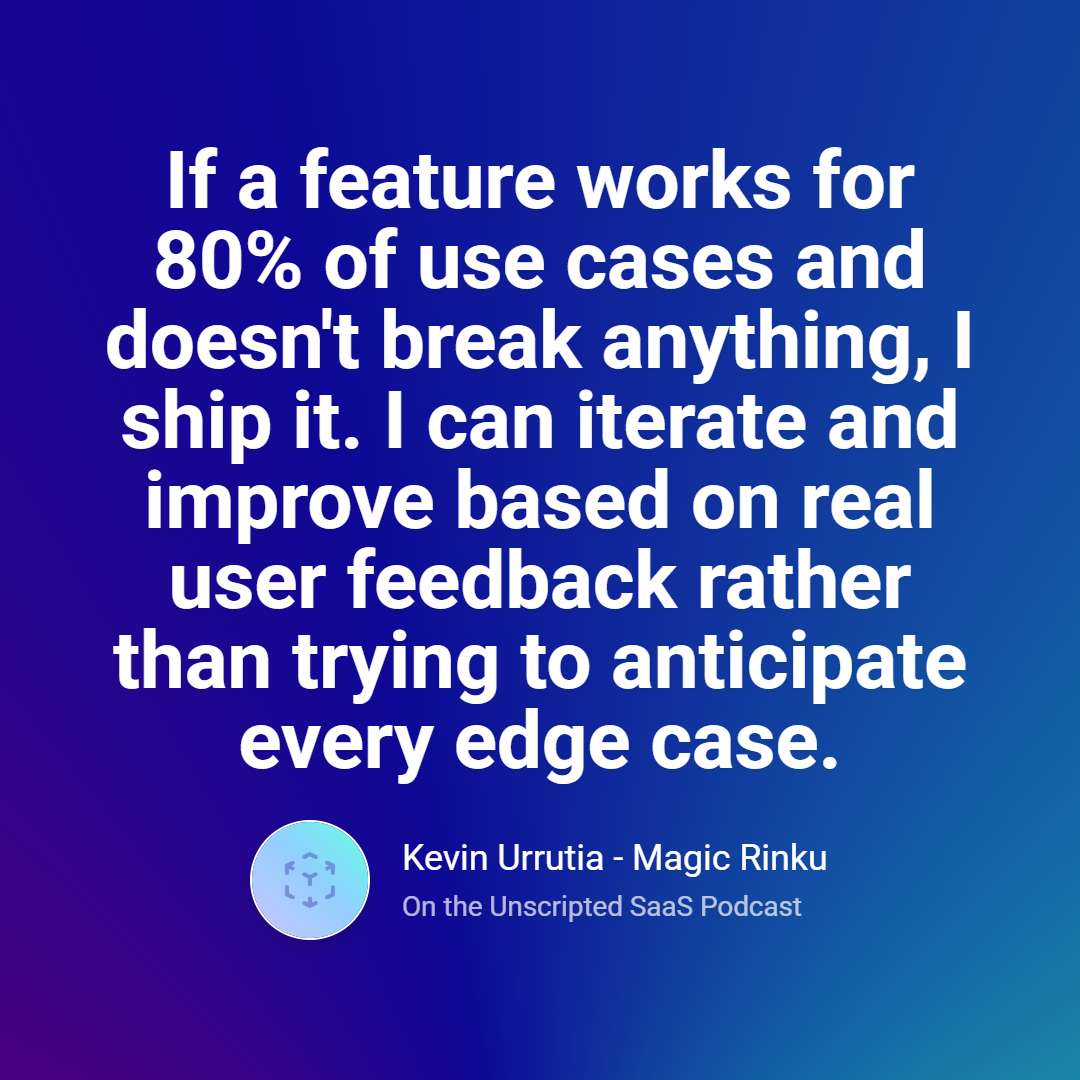
Kevin Urrutia is a software engineer turned serial entrepreneur with 20+ years of experience building tech products. He's worked at Silicon Valley companies including Mint.com and Zaarly, and founded Voy Media, a digital marketing agency that has generated over $50 million in revenue. His latest venture, Magic Rinku, tackles one of SEO's most persistent challenges: automating internal link building at scale.
Connect with Kevin:
Email: [email protected]
Twitter: @danest
Website: Magic Rinku
Episode Summary
In this unscripted conversation, Kevin shares the journey of building Magic Rinku from personal frustration to SaaS solution. We dive deep into the technical challenges of WordPress integration, the strategic use of AI versus traditional algorithms, and unconventional marketing approaches that are actually working in 2025.
Kevin reveals how he discovered 350 out of 400 articles on his own site had zero internal links, the technical nightmare of supporting multiple WordPress page builders, and why cold email and Reddit still outperform traditional SaaS marketing for developer tools.
Key Topics Covered
The Genesis Story
How Kevin's personal pain with internal linking across 8-10 affiliate sites led to Magic Rinku
The validation process through Reddit and direct customer conversations
Why most SEO professionals are missing huge linking opportunities due to broken manual processes
Technical Deep Dive
WordPress ecosystem challenges: Supporting Elementor, Beaver Builder, Gutenberg, and Classic Editor
The 30-second delay problem and why bulk operations are complex in WordPress
Database structure differences across page builders and how they affect plugin development
Error handling and retry systems for WordPress API integration
AI Implementation Philosophy
Strategic use of AI vs. traditional algorithms (RAKE, ENG tagger)
Two specific AI use cases: contextual understanding and smart sentence generation
Why 30% of AI suggestions are perfect, 50% need tweaking, and 20% are unusable
The explainability problem and showing confidence scores to use...
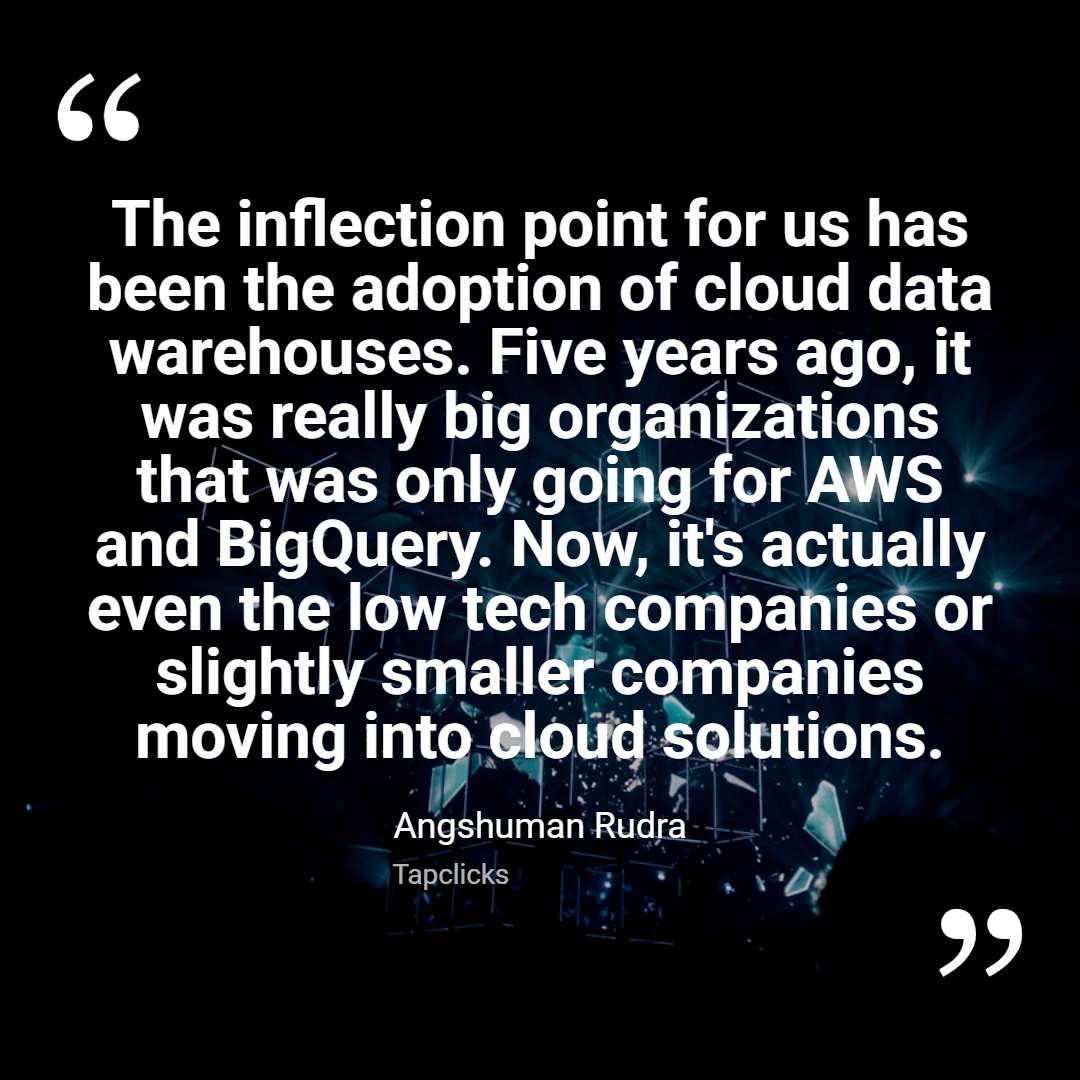
In this conversation, Jeremy Rivera of Community Clean Links and SEO Arcade interviews Angshuman Rudra, a product manager at TapClicks, discussing the company's marketing operations platform, the intricacies of ETL processes, and the challenges of product management in a SaaS environment.
Angshuman shares insights on customer needs, market trends, and the importance of sales feedback in shaping product development. He's been heading up the creation and product management of their new TapDataMax product, and shared a lot of detail on the way Tapclicks views the "movement" of data. The discussion also touches on the evolving terminology in marketing technology, the role of AI in data management, and the future roadmap for TapClicks, including new features and integrations.

Comments

Download from Google Play

Download from App Store
 United States