


 Claim Ownership
Spiritual Infinity
Subscribed: 7Played: 12
Subscribe

© Zenzi Sewaah
Description
Spiritual Infinity is your gateway to deeper self-awareness, transformation, and connection with the limitless power within. Hosted by Zenzi Sewaah,
Through inspiring conversations with guest speakers from around the world, we uncover personal journeys of spiritual awakening, the methods that transformed their lives, and how these practices can empower you. Whether you’re seeking healing, enlightenment, or a greater understanding of the universe, Spiritual Infinity provides wisdom and insights to support your journey.
Join us as we navigate the infinite possibilities of spirituality, one episode at a time.
zenzisewaah.substack.com
Through inspiring conversations with guest speakers from around the world, we uncover personal journeys of spiritual awakening, the methods that transformed their lives, and how these practices can empower you. Whether you’re seeking healing, enlightenment, or a greater understanding of the universe, Spiritual Infinity provides wisdom and insights to support your journey.
Join us as we navigate the infinite possibilities of spirituality, one episode at a time.
zenzisewaah.substack.com
142 Episodes
Reverse

In this episode of Spiritual Infinity, I speak with Jason Fierstein, counsellor, psychotherapist and founder of Phoenix Men’s Counselling in Arizona, about the pressures many men carry beneath the surface. Drawing on both his professional work and his own experiences with identity, relationships and depression, Jason explores why understanding who you are—and developing emotional awareness and vulnerability—can be fundamental to a healthier life.Our conversation looks at the stigma that still surrounds men seeking therapy, as well as the changing expectations placed upon men within relationships and family life. Jason argues that the traditional role of provider is no longer enough: modern relationships also require communication, emotional presence, vulnerability and shared responsibility—skills many men were simply never taught.We also explore male friendship, loneliness and the ways depression can sometimes appear as withdrawal or escapism. Jason highlights the importance of creating space for men to speak without feeling criticised or judged, while also encouraging men themselves to take responsibility for their mental and emotional wellbeing.Ultimately, this conversation asks us to reconsider what strength really means. Perhaps becoming a stronger man begins not with enduring everything alone, but with learning to speak, listen, connect and ask for help.Closing ReflectionPerhaps we need to retire the idea that a strong man is the man who needs nothing from anyone.Strength can also be the courage to say, “I’m struggling.” It can mean listening to the people who care about us, allowing ourselves to be known, and recognising that emotional awareness does not diminish masculinity—it enlarges our humanity.Jason leaves us with a simple but important message: take the risk and ask for help. A healthier relationship, family or life requires work, but we must first believe that our wellbeing—and we ourselves—are worth that work.— Zenzi SewaahFounder & Spiritual Visionary, Spiritual InfinityGuest Bio & Contact DetailsJason Fierstein is a counsellor and psychotherapist based in Phoenix, Arizona, and owner of Phoenix Men’s Counselling, where he works with men and the challenges they face in contemporary life. His work includes individual, marriage and couples counselling, addressing areas such as identity, relationships, depression, emotional awareness and men’s mental health.Website: phoenixmenscounseling.comJason also offers a blog and a free e-book on men and relationships through the Phoenix Men’s Counselling website. Get full access to Zenzi’s Substack at zenzisewaah.substack.com/subscribe

There are some losses for which language will never be enough.In this deeply moving episode of Spiritual Infinity, I speak with Neil Tricarico, a father whose 16-year-old son, Anthony, died by suicide after struggling with depression and suicidality alongside his experience of autism.Yet this is not simply a conversation about death. It is about a father’s grief, the emotional conditioning of men, neurodiversity, spirituality, community and what can happen when unimaginable pain gradually becomes a calling to serve others.Neil describes his life before Anthony’s death as one filled largely with joy. He and his wife, Samara, were raising their son Anthony—known as Ant—and their daughter, Belina, when Anthony was diagnosed with high-functioning autism.There were challenges the family had been prepared for. They were told Anthony might struggle socially or experience bullying. Instead, he developed many friendships and worked hard to connect with others.What Neil and his wife had not been prepared for were the mental-health challenges that could emerge.During the COVID period, when Anthony was around 14, he fell into a deep depression and began experiencing suicidal thoughts. Crucially, he told a close friend, who told his mother, who then alerted Anthony’s parents.That disclosure began an intensive two-year journey as the family tried to support him.Anthony himself wanted to live. He was even planning to devote his senior-year project to challenging the stigma surrounding suicide.Tragically, at 16½, Anthony died by suicide.For Neil, the loss is not something that can be neatly described as something he has “gotten over.”He speaks about waking in the morning and, for a few fleeting moments, feeling as though everything has been a terrible dream—before realising that the nightmare is the reality into which he has awakened.But something else began happening within that grief.Neil describes experiencing a profound spiritual or soul awakening and gradually discovering the possibility of transforming—or, as he puts it, transmuting—pain into purpose.His family’s experience led to the creation of The Endurant Movement, a nonprofit dedicated to helping ensure that teenagers, neurodivergent or otherwise, do not feel unseen.The organisation is working towards safe community spaces for young people who may be struggling but have not yet reached the point of crisis—a place where pressure can come down, where they can simply be themselves and where belonging does not depend upon achievement.Neil is particularly passionate about increasing awareness of the relationship between neurodiversity and suicide. He also reflects on Anthony’s ability to mask what he was experiencing so effectively that some of his friends did not even realise he was autistic.That raises an important question for all of us.How much can be happening inside another human being that we simply cannot see?Our conversation also moves into Neil’s experience as a father.He speaks candidly about initially having to grieve some of the expectations he had unconsciously carried about fatherhood—the sports he imagined coaching, throwing a ball together and other experiences he had pictured sharing with his son.When he was able to release those expectations, however, he could begin meeting Anthony as Anthony actually was.His son loved martial arts and rock climbing. Father and son also spent enormous amounts of time camping together, creating memories that Neil now treasures.There is something profound within that.Sometimes love asks us to release the person we imagined someone would become so that we can fully love the person standing before us.Neil’s professional background also gave him an unusual foundation from which to confront what followed. He had spent approximately two decades working within the personal-development world, including work with Deepak Chopra and Tony Robbins, whom he describes as a friend and mentor.Even with all that exposure to transformation and personal development, however, Neil is clear that nothing could prepare him completely for the death of his son.He experienced shame, guilt, devastating pain and questions about what strength and masculinity actually mean.And that is particularly important within this series on men’s trauma.For generations, many boys have heard some variation of: don’t cry, toughen up, be strong.But what happens when life presents something that cannot simply be “toughed out”?Neil challenges the idea that strength means carrying everything alone.During our conversation, I repeated a familiar spiritual saying: God never gives us more than we can bear.Neil offered an important addition.In his lived experience, we are not necessarily meant to bear life’s greatest trials without the help of others.That became one of the most beautiful moments in our conversation.Whether we call that greater presence God, Creator, Spirit or Universe, help does not always arrive dramatically from somewhere beyond us. Sometimes it arrives through another human being.The friend who notices.The person who telephones.The stranger who shares information at precisely the right moment.The community that surrounds a grieving family.The person willing to sit beside us when there is absolutely nothing they can say to make the pain disappear.As Neil beautifully describes it, there may be angels in heaven, but there are also angels here on Earth.We therefore need not only an open heart, but open eyes, because if we become completely focused upon an expected outcome, we may fail to recognise the help already surrounding us.Neil’s second initiative, The Endurant Way, grew from his own experience of post-traumatic growth and now seeks to help adults carrying significant loss find a way forward.Importantly, Neil does not describe growth as replacing grief.He rejects the idea that healing means reaching some final point at which grief is completed and everything is closed.Pain and joy can coexist.Sorrow and gratitude can coexist.You can miss someone desperately and still laugh.You can grieve and still experience love.You can carry terrible pain and nevertheless discover meaning.Neil describes this as the duality of emotions—the capacity to experience both.And he makes an equally important distinction when we speak about turning grief into something positive.We must not use purpose to escape pain.We must first allow ourselves to experience the grief.Sit with it.Cry.Feel the discomfort.Acknowledge the yearning for the physical presence that is no longer there.Only then can something begin to move.Neil challenges the familiar expression that grief is love with nowhere to go. His experience has taught him something different: grief is love that can no longer go to the physical place where it once went.But the love itself still has somewhere to go.He can send that love to Anthony through prayer and through the spiritual relationship he continues to feel with his son.He can pour it into another grieving father.He can give it to a young person who feels unseen.He can place it into the work of The Endurant Movement.He can bring it into a conversation such as this one.And in doing so, the love continues.Perhaps this is one of the deepest messages of our conversation.We do not honour those we have lost by pretending we are no longer devastated by their absence.Nor do we honour them by allowing our own lives to end emotionally when theirs ends physically.There can be another possibility.We can carry them forward.We can speak their names.We can take the love that once had a physical destination and allow it to become compassion, service, connection and purpose.Neil says that if, as he believes, he is reunited with Anthony one day, he does not want to look back upon the years between and see only suffering. He wants to be able to celebrate the people they helped and perhaps the lives that were saved because Anthony lived.That does not make Anthony’s death acceptable.Neil is very clear: if he could exchange everything he has learned to have his son back, he would.But he cannot.And so he chooses to love his son forward.For the men listening who have been taught that grief must be contained, that tears reveal weakness or that they should somehow be able to carry the unbearable alone, Neil leaves a very different message:You don’t have to carry this alone.Open your heart.Open your eyes.Reach out for help.Allow yourself to cry.Allow others to stand beside you.And remain open to the possibility that somewhere within even the smallest pinhole of hope, another way of living may eventually become visible.We are not separate beings expected to survive life’s greatest trials entirely through our own strength. We are community. We are connection. And for those of us who believe in a Creator, perhaps part of faith is recognising that the hand we have been praying for may sometimes arrive through the hand of another human being.Pain does not have to be denied for purpose to emerge.Grief does not have to disappear for love to continue.And asking for help does not diminish a man’s strength.Sometimes it may be one of the greatest expressions of strength he can make.— Zenzi SewaahFounder & Spiritual Visionary, Spiritual InfinityGuest Bio & ContactNeil Tricarico is the founder of The Endurant Movement, a non-profit created following the death of his 16-year-old son, Anthony, to help ensure that neurodivergent and other young people struggling with their mental health do not feel unseen.Neil also created The Endurant Way, drawing upon his lived experience of profound grief, spiritual awakening and post-traumatic growth to support adults seeking a way forward following significant loss or pain.His professional background spans approximately two decades in personal development and transformation, including work with Deepak Chopra and Tony Robbins.The Endurant Movement: EndurantMovement.orgThe Endurant Way: TheEndurantWay.comInstagram: @NeilTricaricoPersonal contact: Neil invites people t

What happens when the life you imagined for yourself begins disappearing before you have even reached adulthood?In this episode of Spiritual Infinity, I speak with Laura Bratton, speaker, author and coach, whose personal journey is an extraordinary exploration of grief, adaptation, courage and learning how to move forward when life changes in ways we never expected.As a young person, Laura was diagnosed with a very rare eye disease and gradually began losing her sight. By the time she finished high school at around 18, she had only very limited light perception.But the physical loss of sight tells only part of her story.While her friends were learning to drive, Laura was learning how to use screen-reading technology. While they were getting their first jobs, she was learning to navigate safely with a cane. At precisely the age when young people are normally gaining independence, Laura found herself having to depend upon other people in ways her friends did not.She speaks candidly about the grief, anxiety, panic attacks and debilitating depression that accompanied that transition. She was not only grieving her eyesight. She was grieving parts of her youth—the basketball, dancing and activities she loved, the independence she expected to have and the future she had imagined for herself.And because her sight disappeared gradually, the grieving process happened repeatedly. Her vision would deteriorate, plateau for a period, and then deteriorate again. Each change required another emotional and practical adjustment.One of the most important aspects of Laura’s story is that she does not pretend courage means never feeling afraid.Quite the opposite.She believes we need to acknowledge when something is painful.Her understanding of grit is not simply: push through, be strong and get over it.For Laura, grit means recognising that something is incredibly difficult and choosing to continue moving forward even while it remains difficult.That distinction is important.We live in a culture that can sometimes turn positivity into another pressure. We can feel that we should immediately find the lesson, be grateful, recover and move on.But human beings do not always heal that way.Laura’s journey reminds us that sometimes we first need permission to say: this hurts. This frightens me. This was not what I planned for my life.And then we ask: What do I need now?Laura credits much of her ability to move forward to the support surrounding her, particularly during those difficult teenage years.The people who loved her did not pretend that blindness was easy. Nor did they communicate that her life was somehow over. Through their everyday actions, they helped her understand that this was her new reality—and that together they would work out how to live within it.One piece of advice from her parents was beautifully simple: you only have to figure out today.Not next month.Not next year.Today.That philosophy helped Laura continue into education, adulthood and eventually a professional life built around helping other people navigate their own unexpected changes.Today, through her speaking and coaching, Laura teaches what she calls Experiencing Grit & Gratitude®.And her definition of gratitude is equally important.Laura is not grateful for blindness.Gratitude, in her understanding, does not mean pretending that something painful is wonderful. It means recognising what remains available to us and what has supported us while we walk through the difficulty.There can be grief and gratitude in the same life.Pain and purpose can coexist.Fear can be present while we continue moving.And perhaps that is where genuine resilience begins.Laura’s experience eventually became the foundation for her book, Harnessing Courage: Overcoming Adversity with Grit & Gratitude, as well as the speaking and coaching work she now shares with individuals, corporations and organisations.Towards the end of our conversation, I asked Laura to leave us with something practical for those facing change or adversity.She gave us two messages that belong together.First: acknowledge and validate your emotions.We often want to jump immediately from adversity to the solution. Something happens and almost instantly we ask ourselves, How do I fix this? How do I get over it? How do I get back to normal?But Laura reminds us that healing sometimes requires us first to recognise what we are actually feeling.When she could acknowledge the severity of her anxiety and panic rather than telling herself simply to be strong and positive, she could then begin asking what resources she needed to help herself.Her second message is equally powerful:You are enough.Adversity can change our circumstances without diminishing our value.Losing something does not make us less human.Needing help does not make us less capable.And having moments when we are frightened, overwhelmed, anxious or grieving does not mean we have somehow failed at being strong.Listening to Laura, I was reminded of something we return to again and again on Spiritual Infinity: life does not always follow the path we expected.There are moments when the road changes completely and we cannot see where it is taking us.Sometimes we cannot change what has happened.But we can learn how to meet what has happened.We can allow ourselves to grieve without making grief our permanent home. We can accept support without believing that needing support makes us weak. We can practise gratitude without denying our pain. And we can take the next step without needing to know every step that will follow.Laura lost almost all of her physical sight, yet she continued creating a life of purpose. She became an author, speaker and coach, and she continues learning from the very people she seeks to empower.Perhaps that is courage.Not pretending the darkness does not exist, but discovering that even within it, life can continue to unfold.So wherever you may be in your own journey today, remember Laura’s message.You do not have to solve the rest of your life today.Acknowledge what hurts.Accept the help you need.Find what remains worthy of gratitude.Take the next step.And above all, remember:You are enough. You are capable. And your circumstances do not determine the fullness of who you are.— Zenzi SewaahFounder & Spiritual Visionary, Spiritual InfinityGuest Bio & ContactLaura Bratton is a keynote speaker, author and coach whose professional work grew directly from her experience of progressively losing her sight while growing up.Having experienced profound grief, anxiety and the enormous practical adjustments required to live with blindness, Laura now helps others navigate personal and professional change through the principles of grit and gratitude.Her signature work, Experiencing Grit & Gratitude®, teaches people to acknowledge the reality of difficult circumstances while developing the perseverance, perspective and practical tools needed to continue moving forward.Laura is the author of Harnessing Courage: Overcoming Adversity with Grit & Gratitude, in which she shares her personal journey and explores how grit and gratitude can coexist with adversity.Website: LauraBratton.comLinkedIn and email contact: Available through Laura’s websiteBook: Harnessing Courage: Overcoming Adversity with Grit & GratitudeSpeaking & Coaching: Individual coaching, corporate and organisational speaking engagementsLaura identifies her website as the central place for her book, speaking, coaching, LinkedIn and email contact; her current official site also lists Harnessing Courage: Overcoming Adversity with Grit & Gratitude. Laura Bratton’s official website Get full access to Zenzi’s Substack at zenzisewaah.substack.com/subscribe
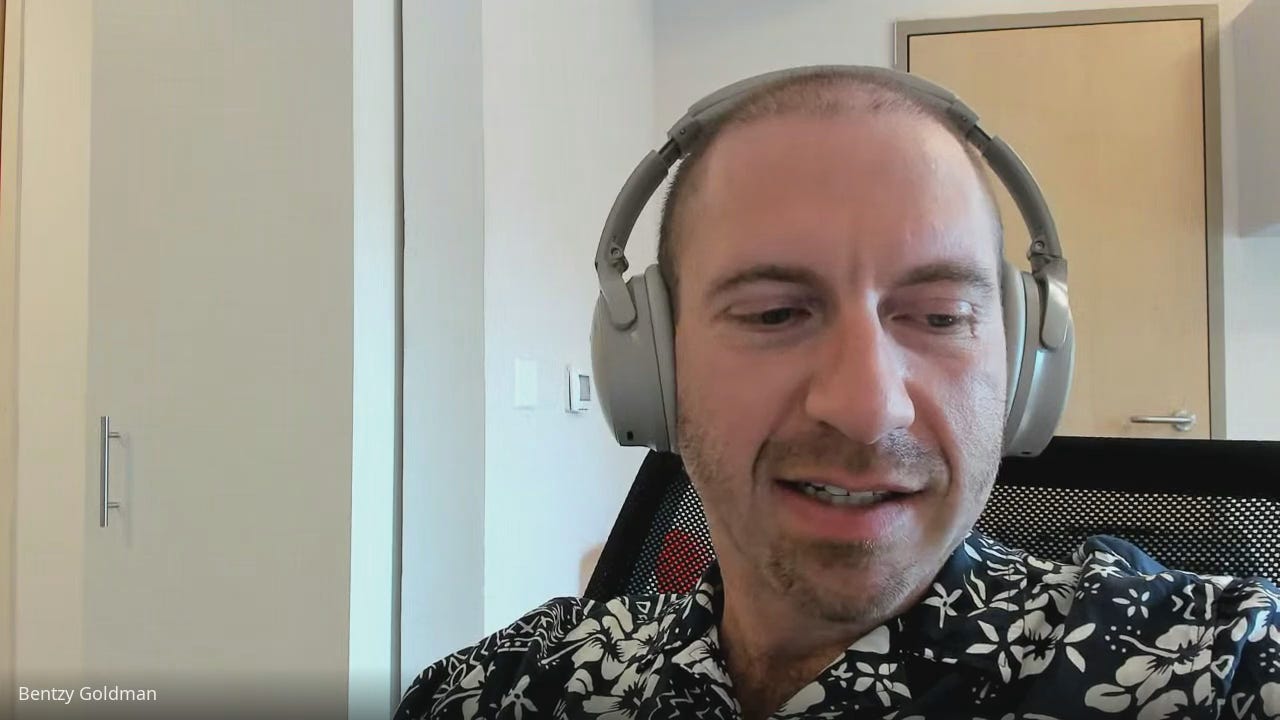
What happens when a boy grows up without the freedom to express his emotions—and carries that disconnection into adulthood?In this episode of Spiritual Infinity’s series on male trauma and men’s emotional wellbeing, I speak with men’s coach Bentzy Goldman about emotional suppression, addiction, destructive relationship patterns and the courage required to change.Growing up in South Africa, Bentzy experienced a culture of traditional masculinity alongside a controlled religious upbringing that, in his particular environment, left little room for emotional expression. He speaks candidly about how his inability to understand and process his feelings contributed to bullying during adolescence and harmful behaviour towards women in his twenties.His turning point came during a period of troubled relationships, addiction and business difficulties. Joining a men’s group gave him something he had been missing: positive male role models, honest accountability and examples of men who could express emotion while treating themselves and others with integrity. Prayer and spiritual practice also became important sources of support throughout his recovery.Today, Bentzy helps men examine the relationship between emotional pain, pornography, compulsive sexual behaviour, intimacy and identity. His 12-week programme, From Consumption to Connection, focuses on changing destructive patterns, developing self-mastery and building healthier relationships with women.At the heart of our conversation is a powerful message: healing male trauma requires more than changing behaviour. It means understanding the pain beneath it, taking responsibility for the harm caused and learning a different way of being a man.One of the most important moments in this conversation is Bentzy’s acknowledgement that his pain did not affect him alone. It affected the people around him, particularly the women with whom he formed relationships.Trauma can help us understand harmful behaviour, but it does not excuse it. Healing asks us to recognise both our suffering and our responsibility.Bentzy also reminds us that facing difficult emotions requires courage. A man does not become less masculine when he acknowledges shame, sadness or fear. He gives himself an opportunity to understand what is happening within him rather than allowing those feelings to govern his actions.And healing is not a race towards perfection. Bentzy describes learning self-compassion as an ongoing practice, recognising that constant self-criticism cannot remain the only fuel driving a man’s life.As we continue this series on male trauma, I want us to remember that boys need emotional understanding before they become men, and men need safe spaces where they can speak, seek help and be accountable without being stripped of their humanity.Let us raise boys who know that feelings are not weaknesses, and support men who are willing to face their pain and choose a different path.— Zenzi SewaahFounder & Spiritual Visionary, Spiritual InfinityGuest Bio & Contact DetailsBentzy Goldman is a men’s coach originally from South Africa. Drawing on his personal journey through emotional suppression, addiction and difficult relationships, he now focuses on helping men develop self-mastery, emotional awareness, integrity and healthier relationships with women.He previously worked in executive coaching before concentrating on men’s personal development. His 12-week programme, From Consumption to Connection, explores identity, intimacy, pornography use and relationship patterns.Website: thefree-man.comCoaching: One-to-one sessions and a 12-week group programme.The website is the contact route Bentzy provides in the interview. Get full access to Zenzi’s Substack at zenzisewaah.substack.com/subscribe

What happens when a young man’s life changes in an instant and the emotions that follow become almost as difficult to navigate as the physical recovery?In this episode of Spiritual Infinity’s continuing series on male trauma and men’s emotional wellbeing, I speak with Daniel Gospodarek, a licensed clinical social worker in Wisconsin who works extensively with men, first responders and military personnel. Daniel’s professional understanding of trauma is deeply connected to his own extraordinary experience. At just 17, Daniel was involved in a devastating car accident that caused a traumatic brain injury. He required brain surgery, suffered a collapsed lung and fractured skull, spent ten days in intensive care and seven days in inpatient rehabilitation, followed by months of physical therapy and 17 months of speech therapy. At an age when independence is normally expanding, Daniel suddenly needed help to walk, shower and carry out the most basic parts of daily life. Although he was determined to graduate alongside his classmates, recovery brought losses that were not immediately visible. Extreme fatigue meant missing much of the social life his friends were enjoying. His concentration had changed, his independence had been disrupted, and the effects of his brain injury continued into college. He also experienced intense irritability and anger, compounded by difficulties with sleep and further concussions. Daniel speaks openly about how that anger sometimes landed on the people closest to him—not because they had caused his pain, but because they were there when everything he was carrying finally came out.Eventually, he recognised that exercise and the support of the friend who had survived the accident with him could only take him so far. He needed a neutral person with whom he could safely explore what was happening inside him. Therapy became part of learning to understand and intentionally express the anger that had become so powerful he could physically feel it building in his body.That experience ultimately helped shape his vocation.Daniel went on to study social work, completing his master’s degree at the University of Denver, and today works with people carrying many different forms of trauma. His work with men has shown him how often anger or the seemingly simple statement “I’m frustrated” can conceal something deeper: anxiety, stress, grief, shame, guilt, addiction, relationship difficulties or years of emotions that have never been expressed.This is particularly significant in his work with first responders and military personnel—cultures in which people may repeatedly witness distressing events while being expected to continue functioning. Daniel explains that emotional numbing may help someone cope in the short term, but shutting down painful emotions can also interfere with the ability to experience love, gentleness, forgiveness and connection. One of the most moving parts of our conversation concerns the safety required for a man finally to let down those protective layers. Daniel describes the importance of creating a therapeutic relationship in which the nervous system begins to sense that it is safe. Sometimes healing begins with something as simple as a man discovering that he is not the only person experiencing what he has kept hidden for years. And sometimes it means allowing a 50-year-old man to cry without rushing to stop his tears, judge them or make them disappear. Daniel also talks about spirituality as one possible source of grounding. Raised Catholic, he drew strength during his own recovery from the thought, “I come as one, but I stand as 10,000” ,remembering the generations who came before him and the adversities they survived. In his professional work, however, he respects each person’s own spiritual or religious framework and also recognises that religion itself can sometimes be associated with trauma.Towards the end of our conversation, I asked Daniel what he would say to the man who knows he is carrying pain but remains hesitant to seek help.His response begins with one question:“Is what I’m doing working?”It is such a simple question, but it requires honesty.Is the way you are coping bringing you closer to the person you want to be—or further away? Is it affecting your partner? Your children? Your relationships? Are you genuinely living according to what you value?Because healing one man does not end with that man. Daniel reminds us that our emotional state affects those around us. When a nervous system remains caught in anger, fear, fight, flight or collapse, that dysregulation can reach into a marriage, a partnership and a family. In the same way, healing can create its own ripple effect.Perhaps that is something we need to remember when we ask men to seek help. It is not weakness to acknowledge that what you have been doing is no longer working. It takes courage to look at yourself truthfully. It takes courage to sit opposite another human being and say, this is what I am carrying. And it takes courage to allow yourself to feel what you may have spent years trying not to feel.To the men watching, listening or reading: your anger may be telling you something. Your frustration may be carrying something deeper. You do not have to wait until everything falls apart before you listen.And to the rest of us: we must continue creating spaces where men can speak without shame and where a man’s tears are not interpreted as the absence of strength.Sometimes strength is precisely what allows the tears to come. Zenzi SewaahGuest Bio & Contact DetailsDaniel Gospodarek, LCSW, is a licensed clinical social worker and the founder of Revitalize Mental Health, a private practice based in Kenosha, Wisconsin. He works extensively with men as well as first responders and military personnel, and provides individual and couples therapy alongside some group work.Daniel’s interest in social work emerged following the severe traumatic brain injury he sustained as a teenager. After completing his bachelor’s degree, he earned his master’s degree from the University of Denver and developed a professional focus that includes trauma, emotional regulation and helping people move beyond the protective mechanisms that can interfere with connection to themselves and others. Website: Revitalize Mental HealthEmail: [email protected] telephone: +1 720-295-6703 Get full access to Zenzi’s Substack at zenzisewaah.substack.com/subscribe

Comments

Download from Google Play

Download from App Store
 United States