


 Claim Ownership
Evolutionary Insights by Anthropology.net
Subscribed: 24Played: 669
Subscribe

© Anthropology.net
Description
300 Episodes
Reverse
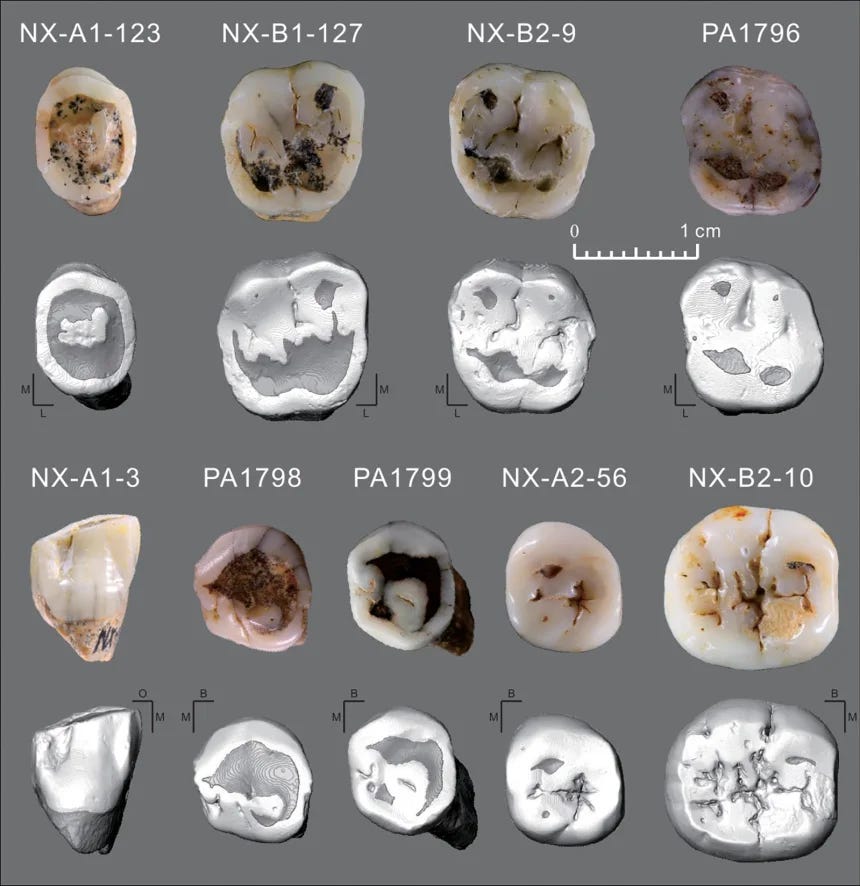
PA1799 is a lower premolar from Baxian Cave, about 20 kilometers north of Chongzuo in Guangxi, southern China. More of the new case for late Homo erectus on the Asian mainland rests on this tooth than on any other fossil. Its enamel still holds proteins. Fragments of amelogenin-Y, a protein made from a gene on the Y chromosome, show that it came from a male. It also carries a single amino acid substitution in ameloblastin, another enamel protein, and that variant has so far been found only in Chinese H. erectus. The tooth itself was dated to 213 ± 18 thousand years. The strontium in its enamel was laid down in early childhood, and it varies across a range that the authors read as time spent far from the cave, possibly in northern Vietnam.A tooth like this doesn’t fit the account the field has worked with. Before these papers, no securely dated H. erectus fossil from mainland Asia was younger than about 400,000 years. The species’ last known population lived at Ngandong on Java in fairly open woodland. Rizal and colleagues dated it to between 117,000 and 108,000 years ago, and the spread of closed-canopy forest has been proposed as one reason the species disappeared there. In that account, Homo sapiens was the only human species that used rainforest regularly.The evidence comes from two companion papers in Nature. Wei Liao of Shandong University and colleagues describe nine hominin teeth from Baxian and from Naxian Cave, which lies 15 kilometers away in the same karst valley. They identify eight of the teeth as H. erectus by tooth shape, and for four of those, by proteins as well. In the second paper, Kira Westaway of Macquarie University, Renaud Joannes-Boyau of Southern Cross University, Liao and colleagues date the deposits and reconstruct the environment. Together the papers place H. erectus in this valley at some point between 324,000 and 184,000 years ago, living among forest animals. They also show that four of the teeth carry a protein sequence that no earlier H. erectus sample has.The ninth tooth adds a second problem. PA1796, an upper second molar from Baxian, does not fit comfortably with H. erectus, Neanderthals or modern humans, and it lacks the H. erectus protein marker. Liao’s team suggests it may belong to Denisovans (Homo longi) or to another population. If so, two hominin lineages lived in this valley late in the Middle Pleistocene.How were the Guangxi Homo erectus teeth dated and identified?The dating is the most solid part of the package. Westaway’s team modelled 43 radiometric ages from five methods. Luminescence dating of feldspar and quartz grains measures how long ago the sediment was last exposed to light. Uranium-series dating measures uranium decaying into thorium. Teeth absorb uranium after burial, so on a tooth this method gives only a minimum age. Pairing it with electron spin resonance, which measures the radiation damage that builds up in enamel, lets the team model when the uranium entered the tooth.The two caves were dated differently, and that matters. At Naxian the six hominin teeth have only uranium-series minimum ages, about 97,000 to 172,000 years. So the team bracketed the breccia around them. Soda straws (thin stalactites) inside the breccia set a maximum age, and the flowstone capping it sets a minimum, which gives 319,000 to 241,000 years ago. At Baxian, PA1799 and an orangutan (Pongo) tooth were dated with the paired method, and the Bayesian model puts the fossils between 324,000 and 184,000 years ago. I give more weight to Baxian, because a hominin tooth there was dated directly. The Naxian teeth take their age from the sediment around them, which is safe only if none of them were washed in from older deposits.The first of the two identification methods is shape. Micro-CT scans showed the enamel-dentine junction, the buried surface under the enamel cap. Its shape differs between hominin species, and in H. erectus it has a distinctive wrinkled, branching pattern. The team compared the teeth statistically with African and Asian H. erectus, Neanderthals and modern humans. Seven of the teeth classified clearly as H. erectus. An eighth, NX-A2-56, was an outlier to every group, but its other features look most like earlier Chinese H. erectus.Proteins are the second method, and I expect them to matter most. Genes set the order of amino acids in a protein, so a change in a protein records a change in DNA. All five teeth sampled yielded original enamel proteins, with 556 to 808 amino acid positions read per tooth. Four of them carry glycine instead of alanine at position 253 of ameloblastin. That substitution is missing from the Neanderthal and Denisovan genomes and from great apes. It is also missing from 1,461,678 living people in the gnomAD database and from a H. erectus tooth about 1.77 million years old from Dmanisi, Georgia. The only other place it has turned up is six Chinese H. erectus teeth about 400,000 years old, from Zhoukoudian, Sunjiadong and Hexian, reported earlier this year by Fu and colleagues.Those six older teeth also carry valine at position 273 of the same protein, as does the one high-coverage Denisovan genome. The four Guangxi teeth instead carry methionine there, the older form. A phylogenetic analysis puts the Guangxi teeth on their own branch beside the older six. The authors conclude that they come from a H. erectus population no one had sampled molecularly before. The two Naxian upper first molars may be a left-right pair from one person, so the four H. erectus teeth with proteins represent at least three individuals, one of them female.Did Homo erectus live in rainforests?The case for rainforest rests mostly on the animals. The breccias yielded more than 18,000 mammal fossils. Forest-dwelling species dominate, including orangutans, Asian elephants, tapirs and the extinct Stegodon. Carbon isotopes help here, because plants under a dense canopy are low in carbon-13 and plant-eaters carry that signal into their enamel. Converted to plant-equivalent values, the Naxian animals average −29.4‰, well under the paper’s dense-canopy threshold of −27.5‰. Neither cave shows any sign of C4 grasses. Baxian averages −27.6‰, only 0.1‰ below the threshold, and some animals there reach −23.0‰. The paper says both groups of animals are well below the line. I’d accept that for Naxian, but I read Baxian as forest with open patches nearby.The evidence from the hominins themselves is much thinner. Only three H. erectus teeth were measured for carbon, all from Naxian. The paper plots them at the boundary between dense-canopy forest and more open C3 vegetation, and it acknowledges that the sample is small. In the press release, Patrick Roberts, a professor at the Max Planck Institute of Geoanthropology in Germany and a co-author, called this “the first clear, direct evidence we have for another hominin living within these habitats.” The Westaway paper states the finding in two ways. In one paragraph it calls the evidence for rainforest use unequivocal. In the next, it describes H. erectus as “at minimum, capable of persisting among rainforest fauna.” I’d stand behind the second version. Three carbon values at the edge of the canopy tell us about diet, and they can’t show that closed forest was where these people lived.The setting adds two more cautions. Westaway and colleagues wr… This is a public episode. If you'd like to discuss this with other subscribers or get access to bonus episodes, visit www.anthropology.net/subscribe
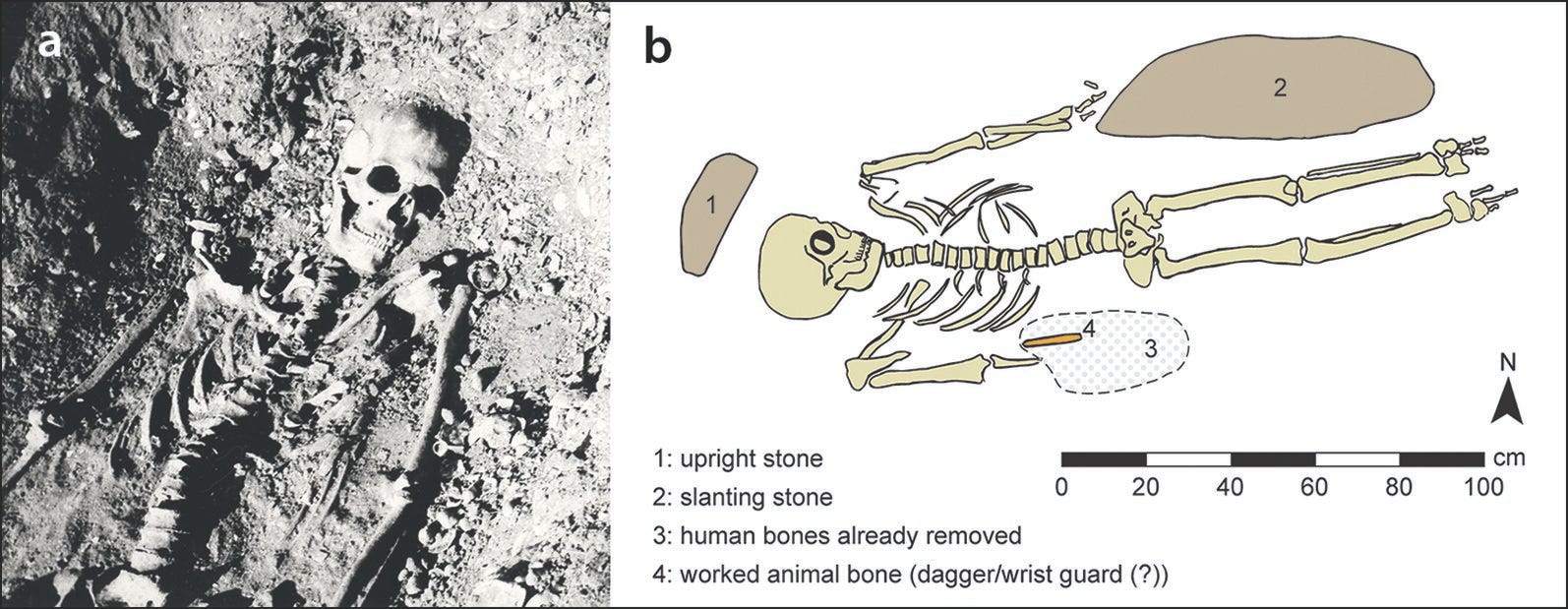
In 1956, residents digging for artifacts in a Stone Age shell midden called Rødhals, on the Danish island of Sejerø, found a nearly complete human skeleton under an unbroken shell layer about 20 centimeters thick. Ole Klindt-Jensen of the Danish National Museum lifted the skeleton, now known as Rødhals Man, in pouring rain, and his notes describe a bone object about 140 millimeters long between the man’s right forearm and lower ribs. A museum employee apparently later redescribed it as an “unformed piece of bone, strongly water-rolled,” and discarded it. A new study suggests it may have been an archer’s wrist guard, an object with parallels in graves of the early Funnel Beaker Culture, the Early Neolithic farming culture of Denmark (c. 3800–3500 cal BC).The object matters because of what most readers believe about the Neolithic transition in Denmark, the shift from Mesolithic hunting and fishing to Neolithic farming. A 2024 study of 100 ancient Danish genomes by Morten Allentoft and colleagues found that farmers with ancestry traced to Anatolia arrived in the fourth millennium BC and replaced the local hunter-gatherers rather abruptly. Rødhals Man has long sat awkwardly in that picture. His bones carry the seafood diet of a Late Mesolithic forager, but radiocarbon put him in the Early Neolithic, when marine food all but vanishes from Danish human bone chemistry.In Antiquity, Dr. Anders Fischer of the University of Gothenburg, John Meadows of the Leibniz-Zentrum für Archäologie and 15 co-authors report that, corrected for his diet, the radiocarbon dates place Rødhals Man’s death between 3930 and 3710 cal BC (95 percent probability), most likely between 3890 and 3770 cal BC, where cal BC means calendar years BC from calibrated radiocarbon dates. His genome, published in 2024, shows entirely Western Hunter-Gatherer ancestry, the genetic profile of Europe’s Mesolithic foragers, and he lived mainly on seafood all his life. That currently makes him the most recent securely dated person in Denmark with both unmixed hunter-gatherer ancestry and a coastal forager’s diet.The result I find more interesting comes from one of his teeth, because it records a change inside a single life. As a child he ate like most people of the Ertebølle Culture, the Late Mesolithic culture of Denmark and its neighbors (c. 5400–3800 cal BC), drawing protein mostly from shallow eelgrass meadows. From adolescence on, around the time domestic cattle and sheep first appear in Denmark, this fisher of purely local forager ancestry ate sharply more food from land while still depending mainly on the sea, and the authors argue the land food was probably farmed.How do isotopes in a tooth record a change in diet?Collagen, the main protein in bone and in the dentine of teeth, is built from the protein a person eats. Ratios of heavier to lighter isotopes of carbon, nitrogen and sulfur in it differ between food webs, and animal bones and mollusk shells from the Rødhals midden separate two marine sources: the shallow eelgrass meadows, with their shellfish, flatfish and eel, and the deeper offshore channels where haddock and mature cod lived. Land food is the third source, and a person’s values plotted against all three give the share of protein from each.Bone renews its collagen through life, so a femur sample averages many adult years. A tooth root grows in sequence through childhood and early adolescence, and slicing it into thin increments matched to approximate ages gives something close to a yearly record. The team sacrificed the root of his lower-right first premolar and got a series from about age seven into his early teens. They compared it with his left femur and with data from 65 other Danish Mesolithic individuals spanning c. 9700–3950 cal BC.Eelgrass foods dominate the whole sequence. Around age eight or nine his diet was slightly more terrestrial, and from about 11 more offshore fish came in. Between the increments the paper’s Figure 6 assigns to ages 12 and 13, the values swing hard toward land food, and the adult femur stays on that side. Against the comparison group, his childhood diet is typical for a coastal Ertebølle person, while his adult diet is unusually rich in land food for someone from the coast.Getting his date right depends on that diet reconstruction. All five radiocarbon dates on the skeleton read too old because of the marine reservoir effect: carbon in seawater is older, in radiocarbon terms, than carbon in the air, so a heavy seafood eater builds bones that test older than they are. The team corrected for this in a Bayesian model, a statistical method that combines the measured dates with corrections for his estimated diet and for how long before death each sample’s collagen formed. I think this is the most careful part of the paper, because the old error ran in a predictable direction and the authors model it in the open, though any error in the diet estimate carries into the date.Was Rødhals Man eating farmed food?The authors handle this claim more carefully than the press release does, stating that isotopes from his femurs and ribs cannot show whether the extra land protein came from hunting and gathering or from farming and herding. They also raise the alternative themselves: he might have spent his adolescence and adulthood foraging on a larger landmass with red deer to hunt, the nearest being Zealand, 18 kilometers away across open water, and come back to Sejerø late in life.Their answer rests on two observations. Typical inland foragers ate freshwater fish, and Rødhals Man shows none at isotopically visible levels; his adult diet also looks unlike any other Mesolithic individual’s over a sustained period. I find the first weaker than it sounds, because it excludes the lakeshore forager while saying nothing about a coastal man crossing to Zealand for deer. The second is stronger, though a diet nobody else in the sample shared also fits a man who was simply unusual.A separate line of evidence comes from the grave. Danish Late Mesolithic graves typically show ochre staining, and this one has none. The body lay on its back between two large stones with their flat faces turned toward it; the larger may be a boulder that was already there, but the smaller seems to have been set on edge deliberately. The authors find that arrangement closer to local burials of Early Neolithic farmers. I give the stone frame more weight than the wrist guard, because the frame is in Klindt-Jensen’s field sketch and the wrist guard is a reading of a description of an object no one can now examine.I worked through the timing myself from the paper’s numbers. Directly dated cattle and sheep bones put the first Danish economy with domesticates at c. 3950–3850 cal BC. On the Sejerø islands, the earliest directly dated individual with farmer ancestry, the Sejerby Female, was buried 2.5 kilometers from Rødhals and 200 to 300 years after him. Rødhals Man died between 30 and 40, probably near the upper end, so his diet turned roughly 20 to 28 years before his death. A death within the model’s most likely range puts that change between about 3920 and 3790 cal BC, after domesticates appear, while a death at the old end of the 95 percent range puts it around 3950 cal BC, at the very first domesticate dates.What the Rødhals Man study can’t showThe plainest limit is that this is one man. Fischer said as much in a statement from Antiquity: “It is only one person’s … This is a public episode. If you'd like to discuss this with other subscribers or get access to bonus episodes, visit www.anthropology.net/subscribe

In the Sakhnin Valley in Israel’s Lower Galilee, a survey recorded more than 200 handaxes from the Lower Paleolithic, the earliest part of the Old Stone Age. About ten of them were shaped from flint nodules with a fossil imprint or an odd geological feature inside, and in each the maker left the feature in the middle of the tool’s face, where it could be seen and touched. Such nodules are harder to work, and the valley’s other handaxe makers avoided them.These handaxes are part of a new case for Stone Age souvenirs, one that runs against a view most readers probably hold. Keeping an object for the memory it carries is usually treated as a late habit of modern humans, from the end of the Old Stone Age onward, and archaeologists have mostly read such objects socially, as carriers of shared meaning or markers of rank.The paper, a review in Evolutionary Anthropology: Issues, News, and Reviews, is by Ran Barkai, a professor of archaeology at Tel Aviv University; Yoav Ram of the university’s School of Zoology; and four colleagues. Its data statement says no new datasets were generated or analyzed. Its core examples come from the team’s earlier work in Israel, which they read as consistent with people keeping objects beyond practical need from about 500 kya (thousand years ago). They propose that these were personal keepsakes, or souvenirs, working as “portable external memory devices.” Once keeping them became routine, the habit may have changed the selection pressures on autobiographical memory, which they define as memory of one’s own experiences plus the family stories folded into one’s identity.What is the evidence for Stone Age souvenirs?The archaeological case rests on three groups of objects, all described in earlier papers by members of this team. At Qesem Cave, people deliberately carried in small, round pebbles of colorful flint from about 400 kya onward, through the roughly 200,000 years they used the cave. Ella Assaf, one of the authors, reported in 2018 that the pebbles show no sign of use; the review gives no count. The Sakhnin handaxes, published this year by Barkai and Shalata, carry fossils and formations that match outcrops in the valley, tying each tool to a particular spot. The authors grant these were probably working tools and ask why someone kept a feature that did nothing for the tool and made it harder to produce.In my reading the third group is the strongest, because the comparison that matters is built into the sites. At Revadim and Jaljulia, two Late Acheulean sites (the Acheulean is the Lower Paleolithic handaxe tradition), and at Qesem, which comes after it, people picked up flint tools made and thrown away long before. The giveaway is patina, a weathered skin that forms on discarded flint and takes its color from the conditions where it lay. On a Qesem scraper shown in the review, the old surfaces are whitish and the resharpened edges are brown, fresh flint. Reworking on such pieces was minimal, and magnified wear traces show their second use was generally light. Because fresh tools dominate the assemblage (the full set of recovered artifacts), Bar Efrati of the University of Oxford, a co-author, argues that the old faces were kept by choice rather than for lack of good stone.The memory half of the argument rests on what the team calls authentication. Psychologists use the term source monitoring for telling whether a memory came from something that happened or from one’s own thoughts. A keepsake adds sensory detail to that judgment; it can’t prove a memory true, the authors stress, only narrow down where it came from. Where alliances and claims to places depend on credible personal memory, people who are better at checking memories against objects should do better. That skill varies between people and is partly heritable, the paper notes, so selection would have had something to act on. Routine curation beyond practical need is what the authors call a “souvenir niche,” after niche construction theory, in which organisms alter their surroundings in ways that feed back on their own evolution.People had lived in the Levant (the eastern Mediterranean) for at least 1.5 million years before this behavior appears, so the review looks for a trigger and finds it in big game. Prey size there fell through the Pleistocene, the epoch of the ice ages, and the elephant disappeared around 400 kya, along with Homo erectus and the Acheulean. As hunting smaller, more evasive prey pushed people into new territory, the authors propose, portable pieces of places became worth keeping. Barkai said in the press release that objects taken from the new hunting grounds “may have helped them maintain a personal connection with the places that would henceforth provide their livelihood.” The review predicts that the practice should track the decline of large herbivores rather than come before it.Can archaeology tell a keepsake from a tool?The patina deserves a slower look, because the time it records works against part of the argument. The whitish skin on that Qesem scraper formed while the flake lay abandoned, and the authors acknowledge that the patinas imply the pieces were found again rather than handed down. So the long interval written on these objects is time when nobody had them. The abstract speaks of the “prolonged retention” of patinated tools, but nothing the review presents measures how long the second owner kept one. Light wear on a resharpened edge fits an object handled now and then for years, and it fits a tool used briefly and dropped; the team itself calls wear its weakest criterion.That gap matters because of the review’s own test for a souvenir: an individual keeps one object safe over a long period, neither discarding it nor trading it for food, and comes back to it from time to time. The authors use this standard to set aside animal cases, including captive chimpanzees that kept a large crystal in their sleeping quarters for two days before trading it back for food. They concede that such behavior could go unseen, because detecting it means following a known individual and a known object for months. No Paleolithic deposit offers that. A site preserves where objects ended up, and how long anyone kept them, or why, has to be inferred.I also think Barkai and Ram chose the hardest level of meaning to detect. They focus on personal rather than social meaning because it assumes the least, needing no shared convention and no audience. That is sound as theory, and it is also why a personal keepsake is nearly invisible to archaeology, since by the paper’s own account its meaning need not be legible to anyone but its keeper. The definition of the souvenir niche sidesteps the problem. It covers routine curation “regardless of motive,” while the memory argument depends entirely on the motive.How strong is the case that keepsakes shaped memory?I find the evolutionary step the weakest link, because its evidence comes from studies of living people and laboratory animals, such as experiments in which learning to make and use tools changed brain networks in macaques and humans. Such studies can make a mechanism plausible, but they can’t show selection at work in the Middle Pleistocene, when these stones were collected.The 500 kya figure is a round number for a period, not the age of any object in the review. It gives no dating method for any of the Israeli material and no stratigraphic context (the layer and setting that would date them) for the surveyed Sakhnin handaxes. Its only number for that evidence is the 400 kya start of the Qesem pebbles, and the authors allow that routine souvenir-keeping may have arrived “later than the earliest examples in the archaeological record.”Their test of failure is also forgiving. The hypothesis fails only when curated items are optimized for use, local and uniform… This is a public episode. If you'd like to discuss this with other subscribers or get access to bonus episodes, visit www.anthropology.net/subscribe
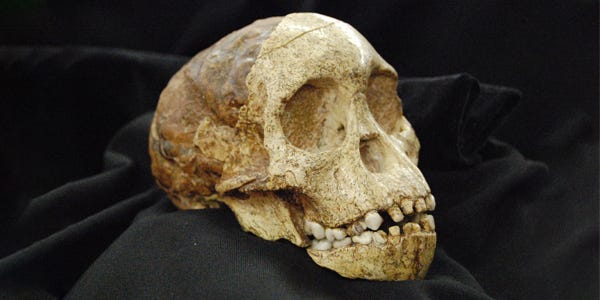
In a new plot of brain shape, the Taung child, a roughly 3-million-year-old skull found in 1924 at the Buxton Limeworks quarry in South Africa’s Northwest Province, sits almost on top of MLD 37/38, an adult from Makapansgat, 670 km to the northeast. The plot compares endocasts, casts of the inside of the braincase that record the brain’s outer shape, and Taung’s comes from a child whose first permanent molar had erupted while the second was still forming. In growth series of 101 chimpanzees (Pan troglodytes) and 84 gorillas (Gorilla gorilla), apes at that dental stage do not overlap their own adults in brain shape, yet Taung plots in the middle of the adult fossils from Sterkfontein. The authors call this peculiar, and I think it is the most important result in the paper, because it is where their case about species is both strongest and most exposed.That matters because Taung is the holotype of Australopithecus africanus, the specimen that anchors the species name. Most readers picture a well-stocked species behind it, with Sts 5, the Sterkfontein skull nicknamed “Mrs. Ples,” as its typical adult. The paper argues that Taung is, strictly speaking, the only fossil that belongs to A. africanus without dispute, and that several adults long filed under the name, MLD 37/38 among them, probably belong to other species.Gabriele Macho (Vrije Universiteit Brussel and University College London) and seven coauthors, including Simon Neubauer and Clement Zanolli, report the work in npj Palaeoecosystems. A flowstone lying above the fossil-bearing deposit gives a minimum age of 2.962 ± 0.059 million years (Ma) for the skull, and an earlier paleomagnetic estimate caps it at 3.03 Ma. Using tooth development, brain growth and molar shape, the team asks whether Taung could have grown into the adults assigned to its species, and concludes that the brain-growth results leave little doubt that the Sterkfontein fossils include more than one species. To explain that diversity, the authors propose that climate swings kept moving populations around, with interbreeding probably following where they met.How old is the Taung child?Southern African sites lack the volcanic ash layers that give eastern African fossils reliable dates, and Taung’s exact find spot was lost during mining. Published estimates have ranged from 942 thousand years (ka), by uranium-series dating, to 3.03 Ma, the start of the last normal-polarity interval of the Gauss magnetochron, a period identified from the magnetic direction recorded in rock.The flowstone, a sheet of calcite laid down by flowing water, was dated by the decay of its uranium to lead. The route previously advocated for South African flowstones, uranium-238 to lead-206, needs a correction for uranium isotopes that were out of balance when the calcite formed, and beyond 1.5 Ma the uncertainty in that correction can exceed the correction itself. The uranium-235 to lead-207 route is largely immune, and it gave 2.962 ± 0.059 Ma with little scatter (an MSWD, the standard measure of that scatter, of 0.7).I find the measurement convincing, because the method was chosen for a stated reason and the result is precise, but what it means for the fossil is less certain than the paper or the press release suggests. The two routes give ages for the same flowstone that do not overlap, a mismatch the authors tentatively blame on uranium moving after the rock formed, and they read both ages as minimums by assuming the rock only gained uranium; loss would make them too old, and the main text does not say why gain is likelier. No radiometric ceiling has been found despite further drilling, so the 3.03 Ma cap rests on paleomagnetic data from a 2013 chapter by A. I. R. Herries and colleagues.Does the Taung child share a species with the adult fossils?The adults in question are Sts 5, Sts 60, Sts 71 and StW 505 from Sterkfontein, in the Cradle of Humankind about 390 km northeast of Taung, plus MLD 37/38, all attributed to A. africanus. The weakest of the three comparisons is tooth development: scored for 11 Australopithecus and 16 Paranthropus fossils, it gives the A. africanus fossils a markedly different slope from every other taxon when first-molar development is set against first-incisor development, a possible sign that more than one species has been lumped together. One Makapansgat specimen, MLD 2, may be skewing that line, and the authors warn against over-interpreting such small samples, so I take the slopes as a hint.Brain size narrows the field only a little. The adults’ endocranial volumes range from 391 to 568 ml, a spread the authors find compatible with one species by chimpanzee and gorilla standards. Apes at Taung’s stage have reached about 92 percent (chimpanzees) and 87 percent (gorillas) of average adult volume, whereas Taung, at 402 to 410 ml, would have reached only 71 percent if it were going to grow into the large-brained StW 505.The argument gets its force from brain shape, measured with 935 landmarks and semilandmarks (matching anatomical points, plus points spread along curves and surfaces) on every endocast, fossil and ape, after the fragmentary fossils were rebuilt from CT scans. Projecting the direction and amount of change seen in growing apes forward from Taung, the team finds the child could have grown into a brain shaped like Sts 5 or Sts 60 but not like Sts 71, StW 505 or MLD 37/38, even allowing for differences in the timing and amount of growth. As I read the plot, MLD 37/38 drops out precisely because it sits where Taung sits: a child with a lot of shape change still ahead of it should end up somewhere else.I find this the strongest evidence in the paper for more than one species, because it uses dense shape data and large ape growth samples rather than a few scored teeth. Its weak point is the assumption underneath, which the authors state openly: that these brains kept changing shape after the first molar erupted, in the direction and roughly the amount seen in living apes. Chimpanzee, gorilla and human growth models all predict large changes from Taung’s stage onward, so the assumption is reasonable, but the paper has no australopith growth series to test it, and the plot covers only two shape axes, which carry 49.5 percent of the variation.The same kind of reasoning has already given a different answer. A 2006 simulation of Taung’s facial growth by K. P. McNulty, S. R. Frost and D. S. Strait found Taung closer to Sts 71 than to Sts 5, judging the gap from Sts 5 extreme by the standards of living African apes and humans. Two projections along growth paths borrowed from living species disagree about the same pair of adults, and until they are reconciled I treat the Sts 71 question as open.The molars pull Taung somewhere else again: on the dentino-enamel junction, the buried boundary between enamel and dentine that forms early and barely changes with wear, Taung’s lower first molars sit at the edge of the A. africanus cluster and inside the range of Paranthropus robustus on the main axis, though the first two axes explain less than 38 percent of the shape variation.What the Taung study can’t tell usThe authors are frank that no clear picture emerges, with no consistent clustering of specimens, which they put down to small samples and fossils scattered widely in time and space.The climate and hybridization proposal is the part the data support least, since the paper never tests hominin hybridization directly. Marine cores off the Limpopo record more variable climate between 4 and 2.5 Ma than from 2.5 to 1.6 Ma, and the authors suggest that hominins tracked shifting habitats and could have interbred where populations met along the Zambezian and Natal/Kalahari biogeographic boundary, which today runs through the Limpopo valley at Makapansgat. They raise the obvious problem themselves, that the Cradle of Humankind lies about 400 km south of the Limpopo and Taung farther still, and answer that hybrids c… This is a public episode. If you'd like to discuss this with other subscribers or get access to bonus episodes, visit www.anthropology.net/subscribe
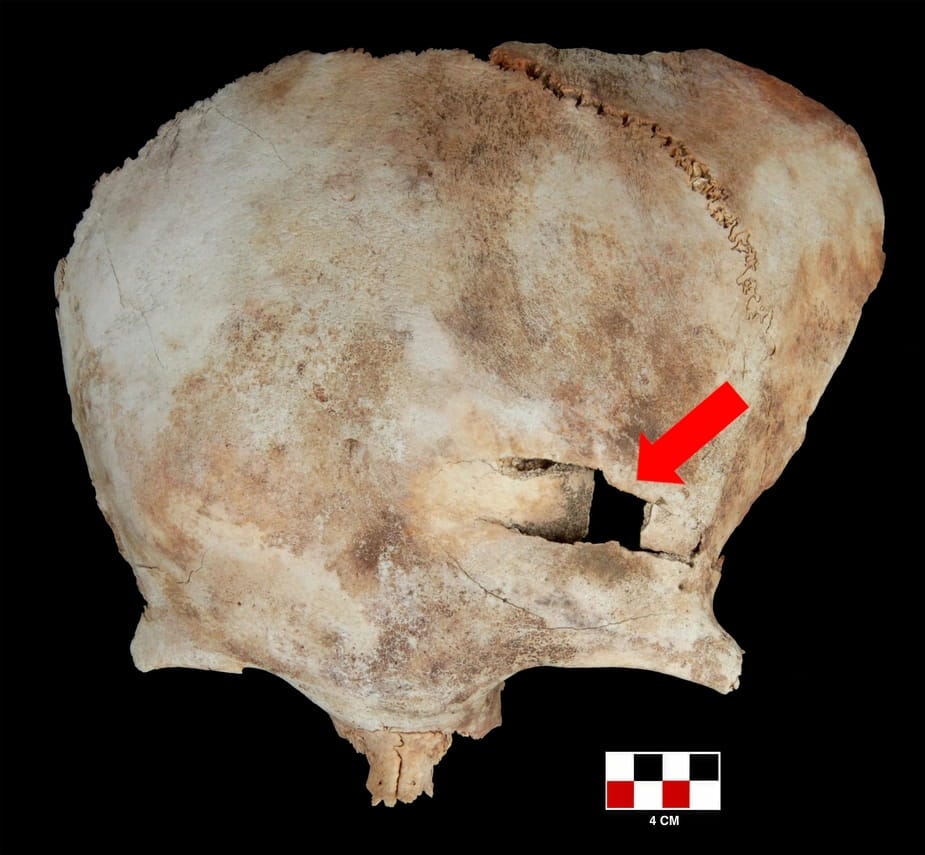
Chornancap Burial 48 comes from the lower Lambayeque Valley on Peru’s north coast and dates to the Chimú period, around 1375 to 1490 CE. The left side of the forehead carries a fracture from a blunt blow, and its edges show no healing, which bioarchaeologists (specialists in human remains from archaeological sites) call perimortem: the injury happened at or near the time of death. A new study of violence in ancient Peru uses this skull to illustrate what its authors counted as interpersonal violence. Among 1,519 skeletons from the valley preserved well enough to examine, spanning more than 3,000 years, they found 25 with skull injuries of that kind.That is a low count for a coast best known in the press for ritual killing. At Huaca de la Luna, a Moche ceremonial center, up to 107 adult men were sacrificed in six closely timed events around 550 to 600 CE, amid evidence of mud and heavy rain from an exceptionally strong El Niño, the periodic warming of Pacific waters that drenches this desert coast. At Huanchaquito-Las Llamas in the Moche Valley, more than 140 children and over 200 young camelids (llamas and their relatives) were sacrificed around 1450 CE, associated with a mud layer that may record El Niño flooding. Neither site is in the new dataset. Finds like these invite a reasonable inference: when the floods came, these societies turned violent, and mass sacrifice was the visible peak of a wider rise in killing over scarce food.Dr. Thomas J. Snyder of New York University and Dr. Haagen D. Klaus of George Mason University test that inference in a paper published November 9, 2026, in Frontiers in Environmental Archaeology, using skeletal records from the Lambayeque Valley Biohistory Project, which Klaus founded in 2002. The Lambayeque Valley Complex (the Lambayeque Valley, for short) consists of five river drainages more than 700 kilometers north of Lima, joined into one water network by the late first millennium CE. The team compiled records for 1,659 people buried at 30 sites, from the Cupisnique period to the Spanish colonial era. Twenty-six were dropped because they couldn’t be placed securely in time, and 1,519 had bones preserved well enough to score. Of those, 25 (1.6 percent) had skull injuries consistent with interpersonal violence, and 77 (5.1 percent) had fractures below the skull of the kind usually attributed to accidents.Neither kind of injury showed a detectable relationship with the two climate measures tested, highland rainfall and El Niño frequency. The authors also propose, without testing it, that the coast’s mass sacrifices were political and religious acts rather than a product of food shortage. For scale, they note that average rates of skull injury in some regions and periods elsewhere in the Andes reach 30 to 45 percent (Snyder and Arkush 2024).How do archaeologists measure violence from skeletons?The method rests on a convention in bioarchaeology: skull injuries count as probable violence, and fractures below the skull as probable accidents. Snyder and Klaus say plainly that this proxy, or stand-in, errs both ways, since a beating that bruises without breaking bone leaves nothing behind and some skull fractures come from falls. Their defense is specific to their question: an undercount doesn’t distort the comparison unless it changes with climate, as it would if fights in drought years tended to stop short of breaking bone.Climate is harder to measure, because the north coast is a desert that gets a few millimeters of rain a year; the water in its rivers and canals falls in the highlands above about 1,500 meters. So the authors measured drought at the source, using CHELSA-TraCE21k, a global climate simulation that estimates past rainfall in 100-year steps, sampled at random points across the valley’s highland headwaters. Simulations can’t reconstruct how often El Niño struck, so the authors used a per-century frequency record from sediment cores at Laguna Pallcacocha, a lake the paper describes only as near the valley.The hypothesis is what the authors call a Malthusian pathway, where scarcity breeds violent competition: drought or frequent floods should shrink harvests and push people toward fighting over food, and toward longer hours of risky work that breaks more bones by accident. Each person was assigned to one of 12 cultural periods, and each period got one average for rainfall and one for El Niño frequency. A Bayesian model then estimated how the odds of each kind of injury shifted with those values, alongside age, sex, colonial rule, and burial site, reporting each effect as a credible interval, a range of plausible values. For both kinds of injury, the 89 percent intervals for both climate measures straddle zero: the data can’t tell whether either one raised the odds or lowered them.I find the skull count convincing and the climate test much weaker, and the weakness comes from that design. Everyone who died in the Late Sicán period, from 1100 to 1375 CE, carries the same rainfall value, so although the model holds 1,633 people, the climate effect rests on at most a dozen period averages. The paper’s own history section describes an event this can’t resolve: a powerful El Niño between 1050 and 1100 CE, followed by a 30-year drought. Folded into averages for the Middle Sicán period (900 to 1050/1100 CE) and the Late Sicán period, each 150 years or longer, that drought shrinks to a modest shift in one or two numbers, set against only 25 injured people. Snyder and Klaus concede that rarity limits their power, which is why the abstract reports no strong evidence for an association rather than evidence against one.What counts as everyday violence in ancient Peru?The choice that shapes the headline number most is one the methods section barely describes: which deaths count. The authors study what they call quotidian, or everyday, violence, so like the regional surveys they build on, they remove sacrifice and massacre victims. It matters here: the paper cites evidence that perhaps more than 1,200 people were buried as offerings atop six monumental huacas, or sacred mounds, at the Sicán capital within as little as 50 years at the start of the Middle Sicán period (Klaus and Shimada 2016). Later Muchik communities, the Indigenous people of this coast, carried out smaller sacrifices at the Chotuna-Chornancap complex and at Túcume, both on the study’s site list.I don’t object to the split itself. Elite-staged mass sacrifice and a fight between neighbors are different social acts, and pooling them would make Lambayeque incomparable with other regions. My objection is that the paper never says how many individuals were removed on these grounds, or how a burial was judged ritual. Burial 48 is a person struck on the head around the time of death at a site with documented sacrifices, and the authors present it as interpersonal violence; I’d want to know what settled that call. And with massacre victims removed too, the measure captures violence between individuals, which may not be where competition over food shows up.Colonial burials are where I think the measure’s limits show most clearly. After the Spanish conquest, Muchik people were forced into colonial towns and exploited for their labor, and the region lost about 40 percent of its population before a slow Indigenous recovery began around 1600 CE. Yet the authors describe skull injuries in their two large colonial samples, from Mórrope and Eten, as nearly absent. The… This is a public episode. If you'd like to discuss this with other subscribers or get access to bonus episodes, visit www.anthropology.net/subscribe

Comments

Download from Google Play

Download from App Store
 United States