


 Claim Ownership
The Citi Institute Podcast
Subscribed: 11Played: 34
Subscribe

© Citi Production External
Description
Explore the forces shaping global markets, digital innovation, and economic progress.
18 Episodes
Reverse
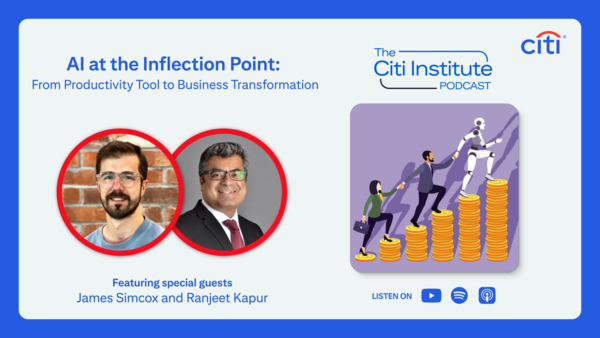
In this episode of The Citi Institute Podcast, host Alex Miller is joined by Ranjeet Kapur, Global Head of Fintech at Citi Commercial Bank and James Simcox, Group Chief Product Officer at Equals. They explore how artificial intelligence has moved from experimental back-office tool to a core driver of business model change in Fintech and corporate banking, focusing on payments, fraud prevention, customer experience, and emerging Agentic AI. Ranjeet Kapur comments that AI and machine learning have existed for decades, but recent advances in hardware and processing power have unlocked their ability to deliver value at scale. James Simcox explains how AI has rapidly shifted from small-scale experiments to pervasive deployment across Equals, with AI now writing around 86% of the firm’s code, up from 5–10% a year earlier, and transforming functions such as reconciliation, finance, fraud detection, and customer service. Together, they examine the rise of Agentic AI and discuss why a strategic approach to AI investment is becoming increasingly important.
Link to Citi Institute - https://www.citigroup.com/global/insights/citi-institute
Citigroup, Citi, and Equals are not affiliated and are independent of each other. Equals maintains a client relationship with Citi Commercial Bank. The speakers' views are their own and may not necessarily reflect the views of Citi or any of its affiliates. All opinions are subject to change without notice. Neither the information provided nor any opinion expressed constitutes a solicitation for the purchase or sale of any security. The expressions of opinion are not intended to be a forecast of future events or a guarantee of future results.

In this episode of the Citi Institute Podcast, host Alex Miller is joined by Paul Goody, Head of Balance Sheet Strategy and In-Business Risk, Treasury, Citi and Karen Dynan, Professor of the Practice of Economics at Harvard University.
They explore how the “mortgage lock‑in” effect—where homeowners with low fixed‑rate mortgages are financially disincentivized to move when market rates are much higher—has become a widespread drag on U.S. household mobility, housing affordability, and economic opportunity.
Paul explains how rising rates have left banks holding large portfolios of low‑coupon mortgages while many borrowers feel “golden handcuffs,” unable to relocate for family, job, or schooling reasons without sharply higher payments.
Karen highlights how constrained geographic mobility can limit access to better jobs and schools, while reduced turnover contributes to thinner housing markets, sharp post‑pandemic price increases, and worsening affordability that particularly harms younger and less affluent would‑be first‑time buyers.
Both speakers stress the need to design any new mortgage products, so they are fair, transparent, and genuinely beneficial to households, drawing lessons from “affordable” mortgage innovations before the financial crisis that ultimately produced poor outcomes for many borrowers.
Link to the Citi GPS report Moving America - https://on.citi/GPS_Moving_America_pdf
Link to Citi Institute - https://www.citigroup.com/global/insights/citi-institute

In this episode of Citi Institute podcast, host Alex Miller is joined by Alexander McWhorter, Citi Country Officer and Banking Head for Ukraine and Lenna Koszarny, Founding Partner and CEO of Horizon Capital.
They explore Ukraine’s remarkable economic resilience during the war, with many companies rebounding to pre-war revenue levels and others continuing to expand.
Alexander McWhorter highlights the strength of Ukraine’s economy, with GDP surpassing pre-war levels despite the ongoing conflict.
Lenna Koszarny outlines the scale of investment needed for reconstruction, emphasizing the significant opportunity for both private and public capital to support Ukraine’s recovery and long-term growth.
Together, they examine the opportunities ahead and the potential for sustained growth despite continued challenges.
Citigroup ("Citi") and Horizon Capital are not affiliated and not independent of each other. Horizon Capital maintains a client relationship with Citi through Citi Investment Banking. The speaker's views of their own and may not necessarily reflect the views of Citi or any of its affiliates. All opinions are subject to change without notice. Neither the information provided nor any opinion expressed constitutes a solicitation for the purchase or sale of any security. Expressions of opinion are not intended to be a forecast of future events or a guarantee of future results.

In this episode of Citi Institute podcast, host Alex Miller is joined by Tony Kim, Global Technology Team Head, BlackRock and Alex Watkins, Global Head of Technology Capital Markets, Investment Banking, Citi. Together, they explore how AI and the ‘Intelligence Revolution’ are the single biggest drivers of growth, and how the shift in value is moving from the top layer of software and labor services to the underlying computing infrastructure and AI models.
Tony Kim discusses breakthrough novelty and original invention as capabilities AI currently struggles to replicate.
Alex Watkins emphasizes that in certain areas of tech, being the lowest cost marginal producer will be key to winning, not just innovation and market position.
Together, they reflect on exciting opportunities and potential breakthroughs in space, quantum computing, and agentification.
Citigroup (“Citi”) and BlackRock are not affiliated and are independent of each other. BlackRock maintains a client relationship with Citi through Citi Investment Banking. The speakers’ views are their own and may not necessarily reflect the views of Citi or any of its affiliates. All opinions are subject to change without notice. Neither the information provided nor any opinion expressed constitutes a solicitation for the purchase or sale of any security. The expressions of opinion are not intended to be a forecast of future events or a guarantee of future results.

In this episode of the Citi Institute podcast, host Alex Miller is joined by Arvind Purushotham, Head of Citi Ventures, and Professor Carl-Benedikt Frey, DSF Associate Professor of AI & Work and Oxford Martin Citi Fellow.
Together, they explore the profound impact of AI and disruptive innovation on societies, economies, and institutions—and why imagination and human creativity remain essential drivers of progress, even as technology accelerates.
Arvind Purushotham explains how Citi identifies and invests in startups to bring innovative technologies into financial services, highlighting the critical role of trust and adoption in scaling AI and frontier technologies.
Professor Carl-Benedikt Frey discusses the distinction between exploration and exploitation in innovation, and why different institutions are better suited to each.
Together, they reflect on why disruptive innovation is rarely instantaneous, but instead unfolds gradually over time.
Explore the podcast: https://www.youtube.com/playlist?list=PL7807xkyz4XT6uWcwk9yI5IIF6UaFbubO
Citi Institute: https://www.citigroup.com/global/insights/citi-institute
Stay informed with timely perspectives on the trends reshaping industries and markets. Subscribe to the Citi Institute Newsletter here: https://www.citigroup.com/global/insights/citi-institute#newsletter
Citigroup, (Citi), and Oxford Martin School are not affiliated and are independent from each other. The speakers’ views are their own and may not necessarily reflect the views of Citi or any of its affiliates.
All opinions are subject to change without notice. Neither the information provided nor any opinion expressed constitutes a solicitation for the purchase or sale of any security.
The expressions of opinion are not intended to be a forecast of future events or a guarantee of future results.

Comments

Download from Google Play

Download from App Store
 United States