


 Claim Ownership
Hardpoints
Subscribed: 2Played: 6
Subscribe

© 2025
Description
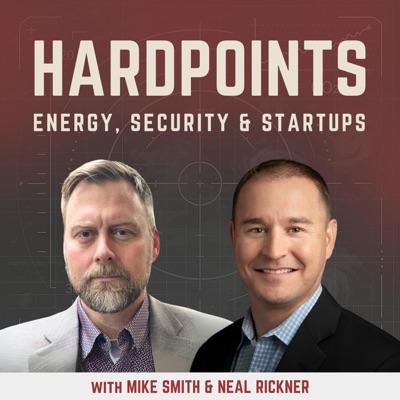
Every week, former fighter pilots and current entrepreneurs Neal Rickner & Mike Smith provide unfiltered insights into the biggest stories in startups, energy, and national security.
71 Episodes
Reverse
Louisville Slugger, the official bat of Major League Baseball, sits under a company controlled by a Chinese-led investor group. So does Arc’teryx. Isaac Stone Fish makes a living tracking exactly this kind of exposure, and he says most founders have more of it than they think.
Mike and Neal sit down with Isaac, founder and CEO of Strategy Risks and author of America Second: How America’s Elites Are Making China Stronger. Isaac spent seven years in China as a journalist. He explains what the Communist Party actually wants (control, not stability), why every Chinese company has to stay on its good side, and why the People’s Liberation Army is the party’s armed wing rather than a national military.
Then he gets practical. His China-exposure framework has four parts: supply chain, partnerships and politics, business fundamentals like investors and joint ventures, and regional ties like Xinjiang and Tibet. Mike brings the view from Aclymate, where supply chains for promotional products and branded merchandise run through Asia, and asks what a small importer should actually worry about. Isaac walks through the Uyghur Forced Labor Prevention Act, why a $4 million shipment stopped at port can make or break a company, and why a Chinese investor who’s harmless at Series A can become a real problem by Series C, once a federal grant is on the table. Neal, who runs Airloom, pushes on whether energy counts as a sensitive sector (Isaac says yes). They also cover how universities get entangled and whether there’s any ethical way to do business with the party at all.
In the mailbag, @heathershoe7429 asks about reports that the president will invade Iran after the midterms. Mike and Neal explain why they think a limited escalation is far likelier than an invasion of a country that size.
Goods, Bads, and Others: Mike enjoys a quiet weekend and a Broncos win, worries about the 82nd Airborne’s extended deployment, and takes on Palmer Luckey’s new cloned-dog startup, Warhound, which raised $200 million at a $1.2 billion valuation. Neal likes that troops get a day off to vote, notes that oil and gas profits are soaring, and admits his wife caught him talking to his AI.
Questions or comments? Email [email protected].
Follow Hardpoints wherever you get your podcasts. Hardpoints is brought to you by the Valor Media Network.
Every military satellite America owns launches with all the fuel it will ever have. When the tank runs dry, a satellite worth hundreds of millions of dollars becomes space junk. This week, Mike and Neal take a question from listener Aimee D. about whether the Space Force is sustainable, and the answer starts with a surprisingly thin supply chain: hydrazine, the main satellite fuel, comes from a single small plant in Louisiana.
Neal walks through why fuel is the real limit on a satellite’s life, from Landsat 7 running low to the $500 million geostationary satellites that sit over one spot for years. Then comes the main event. The U.S. demonstrated in-orbit refueling back in 2007, but NASA canceled OSAM-1, its big follow-on mission, in 2024. Meanwhile, China appears to have pulled off the first satellite-to-satellite refueling in geosynchronous orbit, roughly 22,000 miles up. Mike and Neal argue about how a country falls behind on something it invented, why the same technology can work as a tow truck or a hijacker, and whether the smarter bet is expensive satellites you can refuel or cheap ones you simply replace.
They also dig into what this means for the startup economy. Mike sees a golden age of space startups, driven by cheaper launches, autonomy, and venture funds flush with cash. Neal, who runs a hardware company, expects a cycle of wreckage first. And Mike makes the case that space is a commons, where debris is pollution and nobody has a plan to pay for the cleanup.
In the mailbag, @viveksmom asks whether someone can be an asset without knowing it, and @dodgingrain3695 argues that gas prices and the November midterms are driving the White House.
In Goods, Bads, and Others, Mike’s good is the Financial Times reporting on the collapse of diesel cars in Europe, his bad is the Ramaswamy campaign ad in Ohio’s governor race featuring Amy Acton’s estranged mother, and his other is the Colorado ballot measures on transgender youth. Neal’s good is the Brewers sweeping the Dodgers on their way to the World Series, his bad is the worsening situation in the Strait of Hormuz, and his other is two elections in one week: Brazil’s runoff and Israel’s vote.
Mike Smith runs Aclymate, a climate platform for businesses without a sustainability department. Neal Rickner runs Airloom, an emerging energy company. Send questions and comments to [email protected], follow wherever you get your podcasts, and share the show with someone who would appreciate it. Hardpoints is brought to you by the Valor Media Network.
Ukraine is hitting Russian oil refineries more than 3,000 kilometers inside Russia with a drone that costs about $55,000. Last weekend, the president of the United States told Zelensky to stop. Ukraine went along for three days. Then Russia answered with 39 ballistic missiles aimed at Ukraine’s power grid, and Zelensky says the block on refinery strikes is over.
This week, Mike Smith of Aclymate and Neal Rickner of Airloom pick up where last week’s diesel episode left off. Diesel hit a record this fall, the midterms are three weeks away, and the White House is easing sanctions on Russian diesel while leaning on Ukraine to stop hitting Russian refineries. Washington has stopped paying for this war, but it still controls Patriot sales, intelligence sharing, and a Starlink network owned by the richest man in the world. So what leverage does Trump actually have left — and is Zelensky wrong to ignore him?
Neal makes Trump’s case first — the US still holds the three levers that matter most to Ukraine, and Zelensky is gambling that Trump won’t pull them. Mike argues the opposite. In his read, Trump has given away his carrots, has few sticks, and has backed himself into a corner, while Zelensky has the support of his people and a European backstop that keeps getting stronger. They end up disagreeing about who is really cornered. They also look at what’s actually flying and what it’s hitting. The Ukrainian drone is built from foam, plywood, and carbon fiber — effectively a cruise missile for the price of a used car — and Mike explains why refineries make such good targets at the tactical, operational, and strategic levels. On the other side, Russia is going after power plants and substations as winter arrives, and Mike makes the case that it isn’t breaking anyone’s will.
In the mailbag, Amy D. asks about Space Force and the fuel it needs — a follow-up is coming. A reader from CIR Daily Updates also weighs in on last week’s episode, arguing the diesel deal may be less than the headline suggests, with no US buyer publicly committed and pump prices not moving. Their full analysis is on Cathrop Briefs. In Goods, Bads, and Others, Mike covers EVs gaining ground around the world, the rollback of PEPFAR, and Ukrainian drone strikes on Russian data centers. Neal covers Anne Carson’s Nobel Prize in Literature, the loss of Sergeant Major Anderson, and the UK prime minister saying it’s clear Russia interfered in the Brexit referendum.
Questions or comments? Email [email protected]. Follow Hardpoints wherever you get your podcasts, and share it with someone who would appreciate it. Hardpoints is part of the Valor Media Network.
A new Treasury license allows Russian diesel to be sold into the United States through April 7, 2027, after a phone call between President Trump and Vladimir Putin. The first announced shipment is 300,000 tons, about 2.25 million barrels. America uses about 3.7 million barrels of diesel a day, so the headline deal covers less than one day of demand. It comes from a country whose own fuel exports are collapsing under Ukrainian drone strikes on its refineries. This week, Mike and Neal ask what the deal is really for.
Mike starts with why diesel hurts so much: Russia and Ukraine are bombing each other’s energy infrastructure, and diesel runs the hay trucks, cattle operations and grocery supply chains the working economy depends on. It also reaches your plane ticket, because diesel and jet fuel come from the same part of the barrel. Land O’Lakes CEO Beth Ford puts the rise in farm input costs at $15 billion since February, with diesel roughly double.
Neal presses on the numbers and the motive. If the volume is this small, what did Russia give up? Mike’s answer is nothing, and he reads the deal as a political move ahead of the midterms that also leans on Ukraine’s president. Republican senators Collins, Curtis, Murkowski and Tillis have joined Democrats in objecting, and Mike asks why Congress is stopping at statements when it has levers to pull. Neal asks why the first call isn’t to Canada, our closest energy partner, and both hosts agree you phone your friend before your adversary.
Mike then pulls on a thread most coverage misses: the transshipment points that move Russian oil out of the Arctic, and his worry that the deal could widen the war. They close on a more generous reading, that the deal is a backroom trade to ease Iran’s pressure on the Strait of Hormuz. Neal says he would back that. Mike hopes it’s true but sees a simpler explanation.
In the mailbag, a listener says the F-35’s $1 trillion price tag covers 50 years of fuel, manpower and spares. Mike says the latest projection is closer to $2 trillion and argues that spending defense dollars well is how you look out for the little guy. Another listener asks whether data center water use is exaggerated and whether you could bury the buildings. Neal says the closed-loop and underground ideas have merit, while Mike says the heat, the noise and the power plants feeding them do not go away.
In Goods, Bads, and Others, Mike’s good is wind and solar gaining ground in Europe’s power mix, his bad is a surprise week of prep for a garage sale, and his other is a Dodgers title run that he fears could push baseball into a labor fight. Neal’s good is the Blue Angels turning 80, his bad is what high diesel prices are doing to farmers, and his other is playoff baseball.
Hosts Mike Smith, a former Navy F/A-18 pilot and CEO of Aclymate, and Neal Rickner, a former Marine Corps F/A-18 pilot and CEO of Airloom, unpack energy, national security, and the startup economy.
Questions or comments? Email [email protected] and we may feature yours on a future episode. Hardpoints is brought to you by the Valor Media Network.
Local opposition blocked or delayed an estimated $130 billion in data center projects in the first three months of 2026 alone. In Hazle Township, Pennsylvania, a developer tried to change that math by mailing every household a letter offering $10,000 if its 15-building data center campus gets built. The median household income there is about $60,000, and plenty of residents are still saying no.
This week, Mike and Neal ask whether paying your neighbors is the future of how America builds big things, or proof that some things can’t be bought. Neal draws on his time winning over communities for an energy project on the Big Island of Hawaii, where showing up early and often did what money never could. Mike argues that the fear of loss runs deeper than any check — and that a payout offered after the township already voted no was always going to look like a bribe.
They get into why people really object (power bills, water, secrecy, and distrust of the billionaires behind the projects), how wind developers pay their neighbors, and what a “pay your own way” power deal like Google’s with Xcel Energy in Minnesota looks like. They also cover why one township’s fight lands on a regional grid, and why the national security race for AI needs boundaries — not a stop sign.
In the mailbag, a listener asks about the U.S. military buildup in Palau. Neal shares what he saw landing on islands across the Western Pacific as a Marine in 2002, and why infrastructure out there matters in the competition with China. In Goods, Bads, and Others, Mike’s good is a political ad he recorded that has people recognizing him, his bad is $20 million in Homeland Security money going to ads featuring the president, and his other is Peter Thiel’s comments on evil and competence. Neal’s good is the return of Ali G, his bad is heating oil bills expected to jump more than 30% this winter, and his other is the Navy’s birthday.
Hosts Mike Smith, a former Navy F/A-18 pilot and CEO of Aclymate, and Neal Rickner, a former Marine Corps F/A-18 pilot and CEO of Airloom, unpack energy, national security, and the startup economy.
Questions or comments? Email [email protected] and we may feature yours on a future episode.
Hardpoints is brought to you by the Valor Media Network.

Comments

Download from Google Play

Download from App Store
 United States