


 Claim Ownership
Five Rules for the Good Life Podcast
Subscribed: 1Played: 8
Subscribe

© Darin Bresnitz
Description
The best advice usually comes from someone who learned it by living it. On Five Rules for the Good Life, I sit down with my favorite people from the culinary community and ask them to share five rules on something they know inside and out. Each episode gets straight to the good stuff: the habits, opinions, and little revelations that come from years of doing the work. Short conversations with plenty to chew on, and something you can bring into your own life at the dinner table and beyond.
The Guests
Chefs, restaurateurs, writers, bakers, artists, and the people who make food culture worth caring about. Some you already love; others you’ll be very happy to meet. All have a perspective worth learning from.
80 Episodes
Reverse
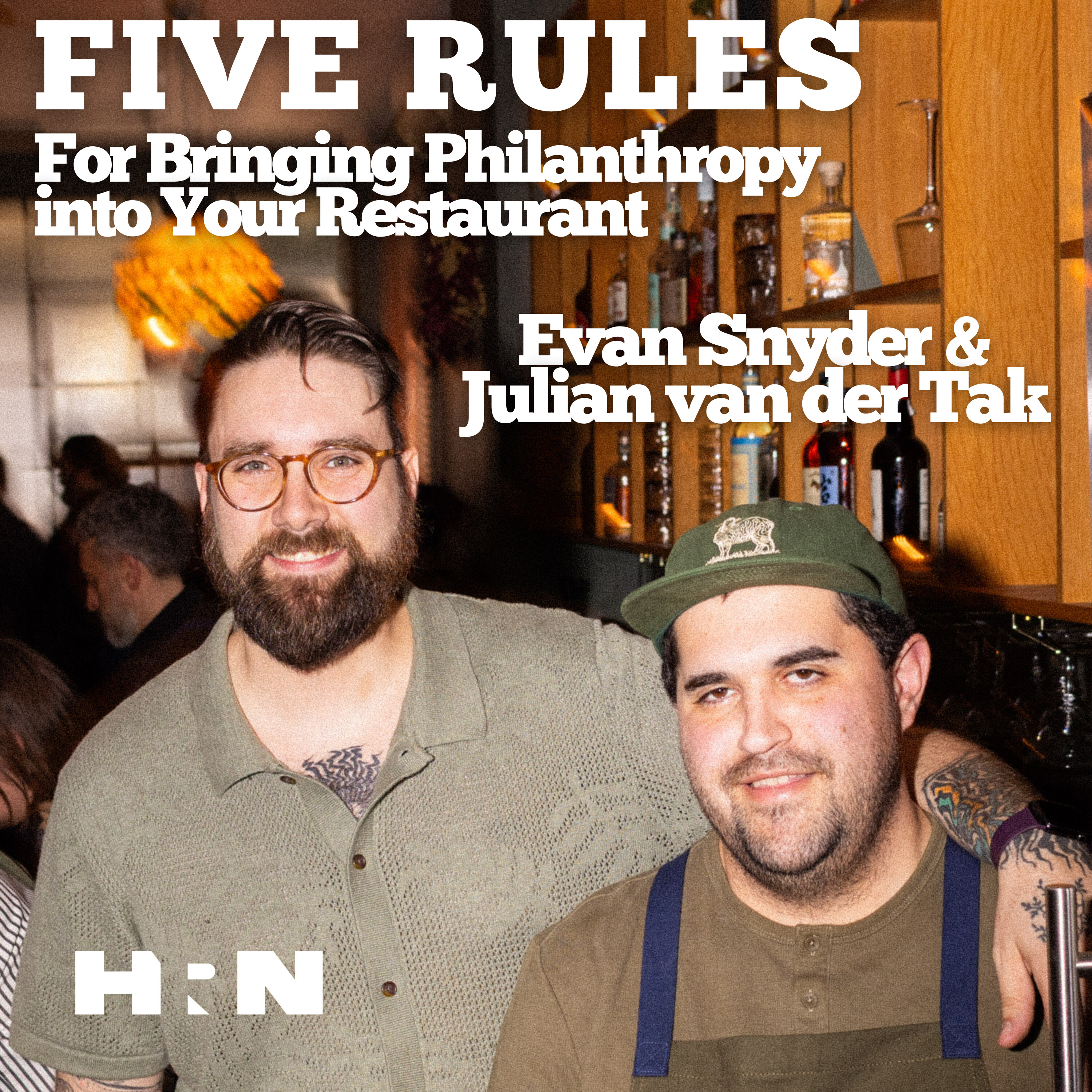
“If we have to sacrifice our time and money and labor, that’s a sacrifice we’re more than willing to make because having a more well-rounded, more understanding, more educated community brings benefit to the whole community, not just your restaurant.” ~ Evan Snyder & Julian van der TakThis week on Five Rules for the Good Life, I head home to Philadelphia to sit down with Evan Snyder and Julian van der Tak, the chef-partner and managing partner of Emmett, to share their Five Rules for Bringing Philanthropy Into Your Restaurant. We talk about choosing a cause that means something to you, recognizing how much you can give through your time, and finding partners who share your values. From supporting food access for children to working with local farmers and artisans, they share how caring for their community informs their decisions every day. It is an inspirational conversation for anyone looking to bring giving into their business or find more ways to show up for the people around them.What I love about this episode is how naturally Evan and Julian put community at the dead center of everything they do. Hearing them talk about celebrating other restaurants, buying from local makers, and making time to teach people makes me so proud to be from Philly. There is something deeply familiar in that willingness to show up for your neighbors and take pride in what someone else is building down the street. They understand that the people who grow their food, make their plates, work in their kitchen, and sit at their tables all contribute to what makes Emmett special. I have always loved how food brings people together, and hearing them talk about the responsibility and joy that come with that makes me even more excited to bring my family in the next time I’m home.Photo by Gab BonghiIntroductionHello and welcome to Five Rules for the Good Life.I’m your host, Darin Bresnitz. In honor of the holiday season and heading home to Philadelphia, I sit down with Evan Snyder and Julian van der Tak, who are the chef partner and managing partner, respectively, of Emmett.They are here to share their five rules for bringing philanthropy into your restaurant. They talk about the importance of picking a cause that means something to you, making giving a part of the business and not an afterthought, and never underestimating the power of bringing people and community together. It is an inspirational conversation for anyone who wants to add philanthropy to their restaurant and for those looking for a guide on how to make giving part of their daily life.Please take a moment to subscribe and rate wherever you listen to this podcast. So let’s get into the rules here on HRN. Evan and Julian, always a pleasure to be in my hometown of Philadelphia.I had such a nice time during the chef conference at Emmett. Thanks for sitting down.I’m happy to be here.Hospitality, Philadelphia, and the Stories Behind the FoodWhen people decide to open a restaurant, of course there’s the business side to it, but it seems that the hospitality is a much bigger driver. Why do you think that that is the more important part in the longevity of a spot?When I first got into this, it was always about the food. I want to cook at the best restaurants.Of course. Make the best food. Yeah.As I get older, the best part about this is making someone’s day, month, or year, and their anniversary, their birthday. To me, that’s a little more special than just making a really good plate of food, which is important, but I think the experience is more important. Being where we are in the industry, we obviously get the opportunity to go eat at a lot of wonderful restaurants as well.And 90% of the time, I frankly can’t remember what I eat. But what I can remember is how someone across from me felt while we were eating that food. How the table next to us was laughing or enjoying or celebrating.It’s really the human element of coming to eat at one of these restaurants that is just so important to us. It frankly is why we do what we do. Not to make an incredible plate of food, but to make sure that someone has a wonderful time eating that incredible plate of food.One of the best times I’ve had going out to eat recently was when I was back home in Philadelphia, which has become one of the greatest culinary cities in the country. How much of that is driven by the different communities in the city and your relationship with them?Philadelphia is so unique in its sense of community between the restaurants. We have so many great friends at some of the best restaurants in Philadelphia.Whenever I talk about them or to them or dine at one of their restaurants, I always view these people as peers of ours, not competitors. It’s beautiful. We all want success for each other.Obviously, the brass tacks is if someone’s eating at our restaurant, they’re not eating at someone else’s. That makes us happy from a business standpoint. Of course.But I love hearing that friends of ours, guests of ours went to this other restaurant, had a wonderful experience. I will always celebrate that for our friends in these other restaurants. That’s really, really unique because when you go to so many other places, most of the time it’s, I hope you come here and not there.I hope people get a chance to dine everywhere in Philadelphia because it has so much to offer. Frankly, the sense of community is what makes it so special.Evan, a lot of the food that you serve pulls from this macro Mediterranean Jewish family style culture of cooking.Yeah.How has that inspired the menu and what you serve at Emmett?I never cooked my grandparents’ food. I never cooked that professionally until this opened.Sure. I find myself cooking more and more dishes that my grandparents made. It didn’t seem interesting to cook food that I was so used to.I get it. But this restaurant is exactly that. It is like grandma’s house.It’s grandma’s cooking. Some of the best food you’ll ever eat is the most comforting food you’ll ever eat. I ended up going back to these memories as a kid, things I grew up eating, trying to make it not necessarily the thing my grandmother made, but maybe a little bit more elevated, maybe not as well done or burnt sometimes.If I might add, what most of the people look for when choosing a dining experience is they just want authenticity. Of course. They want to feel like they’re experiencing something genuine that either the restaurant or the chef has to say.And frankly, cooking anything but what our personal stories have to share would just be disingenuous. And we would not be doing great by our guests if we were choosing to make something or present something that wasn’t necessarily true to us and our stories.The fact that you’re driven by these stories, community and taking care of people, those aspects really make up the center and the drive of what you’re doing at Emmett. Makes me so excited for you to share five rules for bringing philanthropy into your restaurant.Rule One: Choose a Cause That’s Close to YouThe fact that the bottom line is consideration, but not the main driver of what you’re doing is really inspiring. Finding this that helps drive you daily makes up your rule number one.Choose a cause that’s something close to you. If you look at a lot of the work we do outside the restaurant from a community engagement perspective or a philanthropy standpoint, it’s our kids, right?I love it.In Philadelphia, obviously we know it’s a pretty underserved community in terms of civil infrastructure and public funding for support for children and food accessibility.We try to find ways to engage with those issues. Those are things that really, really matter to us. So when we look for ways to expend our energy and our time and what little money we have left to give, the kids and food accessibility for underserved children are really huge for us.Rule Two: Give Your TimeWhat do you think about the money that you have left to give, which isn’t always a possibility? Knowing that you want that to be a part of how you design everything from what you serve to what you charge to what the guests can expect makes up your rule number two.Other than money, time is a factor into this thing. Being able to give our physical time away to do an event, teach somebody something in a class I think is important.Money aside, time is a big part of it, giving our time.Rule Three: Build Relationships with People Who Share Your ValuesBeing able to do this is real easy if you’re a singular pop-up, one person, it’s just you all in. As you have more people involved from those who are working with you to those who are on the same level as you, it makes these decisions to run your business in a different way a little bit tougher, but by having this it allows you to make philanthropy a center of what you’re doing. What’s your rule number three?Our rule number three is that the relationships really matter. Finding partners that not only support us but also share our values, share our ideas, share our goals for our restaurant and our community is really really important. We have wives with two children at home. They can’t do that alone.I wish we could give more time to them and to our families. Oftentimes we can and sometimes we can’t. The adage of it takes a village is so real, not just at home but in business.Of course. We try to find people that share those same goals and those same values with us. When it comes to our ceramicware and our glassware that we use in the restaurants, all of that is local Philadelphia.That’s incredible.When it comes to the farms that we work with, all of those are within a hundred-mile radius. Having people that really ride for Philadelphia, that ride for the local industry, that ride for handmade artisanship are just added layers of the storytelling that we can do here in the restaurant.Rule Four: Serve the Community Beyond Your RestaurantBy engaging the community outside of what’s in the four walls that you’re in every day really is

“Great wine is wine that changes your life.” ~ Randall GrahmThis week on Five Rules for the Good Life, it’s my absolute honor to sit down with legendary winemaker, poet, and cultural visionary Randall Grahm of Popelouchum. Randall is the subject of The Terroirist, a documentary I produced alongside director Jeffrey Reiner, which is available now on Apple, YouTube, Amazon, and Google Play! He’s here to share his Five Rules for Making Great Wine. We talk about finding grapes that belong where they’re grown, knowing when to step in, and having the restraint to let the place come through in the glass. It’s a great conversation for anyone who’s ever wanted to make their own wine or wondered why a bottle can transport you to the place it came from.Getting to work with Randall and Jeffrey on The Terroirist has been one of the highlights of my career. I’ve heard Randall talk about his dream of making a wine that could only come from Popelouchum, and there’s something pretty extraordinary about walking that land with him and then getting to taste what he’s cultivated. Listening to him describe the peace of the place, as he pours you a glass of his own creation, you get a little closer to understanding what drives him every day. Getting to see him realize that dream in the wines he’s put into bottles, and getting to share that story with Jeffrey, has been something that will stay with me for the rest of my life.Photo by Jonathan RamirezIntroductionHello and welcome to Five Rules for the Good Life. I’m your host, Darin Bresnitz. It is my absolute honor to sit down with legendary winemaker, poet, and cultural visionary Randall Grahm, whose vineyard, Popelouchum, is making some of the best vintages in America right now.He is also the subject of The Terroirist, a documentary I produced alongside director Jeffrey Reiner, which is available now wherever you purchase or rent movies. He is here to share his five rules for how to make great wine. He shares the importance of starting with great grapes, intervening only when necessary, and doing everything you can to let the uniqueness of the terroir shine through.It is an inspirational conversation for anyone who’s ever wanted to make their own wine or to understand how a wine of place can be so great. Please take a moment to rate and subscribe to this podcast wherever you’re listening. So let’s get into the rules here on HRN.Randall, so great to see you. It was such a lovely weekend up in Santa Cruz and San Francisco. Thank you for making time for a chat.My pleasure.What Makes a Great Wine?Great wine can be so subjective. After all your years of working in the field and fields, how do you define it?Great wine is wine that slightly changes your life. It enriches your life. It’s an emotional experience. It moves you in some fashion.I love that. At your winery, Popelouchum, you’ve already made some great wine. What keeps pushing you and inspiring you to make more?Repetition compulsion, I think. Otherwise, I’d have to go out and get a job, which would really be a shonda.A real shonda.It’s what I love doing. You do what you’re competent at doing. You do what you do well, and you want to stay productive and busy. I do. I certainly want to continue to contribute if I can.It was an absolute pleasure to work on the documentary, The Terroirist, with you. What do you hope the viewer takes away about wine after watching the film?Oh my gosh. Where do you even start? The film tries to show that wine is not simply a package. It’s not simply a brand. It actually can come from a place.And the most interesting wines in the world are ones that come from distinctive places and have their own distinctive personality. Wines that exhibit soil characteristics or minerality or any goofy parlance that goes on have more meaning and more depth. I think ultimately they’re more satisfying to the consumer than simply wine brands, if you will.Of course. You have worked on great branding. You’ve worked on great wines.Forgive me, for I have Zinned.You lived through the ’80s and ’90s, and there are trends that we just don’t talk about anymore. But given your history, given your legacy, I’m so excited for you to share your five rules for how to make great wine.Rule One: Start with Great GrapesPart of what has driven your pursuits over all these years has been starting with really incredible, if not novel, fruit that comes from the earth, and that makes up your rule number one.Rule number one is start with great grapes. If you want to make great wine, start with great grapes.It seems so simple.It seems so simple, yes. But that’s the tricky bit. Where do you find great grapes? If you have the great fortune to discover a great vineyard that consistently produces great grapes, that’s great. Otherwise, you need to grow the grapes yourself. And that’s tricky because you don’t really know a priori if the vineyard is going to produce great grapes until you’ve actually tried.So that’s always a little dicey, but ultimately the most satisfying if you can pull it off.Rule Two: Don’t Screw Up the Grapes After You Harvest ThemOnce you’ve been able to find or even grow your own great grapes, it is easy to start getting in there and manipulating them. Your second rule talks about staying away from this type of practice. What’s your rule number two?Don’t screw up the grapes after you harvest them.Yes.One of the indications that you’re on your way to getting great grapes is that you don’t have to make a lot of giant interventions in the vineyard to produce the quality. In other words, there’s a good congruity of fit between the grape that you’re growing and the place that you’re growing it. It ripens at the right time, has the right balance of acidity. You don’t have to manipulate the wine after it’s harvested.The quality of the place gives you unique flavors, perhaps intensity, persistence. The grapes arrive in condition. They’re ready to make great wine. Then your job is not to mess it up at the winery.Messing it up means you can overthink it, overmanipulate it, whether it’s adding a lot of acid or enzymes or oak chips, God knows any number of additives. If you don’t have to do a lot of that kind of manipulation, you’re generally on the right track.Rule Three: Intervene with a Light TouchJust because you aren’t screwing with the grapes too much doesn’t mean you’re just taking them off the vine, putting them into the press, and pressing the juice out. There are some tips and tricks that you have learned over the years. A lot of it has to do with restraint, and this makes up your rule number three.Rule number three is make sure your interventions are a light touch. It’s sort of like film directors. Film directors can either be very interventionist or they can give their actors freer rein and more latitude.To that extent, I try to give my grapes a fair degree of latitude, keep them coloring within the lines. The idea is I’m not trying to impose my style so much as discover what the site itself wants to say.Rule Four: Keep the Makeup to a MinimumIt’s easy to hear you talk about restraint, not intervening with the grapes, and think that your wines don’t have multiple layers of flavor, which couldn’t be further from the truth.Right.But finding that right balance and not overwhelming the drinker makes up your rule number four.The French term is maquillage, makeup. You want to keep the amount of makeup down. For example, you don’t use new oak. New oak is a very flashy element that tends to overpower the unique qualities of the grape itself.It tends to make it more generic. Many people associate oak flavor with quality and high price. More often than not, you end up trashing your wine.We try to grow grapes that have lovely natural chemistry. So as a result, we don’t have to add acid to the wine. Without being too geeky, our wines tend to be lower in pH.Low-pH wines are microbially more stable. We don’t have to use as much SO₂ in the wine as other people might have to use. So we’re able to make wines in a less interventionist way. We can get by with using minimal additions to the wine.Rule Five: Find a Place with Its Own CharacterIn all of your work, in all of your journeys to find a land that speaks to you, you have found this incredible piece of land at Popelouchum.Yeah.Your fifth and final rule talks about how all the approaches that you want to put into the product that you make start with finding a real slice of heaven.Correct.What’s your rule number five?I am so incredibly fortunate to have found Popelouchum. You know, without being too New Agey or mystical about it, there is just a special quality to the place, a peace. There’s an energetic quality, if you will. I’m not sure exactly what the mechanism is of how that is captured and conveyed in the wine.There is a certain vitality in the wines themselves. Ideally, people might visit the vineyard. You get the ultimate gestalt to really capture the quality. You should see the place itself. It’s the same idea when you go to the farmers market and you know the grower. That gives you a much better sense of what it is that you’re consuming.When you understand the aesthetic, you understand the values. All those things contribute to the experience of the product itself.Find the Wines and Watch the FilmHaving visited, I can say it is one of one, an absolutely unique place. If people want to order your wines or join the wine club or see the documentary about your life’s work, where can they go?If you want to order wine, which is always a great idea, we do have a website, especially for the holiday season. It’s popelouchum.com. Then, of course, they can see the movie at theterroiristdoc.com. That’s going to be available after November 13thOn all streaming platforms.Cool.Randall, I am so excited to bring a bunch of the wines around for the holiday season and to celebrate what you’ve put in these bottles.Lovely to catch up. Sounds great.See Privacy Policy at https://art19.com/privacy and Califor

“Success is just a series of failures. If you didn’t experience failure, you would actually know nothing." ~ Brian BornemannThis week on Five Rules for the Good Life, I head to Santa Monica to sit down with Brian Bornemann, chef and owner of Crudo e Nudo and Bar Fortuna. A third-generation Angeleno, Brian shares his Five Rules for How to Break Out On Your Own. He talks about how growing up around his grandfather’s garden and the Pacific Ocean shaped his cooking, and how years of putting his head down and learning prepared him to recognize an opportunity when it arrived. It is a great conversation for anyone thinking about taking that first leap or finding the confidence to take another.One of the things I appreciate most about these conversations is when someone puts words to a feeling I have spent years trying to work through. Brian’s perspective on imposter syndrome- that everyone is living for the first time and bringing their own experiences to the table- was great to hear. Working across television, podcasts, writing, and now documentary film, there is always another room to walk into where I can convince myself that everyone else knows something I don’t. I love his willingness to put that feeling aside and get on with the work, along with his belief that every failure gives you something you can bring into your next attempt. There is a lot of freedom in allowing yourself to learn as you go, and a lot to admire in someone who keeps showing up with enthusiasm for whatever comes next.Photo by Catherine Dzilenski.IntroductionHello and welcome to Five Rules for the Good Life. I’m your host, Darin Bresnitz. Today, I’m on the west side in Santa Monica, hanging out with Brian Bornemann, who is the owner and chef of Crudo e Nudo and Bar Fortuna.He’s here to share his five rules for how to break out on your own. He talks about the importance of staying ready so you don’t have to get ready, ignoring imposter syndrome, and how success is moving from one failure to another without losing enthusiasm. It’s a great conversation about Brian’s journey from growing up in Santa Monica to owning his own restaurant and bar, and fantastic inspiration for anyone who’s ever wanted to strike out on their own.Please take a moment to rate and subscribe wherever you listen to podcasts. So let’s get into the rules here on HRN.Growing Up and Finding His Own PathBrian, so good to see you again. Thank you for the incredible hospitality when we were in last time at Crudo e Nudo. Welcome to the show.Thanks for having me, man.Such a pleasure to feature you and chat.You are born and bred in Santa Monica. How much of the ethos of local cooking and ingredients inform your upbringing?I started cooking at a young age.I didn’t consider cooking to be a career until much later in life. Third-generation Angeleno here. So I had grandparents who grew up in the city.We were lucky to grow up on lots of land with abundant fruit trees and chickens, plenty of room to garden. Beautiful. My grandfather was an avid gardener and horticulturalist.He’s really the one who imbued in me from a very young age how to just enjoy things at their absolute peak and prime. I didn’t think much of it at the time. I mean, it was just normal to me eating figs or peaches or blackberries or sapotes or passion fruit or guavas the best day when they’re just shining.In learning how to tend to vines, how to grow the best tomatoes, tend the soil, etc. was something that was just part of how I spent my weekends and how I grew up. What I love doing with Crudo and my style of cooking in general is focusing on what is good here and what we are already good at doing.Bringing the food culture back to what we have around us. That really is what drives me and informs me. We grew up with this abundant huge ocean right in front of us and yet no seafood restaurants that would focus on local fish.We have such good ingredients. It’s insane that there isn’t more readily available resources for buying local fish or buying proper ingredients outside of a farmer’s market. That’s really what keeps me going.You cooked in some incredible local restaurants as well. The Tasting Kitchen and Michael’s. Did you always have it in the back of your mind that you wanted to open up your own space?When I started cooking, I really put my head down and intentionally didn’t set any goals.I just want to cook pasta. I just want to learn how to butcher. I did not go into it being, I want to own a restaurant.Sure. When you put your head down and just focus and just try to improve a little bit every day, every week, new opportunities get presented. If you say yes, keep applying yourself well.Eventually it gets to the point where it became obvious to me that there is a gap. If you don’t feel that way, you certainly shouldn’t open a restaurant. I see a different way to do things and I know that I can do them.Opening a restaurant was not a question of like, oh, do I want to do this or not? It was more like, oh, I have to do this.What eventually gave you that confidence, that catalyst to launch the Crudo e Nudo pop-up and eventually the brick-and-mortar?I have always described it as I played a lot of football and rugby growing up and as a running back, sometimes you’ll get the handoff and you’ll be met with a wall of bodies and you can just see this one step here, this hole opens up and then I can just run straight through it. That moment was the pandemic.If you had a lease, you were so focused on just trying to stay alive that nobody was thinking about, oh, let me open another location. I was lucky to not have a lease at that point and have the ability to see a hole of, oh, well, everybody’s doing this takeout food stuff in to-go containers. I was like, man, if I just sliced some fish and put it on the plate and made it beautiful, gave people something totally different from what they were having at the moment, they’ll be rejoiced.I was lucky enough to have a good amount of food media in my corner already from the crudo program that I’ve built at Viale dei Romani. Being aligned with my goals and being from here, if I took that technique that I was now associated with and known for and applied that to a sustainable local product and be like, hey, I’m from here, this is from our ocean, here’s something you already know, look at what we’re able to do in this way that doesn’t exist yet. Everybody was so focused on Japanese fish or the best stuff from New Zealand or bluefin from Spain.There was always this exoticism to fish culture. There was this feeling that fish was better if it came from somewhere else. It’s all kind of happened at the same time that the local Ikejime movement was really taking off.We got timing, we got everybody else tied up, we got this quality of local fish improving to a world-class level. All these things just line up, I get to run through this hole. Being able to identify that opportunity, also being a native son of Santa Monica, along with understanding what it takes to honor the local ingredients, is why I’m so excited for you to share your five rules for how to break out on your own.Rule One: When You See a Window, Sprint Through ItA lot of the times, people are presented with an opportunity but are afraid or not confident enough to take it. Your first rule talks about what to do when that moment presents itself. What’s your rule number one?Rule number one is when you see a window, sprint through it.Windows don’t open up every day, sometimes it takes a major pandemic or something crazy to create that opportunity. What is unfortunate is when folks want to break out on their own or take the risk but aren’t actually willing to grab the ball and run full speed ahead, you’ve got to be able to sprint to the gap because otherwise you’re not going to make it. If you have hesitation, if you keep a foot in the door, if you’re like, well, I’m going to try this over here but I’m really going to keep a couple days a week over here as a backup plan, you’ve got to let go of the backup plan, let go of the safety net.Otherwise, energetically and emotionally, you’re not going to make it happen.Rule Two: Stay Ready So You Don’t Have to Get ReadyBeing in the restaurant industry for so long, you can probably count on one hand the amount of times that a real opportunity has come your way. Being in this mindset allows you to act when the right moment presents itself. What’s your rule number two?Rule number two is stay ready so you don’t have to get ready. Exactly. I just applied myself daily and weekly to being like, all right, what can I do to get better this week? What can I do better than last week? Not worrying about the people around me or the other cooks or chefs.I want to improve this because this is important to me, whether it was my butchery or my business acumen and understanding of P&Ls and food costing, etc. If you’re coasting, if you’re just, I’m comfortable here, I’m showing up, clocking in, clocking out, you’re not staying ready. No opportunity is going to come if you’re not pushing yourself and trying to improve.And that’s fine. It’s totally okay. It’s not how opportunity is going to strike you.Opportunity is going to strike if you are constantly working to be ready for the opportunity. Luck is 99% perspiration and 1% inspiration. I think that was Thomas Edison.You create your own luck by working to be ready.Rule Three: Don’t Give a Single Thought to Feelings of Imposter SyndromeEven though the opportunity might come your way, even though the moment is right, you might still feel like you’re not ready to take on that moment because you’re afraid of what other people think. Getting rid of this feeling makes up your rule number three.Rule number three is don’t give a single thought to feelings of imposter syndrome. Toss it. One beautiful takeaway from the pandemic is that it proved that we’re all trying to figure it out.Literally nobody knows what to do or what the plan is. In that way, it’s refreshing. It

“A partnership is also so much about having your own little parts of the restaurant that are actually just yours. Then we bring them together in a way that complements each other.” ~ Tatiana EttensbergerThis week I sit down with Tatiana Ettensberger, co-founder of Wilde’s in Los Feliz, who shares her Five Rules for Opening a Restaurant with Your Best Friend. As Wilde’s celebrates its first anniversary, Tatiana shares what she and her lifelong BFF and business partner, Natasha Price, have learned about building a business while protecting the relationship that started it. From making time for each other outside of service to encouraging time off and knowing when a secret code word is necessary, her five rules offer a thoughtful, funny, and honest look at working with someone you love.I have always loved the idea of building something with your best friend. Taking all those conversations, shared meals, and late-night plans, then turning them into a place where other people can make their own memories is a pretty incredible thing. What I admire about Tatiana and Natasha is how much thought they have put into making that work, giving their friendship the same care and attention they give Wilde’s. Being able to tell each other where they need help, cheer each other on when they take a night off, and recognize that an equal partnership can look different on either side of the kitchen door takes real trust. Hearing Tatiana talk about how their first year has brought them closer makes me even more excited to see what they build together next.Photo by Kort HavensIntroductionHello and welcome to Five Rules for the Good Life.I’m your host, Darin Bresnitz. Today, I sit down with Tatiana Ettensberger, who is one of the co-founders of Wilde’s, a Los Feliz restaurant that is celebrating its one-year anniversary.She’s here to share her five rules for opening a restaurant with your best friend. She talks about the importance of making time for each other outside of the restaurant to be each other’s biggest advocates and the outright necessity for having secret code words. It is a great conversation for anyone who is thinking about starting a business with a dear friend in their life or for anyone who’s already done so and is looking for a way to navigate their relationship.When you have a moment, please make sure to rate and subscribe to this podcast wherever you listen. So let’s get into the rules here on HRN.Tatiana, so good to see you. Congratulations. One year of Wilde’s. Thanks for making time for the show.Thank you so much for having me. I’m so excited.Friendship, Hospitality, and Building Wilde’sFor anyone who’s never worked in a restaurant, how would you describe those relationships that you form with the people you work with?There’s a couple ways that I could think about it.Anytime someone asks me how work is and how owning a restaurant is, the one thing that I’ll always say after a slew of negative things, I’ll try to turn it back around and be like, the best part of it and the reason why I entered it is you’re constantly having fun. That is so much to do with the camaraderie that happens when you work in restaurants together and it bonds everybody together. I think that’s what happens when you’re in any form of service industry.There is a bit of us versus them mentality that comes where you just have to be on the same team. Of course. Through that, you just end up truly becoming family.There’s a reason it’s called, as cheesy as it might be, family meal. Then you also end up spending pretty much all of your time with the same people every day. When you’re working dinner service, you’re spending time with people at the time when people are normally socializing with other friends.It just becomes your entire social life. I’m a huge Survivor fan. I feel like everyone who goes on Survivor, they all become obsessed with each other and are lifelong friends, even though they spend 28 days together.It’s because you’re going through intense adrenaline-filled nights, night after night.When you met your longtime friend first, business partner second, Natasha Price, did you immediately think we’re going to open up a restaurant together or did that come later?That is such a funny question because I was one and she was two. I don’t know if my brain even had real thoughts at that point.As we grew up, we spent every single day together. We came up with a lot of different things we were going to do with the rest of our lives. I love that.We were playing with Polly Pockets and every day they had a different story. I’m sure in there, they were owning restaurants for sure. Natasha was the one who knew from the jump that she was going to be a chef.We both found ourselves in New York a little bit later when we were in our early 20s. She was the CDC at Mina’s. I just started serving at these pop-ups that they were doing at MoMA PS1.That was our first time doing something together in service. It was just really fun. So cool.I was doing all sorts of other stuff and doing marketing. It wasn’t until I had this quarter-life crisis when we were both back in LA and she was also having a quarter-life crisis. She was private chefing and she missed the really wonderful creative elements that happen when you’re working in restaurants, also the camaraderie of working in restaurants.Of course. Mine was a bit of a bigger crisis because I was like, I don’t have a passion in this life and what am I going to do for the rest of my life? She was the one who was like, you are obsessed with natural wine and you host dinner parties every weekend. Maybe that’s your passion is hosting, eating good food and drinking good wine.I was like, oh, I guess I could do something with this. We started a supper club with two of our other friends, which was just out of her house in Highland Park. Even then it was still like, Natasha is going to open a restaurant one day.And I’m going to sit at the bar. I would ask questions. Am I going to get free stuff when I come to your restaurant? And then my career in wine and hospitality just started moving further and further along.Once I started managing at Cafe Triste, it became really clear that this was my life purpose too. Incredible. So then I was just lucky that there was a built-in best friend who was also this incredible chef.I love that. You’re celebrating one year of Wilde’s.Yes. Congratulations. Thank you so much.How has your working relationship with Natasha evolved?It’s not even like an evolution.It was a birth of it, which I think is something that we didn’t really think about going into this. So many people say, don’t enter a business with your partner. We’re like, oh, we’re not partners.We’re best friends. It’s fine. The reality is we had never really worked with one another.Interesting. It was a crash course in a lot of ways. Now I would say our relationship has never been closer.It’s incredible. And it feels more like a marriage than anything else. I was actually looking over my five rules earlier this morning and I was like, I feel like I just wrote how to be in a marriage.Not that I know what that’s like. She does, and it feels we’re closer to that than anything else. But that’s not to say there weren’t road bumps along the way, which I think is why I chose this to be the five rules.Because I think it is probably the growth of Wilde’s that I feel proudest of in a lot of ways. The fact that you’ve been able to have this lifelong friendship and then not just make both of your dreams come true, but to have them come true together is why I’m so excited for you to share your five rules for opening a restaurant with your best friend.Rule One: Schedule Monthly Dates That Have Nothing to Do with the RestaurantFor anyone who’s ever worked with a close friend, seeing each other every day is not always the same as spending time with each other and makes up your rule number one.Rule number one is to schedule monthly dates that have absolutely nothing to do with the restaurant. That’s so cool. Disclaimer.I don’t know if we follow this rule perfectly every month. It’s an idealistic rule. It’s the goal.Maybe it’s not even a monthly date. Maybe it’s one cigarette break where we’re like, okay, this time we’re not talking about anything having to do with the restaurant. It’s about carving out that time we spend every second together.We spend more time with each other than we do with our families, with our partners. There was a time where we would look at each other and be like, I have no idea what’s going on in your life. Part of that was that there was nothing else going on in our lives.At the beginning when heads were so underwater and all we were doing was this restaurant, when we would try to carve out time, there was honestly nothing else to talk about because all we did was breathe and sleep Wilde’s. Which you have to do. Yeah, totally.It was a rule that we had from before we opened the restaurant. Obviously, you don’t want to lose yourself in your business, but we also really didn’t want to lose each other in our business.Rule Two: Be Each Other’s Biggest Advocate for Time Off and Time AwayMaking that space for each other, respecting each other is so important to your relationship. Protecting that relationship with other people outside of it is equally important and makes up your rule number two.Number two is to be the other’s biggest advocate for time off and time away. This one I really learned from Natasha and learned by her example.It took months before either of us were out of service. The stakes of what we can do that for were really high at the beginning. Now we’re starting to get a little calmer about it.I took a night off to go see Robin. That’s something I never would have thought about doing in a million years a year ago. Fantastic show.I was so nervous to tell her, I’m going to have to take this day off for a wedding. She immediately was so jazzed for me and she was like, you have to do this. There’s no way that y

“Young people are drinking, but they’re being very particular about what they’re drinking.” ~ Eric BachA Note About The TerroiristBefore we get into this week’s episode, a big thank you to everyone who showed up for the Santa Cruz Film Festival and the Green Film Festival of San Francisco for the world premiere of our documentary, The Terroirist. We were absolutely honored to take home the Morton Marcus Award for Best Documentary Feature at the Santa Cruz Film Festival and are looking forward to taking the movie on the road to Austin, New York, LA, Minneapolis, and Fairhope, Alabama over the next few weeks. And if you can’t make it to any of the screenings, it will be available on streaming platforms on November 13th.What makes someone buy into a world instead of just buying a product? This week, I sit down with Eric Bach, co-founder of Good Boy Wine, to talk about his Five Rules for How to Build a World, Not Just a Product. Through their wines and annual Good Boy and Friends festival, Eric and his partners bring together food, music, art, and a community that shares their curiosity. We get into trusting your taste before everyone else agrees, knowing what to leave out, and creating experiences that give people a reason to show up. It’s a great conversation for anyone trying to turn their interests into something bigger—and figure out how to keep the magic intact as it grows.I’ve always been drawn to world-building. From making television to throwing events to putting together this show, I love finding ways to bring the people, food, music, and ideas I care about into the same space. That’s what I love about what Eric and his partners have built at Good Boy. You can feel their taste running through everything, and spending a day at Good Boy and Friends, I got to experience how all those pieces come together. There’s great wine in your glass, something you want to eat, music you want to hear, and people you’re happy to spend the afternoon with. It’s a world they clearly want to live in, and they’ve made it easy for the rest of us to want to join them.IntroductionNow on to this week’s episode. Hello, and welcome to Five Rules for the Good Life. I’m your host, Darin Bresnitz.Today, I sit down with Eric Bach, the co-founder of Good Boy Wine, whose annual festival, Good Boy and Friends, is LA’s preeminent wine, music, and food gathering. He’s here to share his five rules for how to build a world, not just a product. He talks about the importance of trusting your taste for mainstream consensus, how to make curation a part of your daily routine, and that by creating participation, not just consumption, will lead to a larger world.It is a great conversation for anyone who’s ever wanted to build anything and for those who want people to buy in to what they’ve built. Please take a moment to subscribe and rate this podcast wherever you listen. So let’s get into the rules here on HRN.Young People, Wine, and Finding CommunityEric, so good to see you. Thanks again for sorting me at the festival. I had an absolute blast. Five years, congratulations. Welcome to the show.Thank you. It’s good to be here. I hope you had a good time at the fest.There are endless articles about how young people are not drinking, but anyone who attended the latest iteration of your festival, Good Boy and Friends, saw that this is not the full story. What do you think the media is missing about young people in wine?That’s our whole mission, get young people drinking again. Someone needed to do it.Yeah.Young people are drinking, but they’re being very particular about what they’re drinking. They are wanting to do it in social settings. COVID really amplified, obviously, everyone working from home.People are looking for ways to participate and feel connected, feel part of the community. At the same time, they care about what they’re putting in their body. We take that into account as we’re putting this little festival together.Wine as a Vehicle for CultureThat social aspect really came through. What I enjoyed about the event was how it blended all these different aspects of art, music, and food. Where do you see wine sitting within culture at large?I can’t really separate my passions from my work. They’re seamlessly integrated. I view wine, especially naturally produced wine, as part of everything you’re doing. Whether you’re going to an art show, you’re going to a concert, you have a glass in your hand.Wine is a vehicle for the things that we like to experience. For me, it’s an excuse to create more of this world around it.I love the fact that Good Boy is driven by great wine design and also community that seems to be at the center of everything you do. Why is that focus such an important North Star for you?It’s honestly building this world that I want to exist in. Take this in Los Angeles in little pockets. There’s these micro communities.I wanted to be able to create it at a larger scale and bring all of these things together. I’m an art collector, wine, food, music, dogs, all these things. I look at it as a direct expression of my interests.I feel like if it’s something that I’m interested in, there are other people out there that would also like to experience that.Rule Number One: Build a World That You Want to Exist InHaving that vision, being able to stick to what you like as a guiding principle, while keeping in mind that you are creating something for a group of people at large is why I’m so excited for you to share your five rules for how to build a world, not just a product.Today, it’s so easy just to say, I’m selling you something. I just need you to buy it. But very little time do you get people to buy in to the larger idea of what you’re trying to create, which ties directly into your rule number one.The number one rule is build a world that you want to exist in.The things that I’m really obsessed with, wine, food, art, music, etc. It’s the things that make my work interesting. I can’t help but integrate them into what I do.I think a lot of people separate their work from their passion. It happens a lot. I can’t do that. It all is one thing. We only have one life to live. So why wouldn’t you express what you’re passionate about through what you’re working on?Rule Number Two: Trust Your Taste Before ConsensusBeing passionate about not just what you’re working on, but what you like, I think has gotten harder over the years. There’s so many different inputs of what people are into and what trends are going in which direction. It’s easy to get distracted from what you feel in your core is something that you really believe in.Your rule number two talks about following your own path before many others. What’s your second rule?The second rule is trust your taste for consensus.I love that.Everyone knows the general consensus out there. But I think if you’ve spent years really developing your taste and paying attention, you have to learn how to trust your own read before there’s proof that everyone else agrees.That comes with time. It comes with age. It comes with making mistakes. A lot of mistakes. Doing all of these things that eventually, hopefully you’ve had enough successes, even if they’re small, to where you’re like, okay, I can trust myself a little bit.Rule Number Three: Curate RelentlesslyBeing able to trust yourself really does mean not resting on your laurels. That can apply to business and growth. But I also think it applies to inspiration, getting out in the world and finding more stuff that you like, especially as what you like evolves with age.Your third rule talks about the idea of taking those inspirations and making them work for your world. What’s your rule number three?Rule number three is to curate relentlessly. I think it’s important to not only know what you like, but what you don’t like and what to say no to.I’ve had to do that my whole career through my agency at Space and Time. We know our values and if it doesn’t feel core to our values, then we say no to it. The same goes when we’re curating a festival, whether it’s a musician, a food vendor, wine vendor, et cetera.Your taste isn’t just what you like, but it’s also what you’re willing to leave out.Rule Number Four: Create Participation, Not Just ConsumptionBeing able to say no to things is such a lost art. And in a world where people want you to always agree with them, where you feel the pressure to, it can be isolating at times.If you are pushing this idea that you want people to be a part of what you built, it creates a flow both ways, which makes up your rule number four.Create participation, not just consumption. I build a much stronger relationships when I am experiencing things and participating in things rather than simply buying.Thinking about, Good Boy, what you’re doing as far as an experience goes, when you have a glass of wine. What’s in the glass is important, but what you’re doing is equally as important. And I wanted to build a brand and a world around that, not just the wine.Rule Number Five: Protect the Magic With StructureBuilding the framework for this world is extremely important. That doesn’t mean that you’re being conservative or everything’s this binary choice. Once you know the boundaries of what you want to make, what you put inside of it becomes really freeing.Your fifth and final rule talks about protecting what’s inside this box. What’s your rule number five?Rule number five, and this can often be the hardest one for creatives, is protect the magic with structure. A lot of chaos, creative chaos can work when it’s really tiny, it’s small, it’s just getting going.Once it grows, if you still have a lack of systems, it can really start destroying the creativity. That’s something we’ve had to learn the hard way on many occasions.Always.Whether it’s making wine or whether it’s building a festival, there’s definitely a lot of growing pains and you’re constantly learning and evolving. You have to build a team, you have to create structure that all

Comments

Download from Google Play

Download from App Store
 United States