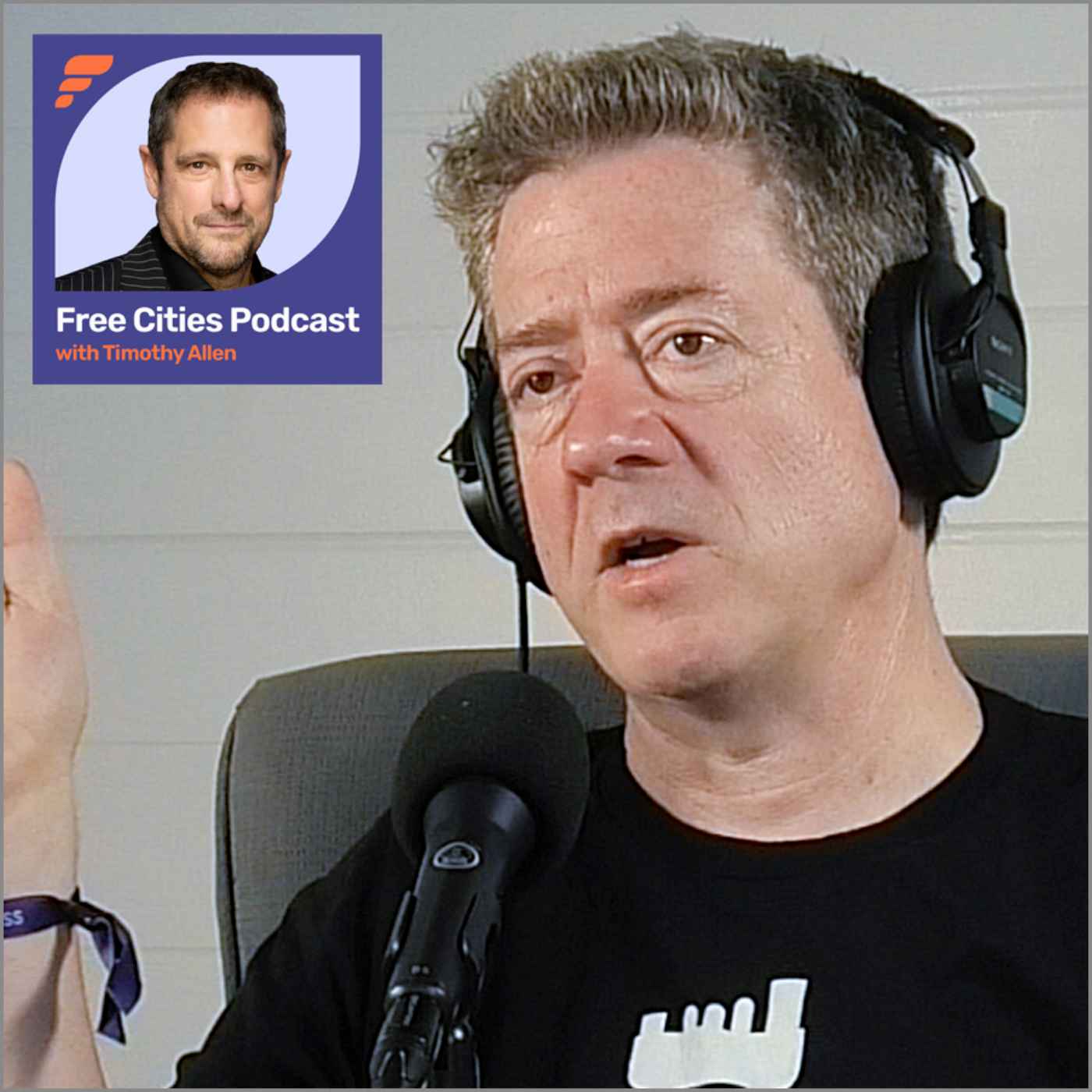
DiscoverFree Cities Podcast
Free Cities Podcast
Claim Ownership

Free Cities Podcast

Author: Timothy Allen

Subscribed: 33Played: 1,724
Share

Description

The Free Cities Podcast is the leading podcast covering alternative governance, new jurisdictions, and the global movement to build freer societies.


Hosted by Timothy Allen, the show features long-form, in-person conversations with the people building autonomous jurisdictions and real-world pathways to more freedom. We focus on what actually works, the legal structures, incentives, economics, and business models that turn freedom from an idea into a way of life. Builders and sceptics welcome.


Free Cities, Charter Cities, Special Economic Zones (SEZs), Network States, Startup Societies, Pioneer Communities, Intentional Communities, Popup Cities, Governance Innovation, Competitive Governance, Governance as a Service, Regulatory Innovation, Polycentric Governance, Geopolitics, Seasteading, Homesteading, Freesteading, Digital Nomadism, Flag Theory, Freedom, Liberty & Bitcoin.


We are the official podcast of the Free Cities Foundation. New episodes every Friday.

216 Episodes
Reverse
Can you escape bad government by moving your home out to sea? Timothy Allen sits down with American lawyer O. Shane Balloun, whose research into the legal position of seasteads helped inspire Joe Quirk’s involvement in the movement. This conversation examines what freedom at sea could mean when floating communities encounter existing laws, competing jurisdictions and governments with the power to intervene. Timothy has become increasingly convinced by the idea of a city whose residents can move their homes when they dislike how it is being run. But how far offshore would they need to go? What protection does a country’s flag provide? And could neighbouring platforms operate under different legal systems without creating problems for the people moving between them? O. Shane explores territorial waters, the contiguous zone, exclusive economic zones and the distinction between maritime law and the law of the sea. They discuss vessel registration, developments towards flagging seasteads in Panama, and why finding a favourable legal framework still requires an understanding of politics and power. That leads to a broader argument: the law is not a spell book. O. Shane explains why “sovereign citizen” scripts cannot simply remove a court’s jurisdiction, and why aspiring seasteaders need to distinguish the freedom they want from the protections a legal system can deliver. The conversation also explores competition between flag registries, the incentives behind regulation, Sealand, shared social norms and the choice between staying to fight and leaving for a new frontier. It ends with the American Constitution, natural rights and O. Shane’s view of the legitimate purposes of government. In this conversation: The legal research that helped bring Joe Quirk into seasteading Why a floating city appeals to Timothy as a model for greater freedom What changes at 12, 24 and 200 nautical miles offshore Flags, stateless vessels and the limits of legal protection The complications of connecting platforms under different jurisdictions Why the law is not a collection of magic words Common law, courts and the distinction between law and power Progress towards flagging seasteads in Panama, as discussed at the September recording Maritime law, the law of the sea, treaties and customary international law Whether competition between flag registries can improve governance Sealand, mobile communities and the practical meaning of exit Shared norms, declining trust and finding somewhere better to live Free speech, the American Constitution and rights that precede government Collective defence and the legitimate purposes of government Enjoy the conversation. Timestamps (audio version, includes Timothy’s episode introduction): 0:00:00 - Episode introduction: Bitfest, Freedom Fest and this week’s guest 0:03:36 - The January relaunch, midweek episodes and the new video home 0:08:59 - And finally: the first resident of a deserted Spanish village 0:10:29 - Start of conversation: O. Shane’s name and his connection to Joe Quirk 0:13:48 - Why Timothy has changed his mind about seasteading 0:16:34 - Territorial waters, the contiguous zone and exclusive economic zones 0:21:17 - Nation states, flags and the position of stateless vessels 0:24:38 - Could one floating city contain several legal jurisdictions? 0:31:38 - The law is not magic: sovereign citizens, jurisdiction and power 0:41:10 - Panama flags and the distinction between vessels and fixed structures 0:47:34 - Maritime law versus the law of the sea 0:53:57 - Treaties, customary international law and how the system works 1:03:00 - Regulation, commercial incentives and competition between flag registries 1:12:06 - Would O. Shane live on a seastead? Sealand and future floating cities 1:15:07 - The rule of law, shared norms and the freedom to leave 1:25:25 - Free speech and the power of the American Constitution 1:29:36 - Natural rights and the origins of the Bill of Rights 1:36:17 - What is the legitimate purpose of government? 1:38:22 - Supporting the show and closing remarks Guest: O. Shane Balloun | Seasteading research Links mentioned: O. Shane Balloun: The True Obstacle to the Autonomy of Seasteads: American Law Enforcement Jurisdiction over Homesteads on the High Seas, published in the University of San Francisco Maritime Law Journal, 2012 The Seasteading Institute Sealand The Bill of Rights: official transcription at the US National Archives Patrick Hiebert: Not Left, Not Right, Just Logical: What the Midterms Tell Us About Freedom Bitfest: Manchester, 19–22 November 2026 | Freedom Fest, where Timothy will be speaking on Saturday 21 November. Code FREECITIES applies to separate Freedom Fest tickets; a full Bitfest ticket includes Freedom Fest. And finally: Mariano’s return to Biamón, reported by Cadena SER, Spanish-language report published 15 November 2026 The Free Cities Podcast is the official podcast of the Free Cities Foundation, hosted by Timothy Allen. New episodes every Friday. Long-form, in-person conversations with the builders, investors, residents and thinkers shaping the future of Free Cities, charter cities, special economic zones, Network States, private cities and governance innovation worldwide. From 1 January 2027: the show becomes independent as Free Cities with Timothy Allen. The podcast feed stays the same. New video episodes will move to Timothy Allen’s YouTube channel, where clips and additional conversations are already appearing. Listen & follow: freecities.fm | All platforms | Fountain (bonus episodes & early access) Community: Telegram | Free Cities Foundation newsletter | Free Cities Conference Support the show: Donate via Stripe | V4V podcast apps Lead show sponsor: Veritas Villages - Freedom-oriented communities in Panama, Costa Rica and Nicaragua, with opportunities to generate power, grow food and rely less on outside systems. Bitcoin accepted for property purchases. Sponsor: AmityAge - Turning stranded gas into power for Bitcoin mining in Alberta. Accredited investors can follow the link to request details about the project. Follow: New YouTube channel | Free Cities Podcast on X | Free Cities Podcast on TikTok | Timothy Allen on X | Timothy Allen on Nostr | Free Cities Foundation on X
You can find land, raise money and design a new town. But what would make people actually move there? Timothy Allen sits down with Stacia Wilson, co-founder and Chief Community Officer of Meridia, a proposed new town near Austin, Texas. Before there are streets and houses, Stacia is working on the people: introducing prospective residents, building friendships and finding out what would persuade them to make a home together. Recorded in Próspera in September 2026, this conversation explores the practical problems of community building. Businesses need customers, residents need services, and knowing one person in a proposed community doesn’t mean you know your future neighbours. Stacia explains how Meridia is building its community through Austin meetups, and why she wants people trading with each other before the town exists. They also explore what kind of life that community could support. Drawing on Stacia’s childhood in Japan and Timothy’s experience raising three children, the discussion turns to independence, phones, schooling, motherhood, relationships and meaningful work. Can choosing the people and culture around you change how everyday life works? In this conversation: Building friendships before asking people to move somewhere together What anthropology and dance communities can teach us about culture Political disagreement, independent journalism and critical thinking First impressions of Próspera and the importance of everyday services Fractal NYC, walkable neighbourhoods and starting with an existing community Why land and funding do not automatically attract residents Creating a local economy before a new town is built Children’s independence, homeschooling and learning through useful work Whether shared expectations can change how families use technology Phones, social pressure and the difficulty of leading by example Relationships, feminism and different expectations of men and women Motherhood, ambition and integrating children into working life What Meridia could learn from Stacia’s childhood in Japan Enjoy the conversation. Timestamps (audio version, includes Timothy’s episode introduction): 0:00:30 - Introduction: the 2027 relaunch and a search for new music 0:03:29 - Raphaël Lima and the new midweek episode format 0:06:02 - Should the spoken introduction stay? 0:07:53 - Liberland: citizenship, membership and AI administration 0:09:29 - Fountain supporter thanks and the Manchester events 0:12:31 - And finally: tracking down a stolen Lancashire wall 0:13:46 - Start of conversation: AI researches the guest 0:17:02 - Growing up in Japan, anthropology and West Coast Swing 0:21:44 - Political divides, Second Look News and Curio 0:28:29 - Próspera’s culture, coffee shops and attracting families 0:34:02 - Fractal NYC, Culdesac and building a community first 0:41:52 - Austin meetups and getting future residents trading 0:45:27 - Stacia’s pitch: a town that makes family life easier 0:48:47 - Ambition, motherhood and children’s independence 0:52:45 - Can a different community culture change children’s phone use? 1:02:15 - Dating, Snapchat and choosing a partner 1:05:22 - The Queen’s Code and expectations of men and women 1:13:40 - Feminism, careers and integrating work with raising children 1:19:59 - Homeschooling and childhood freedom in Japan 1:23:05 - Trust, social pressure and the culture children grow up in 1:25:42 - Meridia’s community-building phase and getting involved 1:26:58 - Closing thoughts and supporting the show Guest: Stacia Wilson: Meridia team profile | Meridia | Meridia on X | Meridia Substack Links mentioned: Meridia: project information and getting involved | Meetups and events Curio: Stacia’s critical-thinking project Fractal NYC The Queen’s Code by Alison Armstrong Episode 208: Paraguay’s Banking Scandal: What’s Really Going On? | Raphaël Lima Liberland’s proposed Citizenship Act: citizenship and membership explained Liberland president’s November message: AI administration and Ethereum Bitfest: Manchester, 19–22 November 2026 | Freedom Fest, where Timothy will be speaking. Code FREECITIES applies to separate Freedom Fest tickets; a full Bitfest ticket includes Freedom Fest. Veritas Villages: community news and updates And finally: a hidden AirTag helps recover stolen historic wall stones in Rufford Timothy’s interview with Meridia co-founder Billy Tetrud, mentioned during the conversation, is forthcoming. The Free Cities Podcast is the official podcast of the Free Cities Foundation, hosted by Timothy Allen. New episodes every Friday. Long-form, in-person conversations with the builders, investors, residents and thinkers shaping the future of Free Cities, charter cities, special economic zones, Network States, private cities and governance innovation worldwide. From 1 January 2027: the show becomes independent as Free Cities, with the same podcast feed and new video episodes on Timothy Allen’s YouTube channel. Follow the channel now for clips and additional conversations ahead of the relaunch. Listen & follow: freecities.fm | All platforms | Fountain (bonus episodes & early access) Community: Telegram | Free Cities Foundation newsletter | Free Cities Conference Support the show: Donate via Stripe | V4V podcast apps Lead show sponsor: Veritas Villages - Freedom-oriented communities in Panama, Costa Rica and Nicaragua, with opportunities to generate power, grow food and rely less on outside systems. Bitcoin accepted for property purchases. Sponsor: AmityAge - Turning stranded gas into power for Bitcoin mining in Alberta. Accredited investors can follow the link to request details about the project. Sponsor: Blink - A Bitcoin and Lightning wallet for everyday payments and local Bitcoin economies. Follow: New YouTube channel | Free Cities Podcast on X | Free Cities Podcast on TikTok | Timothy Allen on X | Timothy Allen on Nostr | Free Cities Foundation on X
How does a bank that collapses on Monday leave the president under arrest by Friday? Timothy Allen speaks with Raphaël Lima, who lives in Paraguay, about the collapse of Ueno Bank. Paraguay’s central bank shut the digital bank down in the early hours of Monday 2 November. By Friday evening, the Senate had removed President Santiago Peña from office and he was under arrest. Raphaël takes Timothy through the week as it happened: the arrests at the bank, the resignation of the head of the central bank, the guarantee fund that began paying depositors within days, and the links to the bank that left Peña’s own party unwilling to defend him. He explains why most account holders lost very little, since many accounts held almost nothing, while Paraguay’s social security fund and other state bodies had large sums in the bank. Timothy asks whether Paraguay’s drive to attract investors and new residents survives this. Raphaël, whose company Settee helps people move to Paraguay, says demand from Brazil has surged since Lula’s re-election. They discuss why Paraguay held powerful people to account so quickly when bankers elsewhere rarely face consequences, why Ueno was so popular, and how loans to companies linked to its owner left it badly short of capital. Raphaël also explains why Bitcoin is still hard to use day to day in Paraguay, and how a new crypto reporting rule has changed things. The conversation then widens. Raphaël argues that voters, not politicians, decide how big the state gets, and that people rarely change their minds without pain. They discuss Javier Milei, Nayib Bukele, fusionism and why the right drifted away from free-market economics, and why Raphaël thinks small, like-minded countries are easier to govern. He ends by answering the question Brazilians keep asking him: should they still move to Paraguay? In this conversation: What happened in the hours after the central bank closed Ueno Bank How the deposit guarantee fund paid people back so quickly Who actually lost money, and how much state money was in the bank How the scandal reached President Santiago Peña Why Congress refused his resignation and impeached him instead Whether Paraguay can still attract investors and new residents Why Paraguayans held their leaders to account when other countries rarely do Why Ueno was so popular, and what went wrong inside it Bitcoin, crypto and Paraguay’s new reporting rule Whether this points to a wider financial collapse Javier Milei, Nayib Bukele and why the right lost its way on economics Why Raphaël thinks small, like-minded countries are easier to govern Whether he would still tell Brazilians to move to Paraguay Enjoy the conversation. Timestamps: 0:00:59 - Start of conversation 0:01:58 - The night Ueno Bank was shut down 0:03:19 - Arrests and a central bank resignation 0:04:12 - The deposit guarantee fund steps in 0:05:25 - How the scandal reached the president 0:06:08 - Social security and state money in the bank 0:07:48 - Resignation refused, impeachment and arrest 0:09:51 - Who actually lost money 0:11:45 - Paraguay’s push for foreign investment 0:13:06 - Settee and the rush of Brazilians after Lula’s re-election 0:16:32 - Has the collapse hurt confidence in Paraguay? 0:18:56 - How locals and foreigners reacted 0:19:58 - Why people went to jail in Paraguay and not elsewhere 0:24:22 - Was Peña seen as corrupt before this? 0:27:08 - Why so many Paraguayans banked with Ueno 0:30:28 - What went wrong inside the bank 0:32:58 - What happens to Ueno now 0:34:09 - Bitcoin and crypto in Paraguay 0:36:47 - The new crypto reporting rule 0:38:03 - What comes next for the investigations 0:40:40 - Is this part of a wider banking problem? 0:44:09 - How Brazil’s left and right are using the story 0:48:29 - AmityAge: turning stranded gas into power in Alberta 0:49:42 - Has this changed Raphaël’s view on financial collapse? 0:52:50 - Why voters, not politicians, decide the size of the state 0:54:44 - Is the West swinging back to the left? 0:58:14 - Fusionism and how the right lost its way on economics 1:03:01 - Why nobody has an incentive to shrink government 1:07:02 - Why change needs pain: Lew Rockwell and Javier Milei 1:14:27 - Nayib Bukele: too good to be true? 1:22:57 - Why small, like-minded countries are easier to govern 1:27:44 - Paraguay, Free Private Cities and choosing where you live 1:28:30 - Would Raphaël still tell Brazilians to move to Paraguay? 1:30:49 - Where to find Raphaël and Settee Guest: YouTube | X | Settee Links mentioned: Subscribe to Timothy’s new YouTube channel The Free Cities Podcast is hosted by Timothy Allen. New in-person episodes every Friday plus midweek news dispatches. We speak with the builders, investors, residents and thinkers shaping Free Cities, charter cities, special economic zones, network states, private cities and governance innovation worldwide. Listen & subscribe: freecities.fm | All platforms | Fountain (bonus episodes & early access) Community: Telegram | Free Cities Podcast newsletter | Free Cities Conference Support the show: Donate via Stripe | V4V podcast apps Lead show sponsor: Veritas Villages - Freedom-oriented communities in Panama, Costa Rica and Nicaragua, with opportunities to generate power and grow food. Bitcoin accepted for property purchases. Sponsor: AmityAge - Turning stranded gas into power for Bitcoin mining in Alberta. Accredited investors can request project details at the link. Follow: NEW YouTube channel | Free Cities Podcast on X | Timothy Allen on X | Free Cities Podcast on TikTok | Timothy Allen on Nostr
How do you start a city for nearly 100,000 people with just two employees? Timothy Allen sits down with Oliver Porter in Próspera to hear how Sandy Springs, Georgia, got its own local government and hired private companies to deliver most of its services. The mayor and council still set policy and budgets. The change was in who did the work. Sandy Springs had spent decades trying to become a city. When it finally got the go-ahead, Oliver faced an unusual problem: the new government had to be ready to operate on day one, but nobody could sign a contract on its behalf until the council took office. He explains how he approached companies willing to take that risk, how the city financed its first months, and what residents noticed when the new contractors got to work. The city kept changing the model. It moved from one main contractor to several, then brought some services back in-house in 2019. Oliver argues that splitting up the original contract lost some of the benefits of running services together. Timothy asks how you would tell whether the original model still worked better, especially when the city itself had grown and changed. The conversation then moves to Próspera, where Oliver says he serves on the council. They discuss what carries over from an established Atlanta suburb to a new development in Honduras, how Próspera differs from Ciudad Morazán, and whether an experiment in governance can keep its character after the people who started it step aside. Oliver also explains why he thinks Próspera’s visitor rules can make it harder to build trust with its neighbours. In the introduction, Timothy announces that the show will become independent on 1 January 2027 as Free Cities with Timothy Allen. The RSS feed stays the same, and new videos will move to his own YouTube channel. He welcomes Blink Wallet, explains last week’s Joe Quirk roast, covers two cross-border free zone stories and Sealand’s 59th anniversary, and shares a reminder about Bitfest and Freedom Fest in Manchester. And finally: why six priests have sold out a comedy show in Sandy Springs. In this conversation: Why Sandy Springs wanted local control, especially over zoning What a contract city outsources and what elected officials still decide How Oliver found a company willing to help start a city before it could sign a contract How the city got through its first months before tax revenue came in What residents noticed about roads and traffic signals Why police and fire followed a different route What changed when Sandy Springs split up its contracts and brought services back in-house How budgets, pensions and debt complicate comparisons between cities What Oliver took from Sandy Springs to Próspera How Ciudad Morazán and Próspera approach development differently Why founders step aside and what happens to their ideas afterwards How visitor rules and media coverage affect trust in Próspera Enjoy the conversation. Timestamps (audio version, includes Timothy’s episode introduction): 0:00:30 - Introduction 0:01:08 - Blink Wallet joins the show 0:01:37 - Going independent on 1 January 2027 0:03:20 - The audio feed, new YouTube channel and where to follow 0:07:47 - Introducing Oliver Porter and Sandy Springs 0:09:13 - What the Joe Quirk roast was about 0:14:20 - Veritas Villages: the first keys in Coronado 0:15:11 - AmityAge: turning stranded gas into power in Alberta 0:17:00 - Start of conversation 0:21:44 - From Sandy Springs to Próspera 0:22:34 - How a contract city works 0:24:21 - Why Sandy Springs wanted to become a city 0:29:50 - The political fight and the deadline for opening day 0:35:10 - Finding a contractor willing to take the risk 0:42:36 - How the new city paid its bills 0:44:31 - What residents noticed about local services 0:50:53 - Why police and fire were different 0:55:58 - Why Sandy Springs brought services back in-house 0:59:26 - Municipal pensions, debt and comparing budgets 1:05:13 - How Oliver got involved with Próspera 1:10:40 - Ciudad Morazán and a different approach to development 1:13:57 - Bringing elected representatives closer to residents 1:16:21 - Could the model spread to existing American cities? 1:19:51 - What happens when the founder steps away? 1:27:28 - Próspera’s political relationships and public image 1:32:06 - Visitor rules and trust 1:33:28 - What Próspera can learn from Sandy Springs 1:36:45 - Supporting the show and staying connected Guest: Oliver Porter | The Sandy Springs contract-city model Links mentioned: Subscribe to Timothy’s new YouTube channel Follow the Free Cities Podcast on Apple Podcasts Last week’s conversation with Joe Quirk Johor–Singapore Special Economic Zone: the committee’s investment update Al Mazunah Free Zone: Oman–Yemen trade forum Sealand: the story of Roy Bates and Roughs Tower Bitfest UK, Manchester, 19–22 November 2026 Freedom Fest, Pendulum Hotel, Manchester, Saturday 21 November 2026. Timothy will be speaking. Use FREECITIES when buying a separate Freedom Fest ticket. Full Bitfest tickets include Freedom Fest access. 40HPW on OnlyBoosts The Free Cities Podcast is the official podcast of the Free Cities Foundation, hosted by Timothy Allen. New episodes every Friday. Long-form, in-person conversations with the builders, investors, residents and thinkers shaping Free Cities, charter cities, special economic zones, network states, private cities and governance innovation worldwide. Listen & subscribe: freecities.fm | All platforms | Fountain (bonus episodes & early access) The Free Cities Podcast is the official podcast of the Free Cities Foundation, hosted by Timothy Allen. New episodes every Friday. Long-form, in-person conversations with the builders, investors, residents and thinkers shaping Free Cities, charter cities, special economic zones, network states, private cities and governance innovation worldwide. Listen & subscribe: freecities.fm | All platforms | Fountain (bonus episodes & early access) Community: Telegram | Free Cities Podcast newsletter | Free Cities Conference Support the show: Donate via Stripe | BTC: bc1q5jun0nzxzqepch84rqk0jnv0rd8uvns28df7mg | V4V podcast apps Lead show sponsor: Veritas Villages - Freedom-oriented communities in Panama, Costa Rica and Nicaragua, with opportunities to generate power and grow food. Bitcoin accepted for property purchases. Sponsor: AmityAge - Turning stranded gas into power for Bitcoin mining in Alberta. Accredited investors can request project details at the link. Follow: New YouTube channel | Free Cities Podcast on X | Timothy Allen on X | Free Cities Podcast on TikTok | Timothy Allen on Nostr | Free Cities Foundation on X
Seasteading has reached “escape velocity”, says Joe Quirk. But can AI help him tell its story? Timothy Allen catches up with Joe Quirk, president of the Seasteading Institute, in Próspera. Fresh from Timothy’s tongue-in-cheek conference presentation, which included a section entitled “Don’t Listen to Joe Quirk”, one of the podcast’s most familiar returning guests arrives ready to defend himself. First, there is seasteading news to discuss. Joe reports that an ArkPad floating home has secured a Panamanian flag, a milestone for a design intended to operate in international waters. He also describes a floating resort in the Philippines that moved after trouble with local authorities and found a more welcoming jurisdiction. What changes when a business can take its buildings with it? Timothy then tries to discover whether Joe ever thinks about anything other than seasteading. That takes them into his garden, his writing routine and his book about Chad and Nadia’s escape from Thailand. Built from years of interviews, the story brings together a manhunt, a love story and the beginnings of a seasteading movement. But how do you turn all that material into a book people cannot put down? Timothy thinks AI could help Joe sharpen the manuscript. Joe wants the response of a real human reader. Their disagreement opens up questions about creativity, honest criticism, privacy and trust. Does useful feedback depend on who gives it? What does an artist need from an audience? And can synthetic voices convey the fear, humour and humanity of a true story? In this conversation: What happened when Timothy roasted Joe at the Free Cities Conference Using a podcast archive and AI to develop a comedy presentation Cruise ships as a practical example of private governance What a Panamanian flag means for the ArkPad project Combining floating accommodation, tourism and fish farming How moving a business can change its relationship with local authorities Joe’s writing routine and the difficulty of switching off Telling Chad and Nadia’s story through their own words Whether AI can offer useful criticism without being a human reader Manuscript privacy, trust and the provenance of feedback The Odyssey, the hero’s journey and finding patterns in real events Editing, self-publishing and the challenge of producing an audiobook with multiple voices Enjoy the conversation. Timestamps (audio version, includes Timothy’s episode introduction): 0:00:00 - Episode introduction 0:00:30 - Welcoming Joe back and taking the conversation beyond seasteading 0:04:25 - Freedom Fest, Bitfest UK and the FREECITIES discount code 0:05:23 - Próspera, Shakespeare and a new critique 0:06:19 - Research into charter cities and the offshore world 0:07:30 - Veritas Villages: communities in Latin America 0:08:44 - Value-for-value supporters and listener feedback 0:09:40 - AmityAge: owning the energy behind Bitcoin 0:11:21 - And finally: Kitimat elects a dog mayor 0:13:04 - Start of conversation: “Don’t Listen to Joe Quirk” 0:16:10 - When a failed presentation turns into improvised comedy 0:19:41 - How AI helped Timothy build the roast 0:22:57 - AI, poetry and the father-daughter bond 0:26:24 - Cruise ships and private governance in practice 0:28:37 - A Panamanian flag for an ArkPad 0:32:38 - Testing the structure and preparing it for life at sea 0:33:32 - Floating resorts, fish farming and the business of seasteading 0:37:54 - Moving a business to a better jurisdiction 0:39:38 - Territorial waters and the limits of freedom at sea 0:41:40 - Does Joe ever stop thinking about seasteading? 0:44:08 - Writing routines, dictation and AI assistance 0:47:30 - Is AI impressive, and where does the human contribution begin? 0:53:15 - Chad and Nadia: telling a true story in their own voices 0:58:06 - What is an AI agent? 1:01:14 - Could AI help edit Joe’s book? 1:07:10 - Why the response of a human reader matters 1:18:30 - Manuscript privacy and sharing unpublished work 1:19:20 - Human feedback, target audiences and judging criticism 1:27:24 - Would AI feedback mean the same if you thought a friend wrote it? 1:30:22 - The Odyssey, archetypes and the hero’s journey 1:37:45 - Writing a book people cannot put down 1:42:07 - Self-publishing, audiobooks and human actors 1:46:43 - Closing thoughts and testing AI on an older manuscript 1:47:27 - Supporting the show and staying connected Guest: Joe Quirk on X | The Seasteading Institute | The Seasteading Institute on X Links mentioned: ArkPad Previous conversations with Joe Quirk Freedom Fest, Pendulum Hotel, Manchester, Saturday 21 November 2026. Timothy will be speaking. Use discount code FREECITIES when booking your Freedom Fest ticket. Bitfest UK, Manchester, 19–22 November 2026. Bitfest tickets include Freedom Fest access. Próspera Inc., Prospero’s Island? Reflections on ICONS 2026’s Keynote Northumbria University: Dr Alexandra Hall’s Philip Leverhulme Prize and research into the offshore world And finally: Gus wins Kitimat’s Dog Mayor election The Free Cities Podcast is the official podcast of the Free Cities Foundation, hosted by Timothy Allen. New episodes every Friday. Long-form, in-person conversations with the builders, investors, residents and thinkers shaping the future of Free Cities, charter cities, special economic zones, network states, private cities and governance innovation worldwide. Listen & subscribe: freecities.fm | All platforms | Fountain (bonus episodes & early access) | Subscribe to the new Free Cities YouTube channel Community: Telegram | Free Cities Foundation newsletter | Free Cities Conference Support the show: Donate via Stripe | BTC: bc1q5jun0nzxzqepch84rqk0jnv0rd8uvns28df7mg | V4V podcast apps Lead show sponsor: Veritas Villages - Freedom-oriented communities in Panama, Costa Rica and Nicaragua, with opportunities to generate power, grow food and rely less on outside systems. Bitcoin accepted for property purchases. Sponsor: AmityAge - Turning stranded gas into power for Bitcoin mining in Alberta. Accredited investors can follow the link to request details about the project. Follow: Free Cities Podcast on X | Timothy Allen on X | Timothy Allen on Nostr | Free Cities Foundation on X
loading
Comments