


 Claim Ownership
The Journal of Space Commerce Podcast
Subscribed: 0Played: 0
Subscribe

© Ex Terra Media, LLC
Description
This podcast focuses on issues related to the commercial space industry, and the impacts for people on Earth
www.exterrajsc.com
www.exterrajsc.com
172 Episodes
Reverse

NASA said Friday that the designs and flight plans for two commercial crewed Moon landers have changed. The goal is a 2028 landing.“Regardless of who goes first, both providers are planning for lunar landing missions in 2028.” Jeremy Parsons, NASAThe changes affect landers from Blue Origin and SpaceX. NASA gave details in a news release and at a news conference at Kennedy Space Center in Florida.Artemis III will stay in low Earth orbit next year. Four astronauts will practice docking Orion with test versions of both landers. NASA officials said Artemis IV is the mission planned to land astronauts.Neither company is assigned to that mission. NASA said it will decide later, based on lander readiness.Jeremy Parsons, NASA’s Artemis program manager, said the agency will wait.“The uncrewed demonstrations for us are gonna provide critical operations to reduce risk for our initial surface mission. It’s gonna allow us to learn how do we start and restop cryogenic engines on the moon rather than hypergolic. We’re gonna understand kind of the conditions of the regolith at the South Pole, plume conditions and surface interaction, thermal performance of the landers, and really is gonna be a critical stepping stone to the eventual lunar landing. If all goes according to plan, we’ll also have a lunar terrain vehicle on the lunar surface by the time the first Artemis astronauts arrive near the South Pole, giving us additional options as the moon base begins to take shape. NASA and we intend to wait as long as possible to make a decision about which provider is ultimately going to provide the first American astronauts back to the moon in 2028,” Parsons said. “And so this is, again, really trying to go along with them in the development cycle, and we have dedicated teams working hand in hand with both providers, marching along the way, doing everything we can to accelerate. Regardless of who goes first, both providers are planning for lunar landing missions in 2028.Both landers will reach lunar orbit differently than first planned. The Starship lander will wait for Orion in Earth orbit. The two will dock there. Starship will then fire its engines to push the combined stack to low lunar orbit. NASA said it is modifying Orion for that push.Blue Origin will skip propellant transfer. It will use three transfer stages to carry its Blue Moon Mark 2 lander to an elliptical polar orbit.Both companies must fly an uncrewed demonstration mission before NASA’s crewed landings.SpaceX still plans to refuel Starship in orbit. At the news conference, a reporter asked about a figure of 22 refueling flights, cited at a panel the day before. Parsons said NASA is not tracking that high.“So we were definitely not tracking as high as 22 unless your transfer efficiency and performance wasn’t the same, so I would say Elon’s answer of six to eight is probably more, again, what SpaceX is planning to,” Parsons said. “What I will tell you is our propellant transfer demo is really gonna be probably the best method we have to really figure out exactly how many we’re gonna need.”Parsons said six to eight flights is closer to what SpaceX is planning. He said early, conservative estimates put propellant loss in transfer between 5% and 10%.NASA officials said Artemis III is running 90 days behind schedule.The mission is planned for summer 2027. NASA Administrator Jared Isaacman said work ahead includes a tanking test of the rocket at the end of this year.Parsons said the delay traces to the supply chain.“So right now it’s supply chain for the lunar builds that are really kind of driving it. And so kind of what you’ve seen in terms of the broader industrial supply base right now is you have a number of components that, you know, may get outclassed for certain DOW builds, you know, that are kind of higher rated.”Parsons said avionics was the key item. He said Blue Origin is returning its New Glenn rocket to flight after an incident in May. Blue Origin is aiming to restart pad operations in November, Parsons said.The baseline Artemis III mission lasts 14 days and can extend to 17. Blue Origin’s test lander launches first on New Glenn. Orion follows on SLS and docks with the lander. The crew will enter it.Starship launches from Florida later. Orion will dock with it for about two hours. The crew will not enter Starship.NASA is also adding a stretch Centaur upper stage as an option for SLS, alongside the existing upper stage. Parsons said the stretch Centaur carries about 50% more propellant than the standard Centaur. NASA switched to it from the Exploration Upper Stage.“When we switched from the EUS to the centaur, we did so very deliberately. We simply did not have confidence that EUS could meet our timelines or the cost and schedule growth that we were seeing was acceptable,” Parsons said. “The centaur is a vehicle that is in production, that NASA and ULA know well and one that is capable of achieving our missions.”NASA and Axiom Space are also developing a second suit configuration for early missions. Parsons said it cuts suit mass from a little over 500 pounds to about 250 pounds.Parsons said NASA expects to choose between the two SLS upper stages around next summer, near the time of Artemis III. This is a public episode. If you'd like to discuss this with other subscribers or get access to bonus episodes, visit www.exterrajsc.com/subscribe
By all accounts Earth orbit will be a major driver of the world’s economy in the coming decades. Companies are developing processes for manufacturing and medical research in microgravity, as well as infrastructure for communications, satellite life extension and national defense. It is a very exciting time to be in the business of space.“We see this platform as something which is very complementary with a future commercial infrastructure. And obviously, as investors invest and scale these opportunities, this is very valuable channel for them as well.”Sven Eenmaa, ISS National LabsThe ISS National Laboratory Orbital Edge Accelerator was created to identify and support companies with great ideas, but which need funding to get those ideas off the drawing board and into space.On this edition of The Journal of Space Commerce Podcast, Tom Patton talks with Sven Eenmaa, ISS National Lab Chief Economist about the program, its scope and funding, and how interested companies can get involved. This is a public episode. If you'd like to discuss this with other subscribers or get access to bonus episodes, visit www.exterrajsc.com/subscribe
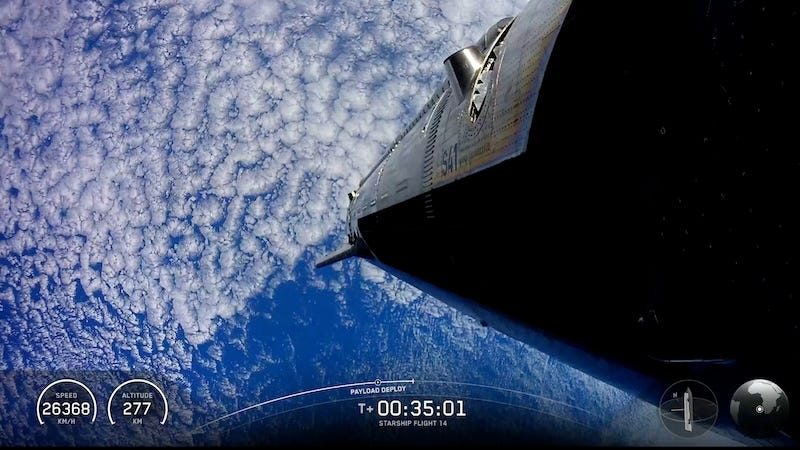
A SpaceX Starship reached orbit on Test Flight 14, marking a significant milestone towards NASAs goal of building an ongoing human presence on the moon.Starship lifted off as its launch window opened at 7:48 am local time at Starbase Texas. The super heavy booster performed mostly nominally, though one of the 33 Raptor engines did shut down prematurely. Still, the mission continued with a clean stage separation and booster return to Earth, splashing down in the Gulf of America about 8 minutes after launch. The booster simulated the manuver that will be needed for a capture back at Starbase, but it did not attempt that land recovery on this mission.There were more tense moments when one of the two Raptor Vac engines on Ship failed during the initial ascent. But the SpaceX team determined that since the sea level engines were all that were needed for orbital insertion and de-orbit burn, the mission could continue. Through the Starlink relay, SpaceX was able to provide spectacular images of Earth and the spacecraft in orbit while a batch of 28 operational Starlink V3 satellites were deployed.Ship did not complete the planned six orbits of the Earth. The de-orbit burn was initiated after just one full orbit, with splashdown occurring in the northern Pacific Ocean. The mission was cut short after mission controllers determined that all objectives had been accomplished and they had collected all pertinent data.With this orbital milestone achieved, SpaceX and NASA can start looking ahead to testing the in-orbit docking and refueling capability that will be necessary for the return to the lunar surface. Executive Order 14369 signed by President Trump last December directed NASA to land humans back on the Moon by 2028, with a permanent human presence established by 2030.-0- NASA and Boeing held a news conference Monday to provide an update on the Starliner program.Boeing was awarded a commercial crew contract to provide transportation to and from the International Space Station in 2014. Three test flights were completed, one manned, that took Butch Wilmore and Suni Williams to the ISS ... but ongoing issues with multiple systems forced NASA to bring the Starliner spacecraft back to Earth without its crew. Wilmore and Williams spend nearly nine months aboard the station, and eventually returned to Earth aboard a SpaceX Crew Dragon capsule.In June, the NASA Office of Inspector General issued a report that said Starliner would be at least a decade behind schedule. In the meantime, the agency has shifted several crew rotation flights over to SpaceX, which is currently the sole U.S. provider of transportation services to the station.During the news conference, NASA Administrator Jared Issacman said Starliner is still critical for assuring reliable continued access to ISS.“So given our extensive history with Starliner and the taxpayer investment already made, we believe it represents the fastest path to preserving reliable crewed access to low Earth orbit. But from the beginning, commercial crew was built around competition, and NASA continues to see real value in having two crew transportation providers,” Issacman said. “Our forecasted demand is approximately 1 crewed mission to low Earth orbit every six months, and competition can help drive down costs, strengthen resilience, and support the broader commercial ecosystem.”Isaacman noted SpaceX plans to retire Falcon 9 and Dragon as it transitions to Starship, which reached orbit the same day as the briefing. He said NASA wants a second ride.John Mulholland, Boeing’s Starliner Program Manager, said the uncrewed flight is on track for the December–January timeframe, lined up with the station’s schedule.“NASA and Boeing, as I mentioned, are confident in the Starliner for the uncrewed mission. The safety findings from CFT have been addressed. We’ve worked corrective action plans for the eight Starliner 1 PIT recommendations, and out of the 21 CFT in-flight anomalies, 19 are closed,” Mulholland said. “The remaining actions are expected to close in October. Some of the mitigations require in-flight demonstration, which we’ll achieve during Starliner 1.”But NASA Astronaut Woody Hoburg, who has been named as the crewed Starliner mission commander, was blunt about the bigger problem NASA’s investigation found.“So what keeps me up at night? It’s not the hardware, it’s the underlying pattern. The PIT, the program investigation team, they zoomed out and looked at root causes, so the organizational causes, and they identified 3. And I want to highlight one of those today,” Hoburg said. “It was inadequate systems engineering and integration, creating gaps in hardware qualification. In the case of the helium leaks and the crew module RCS failures, the unqualified environment was actually on the ground, not in space. And we now know that the hardware damage occurred before liftoff.”Isaacman said that NASA would like nothing more than to see additional crewed and cargo transportation providers, a thriving commercial LEO destination, and a robust overall orbital economy. That would lead one to believe that the planned retirement of Crew Dragon could open the door for other companies to develop human-rated spacecraft. -0-The National Oceanic and Atmospheric Administration has awarded Spire Global a $33.2 million task order for commercial satellite weather data.Spire, based in Virginia, will deliver radio occultation data from Dec. 1, 2026, to Dec. 1, 2028. Radio occultation uses global navigation satellite system signals to measure the atmosphere. Spire says its near-real-time data gives vertical profiles of pressure, humidity and temperature around the globe.The order includes what the company calls Temporal Resolution Enhancements. Spire says they provide a broader range of time sampling.The data will feed NOAA’s operational forecast models and support weather forecasting, space weather work and research with partner agencies and universities, according to the company.The order also carries unfunded surge options. Spire says if NOAA exercises all of them, the order could be worth about $66 million over two years. NOAA’s award notice confirms the options but doesn’t put a dollar value on them.The award falls under NOAA’s Space-Based Environmental Monitoring contract, a multiple-award indefinite delivery, indefinite quantity vehicle. Spire says it has a five-year base period and a five-year option. It sits under NOAA’s ProTech 2-point-0 program, which has a shared $8 billion ceiling.The new order follows a $3.7 million NOAA contract for the same type of data. That one runs from Sept. 18 through Dec. 1, the day the new order begins.Spire says it was also selected under the same contract to provide reflectometry, hyperspectral microwave sounding and thermospheric neutral density data. The company says it’s eligible for future task orders in those categories over the five-year contract period.The FCC voted Wednesday to open more than 1,000 megahertz of spectrum to satellite broadband in the 12-point-7 and 42 gigahertz bands. The order is a binding rule, and it’s the latest step in the commission’s spectrum abundance proceeding. Chairman Brendan Carr has said the goal is to keep competitive, high-speed internet from next-generation satellites flowing to consumers.The commission also asked for more. A further notice attached to the order seeks comment on another 1,450 megahertz in the Ku- and Ka-bands, plus 138-point-25 gigahertz in the D-band. Those numbers are proposals, not final allocations.A second further notice adds bands to what the FCC calls its “Weird Space Stuff” docket. The commission opened that proceeding in March. It covers spectrum for missions that don’t provide connectivity to the public: in-orbit servicing, refueling, in-space manufacturing and operations around the moon. Those missions fall outside the FCC’s traditional service categories.“This clarification means that our nat… This is a public episode. If you'd like to discuss this with other subscribers or get access to bonus episodes, visit www.exterrajsc.com/subscribe
NASA still wants a second ride to the International Space Station. The obvious choice is Boeing’s Starliner, on which the taxpayers have already spent a lot of money. But the issues with the spacecraft are well documented.On Monday, shortly after SpaceX’s Starship was reached orbit for the first time, NASA and Boeing officials held a news conference at the Kennedy Space Center to outline where the Starliner program stands, what is being done to correct the issues, and introduce the commander of the next crewed mission. This is a public episode. If you'd like to discuss this with other subscribers or get access to bonus episodes, visit www.exterrajsc.com/subscribe
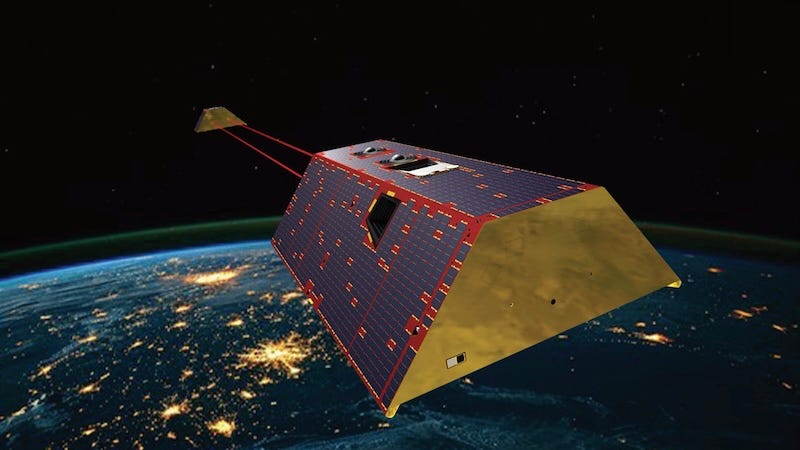
A NASA OIG audit released Wednesday found the GRACE-C gravity mission on track to launch within its $658 million baseline. But the project has already used most of its cost reserves.GRACE-C stands for Gravity Recovery and Climate Experiment-Continuity. NASA’s Jet Propulsion Laboratory, or JPL, manages the mission in partnership with the German Aerospace Center, known as DLR. The mission’s twin satellites will track changes in Earth’s gravity field to measure ice sheets, groundwater and sea levels.NASA’s Office of Inspector General found the project had spent 61.2 percent of its project-managed cost reserves as of May. After known risks were covered, only $13.6 million remained unallocated. That’s about 7 percent of remaining development costs, which is below JPL guidelines.In February, a JPL review group estimated the project could need $637.3 million to finish. That’s $9.3 million over its $628 million management agreement. The inspector general said its own calculations closely matched that estimate. In June, the group cut the projected overrun to $300,000. The inspector general said it didn’t independently verify that figure.The report cites two outside cost drivers. The first is overhead. JPL has gone through reorganizations and workforce reductions since 2024, mainly because of funding uncertainty around the Mars Sample Return mission. The resulting rate adjustments added about $4.6 million to GRACE-C’s cost, and the project expects another $13.3 million.The second is currency exposure. JPL’s firm-fixed-price contract with Airbus Defence and Space in Germany for the two satellites is priced at 150.5 million euros, or about $172.5 million. Smaller euro contracts cover laser work from Tesat-Spacecom in Germany and accelerometers from ONERA in France. NASA budgeted for an exchange rate of up to $1.10 per euro. The rate reached $1.14 in July, adding an estimated $8 million. About $60.6 million in contract payments are still due in euros.The project has kept all 163 days of its schedule margin. The inspector general said managers chose to spend reserves to protect that schedule. That includes $35.3 million to keep JPL’s share of the laser ranging interferometer on track. Two DLR-supplied subsystems are each running about four weeks late.NASA agreed with the first of the inspector general’s two recommendations, which calls for routine review of the project’s risk posture. It partially agreed with the second, which covers how requirements in partner agreements are written. That work has a target completion date of Jan. 29, 2027.Launch aboard a SpaceX Falcon 9 from Vandenberg Space Force Base in California is planned before July 2029.-0-Exolaunch has signed a contract with SpaceX to serve as payload integrator for a Starfall mission. The mission is targeted to launch on a Starship rocket in 2029.Starfall is a SpaceX spacecraft built for microgravity research, in-space manufacturing and return to Earth. Exolaunch already integrates and deploys satellites on SpaceX rideshare launches. This contract moves the company into a different line of business: helping customers fly experiments in orbit and bring them home.Exolaunch says it’ll offer the service to biotechnology and pharmaceutical companies, materials developers, government agencies and research institutions. Expected payloads include life-science experiments, advanced materials research, in-space manufacturing and technology demonstrations.While that all sounds good, no financial terms were disclosed, and no paying customers or specific payloads have been named. The 2029 date is a target, more than three years out.The contract also comes while Exolaunch is the subject of a pending acquisition by EQT Private Equity.The Starfall deal follows two other recently announced Exolaunch missions, Exo-1 and Exo-2. Both are set to fly on SpaceX Falcon 9 missions.It’s worth noting that the deal places an established rideshare integrator between SpaceX and the microgravity research market. That’s the same role Exolaunch already plays for satellite operators.Exolaunch says it’s now engaging customers and strategic partners for the 2029 mission.-0-The Air Force Research Laboratory has agreed to transfer decades-old rocket propulsion hardware and engineering data to Blue Origin.The deal is a Cooperative Research and Development Agreement, or CRADA. It was announced through AFRL’s Rocket and Space Propulsion Division at Edwards Air Force Base in California, and it expands an existing partnership between the lab and the company.The agreement covers hardware and engineering records from two AFRL programs. One is the Hydrocarbon Boost program. The other is the Integrated Powerhead Demonstrator. Those programs pioneered oxygen-rich and full-flow staged combustion technology decades ago.Blue Origin says it’ll study the hardware and data to inform its own commercial engine development. A senior Blue Origin engines executive said the material will help ground the company’s engineering models in government research.The data transfer is separate from an existing arrangement to test Blue Origin’s BE-7 lunar lander engine at Edwards Air Force Base. The BE-7 is a dual-expander cycle engine. Blue Origin says it delivers high efficiency and deep throttling, which suits it for carrying large payloads to the Moon.The head of AFRL’s propulsion division said the transfer is meant to keep the value of past government science and technology investments working for national capability.Rocket Lab has started producing a spacecraft solar cell that doesn’t use germanium, a critical mineral that’s been under supply and cost pressure across the space industry.The product is called Inverted Metamorphic Apex, or IMM Apex. It’s the newest version of a solar cell line Rocket Lab has built for more than a decade. An earlier version powered NASA’s Ingenuity helicopter on Mars.Here’s why it matters for the supply chain. Rocket Lab says conventional multi-junction space solar cells have been built on germanium substrates for about 30 years. The company says that dependency leaves manufacturers exposed to shortages and price swings in the critical minerals market.Rocket Lab says IMM Apex reaches 31.5 percent conversion efficiency at beginning of life. It also weighs 40 percent less than earlier versions, which gives it a higher power-to-weight ratio.The company says the new cell is a mechanical and electrical replacement for existing germanium-based cells. That means satellite builders wouldn’t need to redesign their systems to switch.On capacity, Rocket Lab says changes to its manufacturing process and targeted capital investment now let it produce cells in volumes above 100 kilowatts. The product pairs a germanium-free design with a drop-in fit, which gives spacecraft builders a potential alternative to a single-mineral dependency.IMM Apex is available now. Rocket Lab says it plans more updates to the technology to support future missions.-0-Impulse Space has raised another $308 million, extending its Series D round to a combined $808 million.The Redondo Beach, California, company builds spacecraft that move satellites and other payloads between orbits after launch. The extension builds on a $500 million Series D that closed in June.Existing investors took part, including 137 Ventures, BANNER VC, DFJ Growth, Linse Capital, Lux Capital and Valor Equity Partners.Impulse didn’t disclose an updated valuation. It also didn’t say how the new money will be split among hiring, manufacturing and other costs, beyond supporting product development and team growth. The company’s president said Impulse has more than doubled its headcount over the past year.The raise follows two government contract actions this year. The U.S. Space Force’s Space Systems Command selected Impulse’s Helios spacecraft for the National Security Space Launch Phase 3 Lane 1 program. Impulse says that makes it the first upper-stage developer awarded a prime position in the program.Sp… This is a public episode. If you'd like to discuss this with other subscribers or get access to bonus episodes, visit www.exterrajsc.com/subscribe

Comments

Download from Google Play

Download from App Store
 United States