


 Claim Ownership
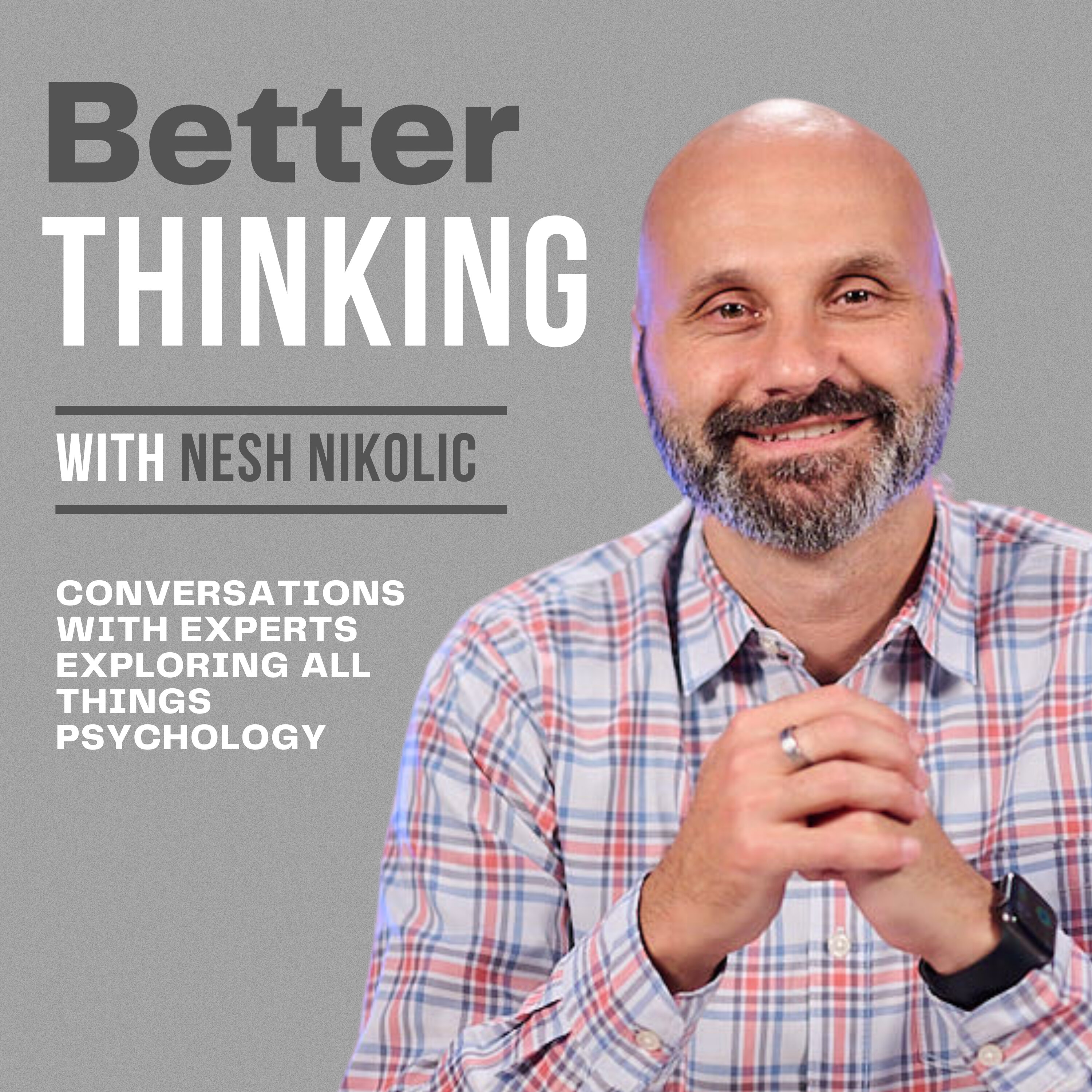
Better Thinking
Subscribed: 273Played: 4,985
Subscribe

© Nesh Nikolic
Description
On every episode you will hear inspiring conversations with leading experts in the fields of psychology, sports, personal growth, nutrition and other fields in order to gain clarity and understanding on how to deal with life in these exciting, yet challenging times. Your host, Nesh Nikolic, is a Clinical Psychologist based in Canberra, Australia with over 15,000 hours of 1-on-1 therapy experience. He’s trained in a number of therapy modes including Acceptance & Commitment Therapy (ACT), Cognitive Behaviour Therapy (CBT) and Schema Therapy. Every week, Nesh will bring raw, down-to-earth and nonchalant talks right into your ears that are designed to make you think smarter and better so you can deal with life as it is - no sugar-coating or playing “happy.”
207 Episodes
Reverse
In this episode of Better Thinking, Nesh Nikolic speaks with Niklas Törneke about understanding human behaviour through Acceptance and Commitment Therapy, Relational Frame Theory, and the practical use of language and metaphor in psychological change.Niklas Törneke is a Swedish psychiatrist, psychotherapist and a peer-reviewed ACT trainer. He has written a series of books on how to apply behavioral principles to psychotherapy, such as Learning RFT (2010) and Using Functional Analysis in Psychotherapy (2025). He has wide experience training clinical workers all over the world.

In this episode of Better Thinking, Nesh Nikolic speaks with Dr Ella Moeck about how emotions shape the way people remember the past, think about the future, and respond to uncertainty.Dr Ella Moeck is a Lecturer in Psychology at Adelaide University who researches the intersection between cognitive and social psychology. Ella completed her PhD in 2019 at Flinders University before spending a few years working as a postdoctoral researcher at the University of Melbourne. In 2024, Ella started a balanced teaching and research role at Adelaide University, where she directs the Emotion, Memory and Uncertainty lab.Ella’s research centres around the interactions between cognition and emotion. Broadly, she aims to understand how everyday stressful events shape people's emotions, and ability to manage their emotions. Recently, Ella has been focusing on emotional functioning during uncertain events, like waiting for medical test results, exam grades, or the outcomes of court proceedings. She has also been investigating the association between emotions and social media, with a focus on the occurrence and consequences of seeing negative content online. Ella’s research combines experimental and experience sampling methods, where people complete multiple smartphone surveys each day. This type of method means she researches people in the moments when they experience stressors in their day-to-day
In this episode of Better Thinking, Nesh Nikolic speaks with Stacey Parker about how jobs and careers can be designed to maximise wellbeing, motivation, and performance, and what psychological principles can help create healthier and more fulfilling working lives.Associate Professor Stacey Parker is an organisational psychologist and academic for the School of Psychology, University of Queensland, Australia. Her research aims to help organisations and their employees devise strategies for realising the dual concerns of feeling well and performing well. To this end, she examines how employees manage their energy during work, how employees recover from work stress in off-the-job time, and how jobs and careers can be designed to maximise well-being, motivation, and performance. She also explores the hidden costs of performance management systems. She studies these phenomena using controlled work simulations and field research in a range of high-performance settings (e.g., small business owners, professional musicians, elite athletes, and safety critical work in healthcare and transport industries). Her consulting and advisory work has included tackling issues with selection and recruitment, training and development, career management, work design, change management, and operational safety. She serves on the Editorial Boards for the Journal of Occupational and Organizational Psychology, Journal of Occupational Health Psychology, and European Journal of Work and Organisational Psychology. Her achievements have been recognised by the Australian Psychological Society, with a Doctoral Thesis Award in Occupational Health Psychology (2013) and Early Career Award in Organisational Psychology (2022).
In this episode of Better Thinking, Nesh Nikolic speaks with Professor Jennifer Hudson about the factors that shape children’s emotional health and how we can improve support and services for children experiencing anxiety and other emotional disorders.Professor Jennifer Hudson has made distinguished contributions to the scientific understanding and clinical treatment of anxiety disorders in children and adolescents as a fellow of the Australian Academy of Social Sciences (2018) and an NHMRC Investigator Fellow (Level 2, 2022-2027). She has delivered sustained and influential insights into the complex aetiology of anxiety, as well as developed and validated innovative, accessible interventions. She was awarded an ARC Future Fellowship (2013-2016), and a Visiting Fellowship, University of Oxford (2015-20), and is recognised as a world leader for her work on parent-child interactions and the development and treatment of anxiety. Professor Hudson also brings her expertise to government advisory panels, such as the Medical Research Future Fund’s Childhood Mental Health Research Plan Expert Advisory Panel, for which she was appointed Chair by the Federal Minister for Health and Aged Care. She plays an influential role in Australian policy as a trusted expert in child mental health, and currently leads the Child Mental Health research program at the Black Dog Institute.
In this episode of Better Thinking, Nesh Nikolic speaks with Dr Eden Robertson about the psychosocial needs of families affected by rare disease and how lived experience can drive better, more compassionate healthcare.Dr Eden Robertson is a Sydney‑based behavioural scientist specialising in understanding and addressing the psychosocial needs of children and families navigating complex, rare disease. For more than a decade, she has worked alongside families, clinicians and advocacy organisations to identify unmet needs and co‑design interventions that are both evidence‑based and genuinely usable in real‑world care. Her academic training spans a Bachelor of Psychology (Honours), a Graduate Certificate in Adolescent and Young Adult Health and Wellbeing, and a PhD in Medicine. Eden has made significant contributions to her field, including developing the world’s first family decision‑making resource for childhood cancer clinical trials, designing and evaluating a new model of care for caregivers of children with genetic epilepsy, and more recently supporting people affected by inherited retinal diseases to better understand and engage with advanced therapeutics. Highlighting her leadership in the field, she was awarded a prestigious Fulbright Scholarship in 2020.Drawing on experience across academia, health services and the non‑profit sector, Eden brings a unique cross‑system perspective that strengthens her ability to translate evidence into meaningful, practical solutions for children, families and the teams who support them.

Comments

Download from Google Play

Download from App Store
 United States