


 Claim Ownership
BIG IDEAS BY NEW ECONOMIES
Subscribed: 5Played: 67
Subscribe

© Ollie Forsyth
Description
Welcome to BIG IDEAS by NEW ECONOMIES - a show where we learn how the most iconic founders have turned crucible moments into global companies.
www.neweconomies.co
www.neweconomies.co
62 Episodes
Reverse
Subscribe to stay ahead of technology trends. Never miss future editions.Two to three years ago, software companies were still planning product roadmaps in years and quarters. Today, as one of our guests put it, the only question that matters is “what are we shipping this week?”That guest was Chano Fernández, co-CEO of Klaviyo. He joined us to explain how AI agents are reshaping marketing and customer engagement, why taste may be the biggest moat AI companies can build, and what it really takes for a public software company to stay relevant when the ground keeps moving.Chano held senior leadership roles at SAP before becoming co-CEO of Workday, where he helped expand its global and enterprise business. He was then co-CEO of the AI-native talent platform Eightfold, and spent two years on Klaviyo’s board, most recently as interim executive. In January, he became co-CEO alongside co-founder Andrew Bialecki. Andrew focuses fully on Klaviyo’s AI vision and products, while Chano runs go-to-market, operations, and G&A. Klaviyo now serves more than 200,000 customers, with around 9 billion profiles and 250 billion transactions a quarter on the platform.In our in-depth episode, we discuss:* Why email may become less relevant as AI agents start reading it for us, and why Klaviyo’s 14 years of data and infrastructure can’t be replicated with vibe coding* Inside Composer, Klaviyo’s agentic marketing tool: seven or eight sub-agents, and why getting a campaign to come out “80% or 90% right” for a CMO comes down to taste* Where software pricing is heading: from seats to consumption to outcome-based deals, and the 5% to 6% revenue share Chano is seeing emerge across the industry* How 70% to 80% of Klaviyo’s code is now written by AI, why its Friday product meetings show what shipped that week, and why a new product only needs to be 60% to 70% ready at launch* How the co-CEO model works in practice: a written operating agreement, two to three calls a day, and why only a handful of decisions each year really need both of themWatch or listen now across YouTube, Apple Podcasts, Spotify, and XDownload the transcript 👇Timestamps (0:00) Intro(1:10) How AI is changing marketing(2:24) Is email dead?(5:15) How Klaviyo has evolved(7:10) How Klaviyo stays relevant(10:35) Where business owners are focusing(14:10) What owning your audience means today(15:07) Building AI model partnerships(16:54) Would Klaviyo build its own AI model?(21:32) What great taste looks like(23:23) What great taste is missing(24:32) Are customers worried about pricing?(25:46) Shipping Klaviyo's latest products(28:17) Is the future of software headless?(30:43) An AI co-worker for Klaviyo users?(32:38) Is trust the new moat?(35:05) The role of the product roadmap(36:33) Klaviyo's favorite AI models(38:10) What's missing from the Klaviyo stack(39:22) Is SaaS pricing dead?(44:19) How much code AI writes(47:05) Keeping up with the speed of change(51:10) Will more companies have co-CEOs?(58:17) Running a public company(59:42) Is the market correcting?(1:01:45) Ollie becomes Chano's Chief of StaffLessons from this episode with Chano1. Agents will read your emails for you Chano thinks email’s role changes once AI agents start acting on our behalf.“I believe it will become less relevant, just because some of those agents will be the ones consuming many of those emails going forward.”Email won’t disappear. It will stay one of the cheapest and most efficient channels. Chano also expects agents to do more than read: they will use what they know about us to surface better products, offers and services. For brands, the challenge is personalizing at scale, and that is where automation and agents come in.2. Marketing and service are becoming one Moving Klaviyo from a marketing tool to an AI agent platform wasn’t optional.“The boundaries between marketing and service have become more indistinct.”If a customer has just complained or asked for a refund, the next thing they want is not a promotion. Most brands can’t see that, because their data sits across six or seven disconnected systems with no real-time view. Chano says this is where Klaviyo’s infrastructure gives it an edge: around 9 billion profiles, 250 billion transactions a quarter, and the ability to send 100 million messages in 20 minutes.3. Taste is the hardest thing to automate Klaviyo’s agent, Composer, builds campaign calendars and campaigns for brands that are short on people or ideas. Getting the output right comes down to taste.“If you’re a chief marketing officer, you want to see the campaign the agent is creating and say: wow, this is really my brand, my image, my language.”Code is fairly deterministic: good code is good code at any company. Brand voice is different for every customer. Klaviyo measures progress through thumbs-up ratings, how many campaigns go live without edits, and direct customer feedback. Each edit a brand makes feeds the next model.4. Stay model-agnostic and route by task With AI labs shipping updates every few weeks, Chano says no company can afford to lock itself to one model.“It’s important to be as model-agnostic as possible.”Composer runs on at least seven or eight sub-agents, covering email templates, flow templates and campaign taste, and each can sit on a different underlying model. Klaviyo’s engineers test new releases quickly and change the routing when a better model appears. Chano expects model capabilities to become more standardized, so routing well will matter more than picking a winner.5. Pricing is heading towards outcomes Klaviyo had a head start on the shift away from per-seat pricing.“We were never on seat-based pricing like many other SaaS companies.”Klaviyo’s pricing has always tracked sends and profiles, rising and falling with seasons like Black Friday. Its customer service agent already charges only when it resolves a conversation. Chano sees the industry settling on a base subscription with usage on top. Outcome-based deals come next, where the vendor takes a share of attributed revenue. The benchmark he is seeing is 5% to 6%.6. Launch at 60% to 70% Around 70% to 80% of Klaviyo’s code is now written by AI, and the planning cadence has changed with it.“Two to three years ago, we were still talking about product roadmaps in years and in quarters, and the conversation today is: what are we shipping this week?”Every Friday, a group of engineers presents what shipped that week. The hard call is when to launch. Customers have less patience than in the old SaaS era, when a product had 12 to 24 months to mature. AI products can also improve dramatically within weeks. Chano’s threshold is a product that is 60% to 70% ready.7. Co-CEOs only work with trust, complementary skills and low ego Chano was on Klaviyo’s board when the company decided Andrew Bialecki needed to spend all his time on product vision.“It’s not an easy model, but it’s a very effective one.”The two wrote down how they would run the company and speak two to three times a day. Andrew owns product; Chano owns go-to-market and the rest of the business. At first they held joint one-to-ones with leaders, which are no longer needed. Chano’s view is that only a handful of decisions each year, on strategy, culture and organization, need both of them. The rest can be made by either and reversed if needed.8. Focus on inputs, not the share price With Klaviyo’s stock down 35% this year at the time of this recording, Chano says his answer is to focus on what the company controls.“If you take care of the right inputs, the outputs will take care of themselves.”For Chano, the inputs are innovation, happy and referenceable customers, the right culture, and getting the few big decisions right. He sees the market as trying to separate AI wrappers from companies with durable moats. In his view, that will get easier as more AI-native companies go public, and it could take anywhere from two to six quarters.Where to connect with usFollow Ollie on LinkedIn: https://www.linkedin.com… Get full access to NEW ECONOMIES at www.neweconomies.co/subscribe
Subscribe to stay ahead of technology trends. Never miss future editions.During San Francisco Tech Week a few weeks ago, we co-hosted our first New Media Summit with Yahoo, bringing together media’s biggest names for candid conversations on where the industry goes next.One of our speakers was Dylan Abruscato, President of TBPN, which has had a huge year. He joined us to share how a bootstrapped, 10-person live tech show became one of the most valuable ad slots in Silicon Valley, why live remains “a truly unskippable ad format,” and why reaching a niche audience can be worth more than reaching a big one.Dylan began his career in live TV at SNL and CNBC. He then helped run HQ Trivia through its rise and fall, and built his own live interactive game show before joining TBPN, a daily, three-hour tech variety show hosted by John Coogan and Jordi Hays. Under Dylan, it grew to roughly $25 million in annual revenue with 30 year-long sponsors, led by presenting sponsor Ramp. Six months ago, it was acquired by OpenAI.In our in-depth episode, we discuss:* Why the OpenAI deal had little to do with the show itself, and how the marketing and comms advisory work built into TBPN’s sponsorships became the real reason behind the acquisition* The Super Bowl stunts that preceded the deal: a hyper-local 15-second spot built from over a thousand founder logos, and claudewithads.com* How TBPN copied Formula 1’s sponsorship model: year-long deals, category exclusivity, 100% share of voice, and an ad read to Mark Zuckerberg as he took his seat* Why the show stayed intentionally niche, and why it only takes one or two founders switching platforms for a tech sponsor’s ad to pay for itself* Inside a daily live show: the 6 a.m. gym sessions, the three-hour run of show, last-minute guest booking, and the vibe-coded internal tools that power it allWatch or listen now across YouTube, Apple Podcasts, Spotify, and XDownload the transcript 👇Timestamps (0:00) Meet Dylan Abruscato(2:20) Why OpenAI acquired TBPN(6:48) What changed after the acquisition(7:43) Will frontier models come on the show?(8:17) What makes TBPN so vibrant(9:32) Prepping for a daily live show(10:46) Why live streaming is hot(12:04) Are niche audiences more valuable?(12:58) How the ad integrations work(15:44) Calling partners post-acquisition(17:10) Building alongside legacy media(18:17) The copycats(19:38) Will another TBPN-style acquisition happen?(20:08) OpenAI’s marketing services(21:02) Thinking about distribution channels(22:10) Dream guests(22:59) TBPN’s next 12 months(23:22) Audience Q&ALessons from this episode with Dylan 1. The OpenAI deal was for the team, not the show Dylan says most people misread why OpenAI bought a live tech talk show.“I think what a lot of folks got wrong about the deal is that it had very little to do with the show itself and much more to do with the interest in us and the brains behind the operation.”Many of TBPN’s 30 sponsorship deals included marketing and comms advisory work, a tactic the team first used to win sponsors. OpenAI’s offer was simple: keep doing the show, wind down the advisory clients, and make OpenAI the only one.TBPN was profitable, had raised no money and had no plans to sell. Fidji Simo reached out the morning after the Super Bowl.2. Build the show you’d want to watch The two stunts that came right before the deal both started as ideas the team found funny.“The truth is we’re just building the show that we always wanted to watch.”The first was a hyper-local 15-second ad that aired in San Jose at noon but still counted as a Super Bowl spot. It spelled out TBPN using over a thousand logos of past guests, and those founders shared it everywhere. The second was claudewithads.com, a reskinned Claude that gave one real answer and then rotated through sponsor ad reads.The team’s brainstorming rule is that if an idea makes them laugh, they run with it.3. Live is the last unskippable ad format Dylan has worked in live TV at SNL, CNBC and HQ Trivia, and has argued for live for a decade.“It’s a truly unskippable ad format, and that’s kind of allowed us to command such high prices.”Almost nothing is watched live anymore. Sports is the exception, and even award shows are now consumed as recaps on X. TBPN’s audience is smaller than HQ’s was, but advertisers value it more because no one can fast-forward.4. Go intentionally niche TBPN never explains the jargon. Where CNBC would spell out what AWS stands for, John and Jordi just say AWS or GPU, and the audience respects it.“It really only takes one or two founders watching the show to switch to this platform for the advertisement to pay for itself.”A small audience of founders, CFOs and VCs is worth more to a tech sponsor than a mass audience. As an example, John once read a Ramp ad straight to Mark Zuckerberg as he took his seat. 5. Copy Formula 1’s sponsorship model TBPN sold only year-long deals, split into a couple dozen categories with one sponsor per category.“Everyone got 100% share of voice in their category on everything that we did over the course of the year.”Sponsors got the same ad read in every episode, plus the ticker, merch, newsletter links and end cards on tweets. Dylan’s view is that repetition is what counts when a founder is finally ready to switch products. TBPN also never tried to upsell new placements partway through the year.The commercial mindset was there from day one. On the first episode, with one viewer, John did fake ad reads for sponsors the show didn’t have. When TBPN wound down its sponsors after the acquisition, viewers asked for the ad reads back. 6. Chemistry plus a fixed format The show depends on the friendship between its two hosts.“It’s like a true one-of-one friendship, and it’s just so relatable.”John and Jordi meet at the gym at 6 a.m. every day and work out the day’s lead story in the sauna. They go live at 11, and after the show ends they still call each other on the drive home.The format never changes:* Hour one: John and Jordi on the current thing, then live reactions to the timeline.* Hour two: one or two tier-one interviews.* Hour three: a lightning round of startup fundraising news.Most guests are booked last minute. Mag Seven–level names take six months or more of back-and-forth.7. Be a companion to legacy media, not a competitor TBPN never tried to beat traditional outlets at breaking news.“We always viewed TBPN as a companion show.”When founders or publicists offered scoops, TBPN sent them to the Journal or Bloomberg. The founder would come on a few hours later to break the story down. Every show opens with a hard copy of the Journal.Dylan doesn’t want copycats making another three-hour daily show. He would rather see new formats in tech media, like a late-night tech show or an interactive Shark Tank.Where to connect with usFollow Ollie on X: https://x.com/ollieforsythFollow Dylan on X: https://x.com/DylanAbruscatoWatch and follow TBPN: https://www.tbpn.comPrevious episodes includeOur partners:Harmonic: Your go-to startup database. Visit Harmonic to learn more.Prelint: Keeps every decision reviewed, recorded, and traceable. Head over to Prelint to learn more.VCX: The public ticker for private tech. Head over to GetVCX.com to learn more. Get full access to NEW ECONOMIES at www.neweconomies.co/subscribe
Subscribe to stay ahead of technology trends. Never miss future editions.Eric Ries, creator of The Lean Startup and author of Incorruptible, joins us to explain why “financial gravity” pulls even the best companies away from their mission. He explains why the standard best practices founders are handed “are designed to make you lose control of your company.”Eric published The Lean Startup 15 years ago and went on to found the Long-Term Stock Exchange. He co-founded the AI research lab Answer.AI and helped start Virgil, an AI-enabled law firm for early-stage companies. In his latest book, Incorruptible, he studies the companies that have resisted this force, from Costco to Novo Nordisk to Anthropic.In our in-depth episode, we discuss:* How the default “any lawful act or activity” clause in a Delaware charter quietly commits founders to maximizing shareholder value, and why lawyers rarely tell them* The story of Sol Price, FedMart and the origins of Costco, and the “governance fortress” that has protected Costco’s $1.50 hot dog for 40 years* The three mission protective provisions every founder can set up in a matter of weeks: becoming a PBC, adopting a director’s oath, and appointing a mission guardian* The difference between a mission statement and a mission, and what Silicon Valley Bank’s charter revealed after its collapse* Why “it’s always too early until it’s too late,” how to win over the roughly 25 people who must agree to a change, and why Anthropic’s Long-Term Benefit Trust has become a commercial advantageWatch or listen now across YouTube, Apple Podcasts, Spotify, and XDownload the transcript 👇Timestamps (0:00) Meet Eric Ries(2:14) Eric’s New Book(3:30) How Startups Are Built Today(6:20) Why Companies Self-Destruct(16:37) Who’s to Blame When Companies Fail(21:25) The Blueprint for a High-Performing Company(26:52) How Companies Protect Themselves(33:13) Building Company Ethos and Structure(46:05) Why Companies Get Bullied(50:32) When Is It Too Late to Save a Company?(55:15) The Company Eric Would Have Saved(1:00:05) What Eric Is Excited About NextLessons from this episode with Eric1. Why great companies are destroyed by financial gravityEric explains why blaming a greedy investor or a reckless founder misses the real cause of most corporate collapses.* “There is a form of what I call financial gravity that operates on these companies. The ones that collapse, the ones that erupt in scandal, whether I’m talking about Boeing or FTX or Wells Fargo or Silicon Valley Bank, they’re all the same story.”* He compares it to a submarine with a weak hull. Asking whether the water is to blame is the wrong question. The right question is who designed the submarine.* Gravity acts on every company, yet some have lasted 50, 75 or even 500 years. Studying the ones that never collapse is how you learn to build differently.2. How the firing of Sol Price led to the founding of CostcoSol Price capped his markups at 14% and treated customers as clients he owed a fiduciary duty to. His investors fought him for 20 years, then changed the locks on his office overnight.* “It is so much easier to destroy than to create. They managed to destroy in seven years what had taken Sol more than 20 to build.”* Within seven years of firing him, the investors had completely liquidated FedMart. Two weeks after his dismissal, Sol leased the office upstairs and started the Price Club, which later merged into Costco.* Costco has survived for 40 years because of what Eric calls a governance fortress. That structure lets its directors act as a bulwark against Wall Street pressure.3. The six words in your charter that hand your company to shareholdersMost founders have never read the first sentence of their own corporate charter. Eric says that sentence decides who the company really serves.* “Since 1986 in the United States, whenever you see ‘any lawful act or activity,’ the courts have decided that actually means maximize shareholder value.”* The phrase sounds open-ended. Legally, it makes your company a financial instrument whose job is to enrich shareholders.* The same duty forced Twitter’s board to sue Elon to complete his deal. It also let Philip Morris take over an inhaled therapeutics company and destroy it.4. Three mission protective provisions that take weeks, not yearsEric gives founders a short list of protections they can put in place early. Some take only days.* “Welcome to best practices. They are designed to make you lose control of your company by force or by corruption.” * First, become a public benefit corporation, a two-page filing in Delaware. Second, require every director to take an oath to protect the mission, much like the Hippocratic oath. Third, set up a mission guardian, such as a foundation or a purpose trust.* Companies owned by an industrial foundation, such as Novo Nordisk, are five times more likely to reach year 50. Eric’s explanation: “Checks and balances work.” 5. A mission statement is not a missionEric’s own deposits were at Silicon Valley Bank when it collapsed. Afterwards, he looked up what the bank had legally committed to.* “They had no mission at all. The whole thing was a scam.”* The bank’s mission statement promised to move the innovation economy forward. Its charter said “any lawful act or activity.” Even if its interest rate bets had paid off, they would have done nothing for customers.* His test: Google spends billions to make sure its quarterly reports are on time, while “Don’t be evil” was one sentence in the employee handbook. What a company invests in shows what it values. 6. It’s always too early until it’s too lateLawyers and investors often tell founders to deal with governance after product-market fit. Eric says that advice really means never. * “In most companies, there are at most 25 people that need to consent to anything like this.”* Veeva Systems became a public benefit corporation after it was already a $40 billion public company. It spent a year on investor relations and won 90% of the shareholder vote.* Eric’s line for pitching a change to investors: “It is my judgment as the founder of this company that it is essential to our strategy that we win the trust of [some group].” Framing it this way forces people to say exactly what they object to.7. Why ethics is an accelerantEric uses Anthropic to show that integrity can be a source of commercial strength.* “People talk about ethics like it’s an impediment to business success, but here it is clearly an accelerant.”* Anthropic is governed by the Long-Term Benefit Trust, which appoints directors to its for-profit board. Eric argues this structure is a big part of why enterprises trust it more than its competitors.* Costco, Patagonia, Vanguard, Mondragon and Anthropic have different missions and cultures. The one thing they share is that each rejected the standard best practices for how a company should be structured.Where to connect with usFollow Ollie on X: https://x.com/ollieforsythFollow Eric on X: https://x.com/ericriesEric's new book - Incorruptible: https://www.incorruptible.coPrevious episodes includeSee all previous episodes here 👉Our partners:Harmonic: Your go-to startup database. Visit Harmonic to learn more.Prelint: Keeps every decision reviewed, recorded, and traceable. Head over to Prelint to learn more.VCX: The public ticker for private tech. Head over to GetVCX.com to learn more. Get full access to NEW ECONOMIES at www.neweconomies.co/subscribe
Subscribe to stay ahead of technology trends. Never miss future editions.Daniel Chait, co-founder and CEO of Greenhouse, joins us to explain why AI has trapped hiring in a “doom loop” where, for the first time he can remember, “neither side is really happy.”He co-founded Greenhouse in 2012 and has built it into one of the world’s leading hiring platforms, used by more than 7,500 companies with a team of over 700. His Dream Job feature lets job seekers flag one application a month as their top choice, and he says those candidates now convert from application to hire at around five times the rate of everyone else.Daniel also shares why 1 to 1.5% of applicants fail an ID check, how North Korean operatives use deepfakes to get through interview rounds, and why he believes starting with an AI interview can remove bias from the most biased stage of hiring.In our in-depth episode, we discuss:* How auto-apply tools and AI résumé filters created the hiring “doom loop,” and why job seekers and employers no longer trust each other* The three-layer “Swiss cheese” model Greenhouse uses to catch fake candidates, and why North Korean infiltrators are so hard to spot once they’re hired* Why an AI interview at the first stage can take racial bias out of résumé screening, and how it cuts around six days from the process* Why Greenhouse’s value has shifted from workflow to data and context, and whether it will come out of this moment as Blockbuster or Netflix* How Daniel decides which bets to place, why “we can do anything, we just can’t do everything,” and what it would mean to hire AI agents through GreenhouseWatch or listen now across YouTube, Apple Podcasts, Spotify, and XDownload the transcript 👇Timestamps[00:00] Meet Daniel Chait[02:16] The state of hiring right now[04:03] Why employers get 1,000 applications in a day[05:31] The AI doom loop explained[10:31] Why AI résumé filters fail[11:35] The “Jared problem”: how AI amplifies bias[13:32] North Korean spies and fake candidates[16:03] 1 in 100 applicants fail ID checks[16:32] The Swiss cheese model of hiring security[20:34] How deepfake hiring rings get caught[22:30] Why Daniel is still an AI optimist[23:34] Dream Job: the feature with a 5x hire rate[26:05] How COVID, rates and ChatGPT changed hiring[29:02] Are entry-level jobs disappearing?[33:00] Is university still worth it?[35:01] Why durable skills beat technical skills[36:00] Is job hopping a red flag?[37:34] Changing business models [40:00] Staying relevant when anyone can clone software[43:03] Blockbuster or Netflix?[45:31] Greenhouse’s new mission[47:30] Why AI interviews can remove racial bias[51:30] What happens to humans in hiring?[53:32] How AI interviews save 6 days per hire[55:03] From software engineers to agent managers[56:30] Could companies one day hire AI agents?[1:00:02] How Greenhouse places bets[1:03:03] A week as Daniel’s chief of staff[1:04:35] Great leaders have no followers[1:05:35] Leading 700 people as CEO[1:07:02] What keeps Daniel motivatedLessons from this episode with Daniel 1. Why AI has trapped hiring in a doom loopDaniel explains how one unremarkable company got a thousand applications on day one, and why the tools meant to help job seekers have made the system worse for everyone.* “That’s kind of what we’ve referred to as the AI doom loop: this idea that the more each side is using the kind of current generation of AI tools to help themselves, the worse the overall system has gotten for everyone.”* For an in-person manufacturing job in the Midwest, the company was flooded with applicants from overseas and people with graduate degrees looking for tech roles.* Job seekers have put their search on autopilot, so AI applies to thousands of jobs on their behalf. That fills every pipeline with noise, which pushes people to send out even more applications.2. The Swiss cheese defense against fake candidatesBetween 1% and 1.5% of applicants on Greenhouse fail an ID check. Daniel breaks down the layered security model used to catch them before they get hired.* “In our data, about one to one and a half percent of job applicants hard fail an ID check.”* Every security layer has holes, so you stack them until the holes stop lining up: a voice AI interview first, then digital signals like IP address and device fingerprint, then full ID verification.* Scammers hate a 25-minute voice interview at the start of the process, and most of them drop out right away.3. The dating app trick that makes candidates five times more likely to get hiredGreenhouse’s Dream Job feature lets job seekers flag one application a month as their top choice. Daniel explains why that scarcity creates a signal that didn’t exist before.* “We’ve had thousands of people get their dream job and they convert from application to hire at about five times the rate of other job applications.”* Because candidates only get one a month, they spend it on a job they actually want and think they can win.* The idea was borrowed from early decision in college admissions and super likes on dating apps.4. Why Greenhouse’s moat is no longer its softwareCustomers no longer click through Greenhouse’s interface. They connect it to Claude or ChatGPT and do the work there, which changes where the value sits.* “It used to be that the value of Greenhouse was the workflow.”* The value is now in context and data: knowing which moves are legal, which candidates need a response, and which of millions of members are real people actively looking.* “Do you want to emerge from this moment as Blockbuster or Netflix? It’s just that simple.”5. How AI interviews can design out the bias of résumé screeningDaniel points to a 2003 study showing that résumé review is one of the most biased stages in hiring, and argues that AI can remove that stage altogether.* Identical résumés with only the name changed showed about a 50 percentage point gap in interview invitations, depending on whether the name sounded stereotypically white or Black.* When interviews are scarce, companies gatekeep who gets one. An AI interviewer lets them interview everyone.* “I don’t care what your name is. I don’t care if you were on the women’s volleyball team or the men’s lacrosse team. None of that. It’s just about how do you answer the questions?”6. What it would mean to hire an AI agent through GreenhouseIn an internal brainstorm, Greenhouse asked what happens when a customer says half of this year’s 100 hires will be agents. Daniel works through the question from first principles.* “What would it mean to put up a job posting for an agent? What would it mean for the agent to apply to that job or be interviewed or get an offer?”* Every step of hiring has a job to do. A job ad tells whoever or whatever can fill a need that the need exists, and an interview tests whether a candidate can actually do the work.* “Some of it’s a little science fiction for now,” but he says anyone in his seat had better be thinking about it.7. Why great leaders have no followersDaniel shares the leadership lesson from Fred Kofman’s Conscious Business that shapes how he runs a company of 700 people.* Picture runners on a track: the one in front looks like the leader, but the others aren’t chasing him. They’re all running toward the same finish line.* “As a leader, my job is not to get people to follow me. My job is to find the finish line and tell everyone as clearly as I can where it is.”* He doesn’t book sales, answer support tickets or ship code. His job is to set the vision and make it clear to customers, investors and employees.Where to connect with usFollow Ollie on LinkedIn: https://www.linkedin.com/in/ollieforsythFollow Daniel on LinkedIn: https://www.linkedin.com/in/dhchait Visit Greenhouse: https://greenhouse.comOur Partner for this episode is Harmonic - your go-to startup database https://harmonic.aiPrevious episodes includeSee all previous episodes here 👉 Get full access to NEW ECONOMIES at www.neweconomies.co/subscribe
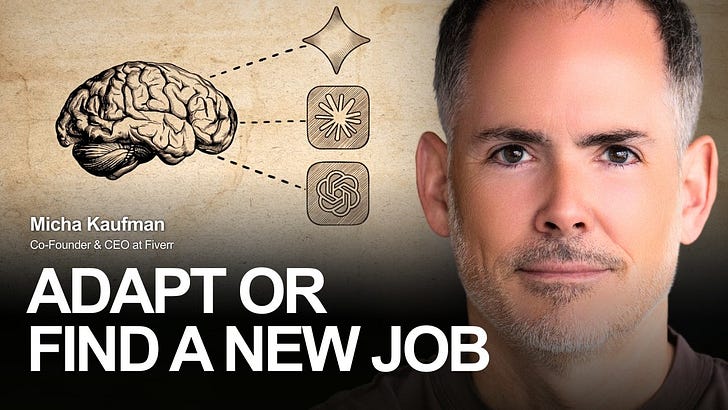
Subscribe to stay ahead of technology trends. Never miss future editions.Micha Kaufman, co-founder and CEO of Fiverr, joins us to explain why anyone who has worked in their profession for more than five years is now “a dinosaur.” He has spent 17 years building Fiverr into a global marketplace connecting millions of freelancers with businesses, and took it public on the New York Stock Exchange in 2019. His internal memo warning staff about AI went viral a year ago, and he says the employees who embraced it are now doing two to three times more than before.Micha also shares why AI has flipped the 80/20 split between human and software work, why an AI that knows everybody “just makes everybody more average,” and why human judgment and accountability will be the biggest moat any professional can have.In our in-depth episode, we discuss:* The asteroid analogy behind Micha’s viral AI memo, and what changed inside Fiverr in the 12 months after he sent it* Why the 20% of work AI can’t do is “infinitely important,” and the risk of outsourcing judgment to machines* Why most AI-generated code is built on poor-quality open source, and what that means for developers whose job was 60–70% copy-pasting* Why Micha wants to stop calling freelancers “freelancers,” and why he believes getting better is each person’s own responsibility* How Micha runs a public company through a period of uncertainty by encouraging impatience, and whether half of Fiverr’s clients could soon be AI agentsWatch or listen now across YouTube, Apple Podcasts, Spotify, and XDownload the transcript 👇Timestamps(00:00) Meet Micha Kaufman (02:17) Is the 9-to-5 dead?(05:20) The viral AI memo(05:50) The dinosaur and the asteroid(12:25) Using AI vs really using AI(14:33) The one thing AI lacks: accountability(18:55) Has AI made us lazy?(19:33) How AI flipped the 80/20 of work(21:02) Why AI is a nightmare for designers(23:23) What happens to freelancers doing basic work?(27:32) Why "freelancer" is the wrong word(28:38) Whose job is it to get better?(32:04) Why most AI-generated code is bad(38:32) Why adaptability wins(41:10) Running a public company in uncertain times(43:06) Why Micha encourages impatience(44:02) The hard part of deploying AI(45:19) Fiverr's next 12 monthsLessons from this episode with Micha 1. Why every experienced professional is now a dinosaurMicha’s viral memo started with one analogy. He explains why anyone with more than five years in their profession is living through an extinction event, and why the outcome is transformation, not the end.* “If you’ve been doing something as a professional for more than five years, you are a dinosaur. And you are a dinosaur at the moment an asteroid makes impact.”* The crater is only the start. The debris, the darkness, the ice age and the food scarcity that follow are what decide which species survive.* Survival is not about evolution, which takes millions of years. It is about morphing into something new, and some species flourish while others go extinct.[0:05:57 – 0:07:20]2. The one thing AI will never haveMicha argues that the real line between humans and machines is not intelligence. It is accountability, and he traces the reason back to our mortality.* When ChatGPT gives harmful advice, the chat window still says, “I’m AI and I make many mistakes.” That line sums up AI’s lack of accountability.* Humans are accountable because we are mortal. Reputation is our most precious asset, and keeping it requires accountability.* “Human in the loop” is a buzzword. What it really comes down to is judgment and accountability, and the risk is that people start outsourcing both to software.[0:14:33 – 0:15:57]3. How AI flipped the 80/20 of workBefore AI, humans did most of the work and software did the rest. Micha explains why that ratio has reversed, and why the part left to humans matters more than ever.* Up until AI, humans did about 80% of the work and software did about 20%. Now it has flipped.* The 80% that AI handles “doesn’t get you anywhere. It just gets you faster.”* The 20% left to humans “is not 20% important. It’s infinitely important.” The danger is starting to outsource that 20% as well.[0:19:36 – 0:21:02]4. The X factor: why the same AI gives different resultsIf everyone has the same AI tools, where does the advantage come from? Micha argues it comes from the person using them.* Whatever AI produces is the average, because everybody has access to it. Something looking slick doesn’t mean it will work.* “If I prompt Claude Design and you prompt Claude Design, we’re not going to get the same results.”* The difference is design taste and knowing what works. “It’s not Claude Design. It’s me. This is the X factor.”[0:26:10 – 0:27:32]5. It’s not your CEO’s job to make you betterMicha shares the message he gave his own team, one he admits he might get criticized for.* “Look, it’s not my job to make you better. Not better human beings, not better professionals, not better husbands and wives, not better parents. It’s your job.”* He holds himself to the same rule: it’s not the board’s job or the market’s job to make him better. It’s his own.* Fiverr’s role is to help those who help themselves. “I would do anything to help those who help themselves.”[0:29:05 – 0:30:22]6. Why most AI-generated code is badCode is being written at blazing speed, but Micha says most of it is poor quality. The reason is built into how AI models learn.* AI is a statistical model. It answers a request from wherever it has the most data, and for code, that is open source.* “The vast majority of open source is terrible.” Repurposing it means code that is insecure, inefficient, full of bugs and weak on edge cases.* Five years ago, about 60 to 70% of a developer’s job was already copy-pasting from open source. AI now does that part.[0:32:35 – 0:34:05]7. Why Micha encourages impatience with the CEORunning a public company takes long-term patience, but Micha pushes his team to be impatient, including with him.* The framework starts with being impatient with yourself. Only then can you demand the same of others.* If Micha says, “Okay, I’ll think about it,” that’s not a good answer. If he says a week, his team should ask: why not tomorrow? Can we talk about this tonight?* The balance: push hard on what can move fast, but “you can’t define 100 years in a day. It takes time.”[0:42:50 – 0:44:02]Where to connect with us Follow Ollie on X: https://x.com/ollieforsythFollow Micha on X: https://x.com/michakaufmanVisit Fiverr: http://fiverr.comOur partner for today's episode is Harmonic, your go-to startup database: https://harmonic.aiPrevious episodes includeSee all previous episodes here 👉 Get full access to NEW ECONOMIES at www.neweconomies.co/subscribe

Comments

Download from Google Play

Download from App Store
 United States