DiscoverSlow English Podcast | Your English Toolbox
Slow English Podcast | Your English Toolbox

Slow English Podcast | Your English Toolbox

Author: YOUR ENGLISH TOOLBOX

Subscribed: 68,872Played: 804,920
Share

Description

Learn English calmly, clearly and with purpose.


Slow English Podcast helps intermediate learners understand real English, build useful vocabulary and speak with more confidence. Each episode uses clear, natural-paced English and turns listening into practical learning.


GO BEYOND THE AUDIO AT YOUR ENGLISH TOOLBOX


• Interactive transcripts and Cinema Mode

• Vocabulary, idioms, phrasal verbs and guided practice

• Translations and bilingual resources in Farsi, Spanish, German and French

• Free transcript and vocabulary workbooks

• Learning Paths, Practice Arena and Learn with Music


Explore every free resource at https://yourenglishtoolbox.com


WHAT YOU WILL PRACTISE


• Listening comprehension with clear, accessible English

• Natural vocabulary, collocations and everyday expressions

• Pronunciation, shadowing and speaking confidence

• English for real life, personal development and meaningful ideas


Every lesson is conceived, written and carefully curated by people committed to language education. Advanced AI voice technology supports consistent clarity and natural pacing.


Listen slowly. Learn deeply. Speak confidently.


Hosted on Acast. See acast.com/privacy for more information.

142 Episodes
Reverse
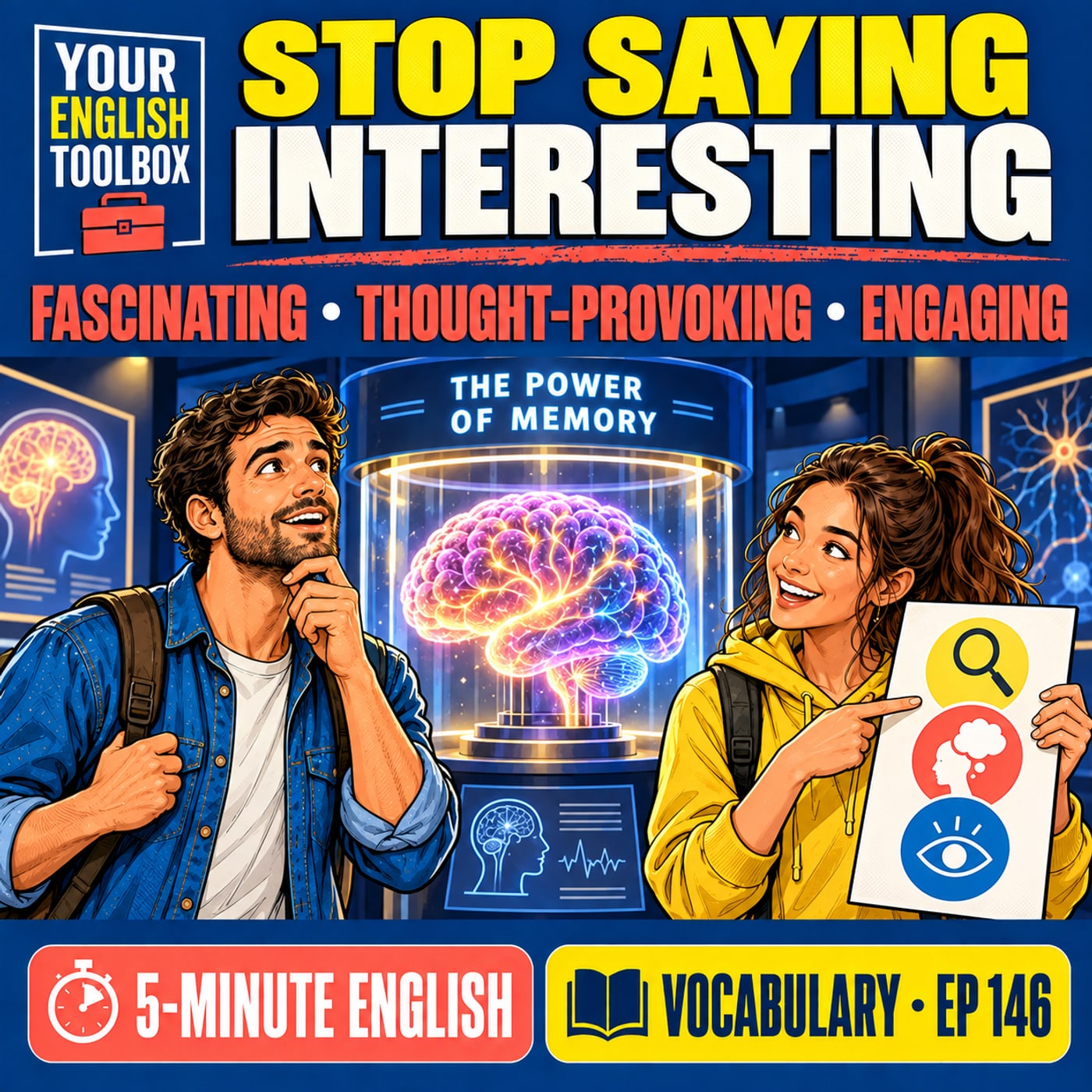
https://yourenglishtoolbox.com/episodes/146-stop-saying-interesting-fascinating-thought-provoking-or-engaging/This podcast is created through a human-led editorial process. Every episode concept, educational strategy, narrative direction and final editorial decision is developed and reviewed by people committed to making English learning meaningful. Artificial intelligence supports script development and editing, while ElevenLabs provides the synthetic voices of our hosts. Human judgement leads the process; technology supports its production.Martin describes an entire science festival with one word: interesting. Julia challenges him to say exactly what held his attention and why.In this short conversational Slow English episode, Martin and Julia compare three precise B1–B2 adjectives for curiosity, deeper reflection and sustained attention.You will learn:fascinating — extremely interesting because something strongly attracts your curiosity;thought-provoking — making you think seriously or consider an idea in a new way;engaging — holding your attention through an appealing or involving style.The episode compares a fascinating subject with an engaging presentation, explains why something uncomfortable can still be thought-provoking and shows the natural nouns used with each adjective.Finish with a four-situation active-recall challenge and a practical method for replacing vague “interesting” sentences with more precise English.Level: B1–B2 · Focus: precise vocabulary · curiosity and attention · adjective collocations · Format: short conversational Slow EnglishKeywords: alternatives to interesting, fascinating meaning, thought-provoking meaning, engaging meaning, precise English vocabulary, English adjectives B1 B2, improve English vocabulary, natural English collocations, slow English podcast, English listening practice, Your English Toolbox#EnglishVocabulary #StopSayingInteresting #SlowEnglishPodcast #LearnEnglish #IntermediateEnglish #YourEnglishToolbox💬 We’d love to hear from you!If you enjoyed this episode, leave a comment, share your thoughts, or tell us how you’re using these tips to improve your English. Your feedback helps us grow and create even better content for you. Hosted on Acast. See acast.com/privacy for more information.
https://yourenglishtoolbox.com/episodes/145-on-the-fence-4-decision-idioms-to-help-you-choose/This podcast is created through a human-led editorial process. Every episode concept, educational strategy, narrative direction and final editorial decision is developed and reviewed by people committed to making English learning meaningful. Artificial intelligence supports script development and editing, while ElevenLabs provides the synthetic voices of our hosts. Human judgement leads the process; technology supports its production.Continue with Lesson 9 — Decisions — in our free Idiom Toolbox course: https://yourenglishtoolbox.com/idioms/lesson-09-decisions/Martin has opened the same workshop registration page six times. Should he wait, trust his instinct or finally press the button?In this short conversational Slow English episode, Martin and Julia explore four useful idioms from Lesson 9 of the free Idiom Toolbox course.You will learn:on the fence — be unable to decide between two options;sleep on it — wait until the next day before making a decision;go with your gut — trust your instinct after considering the facts;take the plunge — finally make a bold decision and act on it.The conversation explains the natural pattern “on the fence about something”, compares careful reflection with instinct and shows why taking the plunge is more than simply choosing.Finish with an active-recall challenge and two personal speaking prompts that turn the four idioms into usable English.Level: B1–B2 · Focus: decision idioms · hesitation and commitment · listening and speaking · Format: short conversational Slow EnglishKeywords: decision idioms in English, on the fence meaning, sleep on it meaning, go with your gut meaning, take the plunge meaning, English idioms B1 B2, how to make decisions in English, slow English podcast, English listening practice, Idiom Toolbox, Your English Toolbox#EnglishIdioms #DecisionIdioms #SlowEnglishPodcast #LearnEnglish #EnglishListeningPractice #YourEnglishToolbox💬 We’d love to hear from you!If you enjoyed this episode, leave a comment, share your thoughts, or tell us how you’re using these tips to improve your English. Your feedback helps us grow and create even better content for you. Hosted on Acast. See acast.com/privacy for more information.
https://yourenglishtoolbox.com/episodes/143-10-habits-of-people-who-live-to-100-part-1-your-body/This podcast is the result of a genuine human creative process. Every episode concept, educational strategy, narrative structure, and pedagogical direction is designed, written, and carefully curated by real people who are deeply committed to making English learning a human, meaningful experience. Artificial intelligence plays a supporting role in two specific areas: it assists in the refinement and editing of scripts, and it powers the voice synthesis technology from ElevenLabs that brings our hosts to life with exceptional phonetic clarity and natural pacing. The result is a podcast where human intelligence leads, and AI serves. Every lesson was designed for you.Julia has found the secret to living to a hundred. It is goat's milk, from a specific island, at a specific time of day. There was a whole article. Martin is about to ruin it completely.For four episodes, How to Live a Good Life argued that relationships are the foundation of a good life. That is still true — but you also live in a body. This bonus conversation begins a two-part exploration of ten habits associated with healthier ageing. Today: the first five.The episode starts with an honest scientific debate. In 2024, demographer Saul Newman received an Ig Nobel Prize for a controversial, non-peer-reviewed analysis challenging the records behind some famous longevity regions. Researchers who study the Blue Zones strongly dispute his conclusions and point to detailed civil, church and genealogical records used to validate ages. Martin and Julia present both sides before turning to stronger observational evidence.That evidence includes two major US cohorts: 123,219 participants followed for up to 34 years. At age 50, the researchers estimated around 14 additional years of life expectancy for women with all five low-risk lifestyle factors and about 12 for men, compared with participants who had none. Those figures are population estimates, not guarantees for any individual.You will also meet Genaro, 79, a former building caretaker in Valencia who has never been inside a gym — and who follows the spirit of all five habits without believing he has any habits at all.What you will learn today:Why an active hour does not make the rest of the day irrelevant.Why maintaining muscle supports independence, and how to approach a simple floor movement safely.The broad food patterns often seen in populations that age well, plus the Okinawan idea of stopping at eight parts full.Why sleep regularity matters as well as duration, and what researchers are learning about overnight brain maintenance.How the evidence around smoking and alcohol has changed the familiar longevity story.English in context includes: a habit, to get into the habit of doing something, to cut down on something, to give something up, life expectancy, evidence, a claim, a preprint, it turns out, to be in good shape, to hold that thought, and to respond at any age.Sentence of the day: You do not need a new life. You need a better Tuesday.Next: Part 2, Your Mind — purpose, rest, learning, belonging, and the habit at the top of the list.This episode provides general information, not medical advice. Every body is different; for anything that concerns you, speak to your doctor or another qualified health professional.Keywords: habits of people who live to 100, longevity habits, blue zones debate, blue zones evidence, Ig Nobel longevity research, Harvard five healthy habits, healthy ageing, how to live longer, maintaining muscle after 50, sleep regularity, eat mostly plants, hara hachi bu, slow English podcast, English listening practice, learn English, English podcast for intermediate learners, English vocabulary in context, health vocabulary in English, Your English Toolbox, English transcripts, intermediate English, IELTS speaking practice, Cambridge B2 First, C1 Advanced#SlowEnglishPodcast #YourEnglishToolbox #LearnEnglish #EnglishListeningPractice #EnglishPodcast #HowToLiveAGoodLife #Longevity #HealthyHabits #BlueZones #HealthyAgeing #StudyEnglish #IELTS💬 We’d love to hear from you!If you enjoyed this episode, leave a comment, share your thoughts, or tell us how you’re using these tips to improve your English. Your feedback helps us grow and create even better content for you. Hosted on Acast. See acast.com/privacy for more information.
https://yourenglishtoolbox.com/episodes/141-weekly-english-recap-20-shadowing-pairs/This podcast is created through a human-led editorial process. Every episode concept, educational strategy, narrative direction and final editorial decision is developed and reviewed by people committed to making English learning meaningful. Artificial intelligence supports script development and editing, while ElevenLabs provides the synthetic voices of our hosts. Human judgement leads the process; technology supports its production.Can you understand an expression, repeat it naturally and recognise the same idea in different words? In this weekly recap, Peter turns the three short episodes from this week into one focused vocabulary and shadowing workout.The two-sentence game is simple:Peter says a short, natural sentence containing one target expression.You get three seconds of silence to shadow it aloud and copy the rhythm and stress.Peter gives you a second sentence with the same meaning but different vocabulary, so you can confirm the meaning without translating.You will review all twenty learning items from this week:Success idioms, collocations and learning language:come out on top;pay off;go places;with flying colours;compete against;a challenging situation;pass an assessment;retrieval practice.Probability vocabulary:likely;unlikely;inevitable.Natural reactions from the audio lesson:No way!;That’s great news!;What a relief!;I’m sorry to hear that.Extra reactions from the web lesson:You’re joking!;I’m so pleased for you;Thank goodness!;That’s a shame;That must be difficult.Listen once for meaning. Then play the episode again and begin repeating as soon as Peter speaks, using the three-second silence to finish each sentence. The paraphrase that follows gives you immediate feedback and strengthens active recall.Level: B1–B2 · Focus: weekly vocabulary review · shadowing · retrieval practice · paraphrasing · pronunciation and fluencyKeywords: English shadowing practice, weekly English recap, English vocabulary review, paraphrasing practice, English idioms, likely unlikely inevitable, react to news in English, retrieval practice, improve English fluency, slow English podcast, Your English Toolbox#EnglishShadowing #VocabularyReview #EnglishIdioms #SpeakEnglish #SlowEnglishPodcast #LearnEnglish #YourEnglishToolbox💬 We’d love to hear from you!If you enjoyed this episode, leave a comment, share your thoughts, or tell us how you’re using these tips to improve your English. Your feedback helps us grow and create even better content for you. Hosted on Acast. See acast.com/privacy for more information.
https://yourenglishtoolbox.com/episodes/142-short-stories-with-peter-the-open-window-by-saki/This podcast is created through a human-led editorial process. Every episode concept, educational strategy, narrative direction and final editorial decision is developed and reviewed by people committed to making English learning meaningful. Artificial intelligence supports script development and editing, while ElevenLabs provides the synthetic voices of our hosts. Human judgement leads the process; technology supports its production.What can happen when a nervous visitor trusts the wrong storyteller?Framton Nuttel has come to the countryside for a quiet rest.Instead, he meets Vera: a poised fifteen-year-old with bright eyes, an open window behind her, and a remarkable story about three men who never returned from the marshes.The window is open because Vera’s aunt is waiting for them to come home.Or so Vera says.In this abridged adaptation of Saki’s classic 1911 story, Peter guides you through a compact mystery with a sharply surprising ending.You will hear how Vera makes an impossible story sound believable, why Framton is ready to accept it, and how Saki prepares the final twist in only a few minutes.After the story, Peter unpacks the language that makes the deception work. You will learn:• spin a yarn — tell an entertaining story that may not be true;• take someone in — make somebody believe something false;• a mischievous streak — a tendency to enjoy playful trouble;• keep a straight face — avoid showing that you are amused or hiding something.You will also notice how the past perfect helps Vera create a believable past, and how tiny descriptive details can make a story feel completely real.This is a slow, carefully paced listening experience for B1–B2 learners who want richer narrative English, clear pronunciation, and a story worth remembering.Level: B1–B2 · Focus: listening comprehension · narrative English · deception and storytelling vocabulary · past perfect · classic literature abridged for English learnersKeywords: English short stories, learn English with stories, Saki The Open Window, B1 B2 English listening, mystery story in English, English vocabulary in context, past perfect storytelling, classic literature adapted, slow English podcast, Your English Toolbox#ShortStoriesWithPeter #LearnEnglishWithStories #B1B2English #EnglishListening #MysteryStory #ClassicLiterature #YourEnglishToolbox💬 We’d love to hear from you!If you enjoyed this episode, leave a comment, share your thoughts, or tell us how you’re using these tips to improve your English. Your feedback helps us grow and create even better content for you. Hosted on Acast. See acast.com/privacy for more information.
loading
Comments