


 Claim Ownership
The Education Equation with Jeremy Singer
Subscribed: 3Played: 41
Subscribe

Description
I'm Jeremy Singer, President of the College Board. I've spent my career grappling with what truly drives student success. On this podcast, I'll talk with people who are researching, building and scaling solutions that matter. Every episode will go beyond the hype and focus on data and evidence to see what's actually working.
Let's stop guessing and let's figure out what works.
14 Episodes
Reverse

In this episode of The Education Equation, host Jeremy Singer talks with former and current Executive Directors of Partners in School Innovation: founder Julien Phillips, Becky Crowe, and Derek Mitchell. The conversation covers the organization's 30-year history in public education, tracing its transition from an early AmeriCorps talent model to a fee-for-service continuous improvement partner.
Key Topics:
🌱 Origin Story: Founder Julian Phillips explains how combining his background in the Peace Corps, McKinsey, and Ashoka led him and co-founder Kim Gross to launch the organization alongside the creation of AmeriCorps.
📊 Navigating Policy and Funding Shifts: Former ED Becky Crowe details managing through the No Child Left Behind era, handling federal funding instability, and shifting to a fee-for-service model with experienced School Improvement Fellows.
🚀 Geographic Expansion: Current ED Derek Mitchell outlines expanding the model outside California into districts like Philadelphia and Battle Creek using an anchor funder strategy.
💼 National Service and Early Talent: The panel discusses national service, the impact of AI on entry-level positions, and the long-term value of early-career work experience.
Advice for Leaders and Funders:
🏫 Focus on Implementation: Derek Mitchell notes that for every $1 spent on materials or programs for schools, systems should invest $7 helping educators use them effectively.
🎯 Funding Human Capital: Becky Crowe calls on philanthropy to prioritize sustained funding for educator and school leadership pipelines.
🤝 Collaborative Partnerships: Julian Phillips stresses that school improvement relies on equal, reciprocal partnerships and continuous learning.
Please follow, like, and share The Education Equation with Jeremy Singer wherever you get your podcasts.
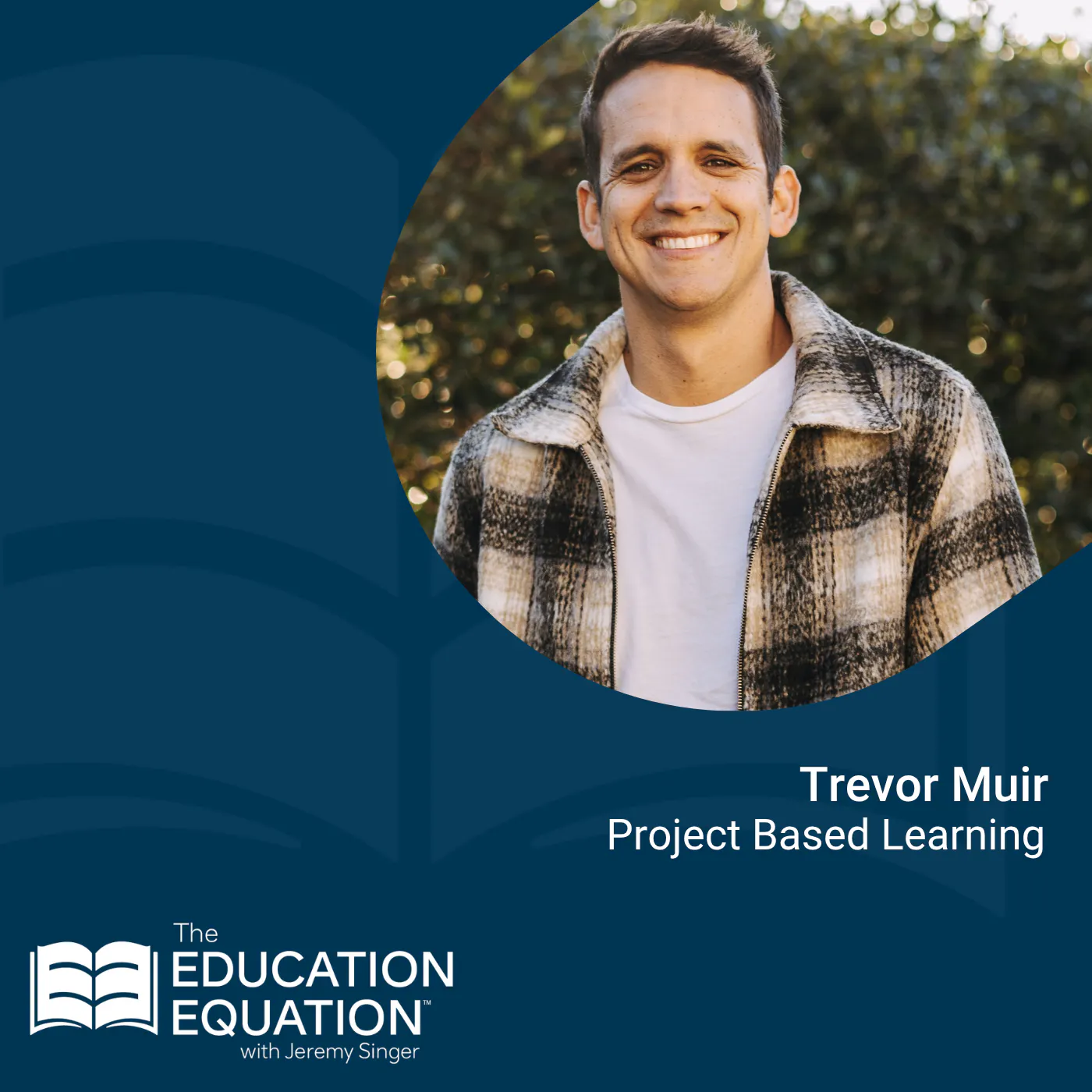
In this episode of The Education Equation, host Jeremy Singer talks with Trevor Muir—an educator, author, speaker, and founder of Epic PBL. Recorded at College Board's Advanced Placement Annual Conference, this conversation explores how project-based learning (PBL) can address the ongoing relevance crisis in today's classrooms and prepare students for the durable skills needed in an AI world.
Trevor shares his journey from a classroom teacher to a leading advocate for "main course" PBL—learning experiences that require students to think critically, collaborate, and solve real-world problems. They discuss the difference between meaningful applied learning and "dessert" projects, how AI can serve as a powerful project-planning partner, and practical ways for AP teachers and school leaders to effectively incorporate and scale PBL while maintaining content mastery.
Key Highlights:
Dessert vs. Main Course Projects: Trevor explains the difference between projects tacked onto the end of a unit (like a model volcano) and projects where a meaningful problem drives the core learning of the subject.
The Relevance Crisis: With growing student disengagement, making content relevant through applied learning is critical. Even traditional subjects like calculus and grammar can be grounded in purposeful, real-world problems.
AI as a Co-Pilot: While AI brings challenges to the classroom, it can serve as a helpful brainstorming partner for teachers looking to generate authentic, localized project ideas aligned with their standards, while still preserving the student thinking that learning requires.
PBL in AP Courses: PBL doesn't mean abandoning direct instruction or lowering expectations. Trevor shares how teachers can gradually introduce problem-solving units into their packed curriculums and why allowing students to grapple with real constraints leads to better outcomes.
Referenced in the Episode:
Trevor Muir's books: The Epic Classroom, The Collaborative Classroom, and New Teacher Mindset
Launch: Using Design Thinking to Boost Creativity and Bring Out the Maker in Every Student by John Spencer
The National Association of Colleges and Employers (NACE) 2026 Survey on Top Employee Skills
Lucas Education research on the impact of rigorous PBL in AP US Government and AP Environmental Science
Timestamps:
00:00 - Show Introduction
01:00 - Meet Trevor Muir
02:00 - What is Project-Based Learning?
03:10 - A Real-World PBL Example: The Refugee Story
05:48 - Trevor's "Aha" Moment with a Hard-to-Reach Student
09:43 - Addressing the Relevance Crisis in Education
15:00 - Dessert vs. Main Course Projects
16:47 - How to Design a Purposeful Project
18:41 - Using AI as a Project Planning Partner
20:00 - The Role of the Teacher in a PBL Classroom
23:53 - PBL in Advanced Placement (AP) Courses
28:47 - Finding the Time and Stealing Ideas: Advice for Teachers
32:48 - How School Leaders Can Support PBL
39:35 - Rapid Fire Questions
If you enjoyed this episode, be sure to subscribe to The Education Equation podcast wherever you listen to podcasts. Visit us at TheEducationEquation.org for more.

Global Tech, Local Impact: Unlocking Classroom Bottlenecks with Emma Dorn
How can we let data drive student success? On this episode, host Jeremy Singer talks with Emma Dorn, a Senior Knowledge Expert at McKinsey & Company, about how school systems improve and sustain progress at scale. While the US debate focuses on whether to use technology, the Global South innovates out of necessity due to resource constraints. From solar tablets in Malawi to WhatsApp coaching in Pakistan, Emma shares how to solve the core instructional bottleneck.
Emma outlines five case studies from around the world where technology solves real instructional problems:
• First, design for the instructional bottleneck, not the tech. In Malawi, where class sizes reach 150, Imagine Worldwide deploys offline, solar-powered tablets running adaptive software, doubling literacy and math fluency.
• Second, technology designed for teachers can be more transformative than direct-to-student devices. McKinsey's analysis of global PISA data shows tech in the hands of teachers adds a year or two of learning, while student devices reduce outcomes due to distraction. New Globe utilizes teacher tablets to deliver structured lesson plans offline.
• Third, technology works better when aligned with the curriculum. Mentu's AI assistant in Colombia and the Dominican Republic maps to local curricula to scaffold lower-skill teachers.
• Fourth, technology is most powerful when scaling proven interventions like teacher coaching. In Pakistan, Talimabad created a WhatsApp-native digital coach analyzing classroom audio to give immediate feedback.
• Fifth, think beyond the Scantron. Using the Teaching at the Right Level (TaRL) methodology, Pratham and Wadhwani AI developed oral reading fluency assessments operating on $50 cell phones, reducing assessment time by 50% across millions of learners.Listen in to learn how a global perspective can provide unique insights into how to leverage emerging technologies to solve real world educational challenges at scale.
Research and Links:
Malawi Scale-Up: globalpartnership.org/blog/malawi-strengthening-edtech-evidence-community-perspectives
McKinsey PISA Study: https://www.mckinsey.com/industries/education/our-insights/drivers-of-student-performance-insights-from-europe
Structured Pedagogy: https://www.wwhge.org/resources/implementing-structured-pedagogy-programmes-effectively-at-scale/
New Globe Impact: https://newglobe.education/impact/
Taleemabad Profile: https://taleemabad.com/
Mentu AI: https://mentulabs.com/en/
Pratham TaRL: https://www.pratham.org/about/teaching-at-the-right-level/
Wadhwani AI: https://www.wadhwaniai.org/
Join the Conversation:
Subscribe, like, and follow The Education Equation wherever you get your podcasts.
Time Stamps:
00:00 Show Introduction
00:38 Meet Emma Dorn
02:03 Why Look Globally
04:14 Constraints Drive Innovation
06:20 Lesson One Bottlenecks
12:21 Lesson Two Teacher Tech
19:00 Lesson Three Curriculum Alignment
23:37 Lesson Four Scaling What Works
29:28 Lesson Five Oral Assessments
34:18 Big Picture Takeaways
35:42 Rapid Fire Questions
37:40 Five Year Vision
38:51 Closing Thanks

AI and the Future of Learning with Ethan Mollick
Jeremy Singer sits down with Ethan Mollick, professor at the University of Pennsylvania's Wharton School and author of Co-Intelligence: Living and Working with AI, a New York Times bestseller and a best book of the year from The Economist and Financial Times. Mollick is a defining voice in the AI space, testing generative tools in real-world classrooms and authoring the widely read newsletter One Useful Thing. He is the Ralph J. Roberts Distinguished Faculty Scholar, Rowan Fellow, and Associate Professor at the Wharton School, where he directs the Generative AI Lab and studies the effects of AI on work, entrepreneurship, and education. He was named one of TIME Magazine's Most Influential People in Artificial Intelligence.
Despite the rapid pace of development, Mollick argues that the AI we use today is the worst it will ever be, necessitating a proactive shift from denial to engagement. In this episode, he explains why the "homework apocalypse" is already here and how the traditional writing assignment has been fundamentally disrupted. The discussion moves beyond simple prompt engineering to explore the "jagged frontier" of AI capability, where the technology excels at complex tasks while occasionally stumbling on simple ones. Mollick and Singer break down the varying impacts of AI on human performance, describing it as a leveler for those with skill gaps and a "king-maker" for experts who can leverage the tool to achieve massive productivity gains.
The conversation also tackles the existential questions of human agency and the future of assessment. Mollick advocates for a "flipped classroom" model where AI serves as an infinitely patient universal tutor outside of school, leaving class time for active learning, debates, and creative projects. He and Singer discuss testing in the age of AI and how educators can teach students to develop "durable skills" like taste, judgment, and a unique personal style . By viewing AI as a teammate rather than just a tool, Mollick suggests that teachers can reclaim hours of their week and focus on the deeply human aspects of education.
Featured References:
Book: Co-Intelligence: Living and Working with AI by Ethan Mollick
Newsletter: One Useful Thing by Ethan Mollick
Book: The Diamond Age by Neal Stephenson (The "Young Lady’s Illustrated Primer")
Research: Wharton AI Labs on student performance and AI interaction
Data: Walton Family Foundation survey on teacher AI usage and time-savings
Case Studies: AI-driven educational outcomes and tutor studies in Taiwan and outsourcing academic writing to Kenya
Episode Timestamps:
00:00 — Introduction to Ethan Mollick and the pace of AI evolution 02:26 — The "homework apocalypse" and the shift in educational thinking 04:45 — Why today’s AI is the worst version we will ever use 09:15 — Lessons from the 1970s calculator debate for modern curricula 13:55 — AI literacy vs. a fundamental reshaping of human interaction 17:30 — Developing taste and agency as essential "durable skills" 19:00 — The Leveler, Elevator, and King-maker effects on human skill 29:10 — The promise of the universal tutor to close equity gaps 32:55 — Using AI to enable the flipped classroom and active learning 36:55 — Shifting from "tool" to "teammate" in teacher workflows 41:50 — Why AI detectors fail and the move toward in-class assessment 45:45 — Rapid Fire: Retirement of AI literacy, Neal Stephenson, and the importance of humanities 48:45 — A three-year vision for positive change in education
Follow, Like, and Share The Education Equation wherever you get your podcasts.

Cognitive Science in the Classroom with Dan Willingham
Jeremy Singer sits down with Dr. Daniel Willingham, professor of psychology at the University of Virginia and author of Why Don’t Students Like School?: A Cognitive Scientist Answers Questions About How the Mind Works and What It Means for the Classroom.
Despite decades of robust research into how the human brain learns, a significant gap remains between laboratory findings and daily classroom instruction. In this episode, Dr. Willingham shares the origin story of his career pivot from memory researcher to educational translator following a transformative 2001 conference with teachers in Nashville. The discussion moves beyond the hype of educational trends to explore the fundamental constraints of the human mind. Willingham and Singer break down why students are naturally averse to thinking, explaining that the brain is designed to save effort by relying on memory rather than slow, hazardous problem-solving. They discuss why spacing—revisiting content over time—is scientifically superior for retention but often resisted by students due to its impact on immediate motivation.
The conversation also tackles the modern challenges of AI and declining reading scores. Willingham argues that the issue isn't necessarily a lack of leisure reading among youth, but rather a decrease in the rigor of texts and expectations within schools. He advocates for knowledge-rich curricula that sensibly sequence factual, procedural, and conceptual information to provide the necessary engine for critical thinking.
Featured References:
Book: Why Don't Students Like School? by Daniel Willingham Book: The Reading Mind by Daniel Willingham
Book: Cultural Literacy by E.D. Hirsch
Research: Sam Wineburg (Stanford University) on digital literacy and vetting information
Data: American Time Use Survey (Bureau of Labor Statistics)
Episode Timestamps:
00:00 — Introduction to Dr. Daniel Willingham and the gap between science and classrooms 03:00 — The Nashville story: Why Willingham pivoted to education 09:00 — The science of spacing: Why laboratory findings don't always translate to classrooms 13:50 — Advice for superintendents: Choosing CogSci-aligned curricula 22:45 — The core thesis: Why the brain is set up to save you from thinking 33:45 — Defining factual, procedural, and conceptual knowledge 41:50 — AI in education: Generalizable skills vs. domain-specific knowledge 51:40 The Reading Mind: Addressing declining scores and the importance of rigor 01:03:50 — Rapid Fire: Retirement of learning styles, the importance of probability, and the future of teacher education
Follow, Like, and Share The Education Equation wherever you get your podcasts.

Comments

Download from Google Play

Download from App Store
 United States