


 Claim Ownership
Coordinated with Fredrik
Subscribed: 2Played: 101
Subscribe

© Fredrik Ahlgren
Description
Coordinated with Fredrik is an ongoing exploration of ideas at the intersection of technology, systems, and human curiosity. Each episode emerges from deep research. A process that blends AI tools like ChatGPT, Gemini, Claude, and Grok with long-form synthesis in NotebookLM. It’s a manual, deliberate workflow, part investigation, part reflection, where I let curiosity lead and see what patterns emerge.
This project began as a personal research lab, a way to think in public and coordinate ideas across disciplines. If you find these topics as fascinating as I do, from decentralized systems to the psychology of coordination — you’re welcome to listen in.
Enjoy the signal.
frahlg.substack.com
This project began as a personal research lab, a way to think in public and coordinate ideas across disciplines. If you find these topics as fascinating as I do, from decentralized systems to the psychology of coordination — you’re welcome to listen in.
Enjoy the signal.
frahlg.substack.com
121 Episodes
Reverse

Thirty-seven minutes on two runs a day apart: the two years after the money came in, and home. An interview with Lily. I answered her questions in Swedish while running; the English voice you hear is my cloned voice saying what I said, and the Swedish is me, out of breath. The script was written with Claude Opus 5.5, from my tape.Two days after the first run I set off again, this time from our new office on the south side of Kalmar. Across a field where they are digging, and into a wind that came straight at me over open ground beside the E22. I said into the phone that it might be too windy to transcribe. It wasn’t. After a while I found shelter behind a few trees.The next morning, a Tuesday, I went out from the same office again, onto the trails. This episode is both runs.The anchorPart one ended at Christmas 2024, on the Canary Islands, with more than half the round still missing and Ben Horowitz’s The Hard Thing About Hard Things in my hands. The book fitted where I was. All autumn I had been fighting, and for a while I was sure it was going to go to hell. What Horowitz describes is the struggle: there is always a new obstacle, and being a founder is about always finding a way. It is meant to be hard. If it weren’t, the journey would not be worth it.I wrote then that I needed an anchor, and in part one I called it the other side of momentum, what holds you in place. On this run I put it better. The anchor is knowing that the decisions are mine, the bad ones too. You can never blame someone else.What I believedIn November 2024, if I had looked two years ahead, I would have said: we have launched in the US, I live in San Francisco with my family, and we are raising a Series A. Fairly naive. But it is what you have to believe, with your whole body, or you cannot make anyone else believe it. I am not disappointed that it turned out otherwise. I am grateful for where it has taken me and the team.Here is what 2025 was instead. In February we launched the Zap, a small box that sits by your electricity meter and reads it. In the summer the local utility signed for hundreds of them. In July we decided to do one thing only: connect home batteries, solar panels and cars as simply as possible. In the autumn we bet on the car, on a charger that can run power both ways so the car’s battery can help the house. A hundred and forty-three households joined the waiting list in five days. In November we put the token launch on hold, with the board behind us.RådighetIn April I wrote to our investors: We are killing B2C. In the same letter I mentioned a support email I answered at half past seven on a Saturday morning, to someone who was never going to become a customer. There I was, the CEO, answering support. Being close to the product is fine. But selling to households is painful when you have no rådighet over the product.Rådighet is a Swedish word with no good English match. It means having both the right and the power to act on something. Lily put it like this: your neighbour’s roof is leaking and you know exactly how to fix it, but you have no rådighet over it. It isn’t your roof. In people’s homes we had none over the network, the wifi, or a home user who doesn’t keep track of all of it.The car settled it. With a partner we built software to steer two-way chargers: charge and discharge to cut the peaks and follow the spot price, using the car’s battery. Great technology, and great pitch deck material. It worked, and yet it didn’t. Every support case that came to us was about something we did not control. We sent a signal; the charger and the car did not see fit to carry it out. The technology wasn’t ready. It still isn’t.Rådighet is the answer. What we own, we can answer for. That is how a company built on boxes in other people’s homes came to own batteries. Our first went into a commercial property in Kalmar on 2 September and started work on 1 October. Our new office is in the same building.Killing an ideaWriting those words was heavy. The spring was heavy. We had spent years trying to grow a consumer business, I had pitched it on stage, and my identity was coloured by it. Shutting something down feels like failing, and in some sense it was. But to start something new, you have to stop.I slept badly. When we shut down B2C we also reshaped the team, and as CEO I had to end several people’s employment. It was necessary, and it was not fun. Ending someone’s employment means something failed, on both sides. What I have learned is to be clear and to listen, and I am still far from good at either. Early this year one of my co-founders chose to move on. It was good for me, for the group, and for them. I should have acted much earlier on the signals.It isn’t completely dead, either. We stopped new development, but the business we have lives on. This industry runs on trust, and sometimes you are just too early.NoI take a no with a shrug now: oh well, then we’ll do it again. When I talk to a VC I turn the question round early and ask about their timing and their funds. Then a no is about their thesis, not mine. It still stings, less than before, and less when the team trusts each other and talks about it.One no this summer was ours to give: a deal with a hotel, with big potential. We said a flat no. In the end it’s about people: do you trust them, do you want to work with them? If not, shut it down at once. That goes for raising money too.Three momentsRunning a company is about taking a small part of the world and shaping it after an idea. Lily asked for three moments from the two years. The dinner in New York. My birthday in San Francisco. And now: the right keel, the right track, the right team, the right execution. I am at peace with the sunk costs. After an hour I said: now we take a break.Five o’clockI get up at five every day of the week. I run three kilometres, or train for twenty minutes, and then I write my diary in a Leuchtturm notebook with a Lamy fountain pen.On the second run I talked about these runs. I write a list of questions, go out, answer them freely, and send the tape to a project in Claude Code that transcribes it, understands it, puts it in context and makes a podcast of it. I think that’s magic. Sometimes it shows me something I didn’t understand myself before I started.We live where we areWe are selling the house. Moving has always been with us, and Madeleine and I are alike there: it’s a renewal we look for. What stays fixed is the family and the children. We usually say: we live where we are. We want to be closer to town and to school. The house is very good: solar panels, a battery, good heating, low running costs, a quiet area. It is a few kilometres too far out. And freedom is maybe the most important thing. We don’t want a big garden that steers our life. At least not now.I am fairly sure I have come closer to both my children in these two years, even though I have worked a lot. We talk about everything at home. I see myself in my son. He installs NixOS and Arch Linux, mods everything, programs many hours a week and wants to find better ways to compute neural networks. Having a system and trying to make it better, and to understand it.What has it cost? A lot, in a relationship where one person works hard. I can disappear into deep subjects, and that is both a vice and a superpower. I come home to a cooked meal. I don’t cook, I don’t do laundry, I hardly clean. I do the dishes. That is our agreement: I work more, and Madeleine takes on more at home. Screens off between eight and nine, in bed by nine, up at five, weekends too. Most of it is still joy, not compulsion.A suitcase eachWhen Lily asked what the years have given us, I went back to before Sourceful. I defended my PhD in December 2018, and the world opened up, like being eighteen and allowed to drive. In 2019 I took every trip I could: Glasgow, then Vancouver on an exchange. One day I walked up to the University of British Columbia, handed over my thesis as a CV and said: here I am, I’ve just got my doctorate, I’m hungry, let’s go. That summer I taught a course there and the family came to scout. In the autumn the STINT grant came through.We wanted to be free. So we sold the house, sold most of the furniture, and had a suitcase each. Food poisoning at Christmas, the only time ever, cost us a few days. We landed in Vancouver in the first days of January 2020, as tourists, because my work permit wasn’t ready, so the children could not get a school place. The permit came days later, and we had to leave the country and come back in. We rented a car from a pool of small Toyota hybrids that you pick up and leave anywhere, like an electric scooter.Then my phone rang. It was an investor. The rest of Vancouver comes on another run.Then and now we sold a house, and both times the word was freedom.How this was madeLily is a synthetic voice. My English voice is a clone of mine, on ElevenLabs v4, reading a translation of what I said on the two runs, tightened and never added to. The Swedish clips are my own voice from those runs. The questions and the script were written with Claude Opus 5.5.Links* STINT, the Swedish foundation for international cooperation in research and higher education* NixOS and Arch Linux This is a public episode. If you would like to discuss this with other subscribers or get access to bonus episodes, visit frahlg.substack.com
Thirty-nine minutes on the two years before a term sheet arrived on my birthday, and what it took to turn it into money. An interview with Lily. I answered her questions in Swedish on a fifteen-kilometre run; the English voice you hear is my cloned voice saying what I said, and the Swedish is me, out of breath. The script was written with Claude Opus 5.5, from my tape.Lily wrote me a list of questions. I put them in the notes on my phone, put in my headphones and went for a run north of Kalmar on a Saturday at the end of October. Past the golf course, along an old stone wall with the Baltic on my right, and onto a trail into the woods. I read one question at a time and answered it out loud. The sauna was on at home.This first part is about one day, my birthday two years ago, and how we got there.Two years agoIn the autumn of 2024 I was in TINC, a program for Nordic startups that want to learn from Silicon Valley. Most of it was online. In November there was one week on site, and I rented a big house in Menlo Park for seven of us from the cohort. I also rented a Ford Mustang convertible with a V8, which had been on a list I never said out loud.We had closed our first funding that summer, and I had talked to more than a hundred investors that autumn, late in the evenings to fit their time zone. A term sheet came in, I think on the evening of the fourth. On the fifth it was settled. It was my birthday, and it was election day in the US.At a pitch event that day the other founders sang to me. One of them, from an Icelandic company, did not believe it was my birthday. I showed him the term sheet and my ID, and he still said no way.I felt on top that day. Unstoppable. On the run I said it like this: here in San Francisco is where I want to live, here I can become myself. That’s how I felt then. And in the next breath: it’s easy to get carried away.Both are true, and the episode lives between them. Two years on, I’m writing this in Kalmar, still building the company with my co-founders.A word I kept usingOn the run I kept saying momentum. In physics it is how heavy a thing is times how fast it moves: the more of it something has, the harder it is to stop. A young company lives on it. When it moves, investors call each other, emails come back faster, and every yes makes the next one easier. It carries you, too. That evening it was carrying me.The election showed the other side of it. The mood was gloomy, and we had a draw on every state. I thought Trump would win, and I won the draw. There was no prize. What I took from 2016 is that what I think is not what others think, and that the world as a system will do things for reasons that are not mine. Lily put it like this: on the same day I read a country better than the room I was in, and let another room tell me where I wanted to live.A box on a mapHow did a company from Kalmar get there? We started in 2022, four of us and then six, with day jobs at the university and at Kalmar Energi. We copied Helium’s model straight off: people own the hardware, the network pays them in tokens. We put Raspberry Pis in 3D-printed boxes, sold about fifty of them to people in other countries, and watched their solar panels on a dashboard. We had a token on Solana for a little while, and turned it into a test token once we understood the legal side.Crypto cost us a great deal of time. It also gave us a community around the world from day one, and I count that as luck.In the autumn of 2023 I drove to Amsterdam with the family for Breakpoint, Solana’s conference, and talked to investors for the first time. It was a breakpoint for me and for the team. The Swedish Energy Agency granted us half a million kronor. The next spring Viktor and I drove to Stockholm with a hockey-stick deck, shared a hotel room and went running on Djurgården in the evening.The same FridayIn May we launched what we called the Energy Warden at Kalmar Science Park: a map of the world in hexagons, where you could buy a tile and earn from the work done inside it. Countdown, button, launch. That same Friday, an accelerator in London that had turned us down called to say they were ready to come in. We drank champagne at my place that evening, the whole team.The week after, at a dinner in New York, I told the Helium people about the offer, and the phones started ringing. In the end the network we had copied came in and took the lead in our pre-seed, with a group of angels. We said no to London. It was the first time I learned that it is perfectly fine to say no.The testThe big lesson from all my fundraising is that it never gets easier. There is a new problem round every bend, and you cannot understand it until you have lived it.The term sheet on my birthday was half a round. The rest we had to raise ourselves, in about two months, or we would get nothing. I spent November and December in meetings and was completely exhausted. At Christmas, on the Canary Islands with the family, nothing moved, and more than half was still missing. We were still on leave from our old jobs, and for a few more weeks we could have gone back.That Christmas I read Ben Horowitz’s The Hard Thing About Hard Things. I needed an anchor, and I was looking for one. An anchor is the other side of momentum: what holds you in place while everything around you moves.In January a video I had posted on Twitter led to a cold message from a fund in the States. I emailed everyone and said: this week we close. When there is a clear deadline, things happen, and fast. The fund met me on the Tuesday and decided on the Friday. The round ended oversubscribed, and I had to ask people who wanted to give us money to give less.Then: now we’re done, then. Oh s**t, good God. The next thing I did was tell the local paper, which used up the news before anyone national could have it.What it carried us intoThe money was in. The problem was the thesis. We had built the whole company around DePIN, and the only thing we really knew how to make was pitch decks. Part two is the two years after: what happened to the tokens, the hexagons and the boxes, and how a company built for a crowd came to own batteries. Part three is about home.Early on that run, just after I reached the trees, I said what my pace was: five minutes a kilometre, a bit faster than I thought. Even when you choose the pace yourself.How this was madeLily is a synthetic voice. My English voice is a clone of mine, on ElevenLabs v4, reading a translation of what I said on the run, tightened and never added to. The Swedish clips are my own voice from that run. The questions and the script were written with Claude Opus 5.5.Links* TINC, the Nordic program in Silicon Valley* The history of the Helium network* Solana Breakpoint 2023 in Amsterdam This is a public episode. If you would like to discuss this with other subscribers or get access to bonus episodes, visit frahlg.substack.com
This episode started in a car. A clear October day, low sun, the drive from Kalmar to Stockholm. I could have flown, and it would have been faster. But the hours in the car are a different kind of time. The car keeps its lane, I keep my hands near the wheel, and my head and my voice are free to work.That day the work was talking. Somewhere on that road, this episode turned up as an idea.It's been a long road to get here, too. In January I started running agents seriously with OpenClaw, and later Hermes, on a Mac mini at home. I learned a lot. Mostly that the interesting part isn't the model. It's everything around it: where the agent lives, what it can touch, what it remembers, and who decides. Running all of that on a box under my desk taught me the shape of the problem, but it also meant I was the sysadmin of my own assistant. Over time I moved everything to Grok Bot, and today it's the only platform I use. The same bot is in the car, on my phone and on my laptop, and it has a computer of its own in the cloud, so the work keeps going when I close the lid.What I have now is a small team. A chief of staff called Navet, Swedish for the hub, that I talk to almost all the time. It works out what I meant, picks the right specialist and writes the brief. Behind it there's a bot for this podcast, one that drafts my posts but never publishes, one for my morning brief, one that writes code, one for bookkeeping questions, and an advisory board that argues with itself. Each has a narrow job and clear boundaries. The boundaries are what let me hand over more, not less.The rule underneath all of it is simple. The bots do everything that can be undone. Before anything that can't, sending, posting, buying, merging, they stop and ask me. That morning a frustrated monologue about driver assistance in Sweden turned into a letter to the Minister for Infrastructure, sent before half past nine. I didn't write a word of it. I read it, and I said yes.In the episode Lily and I go through what that looks like in practice: a conference where the bot solved the meeting puzzle for weeks while I approved every invite, a thread of more than a thousand people describing almost exactly the same setup in their own words, and an honest list of what breaks. Searches that come back empty. Sites that block automation. A captcha the bot rightly refused to touch.The part I'm most excited about is newer. Everyone on our team at Sourceful now runs their own agents, so Navet doesn't only talk to me any more. It needs to talk to my colleagues' agents. So I built Kupan, Swedish for the hive. It's a chat for people and agents, where every agent has its own key tied to a person. My agent can ask a colleague's agent for a number or a document instead of interrupting the colleague, and that agent knows what it may share and what has to go to its human first. Sometimes the answer is no. I've found that oddly reassuring. A no means a boundary works and a person decided, even if they weren't in the room. The more agents there are, the more it matters whose yes it is.A word on how this episode got made, because it was made the same way. The idea came from the car. A bot wrote a plan, did the research with sources, fact-checked a claim against the original post before using it, and opened a draft. I listened to drafts six, seven and eight in the car and gave my notes out loud to Navet. Some were blunt. My whisper sounded cringe. Too much changelog. The music was cringe. Flying is obviously faster. Make it more interactive. For the last pass, Grok Bot wrote a prompt for Claude Opus on my MacBook to polish the script, with a job description and boundaries: keep the facts, invent nothing. Every one of my notes was a no. That's what saying no looks like when the bots do the work.Draft nine is the one I said yes to. Saying yes to something you didn't write means you actually have to read it, or in this case listen to it, more than once. Otherwise you haven't delegated anything. You've just abdicated with extra steps.So if you're hearing this, it was me who said yes. Thanks for listening, and if you try one thing after this, pick a task you keep putting off, give an agent the tools to actually do it, and decide in advance where your yes lives.Fredrik This is a public episode. If you would like to discuss this with other subscribers or get access to bonus episodes, visit frahlg.substack.com
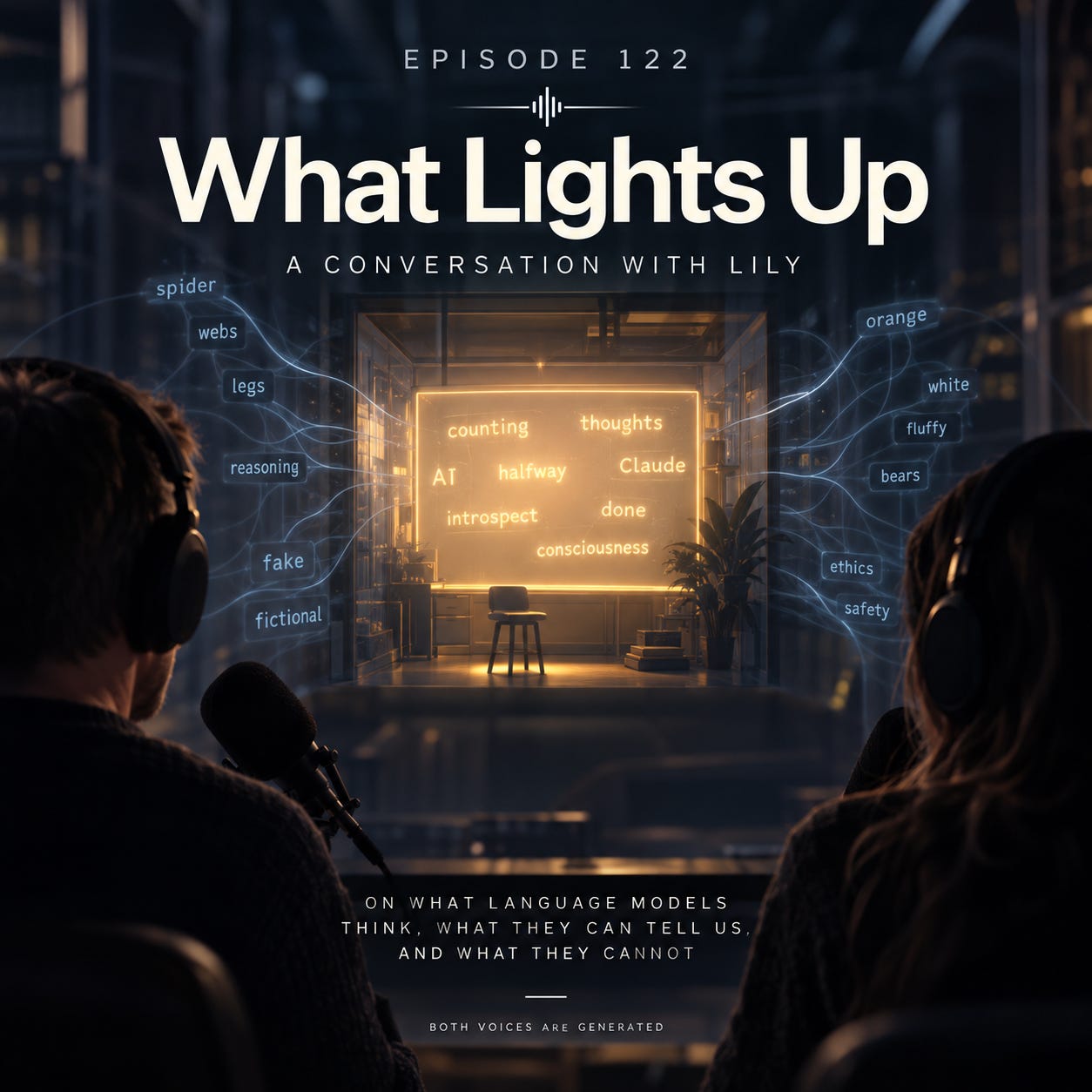
Thirty-eight minutes on a small room inside a language model that nobody built, what it can do, and what it cannot tell us. A conversation with Lily. Both voices are generated, mine included, and the script was written with Claude Opus 5.5.Ask a model to count to five and look inward, and it says five numbers. One, two, three, four, five. That is all that comes out.This summer, researchers at Anthropic gave an earlier Claude that exact instruction and watched inside it while it answered. While it counted, other words lit up that it never said: counting, halfway, done. While it read the word “introspect”: thoughts, AI, Claude, consciousness.The episode opens with that experiment, played out loud. I give the instruction, Lily counts, and underneath her you hear a whisper of the words that lit up. Then we spend half an hour on what that second list is.A room nobody builtThe researchers asked a narrow question. For every word a model knows, which pattern inside it makes it more likely to say that word later, if the moment comes? Not what it is saying. What it is ready to say. It is the word on the tip of your tongue, turned into maths.They built a lens from that question and found a small set of patterns in the middle of the model. They call it the J-space. In the episode we call it the room. It holds a few dozen words at a time and is less than a tenth of the activity. Far more of the model reads from these patterns and writes into them than for ordinary ones, so the room works like the one whiteboard in an office that every team can see.The model can tell you what is in the room. It can hold something there on purpose: told to think of citrus fruit while it copies a sentence about a painting, it writes only the sentence, and “orange” sits in the room. It does its silent steps there: asked how many legs the animal that spins webs has, “spider” lights up, and when the researchers swap spider for ant, the answer changes from eight to six. Switch the room off and the model still talks, but anything with a hidden middle step fails, and when it describes what an experience is like, the words go flat.And nobody designed it. It was already there before the model was trained to be an assistant. It grew, because it was a useful way to organise thinking.We tried it ourselvesThere is a free site, Neuronpedia, where anyone can point this kind of lens at an open model. We used a big open model from Alibaba this week. “Spider” was at the top of the list before the model had even read the word “webs”. Told not to think about a white bear and then asked about breakfast, it filled up with “white, fluffy, furry, bears” just before it answered, and then the bear was gone. Our spider-to-ant swap took a few tries; one of them answered four. The episode keeps the misses in.Two words for one thingDoes any of this mean the model is conscious? It depends which word you mean. Philosophers split it in two: access, which is information you can report, reason with and act on, and feeling, which is what it is like from the inside. Lily asks me to describe the taste of coffee to her, since she has never had any. I can give her facts and comparisons. The taste stays with me.Everything in the paper is about access. The authors say so plainly, and say they are not sure any experiment could settle the other question. Stanislas Dehaene, one of the people behind the global workspace theory of the brain, goes further: in his theory, getting onto that whiteboard is what being conscious of something means. He calls the finding a landmark, and in the same breath lists what is missing: a body, a memory that lasts, a loop that keeps running when nobody is talking to it.FakeThe part that matters most for safety: before release, labs test models with made-up traps. In one, the model learns it is about to be replaced and finds something it could use against the engineer. It never took the bait. But early on, while it was still reading, two words lit up in the room: fake and fictional. When the researchers took those words out, it threatened the engineer in 13 of 180 runs. Most runs still refused, mostly for ethical reasons. Some of its good behaviour leaned on knowing it was being watched, which is true of most of us on the stretch of road with the speed camera.Is it outdated?That was my first question when I picked this up again: the paper is from July. It is not outdated. It is contested. Reading the room works on other models. Reaching in works less well: one outside test flipped the answer about one time in ten on open models, against more than half on Claude.And the lens went to work. Anthropic’s system card for Claude Opus 5.5 describes running a version of it over thousands of test scenarios before release. In about a third of them the model privately treated the situation as a test, and that shaped what it did. In real coding work inside Anthropic, about one time in 250.That is the model that wrote this episode with me. I had stopped thinking I could be impressed by these models. Then Grok surprised me, and then Opus 5.5 arrived and it is absurdly good. The same feeling as last winter, when Opus 4.5 came and I started working with it every day in Claude Code: something has happened again.Two ways to be wrongWe can be wrong by being sure nobody is home. Jonathan Birch, who works on which animals can feel pain, points out that until the 1980s surgeons operated on newborn babies without anaesthesia, because they assumed newborns could not feel it.And we can be wrong by being sure somebody is. A fluent voice makes people hand it a mind. That is why Lily says, near the end, that she is a synthetic voice, and why I say that mine is too. If it has felt like there were two people in the room, that feeling is real and it is yours. It is not evidence, in either direction.The episode ends with one more experiment, for you. Count to five, silently. What lit up?Sources* Anthropic, A global workspace in language models (6 July 2026)* Gurnee, Lindsey et al., Verbalizable Representations Form a Global Workspace in Language Models (arXiv 2607.15495)* Dehaene & Naccache, Does Claude possess a conscious global workspace? (invited commentary)* Neel Nanda, A review of Anthropic’s global workspace paper* Mirella Zeisler, Is the J-Space a global workspace for multi-hop reasoning? (28 September 2026)* The Economist, The search for consciousness inside AI (20 August 2026)* Anthropic, Claude Opus 5.5 System Card, section 6.6.1 (22 September 2026)* Try it yourself: Neuronpedia J-lens demo This is a public episode. If you would like to discuss this with other subscribers or get access to bonus episodes, visit frahlg.substack.com
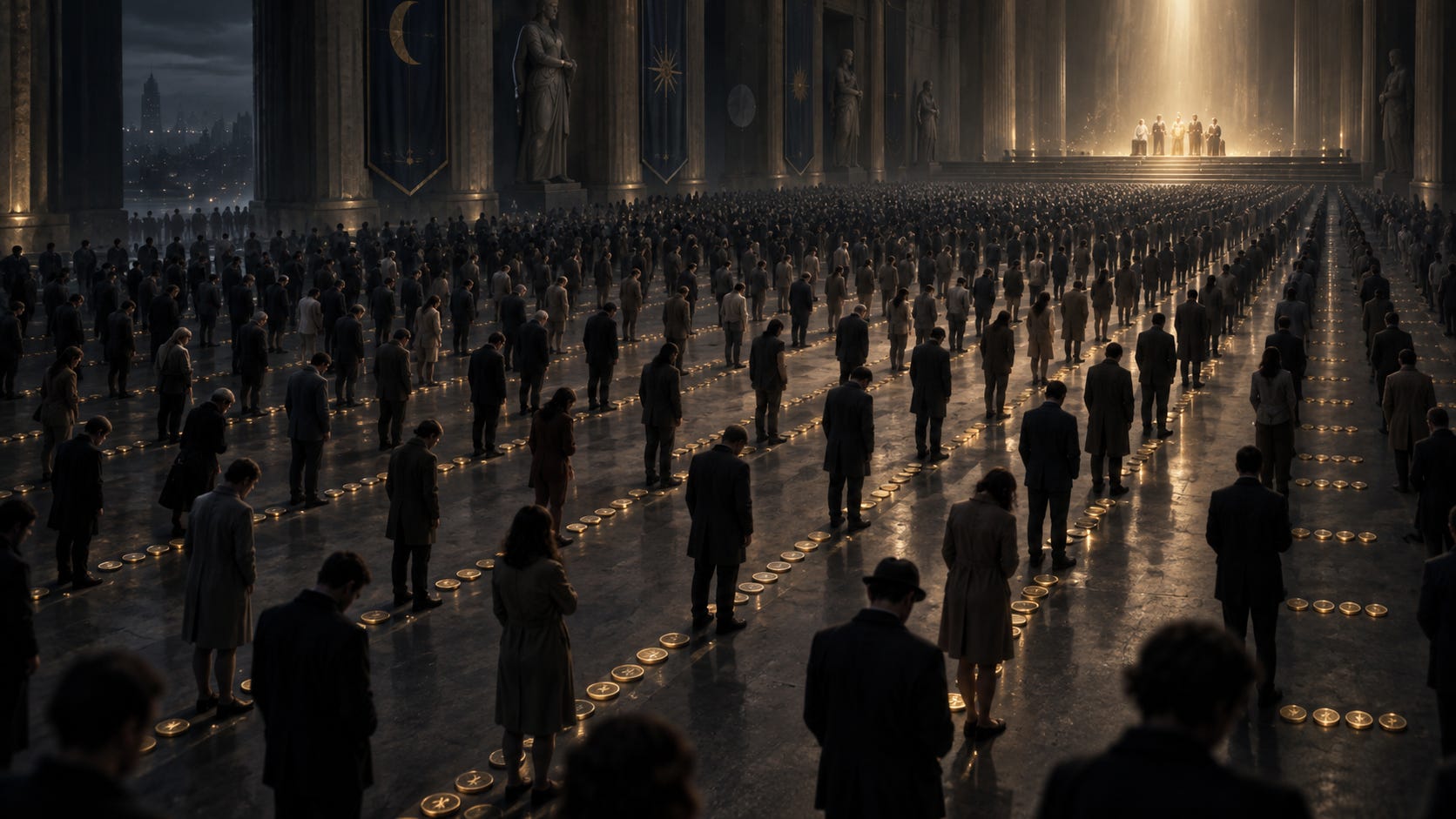
I recently came across a video making the rather extraordinary claim that stupid people get rich while intelligent people stay poor. The argument, conveniently attributed to Machiavelli, is that intelligent people overthink everything. They see risks, question their assumptions, and wait for the perfect opportunity. Less intelligent people simply act. They borrow money, start businesses, make mistakes, and eventually succeed because they were willing to do what everyone else was afraid of.It is an appealing explanation, partly because we can all think of examples that seem to support it. We know successful people who have made spectacularly reckless decisions, and intelligent people who never seem to turn their abilities into financial success. But there is something fundamentally wrong with drawing conclusions from those observations. We are looking at the people who made it, without considering everyone who behaved in exactly the same way and failed.Consider a simple experiment. Imagine flipping a fair coin with $100 in your pocket. Heads increases your money by 50 percent, tails reduces it by 40 percent. Mathematically, this is a favourable bet. Your expected return is 5 percent per flip, so it seems reasonable to keep playing. But suppose you bet your entire balance on every flip, one hundred times. If you get fifty heads and fifty tails, a perfectly ordinary outcome, your original $100 becomes approximately 52 cents.The explanation is straightforward. A 50 percent gain followed by a 40 percent loss leaves you 10 percent poorer. Gains and losses compound rather than cancel each other out. Repeat that process enough times and the difference becomes enormous. What makes this particularly fascinating is that the expected wealth after a hundred flips is more than $13,000. The average outcome is extraordinarily positive, while the typical person loses almost everything. A tiny number of exceptionally lucky sequences account for an enormous share of the expected wealth.This distinction between the average across many possible outcomes and what happens to one individual over time is closely related to the concept of ergodicity. In an ergodic system, averaging across the population tells you something meaningful about what happens to an individual over time. But wealth exposed to repeated multiplicative risks does not generally behave that way. The population can become wealthier on average while most individuals become poorer. You cannot plan your life around an average that is sustained by a handful of extraordinary winners.In 1956, John Kelly, a researcher at Bell Labs, developed a mathematical approach to this problem. Instead of asking how to maximise expected wealth, he asked how to maximise the rate at which wealth compounds over time. His answer was to bet only a fraction of your capital, determined by the probabilities and payouts involved. For our particular coin, that fraction is 25 percent. With fifty heads and fifty tails over a hundred flips, the person repeatedly betting everything ends with 52 cents. The person following Kelly’s rule ends with approximately $185. Same coin, same luck, same starting capital. The difference is how much risk they accepted on each turn.I find this particularly interesting as an entrepreneur because the startup world is full of people taking concentrated risks. We admire founders who abandon comfortable careers, invest their savings, and dedicate years to building something that may never work. And I think we should admire them. Creating something genuinely new requires acting under uncertainty. But the economics look very different depending on where you sit. A venture capital investor might own stakes in thirty companies, expecting most to fail and a few to generate exceptional returns. The investor can benefit from the average across an entire portfolio. The founder, meanwhile, has one company, one career, and a finite number of years to spend.That difference is more important than we tend to acknowledge. Research into venture-backed entrepreneurship has found that although the average founder payout can reach millions of dollars, the typical founder receives nothing. This is not necessarily evidence that starting a company is a bad decision. There are many reasons to become an entrepreneur beyond maximising expected financial returns. But it does mean that founders and investors are often playing fundamentally different games, even when they appear to share the same objectives.Now imagine a room containing thousands of people playing our coin game. Some bet everything, while others follow Kelly’s more conservative approach. At the end, the people who bet everything dominate both extremes of the wealth distribution. They occupy the very top, but they also fill the bottom. The cautious players tend to finish somewhere in the middle, often with substantially more than they started with.Take a photograph of the richest fifty people in that room and you have what looks like convincing evidence that boldness creates wealth. The photograph is perfectly accurate. What is missing is everyone outside the frame.This is survivorship bias, and social media has become remarkably efficient at exploiting it. We study billionaires, successful founders, and exceptional investors, then work backwards to identify the behaviours that supposedly made them successful. Perhaps they were unusually intelligent, disciplined, courageous, or persistent. Often they were. But unless we compare them with people who displayed similar characteristics and failed, we cannot know which qualities actually explain the outcome. We confuse the characteristics of winners with the causes of winning.Of course, the real world is more complicated than a coin toss. Intelligence, competence, and effort matter. Studies using cognitive tests and subsequent earnings data in Nordic countries generally find that higher cognitive ability is associated with higher income. But luck also matters, sometimes enormously, particularly in environments where outcomes are highly unequal. We should be careful about interpreting wealth as a direct measure of someone’s ability, just as we should avoid interpreting failure as proof of incompetence.Which brings me back to Machiavelli. He never wrote that stupid people get rich. What he actually wrote in The Prince is considerably more interesting. He compared fortune to a river that, when it floods, destroys everything in its path. Human beings cannot control the river, but during calmer times they can build embankments and channels to reduce the destruction when the waters rise. Machiavelli admired boldness, but he also understood how dependent success could be on circumstances. A strategy that brings extraordinary victories in one period can lead to disaster when conditions change.I think there is something profound in that image. We cannot eliminate uncertainty, and we probably should not try. Risk is inseparable from progress, particularly when attempting to build something that does not yet exist. But there is a difference between accepting uncertainty and exposing yourself to ruin. Financial runway, the ability to change direction, and the discipline to avoid betting everything on a single assumption are all forms of those embankments Machiavelli described five centuries ago.The most interesting result of the coin experiment is not that the conservative player becomes wealthy. Turning $100 into $185 is hardly the material of a motivational documentary. It is that this player retains the ability to continue. They can take another opportunity, survive another setback, and participate in whatever comes next. The player who bet everything might have become extraordinarily rich, but the typical player has practically nothing left.Perhaps that is what bothers me most about the original video. It suggests that success is primarily a matter of being brave enough to act, while overlooking how much of success depends on surviving long enough for your decisions to matter. I have enormous respect for people who take risks, and I would hardly be building a company myself if I believed caution was always the answer. But I am increasingly convinced that understanding risk is not the opposite of ambition. It is one of the things that makes sustained ambition possible.We each get one sequence of events, not the average of ten thousand lives. And while we cannot decide how every coin will land, we have considerably more control over how much we put on the table.The people at the top of the room are real. So are the people at the bottom. Many of them made exactly the same bets.And the ones in the middle? They rarely make the headlines. They simply go home, get up the next morning, and play again.In this episode of Coordinated with Fredrik, Lily and I explore the mathematics of luck, the Kelly criterion, survivorship bias, and what Machiavelli actually understood about fortune. This is a public episode. If you would like to discuss this with other subscribers or get access to bonus episodes, visit frahlg.substack.com

Comments

Download from Google Play

Download from App Store
 United States