


 Claim Ownership
Environment Variables
Subscribed: 39Played: 1,712
Subscribe

© Green Software Foundation
Description
Each episode we discuss the latest news regarding how to reduce the emissions of software and how the industry is dealing with its own environmental impact. Brought to you by The Green Software Foundation.
162 Episodes
Reverse
TWiGS hosts Tzviya and Kate are joined by Matthias Muehlbauer to explore how businesses can drive more sustainable and responsible AI practices. They discuss the environmental and health impacts of data centres, gaps in AI emissions reporting, and how sustainable procurement can pressure vendors to improve transparency. The conversation also examines the evolving role of AI policy, international commitments, and emerging measurement standards, highlighting how organisations can use existing incentives and better data to make more sustainable decisions.Learn more about our people:Kate Goldenring: LinkedIn | WebsiteTzviya Siegman: LinkedIn | WebsiteMatthias Muehlbauer: LinkedIn | WebsiteFind out more about the GSF:The Green Software Foundation Website Sign up to the Green Software Foundation NewsletterResources:Sustainability and AI Accelerator | 8-Week Live Cohort — OnePointFive Academy [02:27]Hyperscale data centers’ energy consumption, carbon emissions newly estimated by researchers | Harvard [05:19]Assessing the Carbon Emissions and Energy Consumption of U.S. Hyperscale Data Centers | Harvard BC3 has put together best practices for sustainable AI vendors [06:55]EV Ep 151: The Week in Green Software: The AI Water Management Challenge with Masheika Allgood [10:01] COP31 launches a voluntary pledge for clean-powered AI data centers as a Harvard study puts US data center emissions above Denmark's | MLQ.ai [18:55]Empowering Consumers for the Green Transition Directive - EU - 2024/825 [19:42] COP28, Dubai [20:14] Talk and Action | UN News [24:06] EV Ep160: The Week in Green Software: Empowering Consumers for the Green Transition [25:31]EV Ep158: How to make Green Claims with Green Software with Helen Neal [25:40]Data-Center Carbon Disclosure Gaps Make AI Boom’s Climate Impact Tough to Assess [34:00]Sustainable AI Group launches CLEER [37:14] SCI for OpenTelemetry | Green Software Foundation [39:08]Events:Green IO Paris | December 2nd to 3rd [44:34]Open Letter To Microsoft - ClimateAction.Tech [44:44]If you enjoyed this episode then please either:Follow, rate, and review on Apple PodcastsFollow and rate on SpotifyWatch our videos on The Green Software Foundation YouTube Channel!Connect with us on Twitter, Github and LinkedIn!
Hosts Kate and Tzviya are joined by Anne Faubry and Tim Frick to explore the EU’s Empowering Consumers for the Green Transition (EmpCo) directive and what it means for sustainability claims. They discuss the challenges of preventing greenwashing, improving transparency around product durability and repairability, and measuring the environmental impact of digital services. The conversation also looks at planned obsolescence, the need for more democratic input into technological decisions, and how communities and policymakers can hold technology companies accountable for their environmental impact.Learn more about our people:Kate Goldenring: LinkedIn | WebsiteTzviya Siegman: LinkedIn | WebsiteAnne Faubry: LinkedIn | WebsiteTim Frick: LinkedIn | WebsiteFind out more about the GSF:The Green Software Foundation Website Sign up to the Green Software Foundation NewsletterNews:Sustainable consumption - European Commission [03:03]EPREL [15:05]Ecograder [17:39]Stop Planned Obsolescence [24:38]B Corp New Standards [26:14]CSRD directive [29:29] The Rise and Fall of the Artificial State by Jill Lepore [36:31]The 9th Northwest Power Plan [46:53]Draft Ninth Northwest Power Plan Data Center Playbook - Alliance for the Great Lakes [55:29]Digital Greenwashing Guide - Mightybytes If you enjoyed this episode then please either:Follow, rate, and review on Apple PodcastsFollow and rate on SpotifyWatch our videos on The Green Software Foundation YouTube Channel!Connect with us on Twitter, Github and LinkedIn!
TWiGS host Valeria speaks with Claire Fletcher Harris about keeping people and communities at the centre of technology, especially as AI rapidly changes how we work. They discuss the importance of critical thinking, understanding the environmental and social impacts of digital infrastructure, and making AI use purposeful. Claire also shares practical GreenOps ideas and advice for getting involved in open-source sustainability communities.Learn more about our people:Valeria Salis: LinkedIn | GitHub | WebsiteClaire Fletcher: LinkedIn | GitHubFind out more about the GSF:The Green Software Foundation Website Sign up to the Green Software Foundation NewsletterResources:At OS Day 2025 by Schrödinger Hat , me and Claire FH said that one of the slides contained an Easter egg | Valeria Salis [00:03:49] Valeria Salis & Claire Fletcher-Harris - From shy contributor to (kinda) confident community leader [00:10:38 ] The Human Element Is The Real AI Revolution | Forbes [00:39:05]Events:Green Agentic AI with Headroom (November 3 at 6:30 pm CET · Karlsruhe · Hybrid) [01:17:27]Cloud Native Sustainability Month: Barcelona Edition (November 3 at 6:30 pm CET · Barcelona) [01:17:39]Cooling Without Compromise (November 5 at 4:00 pm CET · Virtual) [01:17:52]If you enjoyed this episode then please either:Follow, rate, and review on Apple PodcastsFollow and rate on SpotifyWatch our videos on The Green Software Foundation YouTube Channel!Connect with us on Twitter, Github and LinkedIn!
Chris Adams speaks with climate advisor Helen Neal about the growing regulations around environmental claims, including the EU’s Empowering Consumers for the Green Transition (EmpCo) Directive. They explore why greenwashing often results from poor communication between sustainability, marketing and legal teams, and how businesses can make credible, evidence based claims without falling into greenhushing. Helen also introduces her IMPACT framework and Zena Review, a tool designed to help businesses identify potential risks in their sustainability messaging.Learn more about our people:Chris Adams: LinkedIn | GitHub | WebsiteHelen Neal: LinkedIn | WebsiteFind out more about the GSF:The Green Software Foundation Website Sign up to the Green Software Foundation NewsletterResources:EmpCo Directive [01:09] What does the EU EmpCo Directive mean for my Green Web Foundation badges or my verification? | Green Web Foundation [26:19] Zena - AI Sustainability Review [31:42] Apple unveils its first carbon neutral products [40:12] AWS can help reduce the carbon footprint of AI workloads by up to 99% [43:18] Software Carbon Intensity (SCI) specification | ISO [43:32] Ecology | infomaniak [46:27] Impact Report | infomaniak [46:39] GSF Policy Working Group GSF Policy Working Group Issue #192 If you enjoyed this episode then please either:Follow, rate, and review on Apple PodcastsFollow and rate on SpotifyWatch our videos on The Green Software Foundation YouTube Channel!Connect with us on Twitter, Github and LinkedIn!
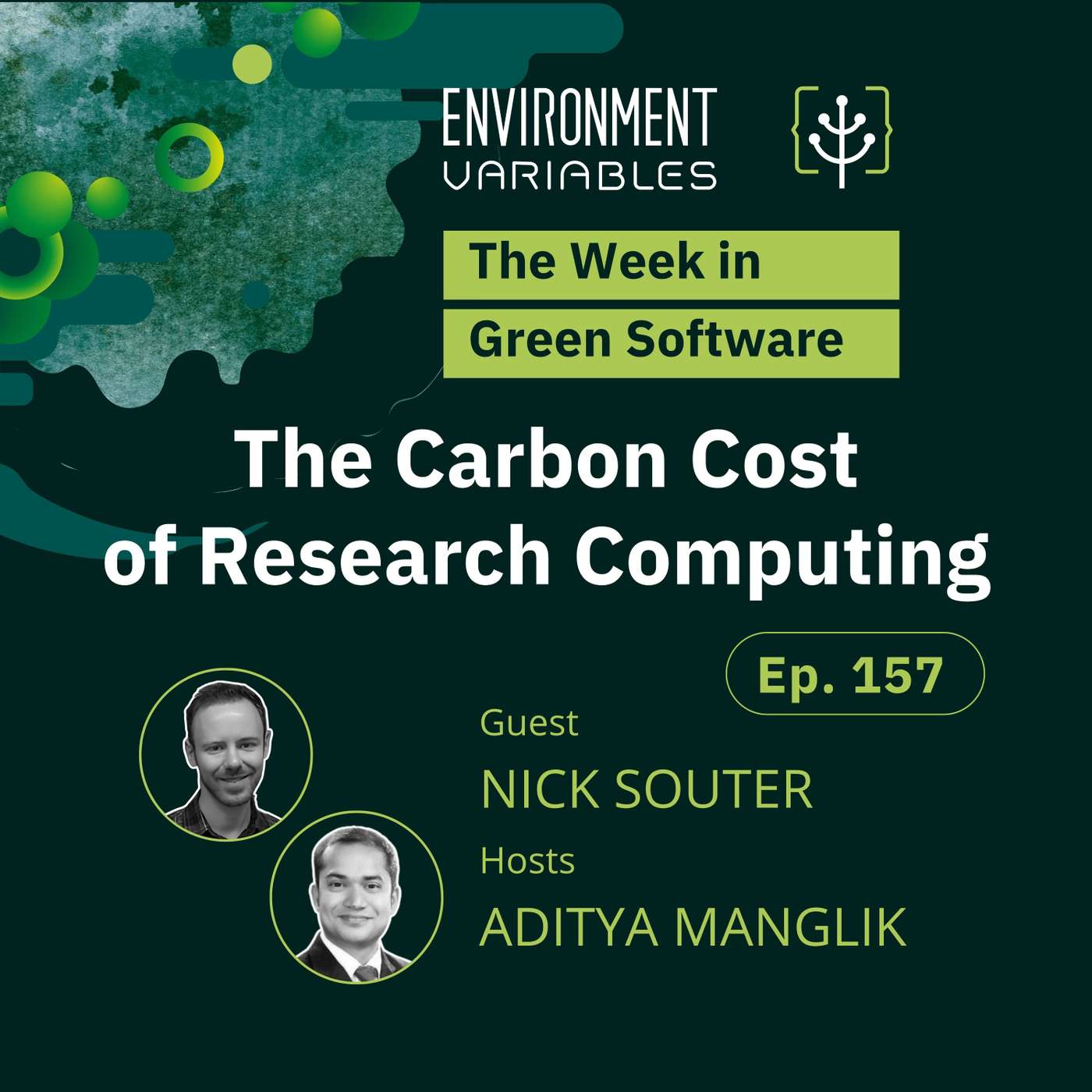
This Week in Green Software, Dr. Nick Souter from the University of Sussex explores how researchers can reduce the carbon footprint of scientific computing without compromising research quality. He shares practical ways to measure and optimise the energy use of fMRI data processing, including how removing unnecessary steps from a pipeline can cut emissions by around 50%. The conversation also examines responsible AI use, sustainable data storage, and how certification initiatives can make sustainability a standard part of scientific research.Learn more about our people:Aditya Manglik: LinkedIn | GitHub | WebsiteDr. Nick Souter: LinkedIn | WebsiteFind out more about the GSF:The Green Software Foundation Website Sign up to the Green Software Foundation NewsletterNews:Comparing the carbon footprint of fMRI data processing and analysis approaches | Dr. Souter et al. [06:46] Green Algorithms Calculator [09:10] Green Algorithms Dashboard [12:05] Ten recommendations for reducing the carbon footprint of research computing in human neuroimaging | Imaging Neuroscience | Dr. Souter et al. [14:23] Measuring and reducing the carbon footprint of fMRI preprocessing in fMRIPrep | Dr. Souter et al. [17:25] https://www.software.ac.uk/GreenDiSC [24:29]Events:Green Agentic AI with Headroom (November 3 at 6:30 pm CET · Karlsruhe · Hybrid) [28:47] Cloud Native Sustainability Month: Barcelona Edition (November 3 at 6:30 pm CET · Barcelona) [28:57] Cooling Without Compromise (November 5 at 4:00 pm CET · Virtual) [29:07]If you enjoyed this episode then please either:Follow, rate, and review on Apple PodcastsFollow and rate on SpotifyWatch our videos on The Green Software Foundation YouTube Channel!Connect with us on Twitter, Github and LinkedIn!

Comments

Download from Google Play

Download from App Store
 United States