


 Claim Ownership
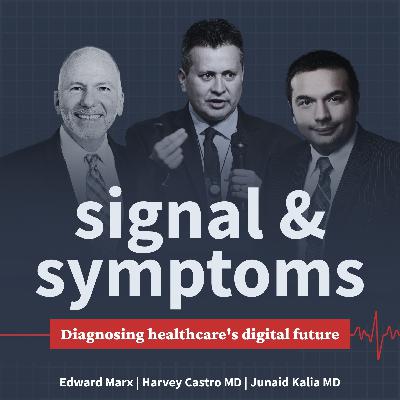
Signal and Symptoms Podcast
Subscribed: 0Played: 0
Subscribe

© Copyright 2026 Harvey Castro MD, Junaid Kalia MD, & Edward Marx
Description
Three healthcare AI experts who've watched millions wasted on failed projects. Dr. Harvey Castro, Dr. Junaid Kalia, Edward Marx, and guest experts cover all things healthcare AI - from digital transformation to clinical reality. Every Tuesday, we diagnose real failures, reveal what actually works, and help you avoid the expensive mistakes we've seen repeated everywhere. Because when AI decisions affect patient care, getting it right isn't optional.
58 Episodes
Reverse
No guest this week, just the two besties with a Healthcare AI Update. DR GPT™ Harvey Castro opens with the six questions he now asks of every healthcare AI tool, adapted from WHO and NIST: can I rely on it, who is responsible, will people actually use it, who sees my data, who can afford it, and what actually improves? Then he holds the evidence to that standard. A Kenya study where AI made documentation faster but showed no benefit for the patient. An odds ratio whose range includes “no difference.” A forecast, at 60% confidence, that within a year an AI will show lower morbidity and mortality than standard care. Dr. Junaid Kalia pushes on liability: if an AI flags a breast mass and the radiologist disagrees, who is liable, and when does not using AI become the lawsuit? Harvey’s answer is the hospital across the street. The episode closes on a live audience question from MaryAnne Rizk, Ph.D.: how do you measure responsible AI for clinical-grade use? Junaid’s answer is practical. Reset the expectations, because even clinical trials are not 100%. Give every model its own KPI. Keep a physician-verified golden dataset to re-score each new version.What You Will Discover:Cold open: even clinical trials aren’t 100% (Junaid)Welcome: no guest today, just the two of us (Junaid)WHO’s six questions for any healthcare AI (DR GPT™ Harvey Castro)What the evidence actually shows: the Kenya study and the odds ratio (DR GPT™ Harvey Castro) Three questions every hospital CEO should ask (DR GPT™ Harvey Castro) The 60% forecast: AI that lowers morbidity and mortality by next year (DR GPT™ Harvey Castro) Who’s liable when AI and the radiologist disagree? (Junaid)Legal will change the culture: the hospital across the street (DR GPT™ Harvey Castro)Audience question: how do you measure clinical-grade AI? Reset the expectations: clinical trials aren’t 100% either (Junaid)A KPI for every model: Dice, F1, job and task completion (Junaid)Golden datasets and re-scoring every new model (Junaid)The close: it’s all about human plus AI (DR GPT™ Harvey Castro)Referenced in the show:🖇️Six questions for every healthcare AI discussion (trust and safety, governance and accountability, culture and workflow, privacy and security, equity and access, outcomes and value), adapted from WHO and NIST guidance; framed on-air as questions, not a certification or validated score🖇️A cluster-randomized primary-care trial in Kenya comparing an electronic record with and without LLM assistance: documentation improved, primary patient benefit uncertain (one tested implementation; do not generalize)🖇️Reading odds ratios and confidence intervals: when the interval includes “no difference”🖇️FDA guidance in progress on evaluating AI-enabled clinical tools🖇️Model-specific metrics: Dice for image segmentation, F1 for medical coding, job and task completion rates for voice agents🖇️Golden datasets: physician- and multi-clinician-verified ground truth for re-scoring new modelsConnect with us:Dr. Junaid Kalia, Neurocritical Care Specialist and Founder of SaveLife.AI™ (host)💼 LinkedIn: https://www.linkedin.com/in/junaidkaliamd🔗Website: https://www.junaidkalia.com/📹 YouTube: https://www.youtube.com/@junaidkaliamdDR GPT™ Harvey Castro, ER Physician (co-host)💼 LinkedIn: https://www.linkedin.com/in/harveycastromd/🔗Website: https://www.harveycastromd.com/🔗Visit our website: https://signalandsymptoms.com/🔗Get advisory insights about Healthcare AI, at zero cost: https://junaidkaliamd.substack.com/New from DR GPT™ Harvey CastroOur co-host DR GPT™ Harvey Castro has a new book out with Wiley: AI in Emergency Medicine: What All Healthcare Professionals Can Learn from the Artificial Intelligence Revolution. Get your copy: https://www.wiley.com/en-sg/ai-in-emergency-medicine-what-all-healthcare-professionals-can-learn-from-the-artificial-intelligence-revolution-p-9781394385096 Medical disclaimer: This conversation is for general informational purposes and is not medical advice. Listening does not create a doctor and patient relationship. Views expressed by the guest and co-hosts are their own and do not represent their employers. No specific vendor or product is endorsed. No PHI is shared.
Most conversations about AI in health systems are about the model. This one is about the invoice, the incentives, and the data underneath. Dr. Alan Young has sat in nearly every seat at the table, vendor CMO, consultant, health-system operator, and buyer-side committee chair, which makes him unusually candid about what each one actually optimizes for.Now with Evidently, a clinical data intelligence platform, Dr. Young joins host Dr. Junaid Kalia with co-hosts DR GPT™ Harvey Castro and Dr. Isha Mannering to name what health systems get wrong when they buy AI. The costs nobody budgets for (compute, cloud, data centers, far beyond the SaaS line). The misaligned incentives that push executives to cut headcount in ways that quietly degrade care. The data-veracity problem (what is a trillion data points worth if twenty percent is wrong?). And the ROI math that is more honest than the marketing: Junaid’s “soft ROI” of keeping one irreplaceable specialist versus the hard-dollar savings. It ends on the optimistic turn, ambient AI pulling clinicians toward adoption, costs trending to zero, and a future that looks more like health care than sick care.What You Will Discover:Cold open: survive, get consolidated, or go out of business Welcome: meet Dr. Alan Young, who has sat in every seat The hidden cost of AI, and the incentives that bite (Alan Young)Soft ROI vs hard ROI: the irreplaceable-specialist math (Junaid) Data veracity: what is bad data actually worth? (Alan Young) Harvey’s digital twin, the future for everyone (DR GPT™ Harvey Castro) Cost of AI heading to zero, and rising customer expectations (Junaid) Stop making patients repeat their history (Dr. Isha Mannering) From sick care to health care: a basic level of care for all (Alan Young) Close, and a teaser: the medical-legal episode is comingReferenced in the show:🖇️ Evidently: an AI clinical data intelligence platform reading structured and unstructured EHR data 🖇️ The hidden total cost of AI: compute, cloud, and data-center spend beyond the SaaS subscription 🖇️ “Pilot purgatory” and the gap between pilot ROI and production ROI 🖇️ Data veracity: the value of a dataset when a fifth of it is inaccurate 🖇️ Ambient AI and the clinician “pull-through” effect 🖇️ Signal & Symptoms Ep 54 (Dr. Alan Weiss): genetic testing at scaleConnect with us:Dr. Junaid Kalia, Neurocritical Care Specialist and Founder of SaveLife.AI™ (host) 💼 LinkedIn: https://www.linkedin.com/in/junaidkaliamd 🔗 Website: https://www.junaidkalia.com/ 📹 YouTube: https://www.youtube.com/@junaidkaliamd DR GPT™ Harvey Castro, ER Physician (co-host) 💼 LinkedIn: https://www.linkedin.com/in/harveycastromd/ 🔗 Website: https://www.harveycastromd.comDr. Isha Mannering (co-host) 💼 LinkedIn: https://www.linkedin.com/in/isha-mannering Special Guest:Dr. Alan S. Young, MD, MBA, physician executive with Evidently (clinical data intelligence); background across vendor, consulting, and health-system leadership 💼 LinkedIn: https://www.linkedin.com/in/alansyoung Visit our website: https://signalandsymptoms.com/ Get advisory insights about Healthcare AI, at zero cost: https://junaidkaliamd.substack.com/ Medical disclaimer: This conversation is for general informational purposes and is not medical advice. Listening does not create a doctor and patient relationship. Views expressed by the guest and co-hosts are their own and do not represent their employers. No specific vendor or product is endorsed. No PHI is shared.
No guest this week, just the two besties going deep. Dr. Junaid Kalia and DR GPT™ Harvey Castro step back to ask what actually changed in healthcare AI this fall, and why it matters. They land on two shifts pulling in the same direction. Junaid’s is technical and under-reported: we have started building AI models for machines, not humans, systems that return a calibrated decision and a probability instead of paragraphs of text, running an entire EHR as a “decision machine” in seconds and at a fraction of the cost. Harvey’s is human and personal: the move from reactive to proactive medicine, built around the one metric he argues beats almost everything else, your VO2 max. One of them lost his father to an emergency that started silently years earlier. The thesis that ties it together: the best emergency is the one that never comes.What You Will Discover:Cold open: what if your emergency has already started? (DR GPT™ Harvey Castro)The shift: we are building AI for machines, not humans (Junaid)Reactive vs proactive medicine, and why it is personal (DR GPT™ Harvey Castro) VO2 max: the longevity metric that beats fixing diabetes (DR GPT™ Harvey Castro) Men’s health, and why men die sooner (Junaid)Self-evolving research agents and “benchmark as teacher” (Junaid) Why SaveLife.AI™ now runs its own GPUs (Junaid) Decisions, not language: building AI for outcomes (Junaid) Warfarin and the EHR as a decision machine (Junaid) 600 questions on one chart, in under a second (Junaid) The close: take care of your body today (DR GPT™ Harvey Castro)Referenced in the show:🖇️ Calibrated “decision” models: System-1-style systems that return a choice and a probability instead of text (product and company names were spoken on-air; verify spelling before citing) 🖇️ Small, knowledge-light models (e.g., the MiniCPM family) as fast decision engines 🖇️ SaveLife.AI™ bringing its own GPUs online 🖇️ VO2 max and cardiorespiratory fitness as a mortality predictor 🖇️ Daily steps and longevity (the 7,500-step discussion) 🖇️ Signal & Symptoms Ep 54 (Dr. Alan Weiss): genetic testing at scaleConnect with us:Dr. Junaid Kalia, Neurocritical Care Specialist and Founder of SaveLife.AI™ (host) 💼 LinkedIn: https://www.linkedin.com/in/junaidkaliamd 🔗 Website: https://www.junaidkalia.com/📹 YouTube: https://www.youtube.com/@junaidkaliamdDR GPT™ Harvey Castro, ER Physician (co-host) 💼 LinkedIn: https://www.linkedin.com/in/harveycastromd/ 🔗 Website: https://www.harveycastromd.com/Visit our website: https://signalandsymptoms.com/Get advisory insights about Healthcare AI, at zero cost: https://junaidkaliamd.substack.com/Medical disclaimer: This conversation is for general informational purposes and is not medical advice. Listening does not create a doctor and patient relationship. The longevity and fitness points are general wellness information, not a treatment plan; talk to your own clinician before changing exercise or health routines. Views expressed are the hosts’ own and do not represent their employers. No PHI is shared.
The cost of sequencing your genome just fell below $100, so the hard question is no longer “can we test?” It is “should you know what you cannot fix?” That is the tension at the center of this episode, and the panel refuses to give it an easy answer.Dr. Alan Weiss, Senior Vice President of Clinical Advancement at Banner Health, returns to Signal & Symptoms (his second appearance) for a conversation on genetic testing at scale, hosted by Dr. Junaid Kalia with co-hosts Dr. Isha Mannering, DR GPT™ Harvey Castro, and Edward Marx. Alan tells the story of a colleague, a genuine health specimen, who did a consumer panel and learned she carries risk for a rare, untreatable cancer, turning her overnight into one of the “worried well.” Harvey shares finding his own macular-degeneration gene during a chess game with his grandfather, and later, how CRISPR let a sickle-cell patient climb a mountain. Junaid raises the Apple Watch AFib problem, where a screening tool floods the system faster than it can absorb. Isha holds the line that genetics is still just a tool, and that newborn screening is where universal testing clearly wins. And Alan closes the loop with a confession: offered widespread testing himself, he said no.What You Will Discover:Cold open: CRISPR, and a gene you cannot unknowA gene you can’t unknowWelcome back Dr. Alan Weiss: genetics, genomics, and AIA grandfather, chess, and a risk gene (DR GPT™ Harvey Castro)The cost just fell below $100 02:08 The “worried well”: a healthy colleague, a frightening resultInformation vs wisdom: knowing what NOT to doPharmacogenomics: the codeine metabolizer exampleOffer it, or patients get it elsewhere (Edward Marx)The Apple Watch AFib problemGenetics is still just a tool (Dr. Isha Mannering)Does knowing your risk change behavior? The back-pain paradoxCISPR let a sickle-cell patient climb a mountain (DR GPT™ Harvey Castro)Newborn screening: where testing clearly wins“I was offered testing, and I said no”Referenced in the show:🖇️ The sub-$100 genome and the falling cost curve of sequencing🖇️ Pharmacogenomics: the fast-metabolizer / codeine safety example🖇️ The Apple Watch AFib screening surge and screening-to-diagnostic capacity🖇️ CRISPR and sickle cell disease🖇️ State-mandated newborn screening and the move toward genomic newborn screening🖇️ Signal & Symptoms Ep 52 (Dr. Alan Weiss, first appearance): the empathy debateConnect with us:Dr. Junaid Kalia, Neurocritical Care Specialist and Founder of SaveLife.AI™ (host)💼 LinkedIn: https://www.linkedin.com/in/junaidkaliamd🔗 Website: https://www.junaidkalia.com/📹 YouTube: https://www.youtube.com/@junaidkaliamdDr. Isha Mannering (co-host)💼 LinkedIn: https://www.linkedin.com/in/isha-manneringDR GPT™ Harvey Castro, ER Physician (co-host)💼 LinkedIn: https://www.linkedin.com/in/harveycastromd/Edward Marx, CEO, Advisor (co-host)💼 LinkedIn: https://www.linkedin.com/in/edwardmarx/ 🔗 Website: https://www.marxadvisory.com/Special Guest:Dr. Alan M. Weiss, MD, MBA, FACP, Senior Vice President of Clinical Advancement, Banner Health (physician-informaticist; former CMIO)💼 LinkedIn: https://www.linkedin.com/in/dralanmweiss/Visit our website: https://signalandsymptoms.com/Get advisory insights about Healthcare AI, at zero cost: https://junaidkaliamd.substack.com/Medical disclaimer: This conversation is for general informational purposes and is not medical advice. Listening does not create a doctor and patient relationship. Views expressed by the guest and co-hosts are their own and do not represent their employers. Genetic and screening decisions should be made with a qualified clinician and, where appropriate, a genetic counselor. No specific company or test is endorsed. No PHI is shared.
Less than half of what a doctor says in a visit is remembered. You cannot fix that with a better algorithm alone, but you can fix the record. That is Dr. Kaitlan Baston’s whole thesis: “We aren’t necessarily fixing universal healthcare, but we are fixing the universal record, and making sure the patient is at the center.”Dr. Kaitlan Baston, Founder and CEO of Vinyl Health and a former New Jersey Health Commissioner, joins host Dr. Junaid Kalia with co-hosts Dr. Isha Mannering, DR GPT™ Harvey Castro, and Edward Marx. A primary care and addiction physician who once ran a safety-net hospital, she built Vinyl as a personal health assistant for patients and families navigating a fragmented system: it translates the medical record into plain language, takes the visit notes so the patient can actually be present, and hands people back control of their own data. The panel widens the lens from there, to the 70% of medical data still moving by fax, what Taiwan gets right about same-day access, Harvey’s personal digital twin, and why data you get for free makes you the product.What You Will Discover:Cold open: fix the universal record, not (yet) universal healthcareMeet Dr. Kaitlan Baston: from integrated care to Vinyl HealthThe EHR as a “junk drawer” (the education that never makes the note)The chaotic clinic visit (Dr. Isha Mannering)Vinyl’s AI note-taker: be present, walk out with a summary and to-dosThe doctor-in-the-loop summary page and the human connectionCare-management duplication and the “I need a ride” fix16 channels, and the 70% of medical data still faxedWhat Taiwan gets right: same-day access, longer life, a third the costHarvey’s personal digital twin (DR GPT™ Harvey Castro)Inside a top AI health system: Nebraska Medicine (Edward Marx)Own your data: when it’s free, you are the productYour record for $2, and the case for physician-led AIReferenced in the show:🖇️ Vinyl Health: a personal health assistant that turns the record into plain language (https://www.vinylhealth.ai/)🖇️ The “junk drawer” EHR and the patient-held, patient-controlled record🖇️ Taiwan’s single-payer system: same-day walk-in access at roughly a third of US cost as a share of GDP🖇️ eFax in medicine: most records still move by fax in 2026🖇️ Signal & Symptoms Ep 52 (Dr. Alan Weiss): the empathy debateConnect with us:Dr. Junaid Kalia, Neurocritical Care Specialist and Founder of SaveLife.AI™ (host)💼 LinkedIn: https://www.linkedin.com/in/junaidkaliamd 🔗 Website: https://www.junaidkalia.com/📹 YouTube: https://www.youtube.com/@junaidkaliamdDr. Isha Mannering (co-host)💼 LinkedIn: https://www.linkedin.com/in/isha-manneringDR GPT™ Harvey Castro, ER Physician (co-host)💼 LinkedIn: https://www.linkedin.com/in/harveycastromd/Edward Marx, CEO, Advisor (co-host)💼 LinkedIn: https://www.linkedin.com/in/edwardmarx/🔗 Website: https://www.marxadvisory.com/Special Guest:Dr. Kaitlan Baston, MD, MSc, Founder & CEO of Vinyl Health (former New Jersey Health Commissioner; former President & CEO, University Hospital, Newark)💼 LinkedIn: https://www.linkedin.com/in/kaitlan-baston/🔗 Vinyl Health: https://www.vinylhealth.ai/Visit our website: https://signalandsymptoms.com/Get advisory insights about Healthcare AI, at zero cost: https://junaidkaliamd.substack.com/Medical disclaimer: This conversation is for general informational purposes and is not medical advice. Listening does not create a doctor and patient relationship. Views expressed by the guest and co-hosts are their own and do not represent their employers. Tools discussed are patient-support and decision-support with a clinician in the loop, not autonomous or cleared diagnostic devices. No PHI is shared.

Comments

Download from Google Play

Download from App Store
 United States