


 Claim Ownership
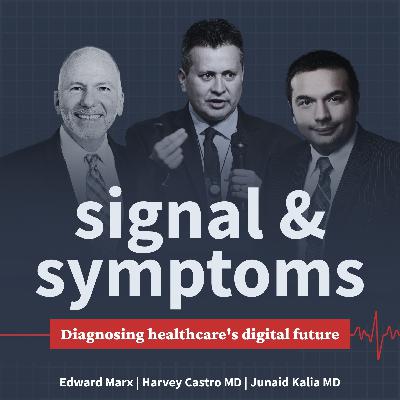
Signal and Symptoms Podcast
Subscribed: 0Played: 0
Subscribe

© Copyright 2026 Harvey Castro MD, Junaid Kalia MD, & Edward Marx
Description
Three healthcare AI experts who've watched millions wasted on failed projects. Dr. Harvey Castro, Dr. Junaid Kalia, Edward Marx, and guest experts cover all things healthcare AI - from digital transformation to clinical reality. Every Tuesday, we diagnose real failures, reveal what actually works, and help you avoid the expensive mistakes we've seen repeated everywhere. Because when AI decisions affect patient care, getting it right isn't optional.
60 Episodes
Reverse
Recommend the wrong movie and no harm is done. Lead a clinician down the wrong path and “you could hurt people or kill people.” Dr. Hooman Rashidi, Associate Dean of AI in Medicine at the University of Pittsburgh School of Medicine and a practising hematopathologist, argues that health systems need AI champions before they need more AI tools. He explains why his team runs a hybrid strategy (“do you actually need a 10-trillion-parameter model to write a letter of recommendation? Usually no”), how Pitt-GPT+ treats a custom chatbot like a laboratory-developed test, and how Field Care GPT runs fully off-grid on a laptop for combat medicine. The heart of the episode is a patient-safety warning: in tumor boards, we question every physician’s limitations, but nobody questions the AI’s output. His answer is no-code AI education, so every clinician can ask about sensitivity, specificity and F1, and push back on a vendor pitch. Co-hosts DR GPT™ Harvey Castro and Edward Marx bring the cost and governance questions, and the conversation closes on keeping the human in the loop, and engaged.What You Will Discover:wrong movie vs. wrong patient (Dr. Hooman Rashidi)from electronic medical records to AI medical records (Junaid)From bioinformatics to medicine: “nobody cared about machine learning” (Dr. Hooman Rashidi)Still on service: why practising medicine keeps AI honest (Dr. Hooman Rashidi)Do you need a 10-trillion-parameter model? The hybrid strategy (Dr. Hooman Rashidi)Pitt-GPT+: a private chatbot built like a lab test (Dr. Hooman Rashidi)Field Care GPT: AI for combat medicine with no Wi-Fi (Dr. Hooman Rashidi)Edge AI: big models condensed onto your phone (DR GPT™ Harvey Castro)Will AI raise hospital costs? Learn from the 5% that got it right (DR GPT™ Harvey Castro)AI literacy is a patient-safety issue (Dr. Hooman Rashidi)Tumor boards: nobody questions the AI (Dr. Hooman Rashidi)AI champions who can push back on a vendor pitch (Dr. Hooman Rashidi)Who is responsible when AI gets it wrong? Educate first, then govern (Dr. Hooman Rashidi)Ed Marx joins: governance boards that say no because they don’t know (Ed Marx)Keep the human in the loop, and keep the human engaged (Dr. Hooman Rashidi)Are new doctors losing the skills AI now does for them? (Junaid)Put yourself in your patients’ shoes: AI is not magic (Dr. Hooman Rashidi)Thank you and closeReferenced in the show:Pitt-AI-cademy: no-code, conceptual AI education for medicine and the health sciences: https://ai-cademy.hs.pitt.edu Pitt-GPT+: a custom, private chatbot-generator framework, validated like a laboratory-developed test (negative and positive controls, model cards): https://ai-cademy.hs.pitt.edu/ Field Care GPT (FCGPT): a fully off-grid derivative of Pitt-GPT+ for combat and disaster care, built with Dr. Nam Tran, Dr. Ron Poropatich, trauma surgeons and ED physicians: https://www.path.pitt.edu/people/hooman-h-rashidi-md-ms-fcap CPACE, the Computational Pathology & AI Center of Excellence (Pitt and UPMC): https://cpace.pitt.edu/ STNG (Synthetic Tabular Neural Generator): Rashidi HH, Albahra S, Rubin BP, Hu B. “A novel and fully automated platform for synthetic tabular data generation and validation.” Scientific Reports 2024;14:23312: https://www.nature.com/articles/s41598-024-73608-0 Nebulon-GPT, CPACE’s open-source, locally hosted generative-AI platform: https://github.com/pitt-cpace/NebulonGPT Hybrid AI strategy: vendor partnerships plus home-built, open-source frameworks when the ROI isn’t thereThe widely quoted statistic that only about 5% of AI deployments show real return on investmentTumor boards and multidisciplinary conferences; sensitivity, specificity and F1 as the questions to ask of a predictive modelLM Studio (local LLM app), referenced as a comparison for Pitt-GPT+Dr. Rashidi’s faculty profile: https://www.path.pitt.edu/people/hooman-h-rashidi-md-ms-fcap CommunityPitt-AI-cademy, Dr. Rashidi’s no-code AI education platform, open to learners everywhere: https://ai-cademy.hs.pitt.edu Leading AI education or governance in your health system? Signal & Symptoms has an open invitation for clinician-builders and AI champions to join the community. Reach us at https://signalandsymptoms.com/. About Our GuestDr. Hooman H. Rashidi, MD, MS, FCAP Associate Dean of AI in Medicine, Professor & Endowed Chair of Lombardi-Shinozuka Experimental Pathology Research at University of Pittsburgh School of Medicine, Executive Vice Chair of Computational Pathology & Informatics Division at UPMC, Executive Director of CPACE (Computational Pathology & AI Center of Excellence)Dr. Rashidi combines his passion for patient care, research, and education with his unique training in bioinformatics and machine learning (ML) to create innovative new tools and resources that improve clinical practice, research, and education.He held several roles before joining Pitt, including serving as the founding director of the Cleveland Clinic Pathology & Laboratory Medicine Institute’s Center for AI and Data Science. Dr. Rashidi’s efforts in the AI-ML space are internationally recognized resulting in speaking engagements at prominent conferences, editorial duties at prestigious AI and pathology journals, and invitations to review articles—the most recent being an eight-part AI review article series in Modern Pathology.Connect with us:Dr. Junaid Kalia, Neurocritical Care Specialist and Founder of SaveLife.AI™ (host)LinkedIn: https://www.linkedin.com/in/junaidkaliamd Website: https://www.junaidkalia.com/ YouTube: https://www.youtube.com/@junaidkaliamd DR GPT™ Harvey Castro, ER PhysicianLinkedIn: https://www.linkedin.com/in/harveycastromd/ Website: https://www.harveycastromd.com/ Edward Marx, former CIO of Cleveland Clinic and health-system board memberLinkedIn: https://www.linkedin.com/in/edwardmarx/ Our guestDr. Hooman H. Rashidi, MD, MS, FCAP, Associate Dean of AI in Medicine, University of Pittsburgh School of Medicine: https://www.path.pitt.edu/people/hooman-h-rashidi-md-ms-fcap LinkedIn: https://www.linkedin.com/in/hooman-h-rashidi-md-ms-fcap-535a8a52/ CPACE: https://cpace.pitt.edu/ · Pitt-AI-cademy: https://ai-cademy.hs.pitt.edu Visit our website: https://signalandsymptoms.com/ Get advisory insights about Healthcare AI, at zero cost: https://junaidkaliamd.substack.com/
Self-driving cars, phones that answer anything, and yet in the operating room, decisions are still made the way they were decades ago. Stanford’s Dr. Jay Park and Dr. Vivek Buch, co-founders of iQ Surgical, call what they are building the surgeon-machine interface: a real-time data layer that brings machine intelligence to the surgeon at the critical moments of an operation. Jay explains why surgery today is like riding a horse, why their team is on the augmentation side of the autonomy debate, and why AI can replace a task but not the human. Vivek explains why workflow barriers are the number one killer of any operating-room technology, and how deidentification, for the patient, the surgeon and the institution, keeps this data from being weaponized against surgeons. Former Cleveland Clinic CIO Edward Marx asks the change-management question, and the answer surprised the guests: some senior surgeons wanted more AI, not less. The episode closes on community, and an invitation to join their SMART Surgeon Collaborative.Join the SMART Surgeon Collaborative. Dr. Jay Park and Dr. Vivek Buch have built a community of surgeons who want to practice data-driven surgery. You don’t have to be a full-time researcher: everyone can take part in AI research, and the collaborative helps PIs at different centres turn their own surgical data into research that is actually usable. They are looking for surgeon colleagues, collaborators and partners.Join here: email Dr. Jay Park at [email protected] You Will Discover:Cold open: surgery today is like riding a horse (Dr. Jay Park)Welcome: Dr. Jay Park and Dr. Vivek Buch (Junaid)From brain-machine interfaces to the surgeon-machine interface (Dr. Vivek Buch)The SIMI Lab, StartX and iQ Surgical (Dr. Jay Park)Why the operating room never got its AI (Dr. Vivek Buch)Ed Marx: from anesthesia tech to Cleveland Clinic CIO, and what never changed in the OR Surgery is still riding a horse (Dr. Jay Park)Autonomy vs augmentation: the surgeon’s job is the last to go (Dr. Jay Park)Is it fair your outcome depends on one surgeon’s anecdotes? (Dr. Vivek Buch) Where are we today, and in five years? “We don’t even have cars yet” (Dr. Vivek Buch)Workflow barriers are the number one killer of OR technology (Dr. Vivek Buch)AI replaces tasks, not surgeons (Dr. Jay Park)The surgeon-machine interface is a data layer, not a device (Dr. Jay Park)Will surgeons actually adopt it? (Ed Marx)Senior surgeons asking: “Where is my ChatGPT?” (Dr. Jay Park)Medical-legal: can AI be weaponized against surgeons? (Dr. Vivek Buch)The FDA is the floor, not the ceiling (Dr. Jay Park)Information giving, not decision giving (Dr. Jay Park)Community: the SMART Surgeon Collaborative (Dr. Jay Park)Thank you and closeReferenced in the show:The surgeon-machine interface (SMI): a real-time data layer for surgeons, independent of the hardware it runs on (Park and Buch’s research at the Stanford SIMI Lab)Autonomy vs augmentation in surgical AIRoelof Botha’s line, quoted by Dr. Park: “not every inevitable future is imminent”Intraoperative MRI as an example of capital-intensive, workflow-interrupting ways to get more information in the ORDe-identification at the point of capture, for patient, surgeon and institutionRadiology as the pioneer for software and AI regulation; “information giving vs decision giving”Stanford StartX and the Stanford GSB communitySMART Surgeon Collaborative: email at [email protected] CommunityJoin the SMART Surgeon Collaborative. Dr. Jay Park and Dr. Vivek Buch have built a community of surgeons who want to practice data-driven surgery. You don’t have to be a full-time researcher: everyone can take part in AI research, and the collaborative helps PIs at different centres turn their own surgical data into research that is actually usable. They are looking for surgeon colleagues, collaborators and partners.👉 email Dr. Jay Park at [email protected] Building in surgical or clinical AI? Signal & Symptoms has an open invitation for founders and clinician-builders to join the community, and even to come on as co-hosts. Reach us at https://signalandsymptoms.com/.About Our GuestsDr. Jay Park is a neurosurgery postdoctoral scholar at Stanford University and the co-founder of iQ Surgical, a surgical AI company. He co-founded the Surgical Innovation & Machine Interfacing (SIMI) Lab and is the first author of the papers that introduced the “Surgeon-Machine Interface.” He studied medicine at the University of Edinburgh and began his residency in England. His research spans surgical computer vision, global neurosurgery and neuro-modulation. A serial entrepreneur, Dr. Park has founded multiple ventures and is a StartX alumnus, where he leads the StartX Med vertical and serves as an admissions judge. He is an alumnus of Stanford GSB’s dy/dx programme and serves as an advisor at Stanford Startup Garage.Dr. Vivek P. Buch, MD, FCNS, FAANS is Co-founder and Chief Scientific and Medical Advisor of iQ Surgical and Assistant Professor of Neurosurgery and Bioengineering at Stanford University. At Stanford he is Director of Cranial Robotics and Brain Mapping, Surgical Director of the Stanford Comprehensive Epilepsy Center, and Director of the Surgical Innovation and Machine Interfacing (SIMI) Laboratory. He is a Faculty Affiliate of the Mussallem Center for Biodesign and a Selected Member of Stanford Bio-X and the Human-Centered AI Institute, and serves as Section Editor for AI/Data Science at NEUROSURGERY (Congress of Neurological Surgeons).Connect with us:Dr. Junaid Kalia, Neuro-critical Care Specialist and Founder of SaveLife.AI™ (host)LinkedIn: https://www.linkedin.com/in/junaidkaliamd Website: https://www.junaidkalia.com/ YouTube: https://www.youtube.com/@junaidkaliamd Edward Marx, former CIO of Cleveland Clinic and health-system board member (co-host)LinkedIn: https://www.linkedin.com/in/edwardmarx/ Our guestsDr. Jay Park, Neurosurgery Postdoctoral Scholar, Stanford University; Co-founder, iQ Surgical; Co-founder, Stanford SIMI Lab: https://linkedin.com/in/drjaypark Dr. Vivek P. Buch, MD, FCNS, FAANS, Assistant Professor of Neurosurgery and Bioengineering, Stanford University; Co-founder and Chief Scientific and Medical Advisor, iQ Surgical; Director, Stanford SIMI Lab: https://profiles.stanford.edu/vivek-buch Stanford SIMI Lab (Surgical Innovation and Machine Interfacing): https://www.similab.org/ Visit our website: https://signalandsymptoms.com/ Get advisory insights about Healthcare AI, at zero cost: https://junaidkaliamd.substack.com/ Medical disclaimer: This conversation is for general informational purposes and is not medical advice. Listening does not create a doctor and patient relationship. Views expressed by the guest and co-hosts are their own and do not represent their employers. No specific vendor or product is endorsed. No PHI is shared.
No guest this week, just the two besties with a Healthcare AI Update. DR GPT™ Harvey Castro opens with the six questions he now asks of every healthcare AI tool, adapted from WHO and NIST: can I rely on it, who is responsible, will people actually use it, who sees my data, who can afford it, and what actually improves? Then he holds the evidence to that standard. A Kenya study where AI made documentation faster but showed no benefit for the patient. An odds ratio whose range includes “no difference.” A forecast, at 60% confidence, that within a year an AI will show lower morbidity and mortality than standard care. Dr. Junaid Kalia pushes on liability: if an AI flags a breast mass and the radiologist disagrees, who is liable, and when does not using AI become the lawsuit? Harvey’s answer is the hospital across the street. The episode closes on a live audience question from MaryAnne Rizk, Ph.D.: how do you measure responsible AI for clinical-grade use? Junaid’s answer is practical. Reset the expectations, because even clinical trials are not 100%. Give every model its own KPI. Keep a physician-verified golden dataset to re-score each new version.What You Will Discover:Cold open: even clinical trials aren’t 100% (Junaid)Welcome: no guest today, just the two of us (Junaid)WHO’s six questions for any healthcare AI (DR GPT™ Harvey Castro)What the evidence actually shows: the Kenya study and the odds ratio (DR GPT™ Harvey Castro) Three questions every hospital CEO should ask (DR GPT™ Harvey Castro) The 60% forecast: AI that lowers morbidity and mortality by next year (DR GPT™ Harvey Castro) Who’s liable when AI and the radiologist disagree? (Junaid)Legal will change the culture: the hospital across the street (DR GPT™ Harvey Castro)Audience question: how do you measure clinical-grade AI? Reset the expectations: clinical trials aren’t 100% either (Junaid)A KPI for every model: Dice, F1, job and task completion (Junaid)Golden datasets and re-scoring every new model (Junaid)The close: it’s all about human plus AI (DR GPT™ Harvey Castro)Referenced in the show:🖇️Six questions for every healthcare AI discussion (trust and safety, governance and accountability, culture and workflow, privacy and security, equity and access, outcomes and value), adapted from WHO and NIST guidance; framed on-air as questions, not a certification or validated score🖇️A cluster-randomized primary-care trial in Kenya comparing an electronic record with and without LLM assistance: documentation improved, primary patient benefit uncertain (one tested implementation; do not generalize)🖇️Reading odds ratios and confidence intervals: when the interval includes “no difference”🖇️FDA guidance in progress on evaluating AI-enabled clinical tools🖇️Model-specific metrics: Dice for image segmentation, F1 for medical coding, job and task completion rates for voice agents🖇️Golden datasets: physician- and multi-clinician-verified ground truth for re-scoring new modelsConnect with us:Dr. Junaid Kalia, Neurocritical Care Specialist and Founder of SaveLife.AI™ (host)💼 LinkedIn: https://www.linkedin.com/in/junaidkaliamd🔗Website: https://www.junaidkalia.com/📹 YouTube: https://www.youtube.com/@junaidkaliamdDR GPT™ Harvey Castro, ER Physician (co-host)💼 LinkedIn: https://www.linkedin.com/in/harveycastromd/🔗Website: https://www.harveycastromd.com/🔗Visit our website: https://signalandsymptoms.com/🔗Get advisory insights about Healthcare AI, at zero cost: https://junaidkaliamd.substack.com/New from DR GPT™ Harvey CastroOur co-host DR GPT™ Harvey Castro has a new book out with Wiley: AI in Emergency Medicine: What All Healthcare Professionals Can Learn from the Artificial Intelligence Revolution. Get your copy: https://www.wiley.com/en-sg/ai-in-emergency-medicine-what-all-healthcare-professionals-can-learn-from-the-artificial-intelligence-revolution-p-9781394385096 Medical disclaimer: This conversation is for general informational purposes and is not medical advice. Listening does not create a doctor and patient relationship. Views expressed by the guest and co-hosts are their own and do not represent their employers. No specific vendor or product is endorsed. No PHI is shared.
Most conversations about AI in health systems are about the model. This one is about the invoice, the incentives, and the data underneath. Dr. Alan Young has sat in nearly every seat at the table, vendor CMO, consultant, health-system operator, and buyer-side committee chair, which makes him unusually candid about what each one actually optimizes for.Now with Evidently, a clinical data intelligence platform, Dr. Young joins host Dr. Junaid Kalia with co-hosts DR GPT™ Harvey Castro and Dr. Isha Mannering to name what health systems get wrong when they buy AI. The costs nobody budgets for (compute, cloud, data centers, far beyond the SaaS line). The misaligned incentives that push executives to cut headcount in ways that quietly degrade care. The data-veracity problem (what is a trillion data points worth if twenty percent is wrong?). And the ROI math that is more honest than the marketing: Junaid’s “soft ROI” of keeping one irreplaceable specialist versus the hard-dollar savings. It ends on the optimistic turn, ambient AI pulling clinicians toward adoption, costs trending to zero, and a future that looks more like health care than sick care.What You Will Discover:Cold open: survive, get consolidated, or go out of business Welcome: meet Dr. Alan Young, who has sat in every seat The hidden cost of AI, and the incentives that bite (Alan Young)Soft ROI vs hard ROI: the irreplaceable-specialist math (Junaid) Data veracity: what is bad data actually worth? (Alan Young) Harvey’s digital twin, the future for everyone (DR GPT™ Harvey Castro) Cost of AI heading to zero, and rising customer expectations (Junaid) Stop making patients repeat their history (Dr. Isha Mannering) From sick care to health care: a basic level of care for all (Alan Young) Close, and a teaser: the medical-legal episode is comingReferenced in the show:🖇️ Evidently: an AI clinical data intelligence platform reading structured and unstructured EHR data 🖇️ The hidden total cost of AI: compute, cloud, and data-center spend beyond the SaaS subscription 🖇️ “Pilot purgatory” and the gap between pilot ROI and production ROI 🖇️ Data veracity: the value of a dataset when a fifth of it is inaccurate 🖇️ Ambient AI and the clinician “pull-through” effect 🖇️ Signal & Symptoms Ep 54 (Dr. Alan Weiss): genetic testing at scaleConnect with us:Dr. Junaid Kalia, Neurocritical Care Specialist and Founder of SaveLife.AI™ (host) 💼 LinkedIn: https://www.linkedin.com/in/junaidkaliamd 🔗 Website: https://www.junaidkalia.com/ 📹 YouTube: https://www.youtube.com/@junaidkaliamd DR GPT™ Harvey Castro, ER Physician (co-host) 💼 LinkedIn: https://www.linkedin.com/in/harveycastromd/ 🔗 Website: https://www.harveycastromd.comDr. Isha Mannering (co-host) 💼 LinkedIn: https://www.linkedin.com/in/isha-mannering Special Guest:Dr. Alan S. Young, MD, MBA, physician executive with Evidently (clinical data intelligence); background across vendor, consulting, and health-system leadership 💼 LinkedIn: https://www.linkedin.com/in/alansyoung Visit our website: https://signalandsymptoms.com/ Get advisory insights about Healthcare AI, at zero cost: https://junaidkaliamd.substack.com/ Medical disclaimer: This conversation is for general informational purposes and is not medical advice. Listening does not create a doctor and patient relationship. Views expressed by the guest and co-hosts are their own and do not represent their employers. No specific vendor or product is endorsed. No PHI is shared.
No guest this week, just the two besties going deep. Dr. Junaid Kalia and DR GPT™ Harvey Castro step back to ask what actually changed in healthcare AI this fall, and why it matters. They land on two shifts pulling in the same direction. Junaid’s is technical and under-reported: we have started building AI models for machines, not humans, systems that return a calibrated decision and a probability instead of paragraphs of text, running an entire EHR as a “decision machine” in seconds and at a fraction of the cost. Harvey’s is human and personal: the move from reactive to proactive medicine, built around the one metric he argues beats almost everything else, your VO2 max. One of them lost his father to an emergency that started silently years earlier. The thesis that ties it together: the best emergency is the one that never comes.What You Will Discover:Cold open: what if your emergency has already started? (DR GPT™ Harvey Castro)The shift: we are building AI for machines, not humans (Junaid)Reactive vs proactive medicine, and why it is personal (DR GPT™ Harvey Castro) VO2 max: the longevity metric that beats fixing diabetes (DR GPT™ Harvey Castro) Men’s health, and why men die sooner (Junaid)Self-evolving research agents and “benchmark as teacher” (Junaid) Why SaveLife.AI™ now runs its own GPUs (Junaid) Decisions, not language: building AI for outcomes (Junaid) Warfarin and the EHR as a decision machine (Junaid) 600 questions on one chart, in under a second (Junaid) The close: take care of your body today (DR GPT™ Harvey Castro)Referenced in the show:🖇️ Calibrated “decision” models: System-1-style systems that return a choice and a probability instead of text (product and company names were spoken on-air; verify spelling before citing) 🖇️ Small, knowledge-light models (e.g., the MiniCPM family) as fast decision engines 🖇️ SaveLife.AI™ bringing its own GPUs online 🖇️ VO2 max and cardiorespiratory fitness as a mortality predictor 🖇️ Daily steps and longevity (the 7,500-step discussion) 🖇️ Signal & Symptoms Ep 54 (Dr. Alan Weiss): genetic testing at scaleConnect with us:Dr. Junaid Kalia, Neurocritical Care Specialist and Founder of SaveLife.AI™ (host) 💼 LinkedIn: https://www.linkedin.com/in/junaidkaliamd 🔗 Website: https://www.junaidkalia.com/📹 YouTube: https://www.youtube.com/@junaidkaliamdDR GPT™ Harvey Castro, ER Physician (co-host) 💼 LinkedIn: https://www.linkedin.com/in/harveycastromd/ 🔗 Website: https://www.harveycastromd.com/Visit our website: https://signalandsymptoms.com/Get advisory insights about Healthcare AI, at zero cost: https://junaidkaliamd.substack.com/Medical disclaimer: This conversation is for general informational purposes and is not medical advice. Listening does not create a doctor and patient relationship. The longevity and fitness points are general wellness information, not a treatment plan; talk to your own clinician before changing exercise or health routines. Views expressed are the hosts’ own and do not represent their employers. No PHI is shared.

Comments

Download from Google Play

Download from App Store
 United States