


 Claim Ownership
The Pool Envy® Podcast
Subscribed: 1Played: 30
Subscribe

© 2026 Jason Davies | Pool Envy LLC. All rights reserved.
Description
The Pool Envy® Podcast goes beyond surface-level swimming pool advice to examine the standards, systems, evidence, and professional judgment behind pool construction, safety, operation, and failure.
Hosted by Jason Davies, a licensed swimming pool contractor and independent consultant, the show explores pool code compliance, construction defects, inspections, workmanship, water chemistry, equipment, litigation consulting, and expert-witness issues through real-world observations and practical explanations.
Created for pool professionals, homeowners, property owners, attorneys, and anyone who wants to understand not only what happens in a swimming pool—but why—each episode helps listeners ask better questions, recognize meaningful evidence, and distinguish confidence from informed judgment.
Pool Envy® — Standards, not suggestions.
Hosted by Jason Davies, a licensed swimming pool contractor and independent consultant, the show explores pool code compliance, construction defects, inspections, workmanship, water chemistry, equipment, litigation consulting, and expert-witness issues through real-world observations and practical explanations.
Created for pool professionals, homeowners, property owners, attorneys, and anyone who wants to understand not only what happens in a swimming pool—but why—each episode helps listeners ask better questions, recognize meaningful evidence, and distinguish confidence from informed judgment.
Pool Envy® — Standards, not suggestions.
40 Episodes
Reverse

Texas pool electrical licensing is more complicated than “we’re just replacing the pump.”In this episode, Jason Davies of Pool Envy® looks at the Texas Residential Appliance Installer license, commonly known as the RAIL, and where that authority begins and ends.The discussion started with a 2025 Texas administrative order involving a pool company and a $6,000 administrative penalty tied to unlicensed electrical contracting activity. Rather than focusing on the company, this episode looks at the larger issue: who is authorized to perform pool-related electrical work in Texas, what license structure supports that work, and what should a homeowner be able to verify?We cover the difference between an individual RAIL license and the Residential Appliance Installation Contractor license, commonly identified by the TICL, including why the contractor license matters, where RAIL authority stops, and when new or upgraded electrical work may require a licensed electrical contractor.Texas homeowners also get a practical walk-around of things they can verify without opening a panel or removing electrical covers: contractor licensing, permit questions, GFCI protection, bonding, pump securement, electrical raceway workmanship, and whether the replacement changed the circuit or electrical capacity.Texas adopted the 2026 National Electrical Code effective September 1, 2026, making this a timely discussion about licensing, electrical compliance, and accountability.Already looking for the hydraulic side of a pump replacement? Listen to our earlier episode:“Sure—Anyone Can DIY a Pool Pump. That’s the Problem.”That episode covers pump selection, variable-speed operation, circulation, suction velocity, and entrapment protection.Pool Envy® — Texas Residential Appliance Installation Contractor, TICL 1350.For this episode, verify Texas licensing, permitting, and electrical requirements with the Texas Department of Licensing and Regulation, the applicable authority having jurisdiction, and the equipment manufacturer.

WHEN FACTS BECOME PERSONAL Experience, evidence, and what happens when reality gets uncomfortableWhat happens when a technical question stops being technical—and becomes personal?In this episode of The Pool Envy Podcast, Jason Davies looks at the tension between experience, evidence, ego, and accountability in the swimming pool industry. A simple week of setting tile leads into a much larger discussion: why “we’ve always done it this way” is not the same as proof, why the most vociferous voice is not always the most informed, and why expertise should remain correctable when better information becomes available.From manufacturer instructions, codes, ANSI standards, and craftsmanship to social-media validation, artificial intelligence, responsibility shifting, and the temptation to defend an opinion instead of testing it, this episode asks a simple question:What would actually change your mind?Because experience matters. Standards matter. Judgment matters. But when the evidence changes, the conclusion may need to change with it.Drama wants somebody to win.Technical work needs an answer.Reality gets the final vote.Standards. Not Suggestions.™Pool Envy, LLC | Florida CPC1460695
You have a swimming pool case. Do you actually need a swimming pool expert?A swimming pool may be the subject of the lawsuit, but the technical question may involve electrical systems, hydraulics, fuel gas, construction, tile assemblies, structural concerns, or several disciplines at once.In this episode of the Pool Envy Podcast, Jason Davies examines a deceptively simple question: What do you actually need an opinion on?The discussion explores how counsel can recognize a productive relationship with a technical subject-matter expert, including appropriate scope and expertise, professional boundaries, independent technical judgment, evolving evidence, disagreement, and the ability to reach an answer that may not have been anticipated.Because finding an expert is one thing.Identifying the expertise the case actually requires is another.Standards, not suggestions ™ Pool Envy, LLC | Florida CPC1460695
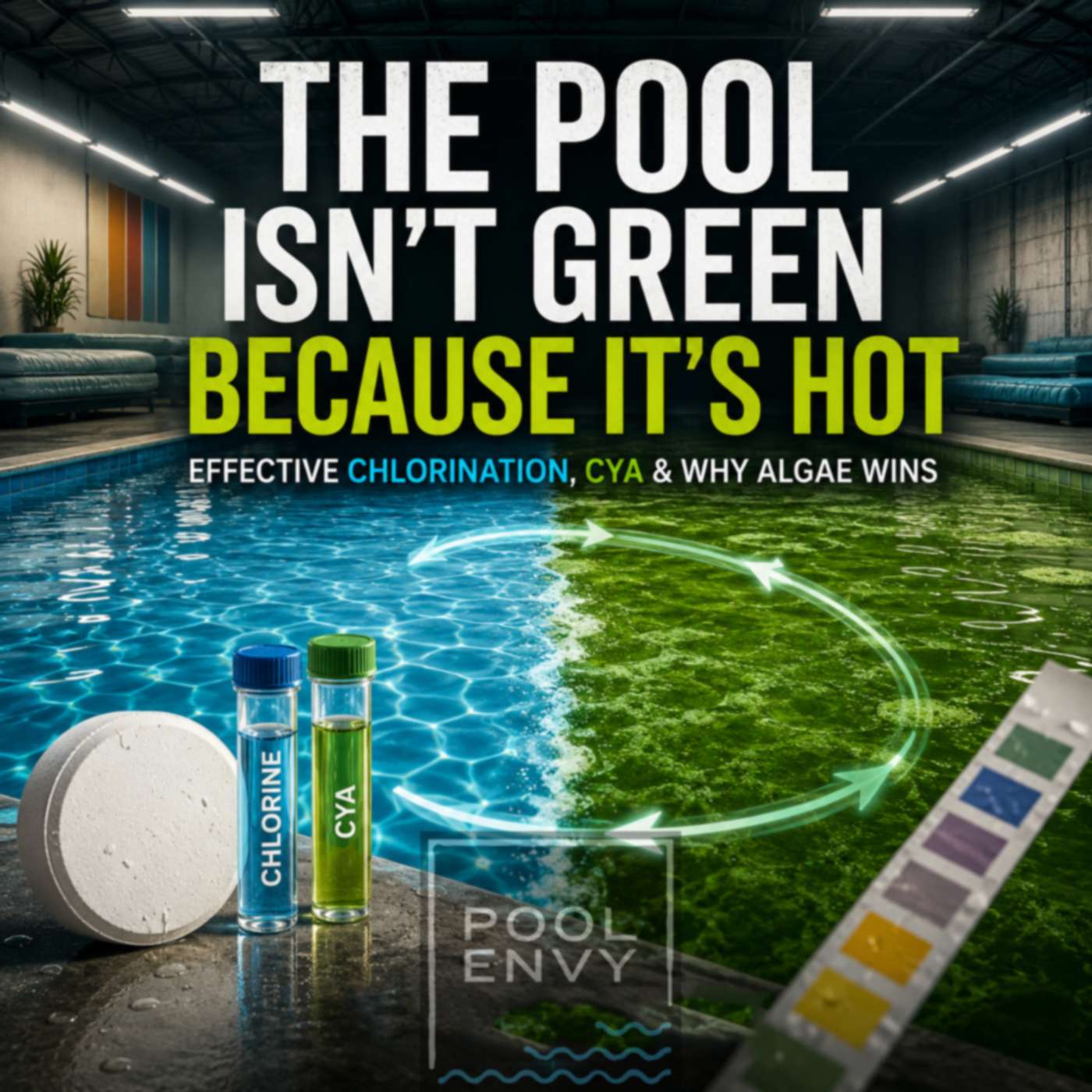
What if your green pool isn’t really a “green pool problem” at all?This week on Pool Envy, we go way past the usual “it’s hot, add more chlorine” advice and into what’s actually happening inside the water. Why can algae show up even when the pool tests like it has chlorine? What role does CYA really play? Why can poor circulation create opportunities for growth? And why does killing algae not necessarily mean you’ve removed what fed it?To make sense of it, we’re taking an unexpected detour into a strange 1970s liminal-space warehouse filled with waterbed mattresses, buzzing fluorescent tubes, leaking containers, and one very questionable quarter-operated machine. Somehow, by the time we leave, phosphates, sequestration, oxidation, circulation, filtration, microbial growth, and nutrient recycling all make a lot more sense.We’ll also talk about why swimming-pool water is not sterile, why microbes are inevitable, how the sourdough-starter analogy explains algae better than most chemistry lectures, why “I have chlorine” may be the beginning of the conversation instead of the end, and why an old filter can become far more involved in the biology of a pool than most homeowners realize.Copper? Phosphates? Dead algae? CYA? Biofilm? Old filter media? Yep.And through all of it, one idea keeps coming back:Contained isn’t removed.Dead isn’t gone.And algae doesn’t need an invitation — it needs an opportunity.If you’ve ever looked at a pool that went green seemingly overnight and thought, “How the hell did that happen?” — this episode is for you.You may never look at your pool water the same way again. Sometimes the reflection is the least interesting thing happening in the pool. Pool Envy, LLC | Florida CPC1460695
Are you tired of the chaos in the swimming pool industry?Pool construction. Inspections. Code compliance. Safety. Water chemistry. Licensing. Expert opinions. Everybody has an answer.Sometimes, less is more.Standards. Not suggestions.Jason Davies of Pool Envy® brings a very short message about an industry that rarely suffers from a shortage of opinions.This podcast is provided for general education and industry commentary only and is not legal, engineering, or professional advice.Pool Envy® — Florida CPC1460695.

Comments

Download from Google Play

Download from App Store
 United States