


 Claim Ownership
HuMed with David Spiro, MD
Subscribed: 0Played: 2
Subscribe

© 2026 David Spiro, MD | Doctor Podcast Network
Description
HuMed goes beyond diagnoses and procedures to explore the profound human experiences of medical professionals. Join Dr. Spiro as he engages in deep, candid conversations with fellow doctors, nurses, and other healthcare providers. They share the often-unseen realities of their work in the demanding hospital environment – the challenging cases, the emotional toll, and the ethical dilemmas they navigate daily.
76 Episodes
Reverse

What do you say to a family when the tests are normal, the pain is real, and medicine has no answer? Dr. Xavier Jimenez, a consultation-liaison psychiatrist board certified in psychiatry, pain medicine and addiction medicine, joins Dr. David Spiro on HuMed to talk about the moments when doctors have to admit what they don't know.About 20 years ago, as a psychiatry resident, Dr. Jimenez was called to see a young man in his 20s with kidney failure who was refusing dialysis. He was homeless, had an intellectual disability and likely schizophrenia, and he ended up stuck in a turf war between medicine, nephrology and psychiatry until a chief medical officer brought everyone back to the table. What fascinated him was not only the patient but how the doctors around him reacted, and it launched a lifelong focus on the humans who deliver care. He and David talk about physicians as humans with an "inner universe," why humility is missing from medical training, shared decision making, how to help children and families living with chronic pain in the ER, and the moral injury of caring for kids in behavioral health crises in a system that can't fix it. He also shares how his hospital trained medical teams to lead behavioral emergency responses, and how he takes care of himself: running, poetry, baseball with his two boys, and cooking dinner with his wife every night.In this episode:– A patient caught in a hospital turf war– Why doctors bring their personal lives to work– Burnout and a system that only reacts– "Physicians are also humans": the inner universe– Paternalism vs. shared decision making– Chronic pain in the pediatric ER: validate, then say "I don't know"– Ping-ponging between pain clinics and psychiatry– Moral injury and "impossible situations"– How COVID changed the way people seek care– Being authentic with young patients in crisis– A 3 a.m. debrief and a new behavioral health simulation– Behavioral emergency teams without a psychiatrist– Self-care in week-long chunksChapters00:00 "The moral injury is very high"00:29 Meet Dr. Javier Jimenez02:23 The case that shaped his career05:27 A patient caught in a turf war07:53 Who brought everyone to the table?08:50 What happened to him10:08 Bringing our personal lives to work11:55 Burnout and the limits of a reactive system14:19 Cultivating humility in physicians15:51 What he means by "inner universe"19:16 Paternalism vs. shared decision making24:37 Children with chronic pain in the ER26:12 Step one: validate27:04 Step two: embrace the ambiguity28:44 Resources for the front lines29:57 Ping-ponging between pain and psychiatry32:04 Giving doctors a humane way out33:07 Behavioral health emergencies in children34:21 Moral injury and "impossible situations"35:45 How COVID changed the way people seek care37:42 Investing upstream in mental health39:17 What ER doctors can do: be authentic40:34 Healthcare deserts and technology42:19 A debrief David is proud of45:11 A generational silver lining46:27 A behavioral emergency team without a psychiatrist49:00 Swiss Army knife physicians49:39 How does he take care of himself?54:04 Community, sleep and food56:54 ClosingThis episode is education and storytelling, not individual medical advice.HuMed unveils the human side of medicine, hosted by Dr. David Spiro, MD.New episodes on Apple Podcasts, Spotify, and YouTube — please follow and leave a rating, it helps other listeners find the show.

What happens when a nurse becomes the patient and catches a medication error at her own bedside? Krista Parsons, a former surgical nurse and author from Grande Prairie, Alberta, joins Dr. David Spiro on HuMed to share what she saw from the other side of the curtain.Krista became a nurse in her late twenties, raising five young children, after watching her father's long struggle with diabetes and dialysis. A few years into her career, a distracted driver rear-ended her on the way to a shift. Back surgery followed, and her surgeon told her she could no longer return to bedside nursing. Then, recovering on the very floor where she once worked, she watched a colleague about to hang the wrong antibiotic and had to take the syringe out of her hand. Krista talks about how fast patient trust can disappear, waiting years for a chronic pain clinic, an allergy her chart didn't catch, writing her book, When the Healer Breaks, and why patients mostly want to be seen and heard.In this episode:– Why she became a nurse: her father's illness– A rear-end collision, back surgery, and "you can't go back to bedside nursing"– When your job becomes your identity– Hours waiting for pain medication after surgery– Catching the wrong antibiotic: ceftriaxone instead of Ancef– Why an apology wasn't enough– Opioids, chronic pain and a two-year wait list– "Waiting becomes its own form of suffering"– Healthcare in Canada and the US– Writing a book and building a community for people after life-altering illness– Look at the patient, not the screen– "That human touch"Chapters00:00 "You're not giving me that medication"00:21 Meet Krista Parsons03:11 Why she became a nurse03:58 Nursing school with five small children04:36 The car accident on the way to work06:05 "I can't clear you to go back to work"07:01 When nursing is your identity09:45 "It was a really rough day"11:12 A medical error, seen as a patient12:19 The wrong room and no post-op equipment14:10 Hours waiting for pain medication15:37 "That is not the right antibiotic"17:42 "How do I put morphine in a minibag?"18:28 "As a patient, it is terrifying"19:15 How quickly trust disappears19:53 Disclosing errors, and an apology that fell short21:49 Opioids and treating pain24:47 Pushed toward narcotics, not answers25:24 A two-year wait for a chronic pain clinic26:31 "Waiting becomes its own form of suffering"29:15 Chronic pain, waiting and addiction29:45 The other side of the curtain30:35 Why she wrote her book31:44 Hashimoto's and thyroid cancer33:13 Building a community to feel seen and heard35:18 Advice to her younger self: advocate early36:34 Advice for clinicians: look at the patient37:54 Listening to families in the ER40:16 Technology at the bedside42:11 Communication is the essence of healthcare43:49 When the chart missed her contrast allergy45:58 "That human touch"46:19 ClosingKrista's book, When the Healer Breaks: https://whenthehealerbreaks.comThe AND STILL… Movement: https://andstillmovement.comThis episode is education and storytelling, not individual medical advice.HuMed unveils the human side of medicine, hosted by Dr. David Spiro, MD.New episodes on Apple Podcasts, Spotify, and YouTube — please follow and leave a rating, it helps other listeners find the show.

About 30 years ago, pediatric emergency physician Dr. David Spiro examined a smiling, well-appearing child with a fever and a rash that looked like chickenpox, and sent the child home. Hours later, the family called: the child was ill and had purple spots on their body. In this special Saturday solo episode of HuMed, David tells the story of a case he felt he had missed, and what it taught him about shame, medical error and the human side of medicine.It was meningococcemia, a fast-moving and potentially deadly bacterial infection. David met the family in the emergency department, where the child needed fluids, medicine to support blood pressure and a transfer to a larger children's hospital, and the child survived. Still, for weeks and months David replayed the case, felt shame and doubted himself. He explains why meningococcemia can look like an ordinary viral rash early on, Dr. Albert Wu's idea of the clinician as the "second victim" of medical error, why a colleague asking "Do you remember that kid?" still drops his stomach, and what happened when he finally saw the family again. Now a section chief in a pediatric emergency department, supporting a team of about 35 to 40 people, he shares the lesson he wants every young clinician to hear: talk about your cases, and build a community you can lean on.In this episode:– A fever, a rash, and a child who looked well– Hours later: a phone call about purple spots– Why meningococcemia is so hard to catch early– Shame, self-doubt and replaying the case– The "second victim" of medical error– "Do you remember that kid?"– Facing the family again– Why every clinician needs a communityChapters00:00 "This case humbled me to my knees"00:11 A special Saturday episode of HuMed00:31 A child with a fever and a rash01:19 Hours later: purple spots01:53 Meningococcemia in the emergency department02:47 Why it's so hard to diagnose early03:28 Shame, replaying the case, doubting myself03:54 The "second victim" of medical error04:25 What he teaches as a section chief05:26 "Do you remember that kid?"06:01 Facing the family again07:23 His message to young clinicians08:10 Community, happiness and longevity08:54 Closing reflectionsThis episode is for education and storytelling purposes, not individual medical advice. A fever with purple or red spots that don't fade when pressed needs emergency care right away.HuMed unveils the human side of medicine, hosted by Dr. David Spiro, MD.New episodes on Apple Podcasts, Spotify, and YouTube — please follow and leave a rating, it helps other listeners find the show.
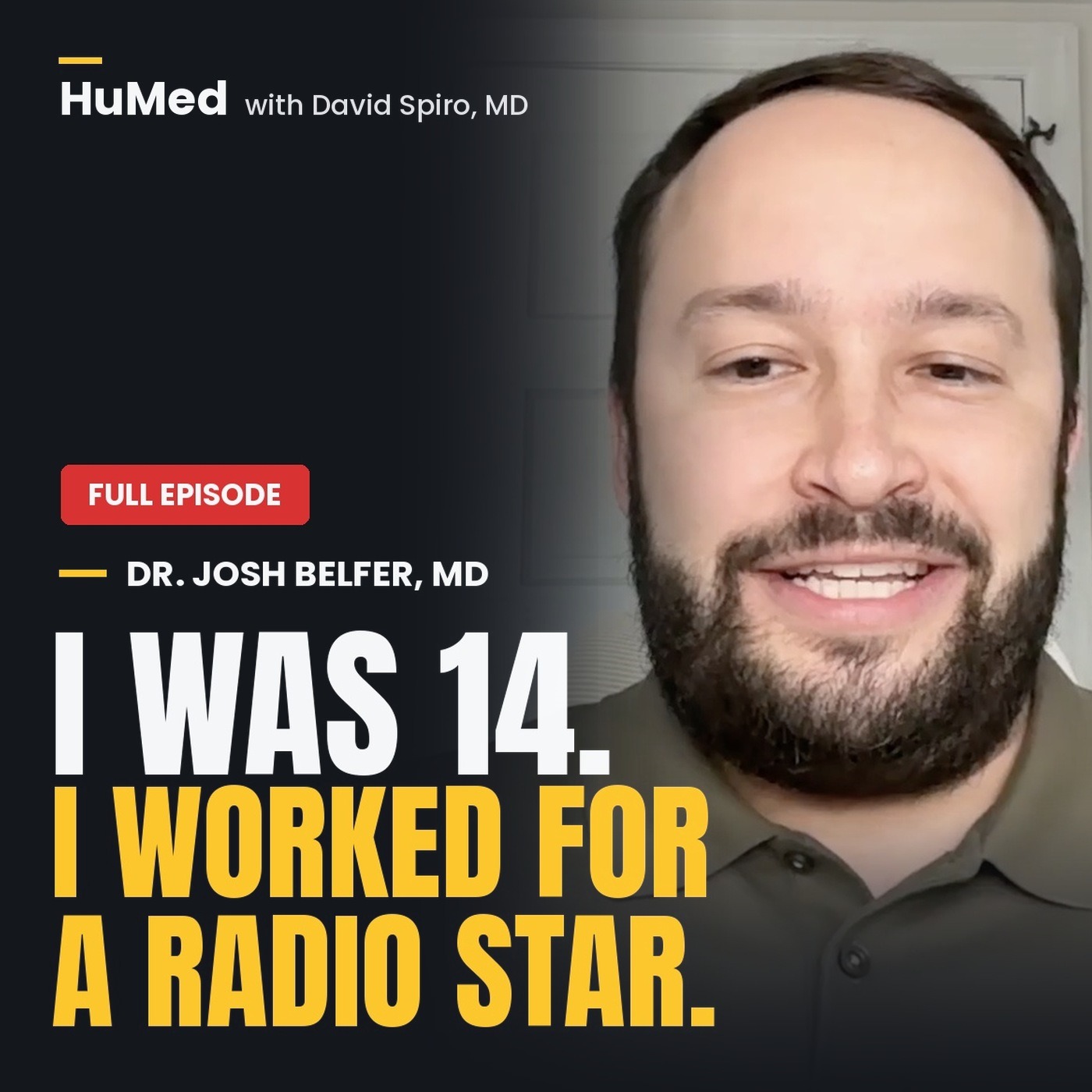
At 14, Josh Belfer was working for a radio star: Philadelphia talk-radio host Michael Smerconish. Today he is a pediatric emergency medicine attending at Children's Hospital of Philadelphia (CHOP) and Assistant Professor of Clinical Pediatrics at Penn, and he joins Dr. David Spiro on HuMed to tell how that mentorship shaped the physician he is today.It started on a 45-minute bus ride to school in 2004, when his dad suggested he switch his Discman to AM talk radio. One visit to the studio led to news tips, then research for a book chapter, then a one-line email, "This is fantastic. Great work.", and years as an intern and researcher, including an elevator interview with Jose Canseco. Josh explains how the pace of live radio taught him to turn on a dime in the ER, and why he feels what his patients' families feel more now that he is a father himself. He and David also talk about surviving overnights, noticing when a colleague isn't OK, hot and cold debriefs after hard cases, and the mentors he watched lead through COVID during his chief residency year. It's a warm conversation about mentorship, resilience, and the human side of pediatric emergency medicine.In this episode:– A Discman, AM radio, and a 14-year-old's first studio visit– The one-line email that launched years as a researcher– An elevator interview with Jose Canseco– How live radio trains you to turn on a dime– "I feel what my patients feel more now that I'm a father"– "If it was your child, what would you do?"– Overnights, sleep, and a two-physician household– Who notices when a colleague isn't OK?– Hot and cold debriefs, and letting residents step away– Mentorship, grit, and working like you could get cutChapters00:00 "The parents are hearing that noise"00:16 Meet Dr. Josh Belfer01:39 The story he chose to tell02:39 2004: a freshman on a 45-minute bus ride04:12 A Discman, his dad, and Philly talk radio05:58 Election night and an invitation to the studio06:49 First morning in a shoebox studio08:47 Research for a book chapter at 1409:41 "This is fantastic. Great work."10:52 Reporting from the field12:11 An elevator interview with Jose Canseco14:56 Radio's pace, and the road to the ER15:15 Breaking news at 6:45 a.m.16:44 No script in the pediatric ER18:09 Focus, hard work, and staying humble20:21 Fatherhood and a career at CHOP22:38 "I feel what my patients feel"23:35 "Is this something to be worried about?"24:45 Overnights, sleep, and emotional reserve26:30 How he gets through overnights29:13 Who notices when a colleague isn't OK?30:47 "Weren't you just here yesterday?"31:34 Starting over as a new attending35:02 When residents see something hard35:54 Hot and cold debriefs, explained37:20 Letting a resident step away39:18 The check-in, days later40:24 The power of "Are you okay?"41:16 Grit, resilience, and working like you could get cut43:56 Mentors, then and now45:05 Chief resident when COVID hit Long Island46:31 Rapid fire: Sixers or Knicks?47:35 HipPEMcrates and the PEM Podcast49:20 Closing reflectionsJosh earned his BA at the University of Pennsylvania and his MD at Rutgers Robert Wood Johnson Medical School, completed pediatric residency and a chief residency year at Cohen Children's Medical Center, and trained in pediatric emergency medicine at Columbia University. He created HipPEMcrates, a pediatric emergency medicine education blog (hippemcrates.com), and works behind the scenes on the PEM Podcast with his father, Dr. Robert Belfer.HuMed unveils the human side of medicine, hosted by Dr. David Spiro, MD.New episodes on Apple Podcasts, Spotify, and YouTube — please follow and leave a rating, it helps other listeners find the show.

What if your cholesterol looks normal, your 10-year risk score is just 2.3%, and you're still a ticking time bomb? Josh Wageman, PhD, DPT, a clinical lipid specialist, physician assistant and author of The Home Security System and the Lipid Neighborhood, joins Dr. David Spiro on HuMed to tell the story of a fit, running friend whose Lp(a) and coronary artery calcium score revealed heart disease his routine labs had missed.His friend's family history was riddled with heart attacks, yet his blood pressure, blood sugar and LDL were all normal. One conversation on a 5:30 a.m. run led to two extra tests: an Lp(a) of 128 mg/dL and a calcium score of 2,814. He needed a five-vessel bypass, and a year later he finished a half Ironman. Dr. Wageman explains why he calls Lp(a) "the felon of the lipid neighborhood," what a low-dose coronary calcium (CAC) scan shows and what it costs, and how statins, ezetimibe and PCSK9 inhibitors work, told through his mailman metaphor. It's a warm, often funny conversation about prevention, friendship, and using what you know to help the people you love.In this episode:– Normal cholesterol, a 2.3% risk score, and a calcium score of 2,814– "Got plaque? Get a CAC": what a coronary calcium scan shows– Why Lp(a) is "the felon of the lipid neighborhood"– A five-vessel bypass, then a half Ironman a year later– The four pillars of your heart's home security system– Why Lp(a) is worth checking at least once in a lifetime– Menopause, statins and rising Lp(a)– Statins, ezetimibe and PCSK9 inhibitors, explained with mailmen– "Prioritize protein and eat real food"Chapters00:00 "He was a ticking time bomb"00:18 Meet Josh Wageman, clinical lipid specialist01:38 Why stories stick better than textbooks02:13 "Beyond the 10-year risk calculator"02:41 A runner friend with a worrying family history03:40 "Got plaque? Get a CAC"04:01 Normal labs and a 2.3% risk score05:05 "He picked the wrong parents": an Lp(a) of 12805:35 A coronary calcium score of 2,81406:20 A ticking time bomb and a five-vessel bypass07:08 A half Ironman one year after surgery07:57 What a calcium scan is, and what it costs09:28 From reactive to preventive medicine10:01 Does a calcium score show narrowing?11:07 "You're fine till you're not"11:58 The four pillars of your home security system12:58 Lp(a): the felons of the lipid neighborhood14:18 The genetic piece: one in five people16:06 Checking Lp(a) at least once in a lifetime17:10 Menopause, statins and rising Lp(a)18:02 The patient whose Lp(a) jumped on a statin19:02 Statins, plaque and the art of medicine21:30 Beyond "HDL good, LDL bad": the mailman metaphor22:34 Statins, ezetimibe and PCSK9, in plain English24:18 Why metaphors and stories matter25:30 Ultra-processed food and the fat-free era26:28 "Prioritize protein and eat real food"28:05 What "real food" means, and what about eggs?30:18 Glucose "dollar bills" and your fat "savings account"32:36 Where to find his book33:23 Closing reflectionsJosh's book, The Home Security System and the Lipid Neighborhood, is on Amazon, with links at lifelovelipids.com.This episode is education and storytelling, not individual medical advice. Talk with your own clinician about testing and treatment.HuMed unveils the human side of medicine, hosted by Dr. David Spiro, MD.New episodes on Apple Podcasts, Spotify, and YouTube — please follow and leave a rating, it helps other listeners find the show.

Comments

Download from Google Play

Download from App Store
 United States