


 Claim Ownership
Thematic Edge Podcast
Subscribed: 12Played: 168
Subscribe

© Thematic Markets, Ltd
Description
Marvin Barth of discusses the thematic investing and the Themes driving markets with Mark Farrington of the Global Watchtower, with and without guests as the occasion demands.
thematicmarkets.substack.com
thematicmarkets.substack.com
24 Episodes
Reverse
IntroductionThe European crisis that Marvin Barth and Mark Farrington have long warned of appears to have begun…while Marvin and Mark were focused on the “mother of all resolution windows” in the US ahead of the US midterm elections, the AI race, Fed credibility, and geopolitics.Mark and Marvin review the thesis for why Europe was a growing pile of dry tinder waiting for a spark before turning to what events and forces coalesced to create that spark. They then discuss how Europe’s increasing self-isolation, its deep and difficult to reconcile problems, and the loss of a credible German balance sheet limit sources of “circuit breakers” to the crisis, raising the stakes and differing markedly from 2011-12 when Europe last had a debt crisis.Marvin then leans on Mark’s deep experience managing institutional portfolios in financial crises of the last four decades for both the “generic” crisis playbook and the specific ways to position for and play this crisis.Key ThemesEurope as “the pit of despair”Marvin and Mark review why they have long warned of an impending European crisis:* Persistent low-growth, the wrong economic model,* poor energy policies that have left it with the highest energy costs in the world,* unsustainable member-state debts dependent on the German balance sheet,* how Germany’s rash fiscal splurge under Merz undermined the whole structure,* increasing political instability,* and the dual hits of the Ukraine and Iran wars worsening all other vulnerabilities.Triggers of the current crisisProximately, the crisis began with riots in France, but Mark and Marvin point to pressures from rising US real rates and the increasing international competition for capital as the ultimate trigger, plus the surprising role of the UK moving closer to Europe.Europe’s increasing isolationAs Chinese mercantilism has evolved from a source of European growth to a threat to it and America has turned more defensive, Europe has increasingly isolated itself in the “rump” of the post-War liberal order as North Asia, the Gulf States and Latin America increasingly align with the US, leaving Europe with few friends or reliable sources of capital.A lack of resolution mechanismsUnlike in 2011-12 when Europe last faced a crisis it no longer has an internal member with a strong enough balance sheet to “solve the problem” by credibly backing European Central Bank interventions, while Europe’s isolation leaves it without likely external help.The crisis playbookWhat are the general rules for a portfolio heading into a crisis and how do you look for opportunities. What are the specific risks and opportunities in this crisis.Timestamps00:00 Introduction: Europe’s emerging crisis02:22 The crisis arrives while attention is elsewhere05:48 Why Europe was a pile of dry tinder10:42 What triggered the crisis now?15:05 US real rates and the competition for capital22:11 The surprising role of the UK29:55 Europe’s increasing isolation36:40 Where is Europe’s circuit breaker?43:09 The crisis playbook48:15 Countertrades and relative value opportunities52:32 The US resolution window and the dollar55:02 Why the traditional volatility trades may not work58:27 Closing thoughtsFurther readingBrexit Blues, ten years on, Seriously, Marvin?!, 1 July 2026Observations: Closing thoughts for 2025, Thematic Markets, 22 December 2025Keystone Cops, Seriously, Marvin?!, 28 October 2025La Cosa Nostra Americana, Thematic Markets, 4 March 2025Leitmotif 7: Breaking point? Thematic Markets, 22 January 2025Leitmotif 6: A “Western Spring”? Thematic Markets, 21 January 2025Leitmotif 5: Time to pay the piper, Thematic Markets, 20 January 2025 This is a public episode. If you'd like to discuss this with other subscribers or get access to bonus episodes, visit thematicmarkets.substack.com/subscribe
IntroductionIn this episode of Thematic Edge, Marvin Barth and Mark Farrington revisit the “resolution window” stretching from the summer through the US midterm elections examine what market signals we’ve gleaned so far.They assess the latest inflation data and central bank decisions, the changing shape of the US Treasury curve, Scott Bessent’s management of the bond market and the strength of corporate earnings. They also examine the growing anxiety surrounding AI, from regulation to US-China competition to the rapidly expansion of financing needs for the investment boom.They note that many of the outcomes feared have so far failed to materialise. Earnings remain strong, Treasury markets have stabilised and capital investment is broader than the “only-AI” narrative suggests. Yet uncertainty remains as the US midterm elections approach and political narratives are approaching a crescendo.The challenge for investors is separating noise from signal.Key themes• The resolution windowMarvin and Mark assess the major events that have passed since their last discussion and whether the balance of evidence is beginning to shift.• Inflation remains stickyThe latest CPI reading was widely characterised as “hot”, but both question that interpretation but agree that inflation expectations remain sufficiently elevated to require further tightening.• Central banks still have work to doThe Fed, Bank of Japan and ECB are all signalling that they may finally understand that their inflation problems have not disappeared, even if their approaches and communication differ.• Bessent and the Treasury curveThe discussion examines how Treasury Secretary Bessent’s buybacks and clear communications have helped improve liquidity and anchor the long end of the US yield curve, drawing institutional investors back to the market.• US China relationsAhead of further talks between Washington and Beijing, Marvin and Mark consider where cooperation remains possible amid continued strategic competition, particularly around trade, technology and managing the dangers of AI.• The AI financing boomAI borrowing has increased dramatically, creating genuine competition for capital. But set against sovereign borrowing and pre-financing being assembled by institutional investors to extend the boom, the picture is more positive than many narratives imply.• The investment boom is broader than AICapital expenditure, manufacturing investment and earnings strength extend well beyond hyperscalers and the Magnificent Seven. The US investment story began before generative AI and remains much broader.• Earnings versus the wall of worryCorporate earnings continue to surprise positively. Marvin and Mark discuss why strong fundamentals can coexist with persistent bearish narratives and how investors should interpret that divergence.• Noise, politics and resolution eventsAs the US midterms approach, political narratives are likely to become increasingly prominent. The discussion focuses on how investors can distinguish those narratives from underlying economic and market signals.Timestamps00:00 The resolution window revisited03:25 Inflation, the Fed and the global central bank cycle16:06 Treasury fair value, term premia and Scott Bessent23:05 US Japan and US China relations29:26 Earnings continue to surprise33:20 AI risk, regulation and strategic competition39:19 AI financing and competition for capital46:19 Why the investment boom is broader than AI52:04 Trading the wall of worry59:01 Global bifurcation and what comes nextFurther readingMissing Productivity, Thematic Markets, 3 June 2026Why the US productivity and investment boom began before generative AI and extends far beyond the technology sector.The US outlook takes shape, Thematic Markets, 21 August 2025Marvin’s framework for stronger than expected US growth, persistent inflation and a broader capital expenditure boom.Global Entropy: Enter the dragons, Thematic Markets, 9 November 2023The foundation of the Global bifurcation thesis and the emerging strategic competition between the Western and Chinese centred economic systems. This is a public episode. If you'd like to discuss this with other subscribers or get access to bonus episodes, visit thematicmarkets.substack.com/subscribe
IntroductionIn this episode of Thematic Edge, Marvin Barth and Mark Farrington reunite to examine what is really driving the rise in sovereign bond yields around the world. Their central argument is that the move is bigger than fiscal policy or any single government: capital is becoming more expensive as investment demand rises, global savings come under pressure and central banks struggle to rebuild credibility.The conversation moves from Kevin Warsh’s first months at the Federal Reserve and the bond market response to the Iran war, to Treasury buybacks, FX intervention and the structural effects of Localization. Looking ahead, they map out what Mark calls the “mother of all resolution windows”, spanning the September Fed and Bank of Japan meetings, the Trump Xi summit, Q3 earnings, and the US midterm elections. They finish with the market implications, including why the yen may offer one of the clearest ways to trade the path to resolution.Key themes* Competition for capital: Rising investment demand, from Localization, defence spending, energy infrastructure, and AI datacenters, is colliding with pressure on global savings. The result is structurally higher real yields and steeper sovereign yield curves.* Fed credibility: Kevin Warsh’s first months as Chair have left bond markets in “trust but verify” mode. The September meeting now poses a difficult test as softer inflation data collides with the Fed’s need to restore credibility.* Looking through shocks: The Iran war demonstrated why central banks can no longer assume markets will simply look through supply shocks. With credibility already depleted, geopolitical shocks are feeding more directly into inflation and term premia.* Bond market intervention: Treasury buybacks and currency intervention are examined as tools for improving liquidity and influencing market behaviour, rather than evidence of covert QE or an impending Treasury market crisis.* The mother of all resolution windows: The Fed and BOJ meetings, the Trump Xi summit, Q3 earnings, and the US midterms create a sequence of events that will determine the ultimate direction for the dollar, equities and global rates.* Equities compete for savings too: Strong US returns to capital continue to attract global savings, while growing corporate debt issuance places companies in more direct competition with sovereign borrowers for capital.* The yen reversal: A more hawkish BOJ and movement towards neutral rates could finally break the yen carry trade, creating the conditions for a sharper fall in dollar-yen and potentially more supportive conditions for Japanese assets.Episode recorded: 8 September 2025Timestamps00:00 Introduction: Why global yields are rising02:30 Marking Kevin Warsh and the Fed to market04:04 The Treasury sell off and steepening yield curve07:20 Bond markets move to “trust but verify”11:30 Why the September Fed meeting matters20:09 Central bank credibility and the Iran shock22:11 The structural competition for capital23:40 Localization, investment and higher real yields26:53 Treasury buybacks and yen intervention30:47 Why higher yields do not necessarily signal crisis35:24 The “mother of all resolution windows”38:11 US earnings, equities and the dollar40:48 CPI and the September Fed decision42:36 Why equities also compete for global savings43:45 What to expect from the Trump Xi summit46:34 Is the Fed becoming untradeable?50:51 The case for a yen reversal54:57 Japan, capital flows and positive contagion56:39 Europe and the US election: what comes nextFurther Reading* Observations: Marking to market, Thematic Markets, 8 September 2026* The velvet glove, Thematic Markets, 20 June 2026* Themistocles’ lesson for the Fed, Thematic Markets, 8 May 2026* Alea iacta est, Thematic Markets, 23 March 2026* What debasement? (Debasement Part II), Thematic Markets, 8 March 2026* May you live in interesting times, The Devil, Thematic Markets, 5 January 2024* The Politics of Rage, Barclays 2016 This is a public episode. If you'd like to discuss this with other subscribers or get access to bonus episodes, visit thematicmarkets.substack.com/subscribe
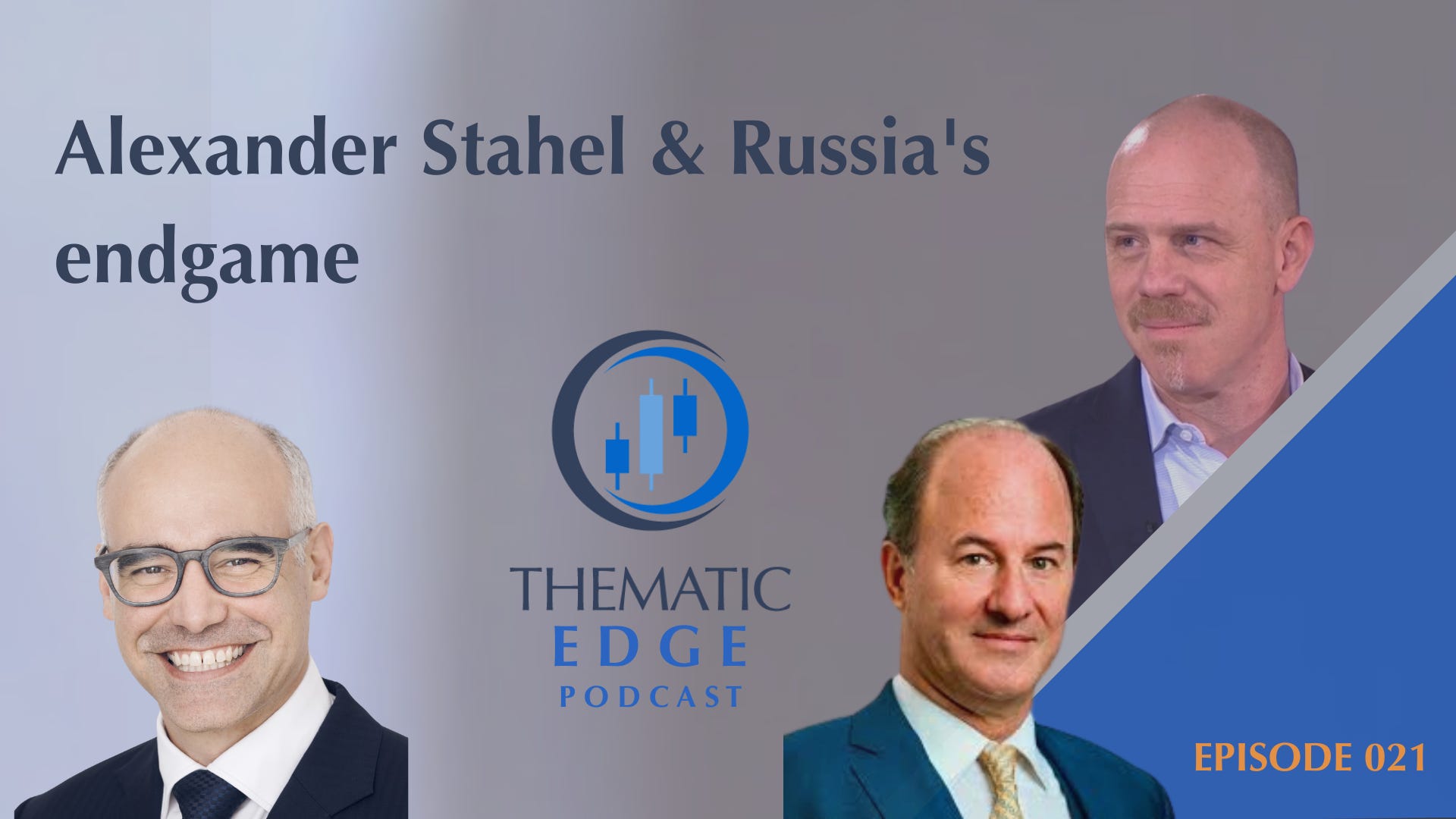
IntroductionIn this episode of The Thematic Edge, Marvin Barth and Mark Farrington speak with Alexander Stahel, Chief Investment Officer of Burggraben Holdings and author of The Commodity Compass, about an emerging crisis in global petroleum product markets.The conversation examines how the war with Iran, Ukraine’s increasingly sophisticated attacks on Russian refining infrastructure and China’s focus on domestic energy security have combined to create severe pressure in diesel, gasoline and jet fuel markets.They explore how Ukraine’s strategy has moved beyond damaging Russian energy infrastructure to disrupting the economic and political networks that sustain the Russian state. The discussion also considers whether these pressures could destabilise the regime, or instead strengthen the patronage system around it.Key themes* A global petroleum product crisis: Why the real pressure is in diesel, gasoline and jet fuel rather than crude oil.* China’s strategic energy reserves: How China’s inventories helped absorb the initial shock, and why Beijing may not use its spare refining capacity to support global markets.* Ukraine’s refinery strategy: How targeted drone attacks on critical equipment are causing lasting damage to Russia’s refining system.* Russia’s domestic fuel shortage: Why Russia is moving from a major exporter of refined products towards gasoline and diesel deficits at home.* Why refined products cannot be easily replaced: How crude quality, refinery design and established supply routes limit substitution.* The Siloviki system: How fuel shortages interact with the patronage networks that underpin Russia’s political economy.* The Russian endgame: Whether economic disruption could destabilise the regime or strengthen by increasing the power of patronage.* A perfect storm for diesel and gasoline: How Russian disruption, Middle Eastern supply risks and limited spare refining capacity are tightening global markets.Episode recorded 21 July 2026Timestamps00:00 Introduction to Alexander Stahel and The Commodity Compass02:58 Alexander’s background and commodity investment approach06:43 Why he created The Commodity Compass10:28 The Iran war and the global energy market12:24 Why the disruption has not yet produced a larger oil price shock13:26 China’s inventories and their role in stabilising the market17:04 Algorithmic trading, oil futures and the physical market19:51 China’s approach to refined product imports and exports26:12 Ukraine’s changing strategy against Russian energy infrastructure27:23 Mykhailo Fedorov and the transformation of Ukrainian drone warfare29:48 Why targeting critical refinery equipment matters31:22 Russia’s dependence on Western refinery technology35:16 The decline in Russian refining capacity36:27 How Ukraine selects its refinery targets38:47 Russia’s emerging gasoline and diesel shortages40:28 What global markets have lost from Russian product exports41:44 Why established fuel supply chains are difficult to replace43:42 The Siloviki system and Russia’s political economy51:33 Whether economic disruption weakens or strengthens the regime53:00 Ukraine’s strategy and the possible Russian endgame58:00 Public criticism, elite tensions and potential political tipping points01:03:22 The greatest risks facing global energy markets01:04:01 The global petroleum product crisis01:05:59 Whether China could relieve the shortage01:07:22 Red Sea shipping risks and the Houthis01:08:09 The perfect storm for diesel and gasoline01:09:00 The Strait of Hormuz and the outlook for product marketsFurther reading* Observations: Dazed and confused, Thematic Markets, 10 April 2026 Why the ceasefire may have been a strategic pause, including the need to release tankers trapped inside the Persian Gulf and prepare for renewed conflict.* Perspective, Seriously, Marvin?!, 8 April 2026 Eight potential paths for the Iran war, the Strait of Hormuz and global energy markets, viewed through the history of major supply shocks.* Alea iacta est, Thematic Markets 23 March 2026: How the Iran war and insecurity in the Strait of Hormuz could reshape global energy flows, alliances and market risks.* Global entropy: Dragons challenged, Seriously, Marvin?!, 16 September 2025: How changing US foreign policy, China and Russia are accelerating global fragmentation and increasing geopolitical tail risks.* Observations: Revealed preference meets real limits, Part III, Thematic Markets, 4 November 2024: The constraints that emerge when political and strategic preferences collide with economic and physical limits.* Global entropy: Enter the dragons, Thematic Markets, 9 November 2023: The strategic foundations of the emerging global order and China’s efforts to secure the resources required to withstand geopolitical disruption.* Wagner’s lessons, Thematic Markets, 14 July 2023: What the Wagner rebellion revealed about the fragility, patronage networks and internal power structures of the Russian state.The Commodity Compass, Alexander Stahel’s Substack, featuring detailed research into commodity markets, energy supply chains and the structure of global petroleum markets.The Great Product Squeeze; The World is Running on Empty, Alexander Stahel, 21 July 2026: Slide show referred to in this episode.Note: All links above point to thematicmarkets.com, now the home of the complete Thematic Markets archive, including research, podcasts and commentary. Existing paid Thematic Markets Substack subscribers can continue to access the same research through Substack. This is a public episode. If you'd like to discuss this with other subscribers or get access to bonus episodes, visit thematicmarkets.substack.com/subscribe
In episode 020 of Thematic Edge, Marvin Barth and Mark Farrington consider the broader implications of the European Central Bank’s retreat in Sintra, Portugal where there seemed to be shift in global central bank philosophy led by new Fed Chairman Kevin Warsh and his drive to end the practice of forward guidance.Marvin and Mark discuss what the end of forward guidance means for near-term Fed policy and markets, and how Sintra may have helped Chairman Warsh push a rate hike back home. They also discuss how forward guidance and increasingly activist monetary policy changed market behavior — for the worse — and what the withdrawal symptoms are likely to be.The conversation concludes with the implications for interest rates, volatility, and the US dollar versus both G10 and emerging market currencies.Key themes* Why the Sintra conference suggested a global shift back towards traditional central banking.* Kevin Warsh’s rejection of forward guidance and what it means for markets.* How forward guidance evolved from an emergency tool into permanent policy.* Why suppressing volatility ultimately encouraged excessive leverage.* The relationship between credibility, optionality and monetary policy.* Whether markets have become too dependent on central bank signalling.* The outlook for US interest rates under the new Federal Reserve.* Why Marvin and Mark remain constructive on the US dollar.* Regional implications for Europe, Japan, North Asia and emerging markets.Timestamps00:00 Introduction02:00 What Sintra revealed about the future of central banking08:00 Kevin Warsh, Greenspan and the end of monetary activism16:00 The rise and fall of forward guidance20:00 Why forward guidance should only be an emergency tool26:00 Volatility, leverage and market behaviour33:00 What the latest economic data means for Fed policy37:00 Why real interest rates are not restrictive40:00 The bullish case for the US dollar45:00 North Asia, Latin America and emerging market currencies55:00 Geopolitics and the outlook for emerging marketsFurther Reading📖 The velvet glove, Thematic Markets, 20 June 2026[Free article] What we learned from Kevin Warsh’s first meeting as Fed chairman📖 Warsh cycle, Part I, Thematic Markets, 10 June 2026What to expect from the Warsh Fed in its first few meetings.📖 What debasement (Debasement Part II), Thematic Markets, 8 March 2026Countering the dollar debasement myth with facts & forecasting its future path📖 Weighing Warsh, Seriously Marvin, 11 February 2026Hawk or dove? Or just a return to orthodox policies?📖 Observations: Goshawks, Thematic Markets, 4 December 2025Markets and the commentariat don’t expect a hawk, but Kevin Warsh is coming.📖 A hawk in dove’s clothing, Seriously Marvin, 1 July 2025Leave President Trump’s rhetoric to the side: he’s incentivized to choose a hawk for Fed chairman📖 Fiscal dominance: narratives versus reality, Seriously Marvin, 25 November 2025Forget about fiscal dominance, it’s regulatory dominance driving the Fed’s balance sheet📖 Regulatory arbitrage, Seriously Marvin, 18 December 2025The battle for the Fed isn’t primarily about interest rates; its about bank regulation📖 The presidents problem, Seriously Marvin, 25 February 2026Don’t forget that Federal Reserve Presidents also play an important role in monetary and banking policy📖 Train wreck, Seriously Marvin, 23 September 2025Jerome Powell will go down in history as one of the Fed’s worst chairmen, objectively📖 The Fed fumbles, Thematic Markets, 20 September 2024The Fed’s rushed policy rate cuts were a mistake that further tarnishes their credibility📖 Leitmotif 4: The Fed sheds cred, Thematic Markets, 17 January 2025The Fed has a lot of work to do to restore its credibility.📖 Everything you know about QE is wrong, Thematic Markets, 24 February 2026QE isn’t the market support many believe; nor will QT have a significant negative effect📖 The employment situation, Thematic Markets, 29 September 2025Both the Fed and markets overestimate the softness of US labor markets This is a public episode. If you'd like to discuss this with other subscribers or get access to bonus episodes, visit thematicmarkets.substack.com/subscribe

Comments

Download from Google Play

Download from App Store
 United States