


Honey Bee Obscura Podcast
Subscribed: 184Played: 15,885
Subscribe

© 2026 by Growing Planet Media, LLC All Rights Reserved
Description
The weekly podcast exploring the joys, challenges, and curiosities of keeping honey bees. Hosted by Dr. Jim Tew and produced by Jeff Ott, Honey Bee Obscura delivers short, focused conversations that dive into the details of beekeeping—from practical how-tos to quirky observations. Perfect for learning something new on the way to the apiary, at home, or wherever your bees take you.
300 Episodes
Reverse

Honey extraction can be rewarding, but for a small operation it can also be sticky, awkward, and surprisingly hard on the wrists. In this episode of Honey Bee Obscura, Jim Tew and Anne Frey compare practical ways to get a modest honey crop from the comb without pretending there is one perfect setup. Jim traces his own path from a two-frame extractor to larger equipment at Ohio State and, decades later, back to a small extractor for seven or eight colonies. Anne suggests that beginners first borrow an extractor and other processing equipment from a local beekeeping club, while Jim makes the case for keeping durable stainless-steel tools that may become useful again as an operation changes. They examine uncapping options ranging from cold and heated knives to uncapping planes, scratchers, and rollers. Anne explains why a pulling motion can be easier on the wrist and what happens to wax fragments after pierced cappings release their honey. The conversation also covers settling and straining honey, saving cappings, and the tradeoffs of crush-and-strain processing. Small extractors bring another challenge: vibration. Jim and Anne swap inventive approaches involving floor anchors, plywood bases, added weight, wheeled stands, and even a spring-mounted utility trailer. They also discuss running multiple small extractors instead of immediately buying a larger machine. Their conclusion is simple: match the equipment to the size of the operation, stay open to changing the process, and keep every surface and tool clean. ______________________ Thanks to Betterbee for sponsoring today's episode. Betterbee's mission is to support every beekeeper with excellent customer service, continued education and quality equipment. From their colorful and informative catalog to their support of beekeeper educational activities, including this podcast series, Betterbee truly is Beekeepers Serving Beekeepers. See for yourself at www.betterbee.com We'd like to thank Vita Bee Health for supporting the podcast. Vita provides proven tools for controlling Varroa—from Apistan and Apiguard to the new VarroxSan extended-release oxalic acid strips—helping beekeepers keep stronger, healthier colonies. Thanks to Bee Culture, the Magazine of American Beekeeping, for their support of Honey Bee Obscura. Available in print and digital at www.beeculture.com ______________________ Honey Bee Obscura is brought to you by Growing Planet Media, LLC, the home of Beekeeping Today Podcast. Music: Heart & Soul by Gyom, All We Know by Midway Music; Christmas Avenue by Immersive Music; original guitar music by Jeffrey Ott Cartoons by: John Martin (Beezwax Comics) Copyright © 2026 by Growing Planet Media, LLC

In this special 300th episode of Honey Bee Obscura, Dr. Jim Tew heads back to his bee yard for a thoughtful look at where the podcast began, where it has taken him, and why these weekly conversations have come to mean so much. Jim remembers how the late Kim Flottum repeatedly tried to persuade him to give podcasting a chance. Jim was committed to video and initially saw an audio-only program as a step backward. Kim, however, was persistent. What began as an experiment with short conversations eventually found its rhythm as the relaxed, 20-minute "plain talk" discussions listeners know today. Jim recalls the friendship—and occasional disagreements—that made his conversations with Kim memorable, from eight-frame equipment to queen introduction and the value of a beekeeper's time. But he also reflects on the difficult years that followed, including Kim's declining health and death and the loss of Jim's wife. During that period, returning to the bee yard and talking with listeners became an important source of normalcy, focus, and continuity. Now, 300 episodes later, Jim considers how his own approach to beekeeping continues to evolve. He may work his colonies differently than he once did, but his curiosity remains. And that, perhaps, is what Honey Bee Obscura has always been about: not having every answer, but continuing the conversation. Most of all, Jim has a simple message for listeners who have traveled this road with him: thank you. ______________________ Thanks to Betterbee for sponsoring today's episode. Betterbee's mission is to support every beekeeper with excellent customer service, continued education and quality equipment. From their colorful and informative catalog to their support of beekeeper educational activities, including this podcast series, Betterbee truly is Beekeepers Serving Beekeepers. See for yourself at www.betterbee.com We'd like to thank Vita Bee Health for supporting the podcast. Vita provides proven tools for controlling Varroa—from Apistan and Apiguard to the new VarroxSan extended-release oxalic acid strips—helping beekeepers keep stronger, healthier colonies. Thanks to Bee Culture, the Magazine of American Beekeeping, for their support of Honey Bee Obscura. Available in print and digital at www.beeculture.com ______________________ Honey Bee Obscura is brought to you by Growing Planet Media, LLC, the home of Beekeeping Today Podcast. Music: Heart & Soul by Gyom, All We Know by Midway Music; Christmas Avenue by Immersive Music; original guitar music by Jeffrey Ott Cartoons by: John Martin (Beezwax Comics) Copyright © 2026 by Growing Planet Media, LLC

 1
1Late summer can expose the colonies that simply haven't kept pace. Maybe they're late splits, small nucs, colonies recovering from swarming, or colonies that never developed the population you expected. What should you do with them before winter? In this episode of Honey Bee Obscura, Jim Tew welcomes Anne Frey of Betterbee for a practical conversation about managing small colonies as summer gives way to fall. Anne and Jim discuss how small a colony can be and still have a reasonable chance of overwintering, along with ways beekeepers can improve those odds. That includes making sure Varroa mites are under control, providing adequate honey and pollen, donating resources from stronger colonies, reducing environmental stresses, adding top insulation, and positioning small colonies so they can benefit from shared warmth. They also explore overwintering nucs above stronger colonies using double-screen boards, multi-compartment equipment, equalizing colonies with frames of capped brood, and when simply combining two weak colonies may be the better choice. And what about moving colonies indoors—or even hauling them hundreds of miles south? Jim has stories about both. The bottom line: small colonies require extra attention, realistic expectations, and sometimes a willingness to cut your losses while protecting valuable drawn comb for another season. ______________________ Thanks to Betterbee for sponsoring today's episode. Betterbee's mission is to support every beekeeper with excellent customer service, continued education and quality equipment. From their colorful and informative catalog to their support of beekeeper educational activities, including this podcast series, Betterbee truly is Beekeepers Serving Beekeepers. See for yourself at www.betterbee.com We'd like to thank Vita Bee Health for supporting the podcast. Vita provides proven tools for controlling Varroa—from Apistan and Apiguard to the new VarroxSan extended-release oxalic acid strips—helping beekeepers keep stronger, healthier colonies. Thanks to Bee Culture, the Magazine of American Beekeeping, for their support of Honey Bee Obscura. Available in print and digital at www.beeculture.com ______________________ Honey Bee Obscura is brought to you by Growing Planet Media, LLC, the home of Beekeeping Today Podcast. Music: Heart & Soul by Gyom, All We Know by Midway Music; Christmas Avenue by Immersive Music; original guitar music by Jeffrey Ott Cartoons by: John Martin (Beezwax Comics) Copyright © 2026 by Growing Planet Media, LLC

When should you feed your honey bees—and when is feeding simply masking another problem? In this Honey Bee Obscura Archive Special, we revisit a conversation between Jim Tew and the late Kim Flottum about one of beekeeping's perennial fall questions: fall feeding of colonies in preparation for winter. Kim and Jim begin with a deceptively simple question: Why are you feeding? A colony may need supplemental food because of poor forage, unfavorable weather, a newly created split, inadequate stores, or another management decision. But feeding can also become what Jim calls a "management Band-Aid"—something that helps a colony through a temporary shortage without addressing why it became short on stores in the first place. From there, they tackle the practical questions. What should you feed? Thin or thick sugar syrup? Fondant? Dry granulated sugar? And with entrance feeders, top feeders, division-board feeders, and other options available, is there really one "best" method? For northern beekeepers preparing colonies for winter, Jim and Kim discuss the amount of stored honey they historically looked for and an old but useful technique: weighing or "hefting" a hive to estimate its stores. They explain why learning what a properly provisioned hive feels like can help a beekeeper decide whether intervention is necessary. Most importantly, they emphasize that meaningful fall feeding can require a significant commitment. Bringing an underweight colony up to adequate winter stores may require gallons of syrup—not simply feeding once and assuming the problem is solved. The takeaway is classic Jim and Kim: feed when you need to, understand why you need to, and stop when the colony has what it needs. ______________________ Thanks to Betterbee for sponsoring today's episode. Betterbee's mission is to support every beekeeper with excellent customer service, continued education and quality equipment. From their colorful and informative catalog to their support of beekeeper educational activities, including this podcast series, Betterbee truly is Beekeepers Serving Beekeepers. See for yourself at www.betterbee.com We'd like to thank Vita Bee Health for supporting the podcast. Vita provides proven tools for controlling Varroa—from Apistan and Apiguard to the new VarroxSan extended-release oxalic acid strips—helping beekeepers keep stronger, healthier colonies. Thanks to Bee Culture, the Magazine of American Beekeeping, for their support of Honey Bee Obscura. Available in print and digital at www.beeculture.com ______________________ Honey Bee Obscura is brought to you by Growing Planet Media, LLC, the home of Beekeeping Today Podcast. Music: Heart & Soul by Gyom, All We Know by Midway Music; Christmas Avenue by Immersive Music; original guitar music by Jeffrey Ott Cartoons by: John Martin (Beezwax Comics) Copyright © 2026 by Growing Planet Media, LLC
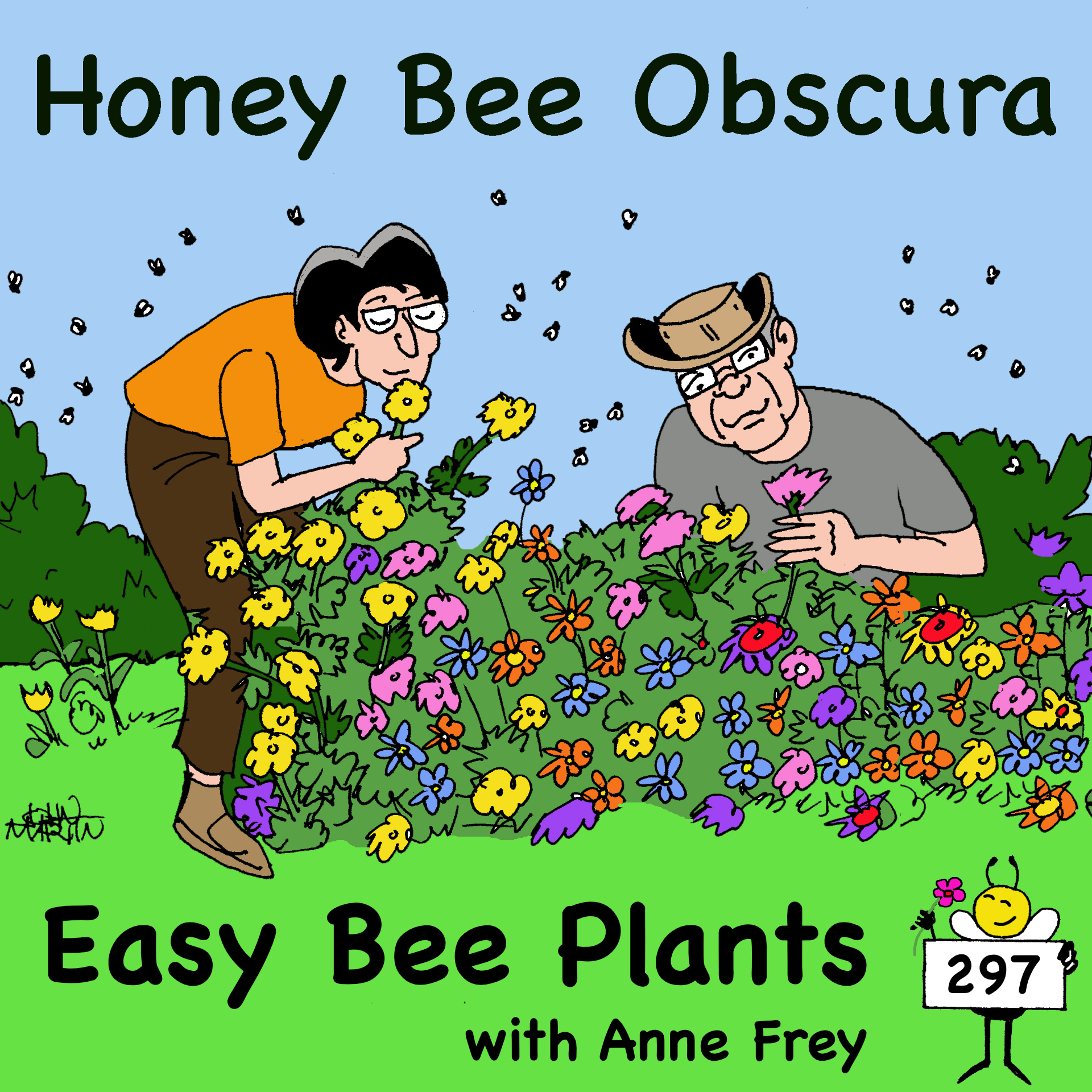
What can the average beekeeper realistically plant to help honey bees and other pollinators? Jim Tew is joined by Anne Frey of Betterbee for a practical and sometimes wandering—in the best possible way—conversation about bee forage. They begin with the idea of planting wildflowers and quickly confront the question of scale. If meaningful forage can require substantial acreage, what can a beekeeper with an ordinary backyard actually accomplish? Anne suggests thinking beyond wildflower plots. A single well-chosen tree, such as an American basswood or linden, can provide an impressive concentration of flowers when it blooms. Jim recalls basswood honey from his years in Maryland and shares the story of a nearby 250-acre farm planted entirely in sunflowers—a spectacular sight that attracted people as readily as it attracted pollinators. They also talk about soybeans, tulip poplar, bee-bee tree (Evodia), and the temptation beekeepers sometimes have to plant anything honey bees find attractive. That leads to an important caution: a plant being good forage doesn't necessarily mean it belongs in your landscape. Some highly attractive plants can also be invasive. Ultimately, Jim and Anne arrive at perhaps the easiest approach of all: when possible, leave some land wild. Locally adapted flowering plants—or what we often dismiss as weeds—may provide more benefit than an introduced wildflower mix. And a perfectly manicured lawn? From a bee's perspective, Anne suggests it might not be much better than a parking lot. You don't need to transform an acre. Plant a native tree, tolerate some untidiness, preserve existing forage, and pay attention to what the bees are already telling you they like. ______________________ Thanks to Betterbee for sponsoring today's episode. Betterbee's mission is to support every beekeeper with excellent customer service, continued education and quality equipment. From their colorful and informative catalog to their support of beekeeper educational activities, including this podcast series, Betterbee truly is Beekeepers Serving Beekeepers. See for yourself at www.betterbee.com We'd like to thank Vita Bee Health for supporting the podcast. Vita provides proven tools for controlling Varroa—from Apistan and Apiguard to the new VarroxSan extended-release oxalic acid strips—helping beekeepers keep stronger, healthier colonies. ______________________ Honey Bee Obscura is brought to you by Growing Planet Media, LLC, the home of Beekeeping Today Podcast. Music: Heart & Soul by Gyom, All We Know by Midway Music; Christmas Avenue by Immersive Music; original guitar music by Jeffrey Ott Cartoons by: John Martin (Beezwax Comics) Copyright © 2026 by Growing Planet Media, LLC

Comments

Download from Google Play

Download from App Store
 United States