


 Claim Ownership
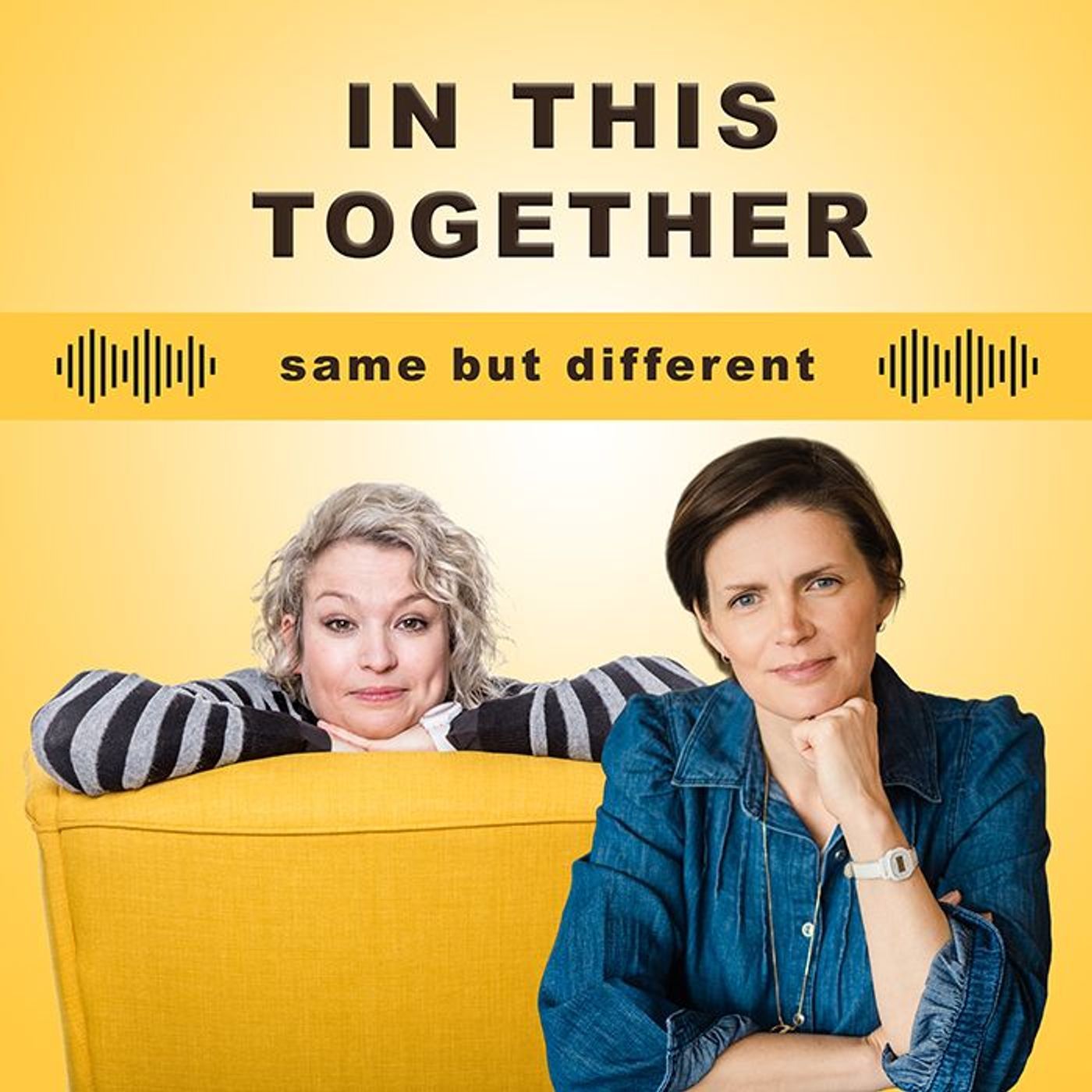
 In This Together - Same But Different
Subscribed: 5Played: 87
Subscribe

© 2026 Bernadette Dancy and Liz Goodchild
Description
Welcome to In This Together: Same But Different.
Hosted by Liz Goodchild, Coach and Supervisor, and Bernadette Dancy, Stress Management Coach — two friends, two coaches, two humans — this podcast is about the weird, lovely, maddening reality of being alive.
This is not a self-help podcast…even though, yes, we are coaches.
We're not here to dish out any how-to guidance or advice, and there'll be absolutely no magic answers or "do this and your life will change" kind of stuff.
Each episode is a real, human chat from two perspectives - so you can feel less alone, a little more understood, and maybe think, "Oh… me too."
Come as you are. We're here to keep you company.
Because we're In This Together: Same, But Different.
16 Episodes
Reverse
Is the midlife crisis actually a thing, or have we just given a slightly ridiculous name to a much more interesting stage of life? In this episode, we talk about what happens when you reach a point where you’ve ticked a lot of the boxes you were supposed to tick, career, relationships, children, stability, and still find yourself wondering: is this really how I want to spend the next 10, 20 or 30 years? We get into ageing, perimenopause, changing bodies, parents getting older, children needing us less, mortality, career changes, emotional needs, values and that occasional urge to burn the whole bloody thing down and start again.We also talk about the very different stories we’re given about men and women in midlife, why women hear so much about what we’re supposedly losing as we age, and far less about what we might actually be gaining. And perhaps midlife isn’t really about avoiding the difficult stuff at all. Maybe it’s about knowing life will batter us sometimes, and building enough trust in ourselves to know we can handle it. A conversation about getting older, taking stock, making changes and deciding what you actually want from the next part of your life.Show notes:Margie Lachman, lifespan developmental psychologist, article in the Guardian:https://www.theguardian.com/global/2026/jun/18/midlife-crisis-researcherDr. Sharon Blackie is an award-winning and internationally bestselling author, speaker and teacher: https://sharonblackie.net/about/Elliott Jaques, Canadian Psychoanalyst: https://www.ncbi.nlm.nih.gov/books/NBK555706/Emotional Needs List (that Liz mentions in the episode):Emotional needs are feelings or conditions that we need in order to feel content, fulfilled and at peace. They include:Security: a safe environment that enables us to develop our potential and live without fearVolition: a sense of autonomy and control over our own livesAttention: receiving it from others and also giving it to othersEmotional connection to others: friendship, intimacyConnection to the wider community: being part of something larger than ourselvesA sense of status: knowing we have a valued place in each of the social groups we belong toA sense of competence and achievement: ensuring we don't suffer from low self-esteemA sense of meaning and purpose: a sense that we are part of something greater than ourselvesGrowth: comes from being spiritually, mentally and physically stretchedA need for certainty: predictability, consistencyA need for uncertainty: spontaneity, excitementThese needs help shape how we feel, relate and respond to life. When some of them aren’t being met, we can start to feel out of balance, disconnected or more vulnerable to stress, anxiety and low mood. (This is a reflective tool designed to help you think about what might be supporting your wellbeing, and what may need a little more attention. It isn’t intended to diagnose or treat any mental health condition).Follow us on Instagram: @in.this.together.pod @liz.good.child and @bernadettedancy_stresscoach or email us at [email protected] with usLiz’s offers 1:1 life coaching and coach supervision www.lizgoodchild.co.ukBernie offers 1-1 stress and burnout coaching and delivers CPD training for stress management for coaches, and wellness professionals: www.stress-ed.co.uk
What role do grandparents play in shaping who we become?In this episode, Liz and Bernie talk about grandparents, the relationships we have with them, what they can give us, and what gets passed down through generations, whether we realise it or not.They explore research around emotional closeness to grandparents, generational trauma and the importance of having steady adults in our lives, alongside their own very different family stories.Liz talks about the relationship she had with her Nan, who became an important source of stability after her mum died, and Bernie shares stories about her Irish grandparents, family history and the generations that came before her.They also talk about watching their own parents become grandparents, why grandparents sometimes seem to get away with everything, the grief of losing them, and how knowing our grandparents can give us a glimpse of who our parents were before they became our parents.Funny, personal and unexpectedly emotional, this is a conversation about family, belonging, inheritance, love and the people who help shape us.Show notes:Emotional closeness to grandparents and adolescent wellbeing: https://pubmed.ncbi.nlm.nih.gov/26237053/Maternal grandmothers as a buffer against childhood adversity: https://pmc.ncbi.nlm.nih.gov/articles/PMC10957867/The “mouse study” on inherited fear responses: https://www.nature.com/articles/nn.3594Intergenerational effects of Holocaust trauma: https://pmc.ncbi.nlm.nih.gov/articles/PMC6720013/Contact us via email: [email protected] or Instagram: https://www.instagram.com/in.this.together.pod
The Battle of Social Media: Stay, Leave or Do It Differently?Is social media bringing us together — or quietly pulling us out of our own lives?This week, we’re having a very same but different conversation about our relationship with social media.Liz has barely used Instagram all summer. There was no grand digital detox and no dramatic announcement; she just stopped opening it, and noticed that she felt more present in her actual life.Bernie has gone in almost the opposite direction. She’s decided to show up more online, particularly for her work, but without bending herself into whatever shape the algorithm currently demands. From there, we get into the much messier question underneath it all: what is social media actually doing for us — and to us?We talk about curated lives and comparison; the strange feeling of knowing huge amounts about people we don’t actually know; whether watching someone’s Instagram Story can trick us into feeling as though we’ve genuinely checked in with them; online friendships and community; creativity; AI-generated content and the growing difficulty of knowing what’s real; social media as a tool for small businesses; algorithms, trolls and digital noise; and why sometimes stepping away is simply the right thing to do.We also talk about something both of us are trying to navigate as parents: raising children in a world where even if they don’t have social media accounts themselves, we can’t completely control what gets shown to them by friends, algorithms or other devices.There’s no “delete Instagram immediately” conclusion here. And there’s definitely no “social media is wonderful” conclusion either.Instead, we land somewhere much more personal:When I use it, how do I actually feel?Connected? Inspired? Amused? Supported?Or just… a bit crap?As ever, we’re figuring it out while we talk.In this episode we talk about:Taking a break from Instagram and noticing what changesSocial media as connection versus social media as noiseWhy algorithms, hooks and trends make us both want to rebelShowing up online authentically when you run a businessComparison, body image and mental healthOnline friendships, community and “checking in” without actually checking inAI-generated writing, images and videos — and the erosion of trust onlineUsing social media intentionally rather than automaticallyParenting, smartphones, YouTube, WhatsApp and unwanted online contentHelping children develop digital and media literacyWhy neither of us thinks social media is simply “good” or “bad”Bernie’s move towards Substack and a more old-school style of publishingAnd, naturally, sending pigeons and knitting jumpers as alternative podcast marketing strategiesContent warning:This episode includes discussion of burnout and suicide, graphic violent content encountered online, pornography and sexual content in the context of children and online safety.We’d genuinely love to know where you land on this one. What does social media give you? What does it take from you? Have you stepped away, leaned in, found a middle ground — or are you still figuring it out too?In This Together: Same But Different — two coaches, best pals, and two slightly different takes on being human.
The wellness industry is worth around 5.6 trillion dollars, and the dodgy end has learned to talk exactly like the qualified end. In the last episode of season 2, Liz and Bernie get into grifters: the influencers and self-styled healers promising to fix your whole life with a weekend retreat and a well-placed crystal.They talk about what being trauma informed actually means, why declaring a space safe doesn't make it so, and why the most confident voice is so often not the most qualified one. There's the difference between evidence and a good soundbite, why nuance never goes viral, and the small but vital things to look for before you hand over your money or your trust: scope of practice, supervision, real training.It's not an anti-wellness episode. It's a be-discerning one. Because people deserve support, and that support should come with honesty, humility and proper ethical care, not grand promises and guru energy.Back in August for season 3!Shownotes:Gabor Maté: https://drgabormate.com/Brené Brown: https://brenebrown.com/China's restrictions on unqualified health and wellness content: https://www.chinadaily.com.cn/a/202508/04/WS688ff13aa310c0209d01abff.htmlAlso mentionedLiz's group coaching programme, It's Not Just Me. A 6-week foundational course for anyone worn out from overthinking, people pleasing and holding everything together. Starts September: https://www.lizgoodchild.co.uk/its-not-just-me/Bernie's CPD training on stress and burnout, open to all practitioners (coaches, therapists, wellness practitioners, doctors, nurses and more), with a community that meets quarterly. Currently running her fourth cohort: https://stress-ed.co.uk/training/Contact:To let us know about themes and topics you’d love us to discussion in Season 3, you can email us here: [email protected] contact Liz directly: [email protected] or via DM https://www.instagram.com/liz.good.child/To contact Bernie directly: [email protected]
Anyone else feeling like the world has collectively lost the plot?Between politics, wars, rising costs, climate anxiety, social media and the endless stream of breaking news, it's no wonder so many of us are feeling overwhelmed, anxious and emotionally exhausted.In this episode, Liz and Bernie dive into what happens when our nervous systems are exposed to a constant flow of alarming information, and why so many people are walking around carrying stress, fear and uncertainty that doesn't seem to switch off.Drawing on their experiences as coaches, they explore how uncertainty affects our wellbeing, why doomscrolling keeps us stuck in survival mode, and what happens when we feel powerless in the face of events we can't control.The conversation also takes a thoughtful look at politics, community, difference, fear and belonging, while asking an important question: how do we stay informed and engaged without becoming completely consumed by what's happening in the world?Along the way, they chat about:• Why the world feels more overwhelming than ever• The impact of constant news consumption on our nervous systems• Vicarious trauma and emotional contagion• The psychology of fear, uncertainty and control• Why people seek certainty when life feels unstable• Social media algorithms and the doomscrolling trap• The importance of community, connection and curiosity• Looking for "glimmers" and practising a little more bloom scrolling• Simple ways to feel more grounded when everything feels chaoticThis isn't a conversation about ignoring what's happening around us. It's about finding ways to stay informed, stay connected and stay human without burning ourselves out in the process.Because maybe the answer isn't carrying the whole world on our shoulders.Maybe it's putting the phone down for a bit, looking for the helpers, finding some glimmers, watching cute Shetland ponies run around a field, and remembering that we're all just doing our best to make sense of a very noisy world.Mentioned in this episode• Julian Rotter's theory of Locus of Control• Pearl Drego's concept of the Cultural Parent• Vicarious Trauma• Doomscrolling and Bloom Scrolling• Mr Rogers' famous advice: "Look for the helpers"• Life Is Beautiful (1997) – the Oscar-winning film Bernie references when talking about finding hope, humanity and moments of joy even in the darkest circumstances.If this episode resonated with you, we'd love it if you'd follow, rate and review the podcast, and share it with someone who might need the reminder that they're not the only one feeling this way.Because we're all in this together. Same, but different.

Comments

Download from Google Play

Download from App Store
 United States