


 Claim Ownership
Graybeard Radio
Subscribed: 0Played: 1
Subscribe

© Copyright 2025 Digital Access Inc aka Graybeard Radio
Description
Welcome to Graybeard Radio. My goal is to help us both stay healthy, discover the real value in your decades of wisdom and experience, and turn that into meaningful impact and income—whether in your current career or business, a completely new direction, or retirement. Here's the thing: if you're stuck, overwhelmed, burned out, disillusioned, or just uncertain about what your next steps should be, you don't have to get out of the game entirely. Maybe it's just a slightly different game. Your game, your rules, on your terms. With the right tools, technology, and strategy, you can stay connected to who and what matters most and thrive in this next chapter..... and have a little fun along the way.
24 Episodes
Reverse
A healthy next chapter is not built by wishing for more energy. It is built the way a building is built: by understanding constraints, making decisions, and doing the repeatable work that holds the whole thing up.
That is where Dino Herbert’s architecture background matters. He is not the romantic version of an architect who only cares about the beautiful image. After 40 years in the field, he thinks in systems. A public project is not just a design; it is committees, separate contracts, HVAC, electrical, plumbing, general contractors, at least three bids, and sometimes 30 days just to get paperwork signed. The pretty picture still has to stand up.
The same standard applies to aging.
Herbert speaks plainly, with a quick joke close at hand. He tells Matt Hempel on Graybeard Radio that he is one of seven children, part of a family big enough to include 13 nieces and nephews and five grand nieces and nephews. He knows noise, motion, and pressure. At 12, while helping his mother clean an architecture and engineering office in Columbus, Ohio, he finds himself inside a 30-by-60-foot room full of drafting tables. He sees drawings on boards, pencils and erasers everywhere, and decides that is what he is going to do.
The career that follows is steady but not simple. Ohio State becomes home after he delays applying elsewhere. He is there when the university adds the “THE” in 1986. He interns at Moody Nolan after his sophomore year, then learns the awkward truth of early career growth: people who meet a person as the young intern may keep seeing him that way even after the résumé changes.
Later, the tradeoff becomes time. Herbert works for a public company with 12,000 employees, with projects across the Midwest, a boss in Detroit, headquarters in Chicago, and national bank branches in motion. He is on the road Monday through Thursday. With two young sons at home and, eventually, three children close together, he sees the risk clearly: wake up one day and the kids are in high school.
So he chooses flexibility.
The walking work begins with a more humbling kind of feedback. Herbert wrestles his 17-year-old son and the match does not go as planned. Then he trains for Mount Rainier, a 14,400-foot peak near Seattle, carries 50 pounds, reaches 10,009 feet, and cannot make the summit push. The former athlete has to admit that intention is not the same as readiness.
His answer is not extreme. It is a daily 5K, 3.12 miles, done because it is enough to matter and still possible to repeat. He turns the camera on for accountability, not entertainment. Ochanda Outdoor Fitness grows from that habit, along with a 50-plus outdoor fitness group and a 13-week walking system at walkbacktolife.com for people starting from the couch.
The counterintuitive idea is simple: walking is not the consolation prize. It is the bridge.

The job was never just the paycheck.
It was Monday morning having a shape. It was knowing what 9:47 on Tuesday looked like. It was the annoying people who were still your annoying people, the problems that came to your desk because someone trusted your judgment, and the clean little answer you could give when a stranger asked, “What do you do?” When that role ends, voluntarily or otherwise, the loss is not just professional. It is personal.
Matt Hempel, host of Graybeard Radio and creator of the Graybeard Project, speaks from the middle of that problem, not from a safe distance. He is blunt, funny, and unsentimental. At 58, after a health wake-up call and after watching respected peers get shown the door while they still had plenty left, he starts asking a harder question than “What job comes next?” The question becomes: what should the next decade actually be for?
Arthur Brooks’ work gives him a frame. Fluid intelligence is speed: solving new problems fast, learning a system overnight, walking into a meeting and being insufferably ahead of everyone else. Hempel calls that being a “baller” at 28, 35, or 40. Crystallized intelligence is different. It is judgment, pattern recognition, perspective, and the ability to know which problems matter before everyone burns a week on the wrong ones.
The hard part is that the old measuring stick stops working.
A 35-year-old may beat the older executive to the first answer in the room. That does not mean the older executive is done. It may mean the value has moved from speed to synthesis, from performing the role to advising, teaching, mentoring, and helping people avoid the mistakes already made dozens or hundreds of times.
Hempel does not romanticize the exit. Some people choose it. Some get reorganized, “right-sized,” or politely told their services are no longer required, possibly by someone half their age. He talks about the anger, the urge to key a car in the parking lot, and the odd humiliation of going from high-status executive to just another guy wandering around Food Lion at 3 PM on a Friday.
His own version comes by email: a few years earlier, he is terminated from his own company. Not like Steve Jobs with millions in stock, he says. It hurts. It dents the ego. It forces the questions that become Graybeard Radio.
The practical move is simple: make two lists. What needs to be left behind? What would be painful to stop contributing? Somewhere between those answers is the work that still belongs to the next decade.
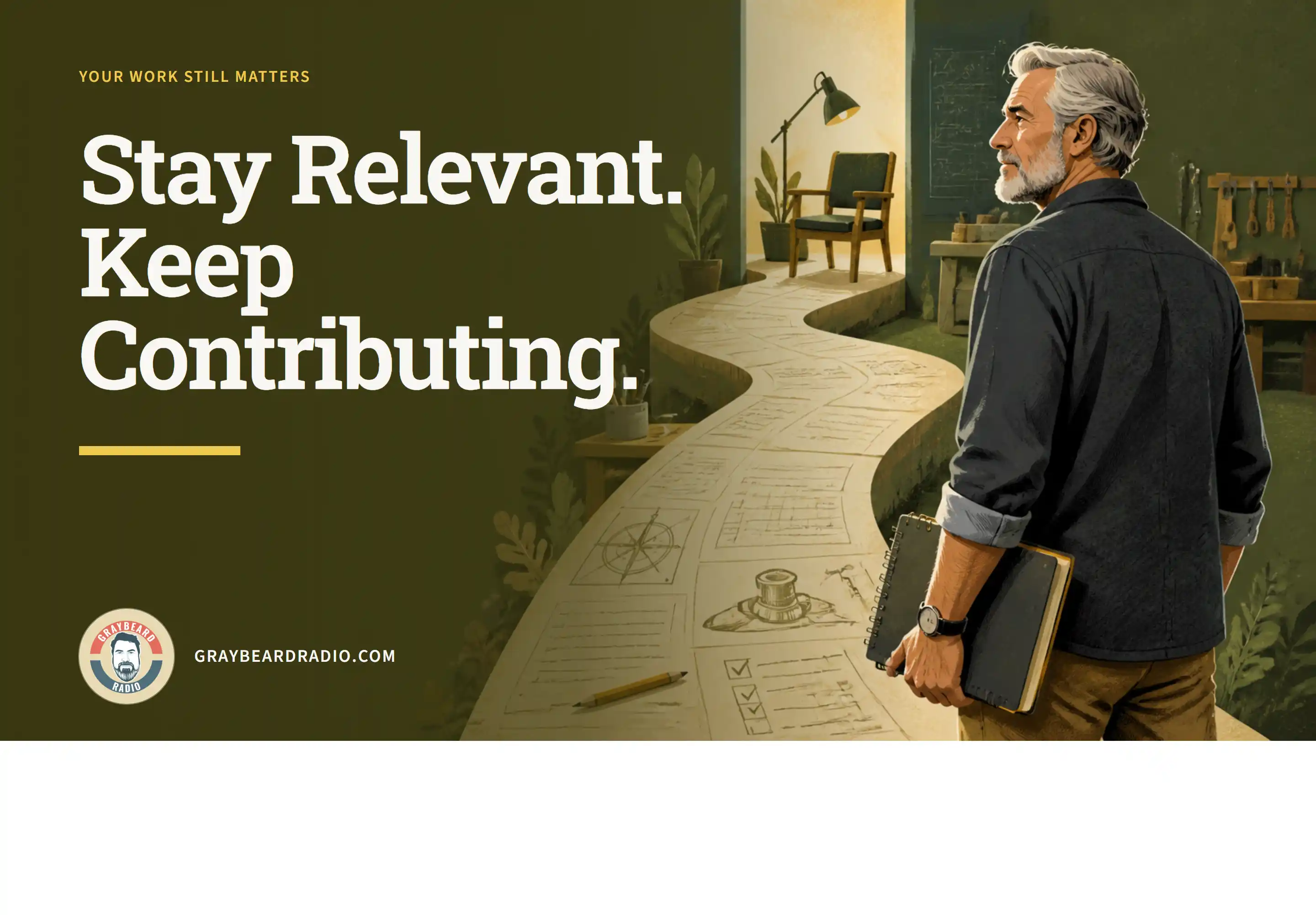
The work after work is not leisure. Not for long, anyway. It is the problem of staying useful without pretending the old title still owns you.
John Fraley brings a plain-spoken kind of authority to that problem. He is a Statesville native, a UNC Chapel Hill graduate, a longtime home textiles executive, a former North Carolina legislator, a UNC Board of Governors member, and board chair of My Future NC. He speaks in practical turns: people matter, timing matters, and if a place is not working for you, it usually shows.
The pattern starts early. A fraternity connection points him toward Cannon Mills, and the young Fraley heads to New York despite never having been there. The Cannon office is in the Time Life building across from Radio City Music Hall, but he spends his first Sunday walking up and down Sixth Avenue trying to find 1271 Avenue of the Americas. Small-town logic tells him the address should be on the building.
New York teaches other lessons fast. A London Fog coat with a zip-in lining is not enough in January. A light green suit with a flap pocket does not pass in corporate New York. Neither do brown zip boots and cordovan patent leather tassel loafers. When a senior executive sees his new tie shoes, he puts an arm around him and says they are glad he got some new shoes.
That is the thread.
The big choices keep coming through people, not theory. In Los Angeles, a competitor offers to triple his compensation, and he says no because the job looks like selling forever rather than management. Later, after 18 years in the Cannon orbit and a senior role at West Point Stevens, he loses a job and ends up learning the international side of textiles through India and China. The industry itself changes around him, moving from U.S. family-controlled companies to offshore capacity, until very few towels and sheets are made in the United States.
Retirement does not hold still either. At 65, tired of 15-hour flights, Fraley tells his wife Adelaide he is ready to stop. She tells him he should run for public office. He thinks she has lost her mind. A poll shows a possible 14% swing, so he knocks on doors for months and beats a 10-term incumbent in a primary by 105 votes.
The more surprising center of the story is Kenya. A friend asks six couples for $1,000 each to start six nomadic preschools for Samburu children in Northern Kenya. The schools begin around a thorn tree with sticks for walls and a blackboard against the tree. The effort grows from about 130 children to about 1,500, from kindergarten through university. One boy Fraley and Adelaide sponsor is now 6'4" or 6'5" and back in the bush teaching chemistry and physics.
Public office, UNC governance, and My Future NC all make more sense after that. Education is not a policy lane for him; it is the work that keeps asking for the next decision.
The college admissions story most families hear is too small. It comes from a narrow band of elite schools, the kind that build classes with exacting selectivity and leave parents believing every college is guarded by some hidden machinery. That is not how most institutions work. Most are trying to identify students who can thrive there, contribute to the community, and leave prepared for a good life.
The problem is not ambition; it is confusion.
Dr. Brian Ralph knows the machinery from the inside, but he does not talk like a gatekeeper. He talks like someone who has spent 31 years in higher education and still believes institutions are made by people. Before serving as the 11th president of William Peace University from 2015 through 2024, he works across admissions, enrollment, student life, athletics, marketing, and senior leadership. His path starts in a less polished place: after earning an MBA from Ohio University and applying to 150 jobs, he works on a hotel grounds crew, picking up cigarette butts in a parking lot until an informational interview turns into an admissions job at Hocking College.
That early admissions work shapes the way he looks at families now. The right question is not simply, “Can my student get in?” It is, “Can my student learn well here?” Ralph points to the learning environment, the campus culture, and the actual conditions under which a student can be academically and socially successful. A high-ability student can still land in the wrong place if the environment does not fit. Prestige does not do the learning for them.
Host Matt Hempel of Greybeard Radio also pushes Ralph into the parts of leadership that rarely show up in glossy university language: crisis, communication, endings, and the work after the big job. Ralph recalls a potential shooter approaching campus, Raleigh police responding fast, and that same day his wife losing one of their dogs at home while unable to reach him. During COVID, he leans on a phrase he learned years earlier: “strategic procrastination.” When some people want a fall mask policy set in February 2021, he refuses because the facts have already changed five times in seven months.
The most surprising idea here is that delay can be responsible leadership.
Ralph’s own career turn carries the same humility. After receiving a five-year renewal in July 2023, he is told in March 2024 that the board wants a different leader. It hurts, and he says so plainly. A later presidency opportunity stalls when a search consultant says the board wants “Jane 2.0.” Ralph knows he is not that. Today, in coaching and advising, he uses Gemini to turn client meetings into summaries and next steps within 15 minutes, saving what he estimates is five hours a week. The tools change, but his central claim stays steady: people matter, fit matters, and leaders cannot fake their way into their next season.

Late-career reinvention is less a lack-of-options problem than an overload problem. After decades of operating, leading, building, or grinding, many professionals do not need another pep talk. They need a way to sort the noise, name what still fits, and stop getting pulled back into the same “fake deadlines” and “fake urgency” that drained them in the first place.
That is the premise behind this part-two
Graybeard
Radio experiment, where host Matt puts his own AI voice agent, Ben, to work on him. Ben is built to help seasoned professionals figure out what comes next after a career inflection point. He speaks in a relaxed, practical register: part coach, part interviewer, part structured thinking partner. Matt later says the technology feels like talking to a good buddy over coffee or a beer.
The test case is personal. Matt is terminated from his own company in his late 50s after about 25 years of doing similar work in one form or another. He cannot simply disappear into retirement, but he does have enough room to choose differently. A health wake-up call sharpens the question: what should the next five or 10 years be for?
The answer is not a single job title.
The
Graybeard
Project grows out of the gap Matt finds when he looks for help. There are few clear resources for blue- and white-collar professionals who still have skill, energy, and judgment, but want a slower pace, different terms, or a more useful role at this stage in our lives.
Graybeard
Radio is already live at graybeardradio.com, and the broader promise is to help people stay healthy, connected, and relevant while using new tools and technology.
Assumptions evolve: Matt first pictures the work as being for professional men, then broadens his focus to include professional women as well. The assessment works for anyone in our age cohort, in our shoes.
The sharpest claim in the conversation is also the most counterintuitive. Matt argues there has never been a better time to turn 60 and redirect professional focus than right now in 2026, with 2027 close ahead. AI gives experienced people leverage: not to become someone else, but to package what they already know into consulting, fractional work, coaching, digital courses, mentoring, board service, charity work, mission work, or some mix of those paths.
Ben’s assessment, first called an assessment, followed by a blueprint - a more narrow, targeted 90 plan. The process is meant to turn that messy crossroads into a usable map: strengths, themes, possible next moves, trade-offs, first steps, and language for a post-career brand voice. Matt directs listeners to graybeardassessment.com to try the process themselves before the next installment shows the finished blueprint.

Comments

Download from Google Play

Download from App Store
 United States