


The Redemption Project Podcast
Subscribed: 1Played: 2
Subscribe

© Brandon L. Burley / The Redemption Project
Description
The Redemption Project tells real stories of change, accountability, and second chances.
Hosted by Brandon Burley—a retired law enforcement detective, criminal justice educator, and journalist—this podcast features conversations with men and women who have lived on both sides of the justice system, along with the ministries, programs, and people helping them rebuild their lives.
Each episode explores what redemption actually looks like after prison: recovery, faith, responsibility, failure, growth, and the long road back to trust and purpose. Some stories are quiet. Some are uncomfortable.
newsroom.theredemptionproject.news
Hosted by Brandon Burley—a retired law enforcement detective, criminal justice educator, and journalist—this podcast features conversations with men and women who have lived on both sides of the justice system, along with the ministries, programs, and people helping them rebuild their lives.
Each episode explores what redemption actually looks like after prison: recovery, faith, responsibility, failure, growth, and the long road back to trust and purpose. Some stories are quiet. Some are uncomfortable.
newsroom.theredemptionproject.news
72 Episodes
Reverse

Simon White’s story does not begin in prison.It begins in Dillon, South Carolina.From there, his life moved to Harlem, then Philadelphia, then Florida, then back to Philadelphia. Along the way, there were early warnings, bad decisions, addiction, pressure, family responsibilities, job loss and a world that started pulling him deeper than he realized.In this episode of The Redemption Project, Brandon Burley talks with Simon about a troubled past and why that past does not have to dictate the future.Simon does not tell his story like a man trying to polish it.He tells it plainly.He talks about growing up around Harlem, drinking, drugging and doing the kind of petty things young men often think they can get away with. He remembers a friend warning him early that drugs and alcohol would take something from him. That friend went on to play professional baseball. Simon went a different direction.At one point, cocaine nearly killed him. A doctor warned him that if he kept using it, he might not see his next birthday.Simon says he made a change for a while.But addiction, as he explains it, is not only about the substance.It is about the way a person is thinking.Simon’s story is not just about drugs.It is about the mindset that kept moving from one thing to the next.When Simon moved to Philadelphia, he worked in a psychiatric hospital. He was married, helping raise children and carrying more responsibility than he and his wife were ready to handle. Then he lost his job.That is where he says the real trouble started.Looking for money and pulled by relationships in the street, Simon began buying firearms and selling them illegally. At first, he hesitated. He knew selling guns could get him locked up. But after losing his job and feeling broke, the hesitation faded.He bought a cheap gun.He removed the serial number.He sold it.Then he bought more.What began as one decision became a pattern.Simon describes driving around to gun shops, buying cheap firearms, removing serial numbers and selling them into the street. He talks about gun dealers who should have known something was wrong, especially when buyers came in repeatedly with cash in small bills. He describes learning that multiple handgun sales triggered reporting requirements, while long guns could be handled differently at the time.The story is disturbing because Simon does not hide the mechanics.He explains how easy it became.How fast it became.How money changed the way he thought.How the same addictive mind that had once chased drugs started chasing something else.That is one of the central lessons of this episode:Addiction can move.It can shift from one object to another.The substance may change, but the thinking can stay the same.Simon’s first contact with ATF came after he bought a Tech-9 while still having an unresolved case in New York. He says agents stopped him outside a gun shop, took the gun and told him he was considered a fugitive from justice because of that old case.That encounter eventually led Simon into contact with ATF Agent Robert J. Wescott. Simon describes working with law enforcement for a period of time, setting up drug buys and testifying against people. But after a family situation involving his brother-in-law, resentment built.Later, after he lost his job and began selling guns, Wescott called him and asked whether he was selling firearms.Simon says he snapped.Instead of stopping, he went further.He describes buying AK-style rifles and handguns, selling them into North Philadelphia and leaving with bags of drug money. He also remembers Wescott asking him why someone did not simply kill him and take the guns.At the time, Simon did not have an answer.Looking back, the danger is obvious.Eventually, the downfall came.Simon moved to Reading after his wife’s job relocated. He says he sold some firearms there and then shifted into selling marijuana because it felt lucrative and less risky. But ATF and law enforcement were still watching.He was arrested.Then ATF arrested him.Simon says he ultimately did four years in federal prison and six months in state prison. He also reflects on what shocked him about sentencing: the gun case exposed him to roughly five years, while the marijuana case could have exposed him to far more time.But the deeper part of the episode is not the legal math.It is what prison made Simon see.Simon talks about men in prison who had no remorse. He talks about how many men were angry not because of what they had done, but because they got caught. He remembers the constant talk about rats and snitches.Then he remembers something another incarcerated man told him:God does not always put you where you want to be.God puts you where you need to be.That became one of the spiritual turning points of the story.Simon’s faith journey was not a straight line. He had church in his background. He had taken children to church. But after a church leader he knew went to prison, Simon pulled back.In prison, he asked for a Quran.A man offered him a Bible instead.Simon started reading it.He was baptized.Later, he converted to Islam while incarcerated. But even then, Christian voices kept showing up. A guard asked him why he was dealing with certain groups. Another guard at Camp Hill sat beside him and asked whether anyone had ever talked to him about Jesus Christ.Simon remembers thinking:Why do people keep asking me about Jesus?He describes it as if Jesus was chasing him down.That is the spiritual center of this episode.Simon had been running through addiction, illegal guns, resentment, prison, religious searching and guilt. But something kept following him. Something kept interrupting him. Something kept asking him to look deeper than the charge, deeper than the sentence, deeper than the story he had been telling himself.Then the weight of the guns started to become personal.Simon talks about conscience.He says that if a person has a heart and a conscience, selling guns brings depression, anxiety and frustration. He remembers law enforcement telling him that someone he sold a gun to had used it in a murder the same day.At the time, he had tried to think like a gun shop owner:I have nothing to do with what that person does.But deep down, he knew he had put something into the street that could be used to harm someone.That knowledge does not leave a man easily.Later, after prison, Simon saw a man who had been shot. He remembers the look of terror on the man’s face. He says gun violence is not like the movies. It is not clean. It is not distant. It is horror.Then gun violence reached his own family.His nephew turned 21 on a Friday.He was killed the next evening.He was 21 for less than 24 hours.That is where the available transcript ends, but the meaning of the episode is already clear.This is not a story about a man asking people to forget what he did.It is not a story that minimizes harm.It is not a story that treats prison as either the whole answer or no answer at all.It is a story about consequences.It is a story about conscience.It is a story about the damage done when guns, addiction, money and street life come together.It is also a story about the God who keeps pursuing a man even when that man is confused, angry, guilty, resistant and lost.Simon White’s story is hard.But that is why it matters.Because redemption does not begin when a man pretends the past was not real.Redemption begins when he finally stops running from the truth.I am a retired detective and criminal justice / government educator based in Tennessee. I founded The Redemption Project, as a place to focus on civics, rebuild non-partisan trust, and provide educational and emotional grace while learning about the news. I also have a column in Knox TN Today. My reporting and commentary have also appeared in other outlets including; Governing, The Arizona Capitol Times, South Florida Sun Sentinel, Police1, among other state and regional outlets. Get full access to The Redemption Project Newsroom at newsroom.theredemptionproject.news/subscribe
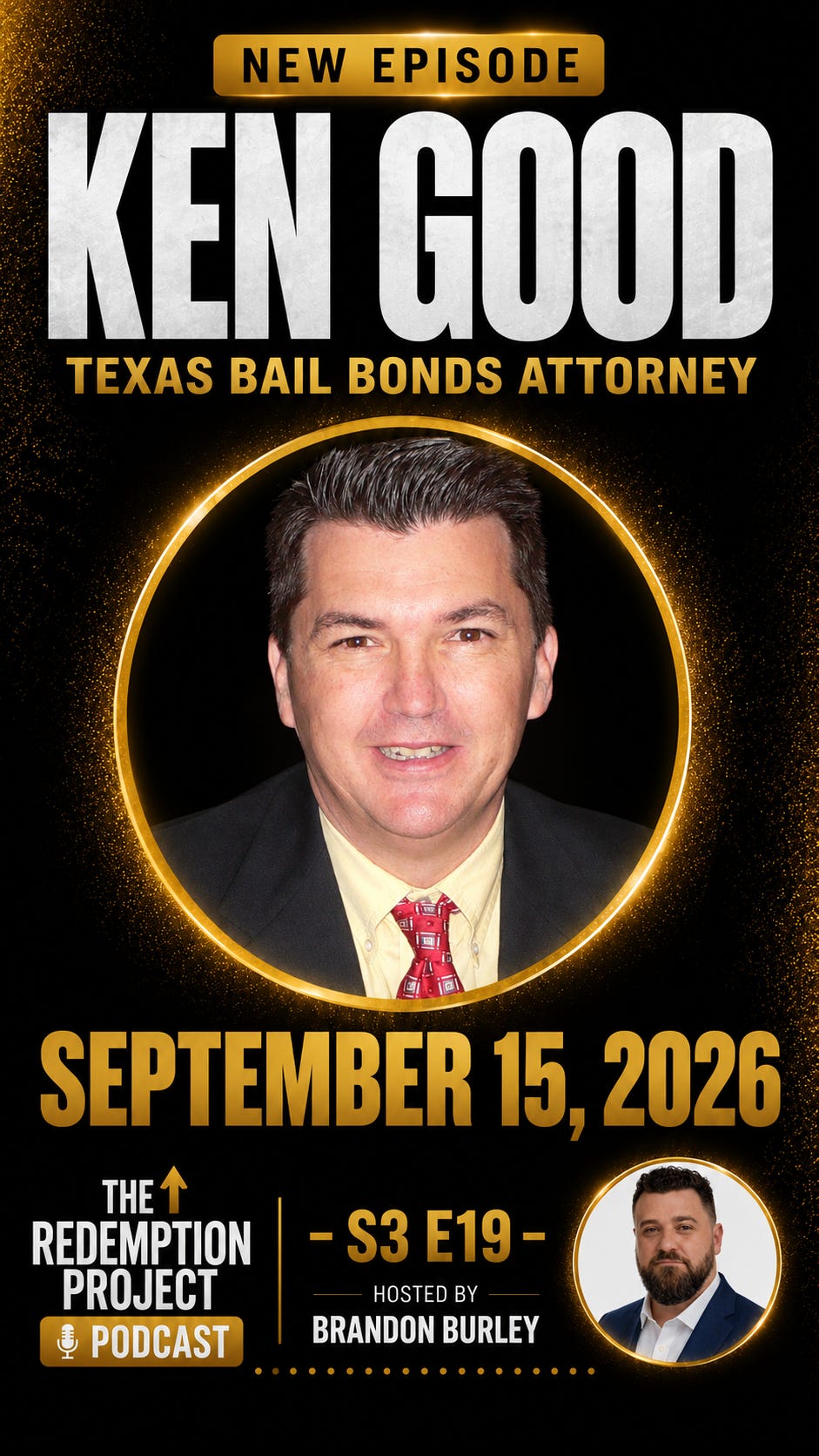
Bail is one of those words people hear all the time but often misunderstand.To some, bail is a way to keep dangerous people in jail.To others, it is a system that punishes poverty.To judges, bondsmen, defendants, victims, families and communities, it can mean something much more complicated.In this Season 3 Systems Explained episode of The Redemption Project, Brandon Burley talks with Ken Good, an attorney from Texas who has spent decades working in and around the bail system.Ken began his legal career representing doctors and hospitals, then developed a practice representing bondsmen and insurance companies across Texas. He has argued bail-related cases before the Texas Court of Criminal Appeals, the highest criminal court in Texas, and the Supreme Court of Texas. He has also written extensively on bail reform, criminal justice reform and what he believes works — and does not work — in the pretrial system.The conversation begins with a basic question:What is bail for?Ken’s answer is grounded in the traditional purpose of bail: making sure a defendant returns to court while the case is pending.That sounds simple.But the details are where the system gets complicated.Brandon and Ken discuss one of the central tensions in bail reform: whether people charged with similar crimes should be treated the same or whether judges should consider the individual facts of the person, the charge, the risk and the circumstances.Brandon raises the example of two people charged with theft.One person has a long criminal history.The other has no record and stole groceries to feed a family.Should they be treated the same?Ken’s answer is no.In fact, he pushes the point further. Even two first-time defendants charged with similar offenses may not present the same risk. One may have deep roots in the community, family nearby, stable housing and a job. Another may have no ties, no support and a much greater risk of failing to appear.That is the heart of the episode.Fair does not always mean identical.Ken argues that the justice system has historically relied on individualized discretion because people, cases and risks are different. The reform movement, in his view, often pushes toward treating people the same based on categories, charge lists or automated tools.But the criminal justice system does not deal with abstractions.It deals with people.And people are not identical.The conversation moves into cashless bail, which Ken describes more broadly as simple release — releasing someone on a promise to return, personal recognizance, zero bail or other similar mechanisms depending on the state.Ken is critical of these systems when they are used too broadly. He argues that simple release mechanisms often produce higher failure-to-appear rates than private surety bonds and can cause major problems for courts because cases cannot move forward until defendants return.Brandon compares that to Tennessee’s citation-release system, where a person signs a promise to appear in court. Ken explains that in Texas, citation release is used much less often and generally for low-level offenses.From there, the conversation turns to what happens when someone commits a new offense while already out on bond. Ken explains a new Texas law requiring that, when a person is out on bond and arrested again for a new felony in the same county, only the judge from the first case can set bail on the second case. He also says the statute requires judges to consider revoking or modifying the first bond.That part of the conversation shows why bail is not just a release question.It is a supervision question.It is a court-management question.It is a public-safety question.The episode then moves into ankle monitors.Ken does not argue that ankle monitors have no use at all. He says they can provide supplemental data and may have a role in high-risk cases.But he rejects the idea that ankle monitors are a replacement for the bail industry.His concern is practical. Monitors can generate false alerts, dead-battery notifications, exclusion-zone violations and other reports that desensitize the system. He also argues that defendants learn how to work around them, including cutting off a monitor late on a Friday to gain a head start before a warrant is issued.Ken also raises the cost issue. If someone is paying daily fees for an ankle monitor over a case that lasts years, that person may end up paying far more than they would have paid through a bondsman.That is an important Season 3 distinction.A tool can sound like reform.But the question is how it works in real life.Who pays?Who monitors?Who responds?How fast?What happens when the alert is false?What happens when it is real?What happens on Friday afternoon?What happens when the case lasts four years?The conversation then moves to the role of bondsmen.Ken argues that private surety bonds provide more than a financial transaction. He says bondsmen often provide reminders, supervision, family contact and a relationship that can help get someone back into court if they miss a date.Brandon raises the example of a family member putting something at risk to help a loved one get out. Ken explains that the details vary by state, but he agrees with the broader point: family involvement can matter.That is another theme running through the episode.Systems are not only statutes and software.They are relationships, incentives and accountability.The conversation then gets into one of the most debated ideas in pretrial justice: risk assessments.Ken is strongly critical of using risk assessments to replace judicial discretion in bail decisions. He argues that risk assessments may be better at predicting group trends than individual behavior, that they can produce racially distorted outcomes, and that they often make mistakes in the direction of recommending release.He also raises a key legal concern: if a risk assessment does not consider the seriousness of the pending charge, but state law requires judges to consider the charge when setting bail, then the tool may not comply with the legal framework.Brandon presses the point with a practical example:If someone has no criminal history but is accused of shooting multiple people, should a tool treat that person as low risk simply because it is a first offense?That question captures the problem.The presumption of innocence matters.But bail is not the trial.Ken emphasizes that presumption of innocence applies to the trial itself. Bail is about assurance — what it takes to ensure that a person returns to court and, depending on the jurisdiction, whether there are public-safety concerns while the case is pending.The episode also covers the political pendulum around criminal justice reform.Brandon uses the image of Newton’s cradle: when policy swings too hard in one direction, the reaction may swing just as hard the other way. Ken agrees and argues that public safety eventually becomes the demand when crime rises and the public believes the system is failing.That leads into Tennessee’s proposed constitutional amendment and the broader question of whether reform can swing too far toward release or too far toward detention.Ken’s position is that the middle ground should involve accountability, private surety bonds and sparing use of simple release mechanisms. He worries that one extreme releases too many people without accountability, while the opposite extreme may hold too many people and create costs the public is not prepared to pay.The conversation does not stay only on bail.It also moves into jail overcrowding, incarceration costs and mental health.Ken argues that part of the problem is that the United States has moved much of its mental-health burden into the criminal justice system. Brandon agrees from his experience in East Tennessee, where the closure of mental-health facilities meant law enforcement and jails became the default place for people who needed very different kinds of care.That may be one of the most important parts of the episode.The jail is not just holding people accused of crimes.In many communities, it is also functioning as the largest mental-health facility.That creates problems for defendants.It creates problems for officers.It creates problems for sheriffs.It creates problems for courts.And it creates problems for the people who needed treatment long before they ended up in a cell.Ken shares a personal example involving his sister, who suffered a severe injury and later dealt with a long struggle involving prescription drugs. He describes the importance of family involvement and says that, in his view, families often provide the best chance for success for people with serious mental-health or substance-related problems.But Brandon adds the necessary caveat:Not every family has the means, resources or ability to provide that level of care.That is the kind of tension this episode keeps returning to.The easy answer is usually too easy.Release everyone is too easy.Hold everyone is too easy.Trust a computer is too easy.Blame judges is too easy.Blame poverty is too easy.Blame crime alone is too easy.The real system is harder.It has defendants, victims, judges, bondsmen, families, mental illness, addiction, money, public safety, constitutional rights, political pressure and imperfect tools.Ken closes by pointing listeners to pbtx.com and thebailpost.com for more information about his group, their blog and their podcast.This episode is a reminder that criminal justice policy cannot be reduced to a bumper sticker.Bail is not only about money.Ankle monitors are not only about technology.Risk assessments are not only about data.And reform is not automatically good just because it is called reform.The better question is the Season 3 question:How does the system actually work — and what happens when we change one part without understanding the rest?I am a retired detective and criminal justice / government educator based in Tennessee. I founded The Redemption Project, as a place to foc
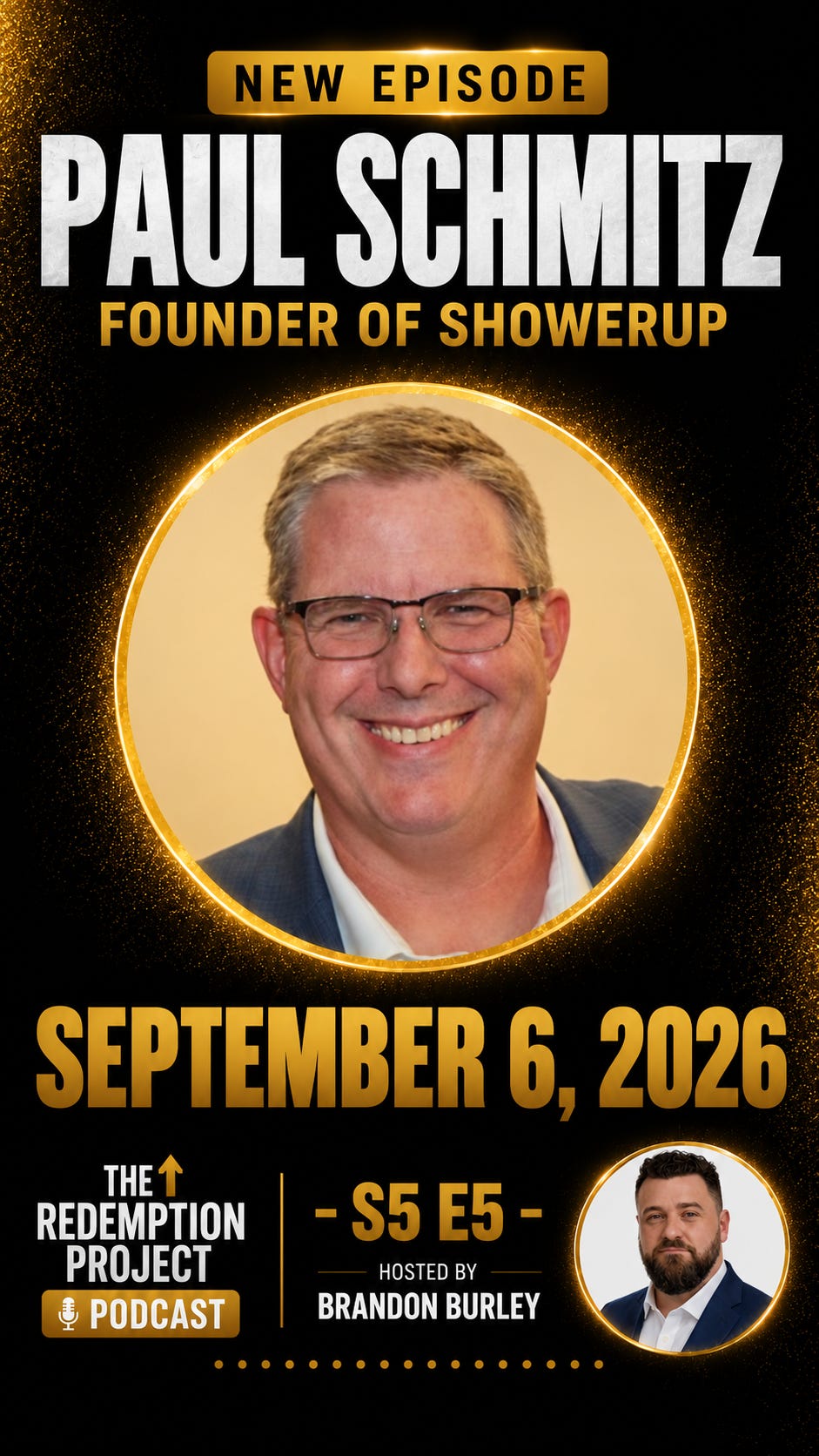
Get full access to The Redemption Project Newsroom at newsroom.theredemptionproject.news/subscribePaul Schmitz thought Christian radio would be his lifelong career.Then God took him on a left turn.In this Season 5 Good Works episode of The Redemption Project, Brandon Burley talks with Paul Schmitz, founder of ShowerUp, a ministry providing clean, private, hot mobile showers and laundry services for people experiencing homelessness.Paul shares how a simple act of serving meals grew into a national ministry, how a box truck became the first ShowerUp unit, why consistency builds trust on the street, and why the work is never really about soap and water.It is about dignity.It is about relationship.It is about helping people feel human again.
Get full access to The Redemption Project Newsroom at newsroom.theredemptionproject.news/subscribe

People hear the word lobbyist and often picture money changing hands, private dinners and powerful corporations attempting to buy political influence.That picture is not entirely invented. It is also far from complete.The better question is not simply whether lobbying is good or bad. It is: Who is attempting to influence public policy, whom do they represent, and what are they asking the government to do?In this Season 4 Civic Conversation, Brandon Burley speaks with Genevieve Turner, founder of Opal Advocacy, about what lobbyists actually do inside Tennessee’s legislative and government systems.Turner explains the difference between an in-house lobbyist representing one organization and a contract lobbyist working with several clients. Those clients may include corporations, nonprofits, community organizations, service providers or advocates seeking changes involving education, healthcare, corrections, disability services and other public-policy concerns.The conversation examines how lobbyists research legislation, follow committee hearings, monitor amendments, seek state appropriations and help clients communicate with legislators and government agencies. Lobbying may involve supporting a proposal, negotiating changes or attempting to stop legislation that a client believes would cause harm.Brandon and Genevieve also discuss ethics, conflicts of interest and transparency. Tennessee lobbyists must register with the state, and members of the public can search for lobbyists and the organizations employing them. That does not resolve every concern about political influence, but it gives citizens a place to begin examining who is involved.The episode also draws an important distinction between professional lobbying and citizen advocacy.A citizen may contact a legislator, testify before a committee or explain how a proposal affects their family or community. A lobbyist typically brings ongoing relationships, procedural knowledge and experience navigating the legislative process. One does not replace the other.Ultimately, this conversation is about how influence works before a bill becomes law—and why understanding that process helps citizens evaluate it more responsibly.I am a retired detective and criminal justice / government educator based in Tennessee. I am a commentary write for Tennessee Lookout and a weekly columnist with Knox TN Today. My work examines public policy, public safety systems and civic responsibility. My reporting and commentary have also appeared in Governing, The Arizona Capitol Times, South Florida Sun Sentinel, Police1, among other state and regional outlets. Get full access to The Redemption Project Newsroom at newsroom.theredemptionproject.news/subscribe

Comments

Download from Google Play

Download from App Store
 United States