DiscoverPest Control Marketing That Actually Works
Pest Control Marketing That Actually Works
Claim Ownership

Pest Control Marketing That Actually Works

Author: Cube Creative Design

Subscribed: 2Played: 3
Share

Description

Pest Control Marketing That Actually Works: The Growth Podcast

Stop wasting money on marketing that doesn't deliver. Pest Control Marketing That Actually Works is the weekly podcast for pest control business owners who want real results, not empty promises.

Hosted by Adam Bennett and Elisabeth Pallante from Cube Creative Design, each 20-minute episode delivers practical strategies you can implement right away. No fluff. No theory. Just proven tactics from a team that's spent 20 years helping pest control companies grow.

What You'll Learn:

Every episode tackles a specific marketing challenge pest control operators face. From building a website that converts visitors into customers, to running Google Ads that actually pay off, to creating content that ranks on page one. You'll hear what works, what doesn't, and exactly how to tell the difference.

We cover topics like:

  • Getting more leads from your website without spending more on ads
  • Building a review strategy that brings in new customers on autopilot
  • Creating content that ranks for searches in your service area
  • Running paid ads that generate profit, not just clicks
  • Using email and automation to turn one-time customers into recurring revenue
  • Hiring marketing help without getting burned

Who This Podcast Is For:

If you run a pest control company with 2-15 trucks and revenue between $250K and $5M, this show was built for you. Whether you handle your own marketing or manage a small team, you'll get strategies sized right for your business.

Episodes are designed for busy operators. Listen on a drive between service calls and walk away with three clear takeaways you can use that week.

About Your Hosts:

Adam Bennett is CEO of Cube Creative Design, a digital marketing agency founded in 2005. He's helped dozens of pest control companies build marketing systems that deliver consistent growth.

Elisabeth Pallante is Content Operations Manager at Cube Creative. She leads the content and SEO strategy that has helped clients increase web traffic by 154% year-over-year.

They're joined regularly by Chad Treadway, Chief Marketing Officer, along with social media specialist Hannah Kilpatrick and web project specialist Emily Porter.

What Makes This Show Different:

We don't sell ads or sponsorships on this podcast. Every minute is focused on giving you value. We share the same strategies we use with paying clients because we believe in leading with generosity.

At the end of each episode, we offer a free marketing audit at marketingthatactuallyworks.ai. No obligation, no pressure. Just a clear look at what's working in your current marketing and what's costing you money.

New Episodes Every Tuesday

Subscribe on Apple Podcasts, Spotify, or wherever you listen. Leave a review if the show helps you. It's the best way to help other pest control operators find us.

Ready to stop guessing and start growing? Hit subscribe and join us next Tuesday.


Pest Control Marketing That Actually Works is produced by Cube Creative Design, a HubSpot Gold Partner agency based in Western North Carolina. Learn more at marketingthatactuallyworks.ai
42 Episodes
Reverse
Year-End Marketing Push: Your Q4 Strategy | Episode 43Most pest control owners treat Q4 like the off-season. Trucks slow down, marketing goes quiet, and everybody waits for spring. Then they pay for it in March.In this episode, Adam Bennett, Elisabeth Pallante, and Chad Treadway of Cube Creative Design lay out the Harvest, Hold, Plant Plan, three jobs that make Q4 pay off now and set up spring.Harvest: The cheapest lead you'll get all year is someone already in your software. The hosts cover seasonal reactivation emails, winter upsells like rodent exclusion, and fixing review recency before January. Chad makes the case for selling full-year prepaid plans in the fall, and he and Elisabeth disagree on whether to discount them.Hold: For one Cube pest client, Q4 Google Business Profile calls ran at about 60% of spring. That's a slower season, not a dead one. Learn what a Hold Floor is, why to set it before December, and the debate over whether floor money belongs in paid search or owned content.Plant: Spring marketing starts in January, so the content has to exist by December. Find out what to build now: spring pest pages, city pages, and a January campaign that sends itself.The episode ends with a working session. Sketch your own 90-day sprint in three lines, then grade it in February on booked jobs.Key takeaways:Harvest first. Your cheapest Q4 lead is a customer who already paid you once.Pick your Hold Floor and stick to it. Going dark costs more than staying on.Plant now. What you finish in December rings the phone in April.One Thing to Fix This Week: Export every customer who didn't renew in the last 12 months and send one short seasonal email.Get your free pest control marketing audit at marketingthatactuallyworks.ai, and see how your site looks to AI search with a free Cube Score at thecubescore.com.Next Tuesday: Marketing During Economic Uncertainty.
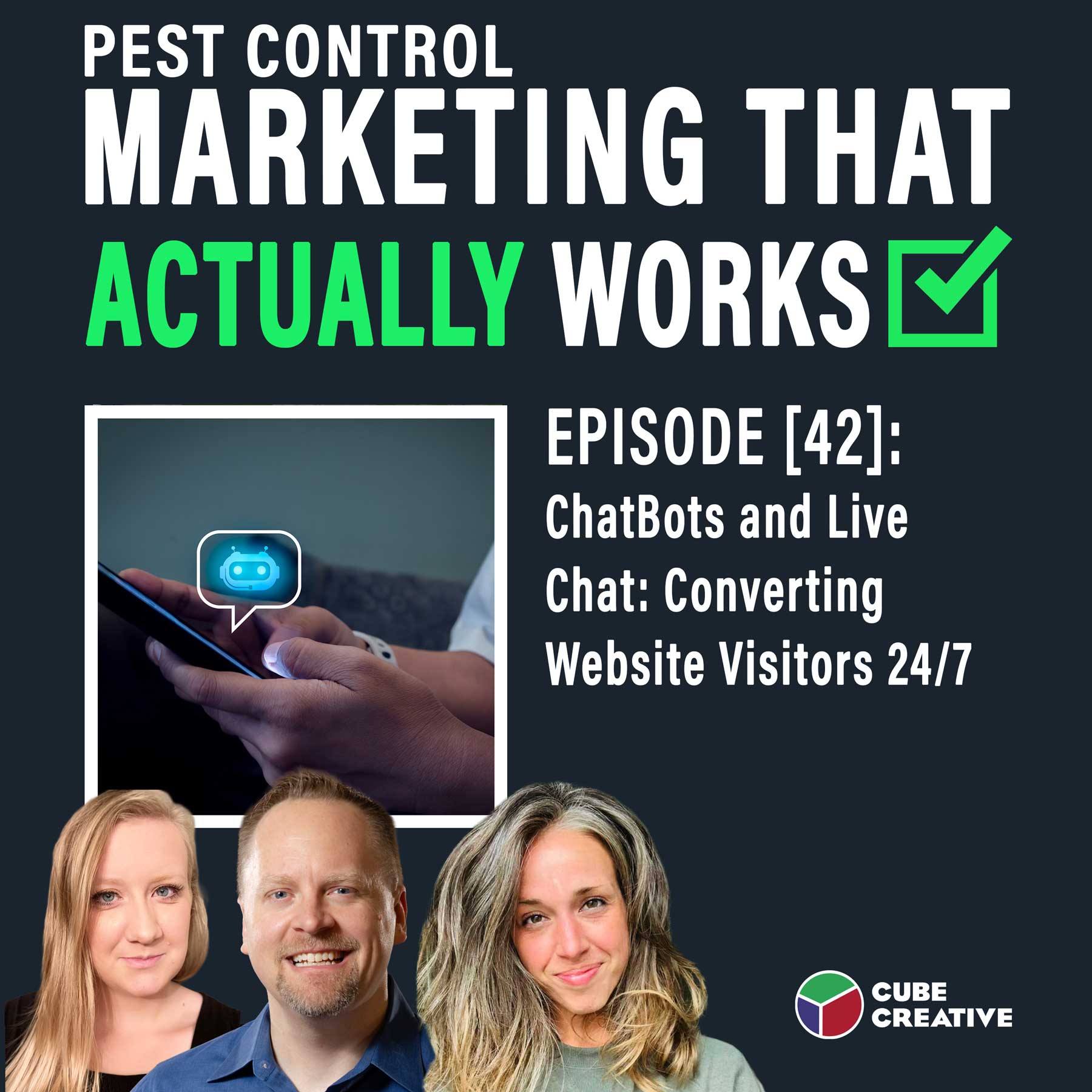
Most pest control owners think they have a lead problem. They have an answering problem.One of our pest control clients took more than 500 calls last quarter. Miss just one in four, and that's about $4,000 a month going to the next company on Google. In this episode, Adam Bennett and Elisabeth Pallante are joined by Emily Porter, Cube Creative's web project specialist, to talk about how website chat catches the leads your phone drops, and how to set it up so it doesn't create new problems.In this episode:Missed-Call Math. Adam walks through the numbers using real call volume from one of our clients, and the team compares blind guesses on how many calls a typical pest company misses.The Three-Question Bot. Emily explains why "How can I help you?" is the worst way to open a chat, and lays out the three questions to ask instead: what's bugging you, where's the property, and what's the best number to reach you. The team also debates whether a bot should ever share pricing.When the Bot Makes Stuff Up. The Air Canada chatbot ruling, why your bot speaks for you, and the Handoff Rule: your bot never quotes a treatment, promises a guarantee, or answers a safety question.The After-Hours Handoff. What to do when a chat lead comes in at 9 p.m., how to route chat leads by service, and why you should track chat as its own lead source.One Thing to Fix This Week: Count last month's missed calls, multiply by your average first job, and write that number on a sticky note by the phone. That's what your chat is competing for.Free download: The Three-Question Bot Setup Sheet, with a Missed-Call Math worksheet, a chat script template, a pre-launch test checklist, and an after-hours handoff plan.Get your free pest control marketing audit at marketingthatactuallyworks.ai. See how your site reads to AI search with a free Cube Score at thecubescore.com.New episodes every Tuesday. Next week: Year-End Marketing Push, our Q4 strategy episode.Pest Control Marketing That Actually Works is produced by Cube Creative Design.
Here's what nobody tells you about marketing calendars: the plan is almost never the problem. Pest control companies build great calendars in January. By March, most of them are dead, because the busiest week for marketing is also the busiest week on the trucks.In Episode 41 of Pest Control Marketing That Actually Works, Adam Bennett and Elisabeth Pallante of Cube Creative Design break down why marketing calendars fail. They explain how to build one small enough to survive peak season.Your three key takeaways:Calendars die from execution, not ideas. They're too big to survive a bad week, and nobody's name is on the tasks. "The office will post more" isn't a plan. "Sarah posts on Tuesdays" is.The smallest calendar that still grows you has three beats. Weekly is a Google Business Profile post plus review asks. Monthly is one real content piece. Quarterly is a seasonal email to your customers.When you fall behind, skip, don't double up. Miss a week, drop it, and hit the next one. The streak matters more than the score.In this episode:The timing trap that kills plans built in the slow seasonWhy owned content dies without a calendar while paid ads keep runningWhy pausing Google Ads can raise your cost per lead 30 to 50% on restartWhere to find content ideas: Google's related questions, your office, and your techsWhether the owner should own any marketing taskWhy every calendar needs at least two names, even at a two-truck shopHow far ahead to plan, and why real tasks only go 90 days outOne Thing to Fix This Week: Pick your weekly beat. One task, one person's name, one day of the week. Put it on that person's calendar as a recurring 15-minute event.Get your free pest control marketing audit: marketingthatactuallyworks.aiSee how your site looks to AI search with your free Cube Score: thecubescore.comNext Tuesday: Chatbots and Live Chat: Converting Website Visitors 24/7, with Emily Porter.New episodes every Tuesday. Follow on Apple Podcasts or Spotify.
How many leads does it take to land one customer? Adam and Elisabeth say that's the wrong question. The number that matters is how many leads you're losing after the phone already rang.In our second Listener Q&A, we answer five real questions from pest control owners. We cover lead leaks and close rates, why review recency matters as much as review count, how long SEO really takes, what happens to your rankings when you move your office, and what to add first when your business runs on referrals.Three Key TakeawaysIt's a leak problem, not a lead volume problem. Your real close rate, booked jobs divided by leads, tells you more than any lead count.SEO is a 6 to 12 month channel, and that's the argument for starting now. Waiting until you're bigger just starts the clock a year late.When referrals stall, add something you own before something you rent: a site that converts, a complete Google Business Profile, and a real way to ask for reviews.What We CoverThree to five cold leads per customer, and why most shops lose leads after the phone ringsHow starting prices on your site filter out tire kickersNurture sequences for leads who don't book right awayWhy a stalled review count hurts, even with hundreds of reviewsTexting review requests: about a 98% open rate vs. about 20% for emailWhy "wait until $1M to do SEO" is expensive adviceSEO fast wins that move in weeksMoving your office: proximity, re-verification, NAP consistency, and duplicate profilesWhy referred customers still Google you before they callOne Thing to Fix This WeekPull last month's leads and last month's booked jobs. Divide booked jobs by leads. That's your real close rate. If you can't get the numbers in 15 minutes, add a lead source field to your job software.ResourcesFree pest control marketing audit: marketingthatactuallyworks.aiFree Cube Score, see how your site looks to AI search: thecubescore.comThe Leak Check Worksheet (Episode 40 download)20-Point Pest Control Marketing ChecklistRelated EpisodesEpisode 8: Word-of-Mouth Marketing Isn't Enough AnymoreEpisode 16: The Customer Review System That Generates 20 Reviews a MonthEpisode 24: Local SEO Beyond Google Business ProfileEpisode 32: Listener Q&A Part 1Next Tuesday: Creating a Marketing Calendar That Actually Gets ExecutedSubscribe on Apple Podcasts or Spotify so new episodes show up on their own.
Most pest control companies close one sale and move on to chasing the next lead. Meanwhile, the customer they just served is five to seven times cheaper to sell to again than a stranger.In this episode, Adam, Elisabeth, and Chad break down the math behind revenue per customer and show you exactly how to grow it.Three key takeaways:Your existing customers convert at 60-70% on a second offer, compared to 5-20% for new prospects. Most operators never make the ask.Timing is everything. Pushing add-ons at sign-up converts at 5-8%. Offering them four weeks in, after the customer has seen results, converts at 25-40%.Three services, one system. Mosquito programs, termite monitoring, and wildlife exclusion are the highest-margin cross-sells, and a simple tech recommendation at the right moment is all it takes.You will also hear the "Service Stack" framework for packaging your services into tiers that move customers up, the CRM triggers that automate upsell timing, and why a $500-per-year customer should be an $900-per-year customer with no extra marketing spend.Hosts: Adam Bennett, Elisabeth Pallante, and Chad Treadway from Cube Creative Design.Get your free pest control marketing audit at marketingthatactuallyworks.aiScore your website at thecubescore.com
loading
Comments