DiscoverBuild. Grow. Repeat.
Build. Grow. Repeat.
Claim Ownership

Build. Grow. Repeat.

Author: Ben Sufiani

Subscribed: 4Played: 103
Share

Description

Build. Grow. Repeat. is the podcast for skilled professionals and early-stage founders who want to build a real product and grow predictable revenue — without hustle culture, or “get rich quick” fantasies.

This show helps you close the gap between building a product with vibe coding and growing with growth marketing by treating them as one craft. Every episode is designed to give you something you can actually use: a clearer decision, a tighter customer journey, a better experiment, or a concrete next step you can run this week.

What you’ll learn here:

  • Build faster (without needing to know how to code): vibe code real software and offers quickly — and validate what matters before you over-invest.
  • Grow calmly and predictably: positioning, funnels, pricing, and experiments that turn attention into revenue without persuasion theater.
  • Run on signals, not just vibes: activation, retention, and product–market-fit indicators that tell you what to double down on — and what to stop.
  • Use AI as leverage: vibe coding and AI-native workflows that speed you up while keeping human judgment in charge.
  • Commit without gambling: how to choose one direction and test it through small, reversible bets that produce proof.

You’ll get a mix of solo deep dives, builder interviews, and occasional teardowns of customer journeys and decisions that looked “logical” on paper — but fail in real life.

About the host: I’m Ben Sufiani, founder of Pirate Skills. I’ve been building and growing products for over 15 years across startups, consulting, and hands-on growth work. Pirate Skills exists to help builders turn ideas into evidence — by shipping, learning, and repeating the loop until something holds. If you want to go deeper, check out Pirate Skills at pirateskills.com.

Build. Grow. Repeat.

Cheers,

Ben

42 Episodes
Reverse
I come from marketing and have never been a developer. Jens Dressler has written software for more than 20 years – semiconductor test equipment, then CTO of the event app Vamos, then CTO at Fanmiles after it bought Vamos. We both spent years trying to build for and sell to developers, and we both ended up somewhere else: helping people who don't code get AI to build real things for them.Jens tells what selling to CTOs was really like – "I want more control" – and what changed when he started talking to people without a development background: "It was not about the stack. … It was really about, I want to achieve this. Can you help me?" We talk about the hard parts non-developers never see coming (data privacy, auditability, race conditions, the happy path), why he thinks no-code was too restrictive, how Turbofy hides the lower layers so you only think about your business logic, and where a chat builder stops and Claude Code or Codex takes over.WHO THIS IS FORA founder or marketer without a developer background who wants to build real softwareAnyone stuck between a no-code tool and a developer quoteA technical founder who keeps getting asked "can you build my idea?"A builder deciding between a chat builder and Claude CodeIN THIS EPISODE00:00:00 – Two sides, one problem00:01:06 – From chip-test software to Berlin startups00:02:26 – Why selling to developers is so hard00:04:31 – Great ideas, 500-euro budgets00:06:23 – My side: the CTO who said "almost ready"00:08:23 – A crash at lunch, and why developers overbuild00:10:18 – Velocity of value: frame it as an experiment00:13:55 – Straight into Claude Code – every bucket at once00:15:11 – What non-developers miss: privacy, auditability, race conditions00:21:53 – How Turbofy hides the lower layers00:23:15 – Developers move up: raising the floor and the ceiling00:26:47 – Why code, not no-code00:27:52 – The December moment: 95% of the code with AI00:31:20 – A Turbofy app in three prompts00:33:05 – Where chat builders stop and Claude Code takes over00:39:14 – What to build this week00:41:17 – Where to find JensDEEP DIVE LINKS🚀 Turbofy: https://turbofy.com📚 Turbofy docs: https://docs.turbofy.com💬 Jens on LinkedIn: https://www.linkedin.com/in/jensdressler/🗓️ All upcoming events: https://pirateskills.com/events🎧 Spotify: https://open.spotify.com/show/7kFl0BJiOYih8yqQTRR9SN🍎 Apple Podcasts: https://podcasts.apple.com/us/podcast/build-grow-repeat/id1870561487💬 Connect with me on LinkedIn: https://www.linkedin.com/in/bensufiani/
At a Product Night in Cologne, people tried my app Zawq and left five post-its of feedback. Feedback is a gift and a trap: there is a gap between what you want to build and what a new user wants.In this episode I sort the notes, pick one and build it live with Claude Code: letting users choose the AI model that writes their content. You'll hear how I decide which feedback to follow, and how I apply the same filter to my agent – it looks around the code first, asks me questions, and I go my own way on most of its recommendations. Then it builds, tests itself on iPhone and iPad, and hands me a test guide.This is a real build, not a demo. My part of the two hours was about ten minutes.WHO THIS IS FORA founder who gets more feature requests than they can buildA vibe coder without a developer background who wants to see a real sessionAnyone building an AI product who is wondering whether to let users pick the modelA builder who wants to listen to users without giving up their product tasteIN THIS EPISODE00:00:00 – Five post-its from one Product Night00:03:37 – The one I picked: model choice00:04:52 – Your taste is the filter00:06:52 – Sort it before you build it00:08:27 – Briefing the feature in Claude Code00:14:31 – Use the same filter on your agent00:28:07 – Linear, and letting it grind00:29:36 – Let the agent prove it first00:35:40 – The test guide – my turn to click00:44:01 – Two hours of agent work, ten minutes of mine00:46:22 – Upcoming events and the Pirate ForgeDEEP DIVE LINKS📖 Full Article + the five steps: https://pirateskills.com/insights/feedback-to-feature🧭 AI Compass – 28 October: https://pirateskills.com/aicompass/2026-10-28🏴‍☠️ Vibe Coding Cologne – 4 November: https://pirateskills.com/events/vibe-coding-cologne/2026-11-04🛠️ Vibe Hackathon Cologne – 20 November: https://pirateskills.com/events/vibe-hackathon-cologne/2026-11-20⚓ Pirate Forge: https://pirateskills.com/pirate/forge🎧 Spotify: https://open.spotify.com/show/7kFl0BJiOYih8yqQTRR9SN🍎 Apple Podcasts: https://podcasts.apple.com/us/podcast/build-grow-repeat/id1870561487🗓️ All upcoming events: https://pirateskills.com/events💬 Connect with me on LinkedIn: https://www.linkedin.com/in/bensufiani/
Your agent can build almost anything now. So why did my projects still move in bursts?Because the agents were never the slow part. I was. With several projects and a full calendar, a project only moved when I sat down with it – and sometimes that meant a whole week without progress. In this episode I show what changed it: one roadmap per project. Two jobs stay with me: deciding what gets built next, and reviewing it before a customer sees it. Everything in between is the agent's.You'll see it in practice: one idea for Customer Magic that became a roadmap item, a brief the agent wrote itself after talking to my compliance session, and a finished trust page I only had to review. Then why the deciding stays human, what a roadmap holds in four stages, and three places to keep it – an artifact in Claude Code, a page in your codebase, or a tool like Linear.This is not theory. I run four projects this way and check in about twice a day.WHO THIS IS FORA founder with several projects where one always waitsA vibe coder whose agent builds fast, in no clear directionAnyone who starts every session by explaining again what comes nextA small team that wants steady progress without a project managerIN THIS EPISODE00:00:00 – Your agent needs a roadmap from you00:00:36 – The bottleneck is you00:01:38 – Two jobs stay with you00:02:04 – One idea, from message to finished page00:05:07 – Why deciding stays human00:06:58 – What a roadmap holds00:07:51 – Three places to keep it00:11:17 – Deciding what's next, twice a day00:13:31 – Give your agent a roadmap00:14:48 – Upcoming events and the Pirate ForgeDEEP DIVE LINKS📖 Full Article + the starter prompt: https://pirateskills.com/insights/agent-roadmap🧪 Pirate Lab – 21 October: https://pirateskills.com/pirate/lab/2026-10-21🧭 AI Compass – 28 October: https://pirateskills.com/aicompass/2026-10-28🏴‍☠️ Vibe Coding Cologne – 4 November: https://pirateskills.com/events/vibe-coding-cologne/2026-11-04🛠️ Vibe Hackathon Cologne – 20 November: https://pirateskills.com/events/vibe-hackathon-cologne/2026-11-20⚓ Pirate Forge: https://pirateskills.com/pirate/forge🎧 Spotify: https://open.spotify.com/show/7kFl0BJiOYih8yqQTRR9SN🍎 Apple Podcasts: https://podcasts.apple.com/us/podcast/build-grow-repeat/id1870561487🗓️ All upcoming events: https://pirateskills.com/events💬 Connect with me on LinkedIn: https://www.linkedin.com/in/bensufiani/
What if a full-time designer was never out of reach for a small team – you just didn't have the process yet?Two weeks ago, screen designs looked dead to me: the old Figma chain where a product manager briefs a designer who briefs a developer. Then one weekend on a design canvas changed that. Nine hours, 77 messages and 79 versions later there was a brand for Zawq, my new project – and not one line of product code. The agent serves the buffet, you are the curator.You'll see the whole canvas: the first six website directions that all sucked, the gardening idea that stuck, the low-poly 3D scene built with Three.js, and the landing page at draft nine. Then the logo that could never have been briefed – from generic wordmarks to an app-icon bonsai in the Moyogi shape, and why the 2D version only worked after going 3D first. And what gets decided before any code exists: colors, dark mode, accessibility checks, a component library and a few app screens.This is not done. The real app isn't built, and the 3D scene still has to run on an average phone. My own design level is a solid six out of ten – so find a friend with real design chops and let them tell you what's still weak.This is not theory. The new homepage went live today: https://zawq.aiWHO THIS IS FORA founder who ships straight into code and ends up with a generic-looking productA vibe coder who has never run a design round before buildingA small team that can't afford a designer or an agency back-and-forthAnyone starting a new product who wants a real brand from day oneIN THIS EPISODE00:00:00 – The design process I got addicted to00:01:43 – Screen designs are back00:04:17 – One weekend, one canvas00:08:57 – Nine hours, 77 messages, 79 versions00:10:46 – How a design round works00:12:30 – The logo I couldn't have briefed00:17:45 – Decide it before it's code00:20:58 – What's not built yet00:22:05 – Your vibe design weekend00:25:06 – Upcoming events and the Pirate ForgeDEEP DIVE LINKS📖 Full Article + the starter prompt: https://pirateskills.com/insights/vibe-design-process🏴‍☠️ Vibe Coding Cologne – 7 October: https://pirateskills.com/events/vibe-coding-cologne/2026-10-07🧪 Pirate Lab – 21 October: https://pirateskills.com/pirate/lab/2026-10-21🧭 AI Compass – 28 October: https://pirateskills.com/aicompass/2026-10-28🛠️ Vibe Hackathon Cologne – 20 November: https://pirateskills.com/events/vibe-hackathon-cologne/2026-11-20⚓ Pirate Forge: https://pirateskills.com/pirate/forge🎧 Spotify: https://open.spotify.com/show/7kFl0BJiOYih8yqQTRR9SN🍎 Apple Podcasts: https://podcasts.apple.com/us/podcast/build-grow-repeat/id1870561487🗓️ All upcoming events: https://pirateskills.com/events💬 Connect with me on LinkedIn: https://www.linkedin.com/in/bensufiani/
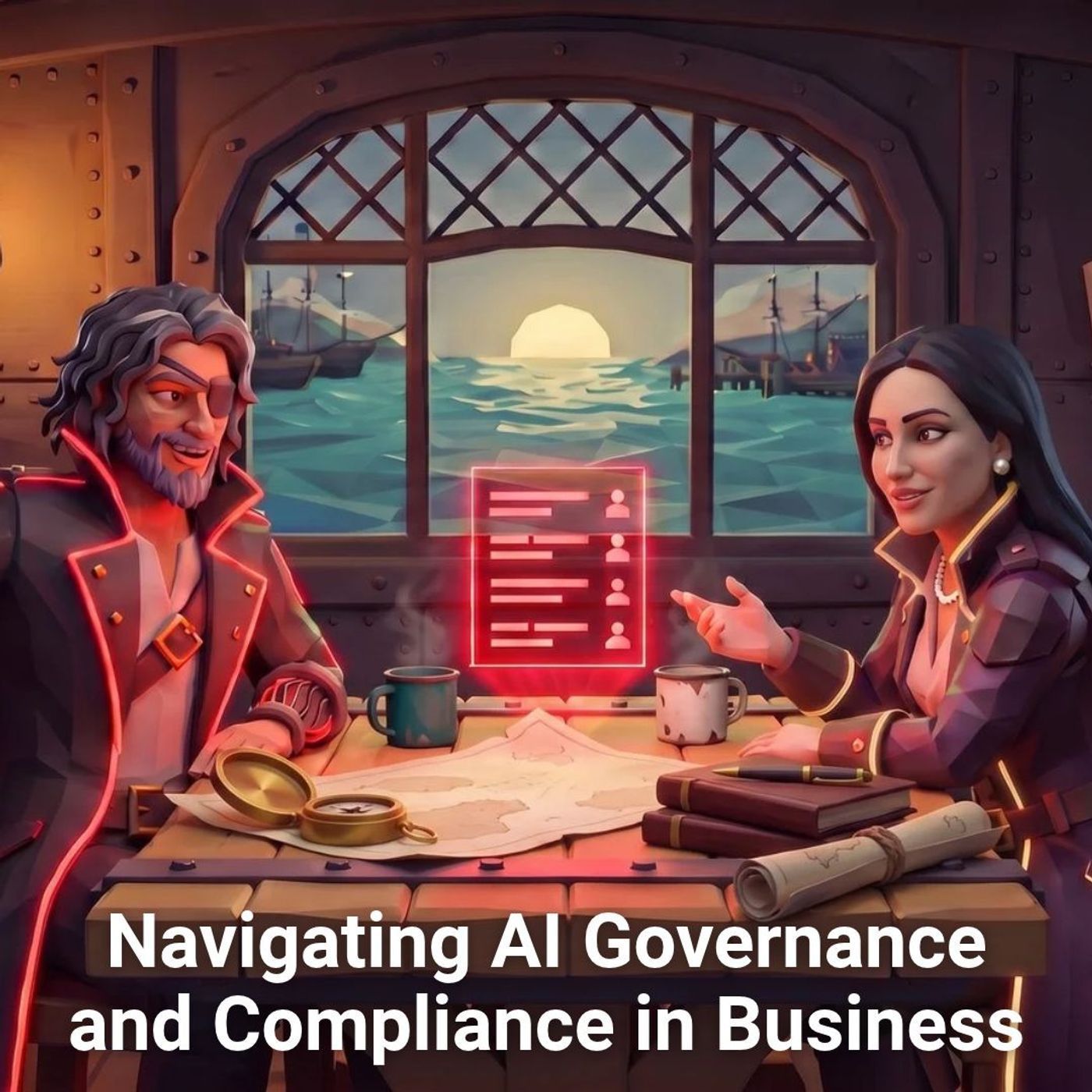
In many companies, nobody can name the person responsible for their AI. So the answer defaults to "no".Nur Aslan founded IADM, the International Academy for Digitalization and Management – a CPD-accredited academy that trains Certified AI Officers. She came to AI governance from HR: for her doctorate she surveyed 397 HR professionals across Europe and kept finding the same gap between AI adoption and AI readiness.In this episode we pick up where the conversation with Dr. Alexa Scheffler ended. Alexa answered "can we use AI for this?". Nur answers the people side: who is responsible, and how do they need to be trained?We talk about why big companies say no to AI for months – in one case, a year and a half – why governance should be an enabler and not a brake, and why a small team doesn't need to hire an AI officer. By the end of the episode, I'm the AI officer at Pirate Skills.Nur's Monday list for a new AI officer: list your AI tools, classify them by risk, name who is responsible for anything high risk, and get technical help where it gets technical.IN THIS EPISODE00:00 Welcome – a compliance academy incorporated in England02:50 The gap between AI adoption and AI readiness06:31 Governance vs compliance – what's the difference?08:18 Why big companies say no to AI11:03 Does a small company need an AI officer?17:02 Training your team: risk classes and the AI inventory18:29 Building the academy: from live Zoom to AI avatars24:28 Is there a Claude skill for the EU AI Act?27:02 The Monday list for a new AI officer32:02 Why Europe needs to move faster34:50 See you at Vibe Coding CologneDEEP DIVE LINKS– The companion article: https://pirateskills.com/insights/navigating-ai-governance– Part one, with Dr. Alexa Scheffler: https://pirateskills.com/insights/navigating-ai-compliance– Pirate Forge – Build phase starts this Wednesday, 30 Sep: https://pirateskills.com/pirate/forge/q4-26– Meet Nur live at Vibe Coding Cologne, 7 Oct: https://pirateskills.com/events/vibe-coding-cologne/2026-10-07– Connect with Nur: https://www.linkedin.com/in/nurgul-aslan-70600833b/– Connect with Ben: https://www.linkedin.com/in/bensufiani/
loading
Comments