


Distillations | Science History Institute
Subscribed: 1,350Played: 25,846
Subscribe


© Creative Commons Attribution-ShareAlike
Description
Distillations is the Science History Institute's critically acclaimed flagship podcast. We take deep dives into stories that range from the serious to the eccentric, all to help listeners better understand the surprising science that is all around us. Hear about everything from the crisis in Alzheimer's research to New England's 19th-century vampire panic in compelling, sometimes-funny, documentary-style audio stories.
364 Episodes
Reverse

Cigarettes: they provide no nutrition and quench no thirst. They serve no purpose other than being an excuse to take a break from the grind, before getting right back to it. And on top of that, they're deadly. As far as American vices go, they might be at the top of the list. So how did they get and stay popular for so long? And why are they making a comeback? This two-part episode dives into the rise of this quintessential American product, the science that proved it was dangerous, and the eventual reckoning that came from a mysterious box of documents—one delivered with the return address of an iconic cartoon character. Along the way, we'll uncover what has driven so many Americans to risk their lives to light up—despite what the science has told us. Credits Host: Alexis Pedrick Executive Producer: Mariel Carr Senior Producer: Rigoberto Hernandez Sound Design: Seth Samuel Fact-Checking: Alexandra Atiya Music by Blue Dot Sessions.
Check out our new season, dropping weekly on Tuesdays, starting September 15th.

Alexis Pedrick joins Sam Jones and Deboki Chakravarti to bring you an episode from Tiny Matters, an award-winning podcast from the American Chemical Society produced by Multitude. The episode, which originally aired in February 2026, explores the surprising origins and evolution of one of modern medicine's most important tools: the clinical trial. Tiny Matters follows the development of experimental design across centuries to modern-day randomized control trials and the debates about their limitations, trying to answer the question, "How do we know whether a treatment truly works?" Credits Host: Alexis Pedrick Executive Producer: Mariel Carr Senior Producer: Rigoberto Hernandez Resource List Placebo Controls, Exorcisms and the Devil The Eight Wars of Religion (1562–1598) The Emergence of the Randomized, Controlled Trial The Emergence of the Randomized Controlled Trial: Origins to 1980 Streptomycin Treatment of Pulmonary Tuberculosis Estimated Costs of Pivotal Trials for Novel Therapeutic Agents Approved by the US Food and Drug Administration, 2015-2016 Conservative Treatment of Acute Appendicitis: An Overview Most Patients with Appendicitis Can Have Antibiotics as Their First Treatment, Rather than Appendectomy Assessing the Gold Standard—Lessons from the History of RCTs

This episode is a co-production with Lost Women of Science. Agnes Pockels did pioneering work in surface science. Her invention, the Pockels Trough, became the basis for an instrument that helped Katherine Burr Blodgett and Irving Langmuir make discoveries in material science that quietly shape our everyday world. But the way we talk about Agnes's life and work often falls back on familiar tropes about women's domestic roles, assumptions about how science gets done, and what it looked like to do science as a woman in the 19th century. Agnes's story invites us to rethink how we define success for scientists. Is our definition too narrow? And what might we gain if we crack it open a bit wider? Credits Host: Alexis PedrickExecutive Producer: Mariel CarrProducer: Rigoberto Hernandez Additional Reporting: Sophia Levin Art Design: Lily Whear Fact-Checking: Alexandria Attia Sound Design: Ana Tuirán Guests Brigitte Van Tiggelen Brigitte Van Tiggelen is the Science History Institute's director of international affairs, working from the Institute's office in Paris. Trained as both a physicist and a historian, she is the coeditor of Women in Their Element: Selected Women's Contributions to the Periodic System (2019), a volume that brings together more than two decades of research and publication of the life and work of women in science. Donald L. Opitz Donald L. Opitz is a historian of science who teaches in the School of Continuing and Professional Studies and Department of History at DePaul University. He is writing a book that traces the international movement for the advancement of women in agriculture and horticulture from the mid-19th to mid-20th centuries. Petra Mishnik Petra Mischnick was a professor of food chemistry at Technische Universität Braunschweig, Germany. There she founded and ran the Agnes Pockels Student Lab to inspire young children, especially girls, to pursue science. Resource List Kohlstedt, Sally Gregory and Opitz, Don. "Agnes Pockels - Surface Chemist and 'Hausfrau'," The Changing Image of the Sciences. 2002. Pockels, Agnes. "On the Relative Contamination of the Water-Surface by Equal Quantities of Different Substances." Nature, 1892. Sella, Andrea. "Pockels' Trough." Chemistry World, 2015. Tiggelen, Brigitte Van. "Fräulein Agnes Pockels: The Shaping of a 'Forschende Hausfrau'," paper presented at the 24th International Congress of History of Science, Technology, and Medicine. Bergwik, Staffan; Opitz, Donald L.; Tiggelen, Brigitte Van. Domesticity in the Making of Modern Science. 2016. A full transcript is available on our website.
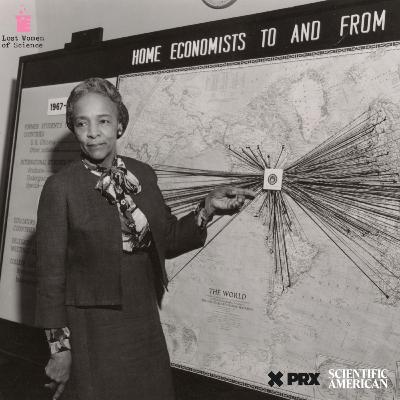
Alexis Pedrick joins Katie Hafner to bring you an episode from The Lost Women of Science Initiative, a non-profit educational organization dedicated to telling the forgotten or untold stories of remarkable female scientists and their groundbreaking work through history. The episode, which originally aired in October 2023, is about Flemmie Kittrell, the first Black woman to earn a PhD in Home Economics. In the early 1960s, Flemmie decided to see what would happen if you gave poor kids a boost early in life, in the form of a really great preschool. Every day for two years, parents would get free childcare, and their kids would get comprehensive care for body and mind—with plenty of nutritious food, fun activities, and hugs. What kind of difference would that make? And would it matter later on? Credits Host: Alexis Pedrick Executive Producer: Mariel Carr Producer: Rigoberto Hernandez Associate Producer: Sarah Kaplan Music by Blue Dot Sessions Resource List Flemmie Kittrell audio interviews, Black Women Oral History Project Interviews, 1976–1981, the Harvard Radcliffe Institute's Schlesinger Library Institute Kittrell, Flemmie, "The Negro Family as a Health Agency," The Journal of Negro Education, Vol. 18, No. 3, The Health Status and Health, 1949 Baure, Lauren, "Does Head Start Work?," The Brookings Institution, 2019 Horrocks, Allison, Good Will Ambassador with a Cookbook: Flemmie Kittrell and the International Politics of Home Economics, University of Connecticut, 2016 First report on Howard Preschool Experiment: Prelude to School: An Evaluation of an Inner-City Preschool Program, Children's Bureau (DREW), Washington, D.C. Social and Rehabilitation Service, 1968 Talbot, Margaret, " Did Home Economics Empower Women?," The New Yorker, 2021 Zigler, Edward, and Muenchow, Susan, Head Start: The Inside Story Of America's Most Successful Education Experiment, 1994.

Comments

Download from Google Play

Download from App Store
 United States