


 Claim Ownership
ADAPT Insider
Subscribed: 0Played: 0
Subscribe

© ADAPT
Description
This is ADAPT Insider. Proudly A/NZ first. For more than 15 years, ADAPT has empowered Australia and New Zealand’s executive community with trusted data, insights, and connections so leaders can make better decisions with confidence. Because this region is different. Our markets are unique. And the challenges facing enterprise leaders from legacy technology to transformation are only getting bigger. Each year, through in-depth research, benchmarking and executive-only events, ADAPT engages with over 2,000 senior leaders across the region’s most influential enterprise and government organisations. ADAPT Insider brings you inside those conversations. Real perspectives from technology and business leaders. Independent research grounded in local data. And practical intelligence you can actually use. This is not theory. It is insight for leaders driving modernisation. Welcome to ADAPT Insider. Built for A/NZ leaders. Backed by data. Designed to help you move with confidence.
34 Episodes
Reverse
Quantum security does not require every system to receive the same level of investment.Organisations can apply post-quantum cryptography broadly while reserving more expensive protections for their most critical assets.In this ADAPT Insider interview, Claudine Ogilvie, ADAPT Executive Advisor and former CIO at Jetstar, joins ADAPT Senior Research Director Matt Boon to discuss how organisations can sequence their response.She connects quantum preparation to investment priorities, governance and the wider convergence of AI and emerging technology.Key takeaways:Post-quantum cryptography offers a practical first move because it is software-based, available now and suited to a multi-year implementation program.Quantum key distribution should be reserved for a small number of high-value or high-risk assets.Clear inventories, accountable owners and board-level risk appetite turn quantum preparation into an actionable business program. Post-quantum cryptography provides a practical first moveOrganisations are moving from awareness towards the long transition to post-quantum cryptography.Its software-based approach makes it more accessible than infrastructure-intensive alternatives.The scale and complexity of implementation still make it a multi-year program.Beginning early gives organisations time to align budgets, technology inventories and delivery plans with their own risk exposure.Claudine describes post-quantum cryptography as the more achievable action available to organisations now, even where quantum risk has yet to secure urgent board attention.The strongest protection belongs around critical assetsDifferent systems carry different levels of business value and exposure, making prioritisation central to quantum security.Quantum key distribution requires fibre, hardware and trusted nodes.Its cost and architectural impact make universal deployment impractical for most organisations.Claudine points to banking backbones and network infrastructure as examples of assets that may justify this stronger layer of protection.Post-quantum cryptography can cover the wider environment, while quantum key distribution protects a smaller group of systems where compromise would carry the greatest consequence.Governance connects quantum risk to business strategyQuantum preparation relies on a clear view of the organisation’s assets, processes, suppliers and accountabilities.Strong inventories and continuous monitoring help leaders identify where sensitive data sits, who owns each risk and which controls match the organisation’s risk appetite.These foundations also support decisions across converging technologies.AI autonomy, quantum computing and connected systems can introduce overlapping risks that cannot be managed through separate technology programs.Translating technical choices into business priorities gives boards a clearer basis for investment and places accountability around the processes and suppliers involved.
The ability to absorb AI rests largely on how an organisation leads change.In this ADAPT Insider episode, David Walker, former Group Chief Technology Officer at Westpac and DBS and ADAPT Advisor, draws on his experience transforming DBS to explain how an ambitious purpose gives people permission to innovate throughout the organisation.He also explores how enduring characteristics can guide technology strategy without locking the business into platforms that may quickly date.Key takeaways:Organisational nimbleness comes from a shared purpose, executive ownership and the ability to innovate throughout the business.Around 70% of the AI blockers identified in David’s research relate to organisational issues. Only about 9% relate directly to the technology.Technology strategies should define enduring characteristics that allow platforms and AI models to change as the market evolves. A shared purpose gives transformation directionOrganisational nimbleness is the ability to change and reinvent when external conditions shift.Technology can support that movement, but leadership determines whether people have the direction and authority to act.During the transformation of DBS, fear of disruption initially supplied urgency.The organisation later adopted a more ambitious goal: becoming the world’s best bank.That purpose gave employees permission to think differently.Innovation extended beyond a specialist team as people throughout the business learned the skills to develop new ideas and act closer to customers.David says the CEO and executive team must visibly own the ambition. Consistent communication from senior leaders connects everyday decisions to the organisation’s purpose. Organisational barriers restrict AI absorptionDavid’s research identified more than 1,300 barriers to AI across 105 countries.Around 70% related to organisational factors such as leadership alignment, processes, training and finance systems.About 9% related directly to AI technology.Many organisations direct their investment towards that smaller technical category.New tools may increase access to AI, yet they cannot resolve unclear ownership, inflexible processes or workforce capability gaps.AI adoption measures whether people have access to the technology.AI absorption reflects whether the organisation can redesign work around it and convert that access into sustained value.Smaller and mid-sized organisations may hold an advantage because fewer layers can allow them to change direction faster.Their opportunity lies in building the leadership alignment, learning culture and operating flexibility required to challenge established organisations. Enduring characteristics protect strategic flexibilityFast-moving technologies can make platform-led strategies vulnerable to technical debt and lock-in.A technology selected today may constrain the organisation as the market evolves.David recommends defining the destination through enduring characteristics.Systems might be automated, built for change, organic, digital to the core and evergreen.These characteristics give boards, employees and vendors a shared view of the intended environment without prescribing a fixed technology stack.Deliberate abstraction layers also allow organisations to replace AI models as new options emerge.Strategic flexibility comes from designing systems that accommodate change before individual technologies harden into long-term constraints.
Every production agent should report its outcomes, costs, quality drift, failures and owner into one operational view.In Episode 3 of ADAPT Insider’s AI Economics Series, The Control Tower and Monday Morning Questions, Vijayan Seenisamy, Author of The Pilot Trap | Enterprise AI Delivery, continues his conversation with ADAPT's Head of Programs and Value Engagement Byron Connolly to outline a practical model for governing AI agents in production.The final episode covers the control tower, the questions every agent must answer before launch and the evidence required for continued funding.Test your readiness before funding another AI agentUse the ADAPT AI Delivery Readiness Assessment to evaluate how prepared your organisation is to build, run, optimise and govern AI agents. Assess your AI delivery readiness now: https://ap1.hubs.ly/H01w6j30 Key takeaways:A control tower shows how agents perform across outcomes, costs, quality drift, failures, handoffs and ownership.Production approval requires clear answers on value, cost, drift, failure recovery and ownership, signed off by business, technology and risk.Cost per successful outcome and production ownership determine whether an initiative receives product or experimental funding.The control tower shows the whole agent fleetIndividual teams see the agents operating inside their own workflows.They lose sight of the wider system once agents exchange work, drift at different rates and produce different costs.Vijayan compares the environment to aircraft moving through changing weather.Air traffic control sees each path, monitors changing conditions and intervenes before routes collide.An AI control tower serves the same operational purpose.It brings each agent’s outcomes, costs, drift, failures, handoffs and owner into one view so problems can be traced across the fleet.The owner then has the information and authority to act when performance changes. Five questions set the production gateEvery agent entering production must answer five questions:What outcome does the agent deliver?What does each successful outcome cost?How will quality drift be detected?What happens when the agent fails?Who owns the agent in production?Three people then sign off on the answers.The business owner accepts responsibility for value, the technical owner for reliability and the risk or governance owner for controls.Missing answers expose work that remains unready for production.Missing signatures expose accountability that has not been assigned.Two Monday questions guide fundingEvery Monday funding decision should begin with two questions: what does a successful outcome cost, and who owns the agent in production?An initiative with evidence for both belongs in the production portfolio.Missing evidence places it in the experiment portfolio, with funding tied to a defined question and time limit.Experiments have value when they produce evidence.Problems arise when organisations fund them as production systems before establishing cost, reliability and ownership.Managing AI as a portfolio gives leaders a consistent basis for continuing, redesigning or stopping each investment.Catch up on Episode 1 to understand the pilot trap, then Episode 2 for the negative unit economics and silent drift that follow in production.ADAPT Insider’s AI Economics Series - Episode 1: https://ap1.hubs.ly/H01tyyC0ADAPT Insider’s AI Economics Series - Episode 2: https://ap1.hubs.ly/H01vbY10
Cost per successful outcome determines whether an AI agent creates value or quietly consumes it.In the second episode of ADAPT Insider’s AI Economics Series, Negative unit economics and the silent drift, Vijayan Seenisamy, Author of The Pilot Trap| Enterprise AI Delivery, joins ADAPT’s Byron Connolly to reveal the costs and performance decline hidden by conventional monitoring.See what each successful AI outcome really costsBased on the AI Economics Iceberg in Vijayan Seenisamy’s The Pilot Trap, the AI Economics Calculator reveals the full cost of one agent in three minutes: https://ap1.hubs.ly/H01v0F20Key takeaways:Cost per successful outcome includes retries, corrections, human review, escalations and oversight excluded from token pricing.Higher transaction volumes multiply weak unit economics, turning an apparently efficient pilot into an expensive production system.Quality-over-time monitoring detects performance drift that uptime, latency and error rates miss.Successful outcomes expose the true costToken pricing captures only one component of AI economics.The full cost extends from the initial request to the successful outcome.Every retry, correction, escalation and manual review adds expense to the transaction.Vijayan illustrates the gap through a human process costing $1 per completed outcome.During the pilot, an AI agent appears to complete the same task for 30 cents.Production introduces failures, rework and oversight. The cost rises to $1.40 per successful outcome.The pilot presents a 70% saving. Production delivers a 40% cost increase.Measuring cost per successful outcome gives leaders a direct comparison between an AI agent and the process it replaces.Volume multiplies weak unit economicsHigher transaction volumes amplify every unresolved weakness in an AI agent.Probabilistic outputs create retries, escalations and human intervention, with pilot teams manually correcting failures that reported costs exclude.In production, those failures repeat across thousands of transactions and expenditure grows faster than value.Measuring unit economics before wider deployment reveals whether scale will improve returns or multiply losses.Quality drift erodes value over timeTraditional software monitoring tracks availability, latency and errors.AI agents also require outcome-level monitoring that tests accuracy, relevance and commercial value as source data, customer behaviour and language change.Quality-over-time monitoring measures each response against a defined business standard.Combined with cost per successful outcome, it shows whether the agent delivers value after launch.Catch up on Episode 1 to learn why polished AI pilots fail when they reach production: https://ap1.hubs.ly/H01tyyC0
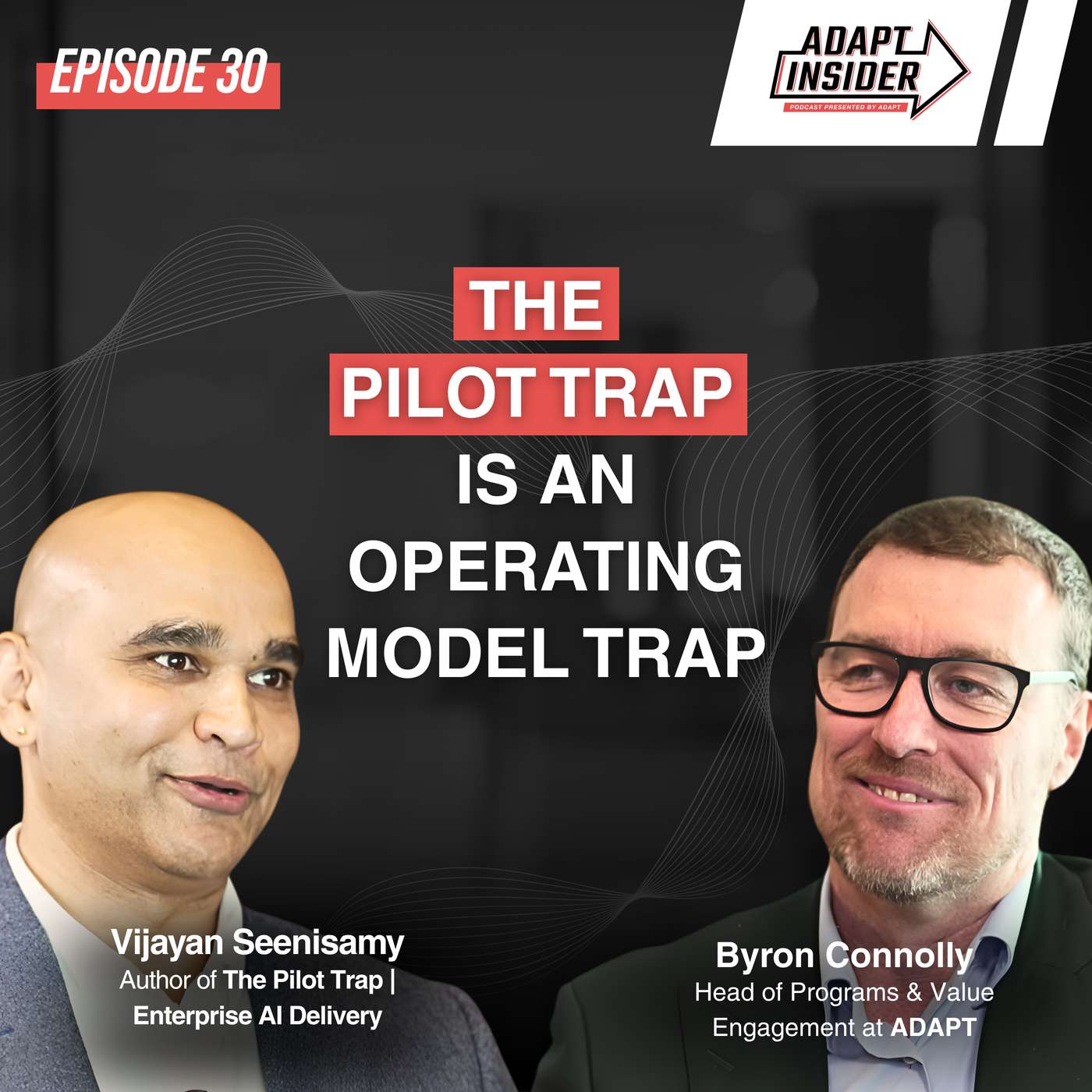
Enterprise AI pilots often succeed under controlled conditions, then break when messy data, edge cases and dependent systems enter the journey.In this first episode of ADAPT Insider’s AI Economics Series, Escaping the Pilot Trap and the Demo God Curse, Vijayan Seenisamy, Author of The Pilot Trap | Enterprise Agentic AI Delivery, joins ADAPT’s Byron Connolly to explore why organisations manage probabilistic AI through operating models designed for deterministic software.The gap surfaces when a successful demonstration reaches production.AI systems change with data, context and user behaviour, requiring continuous monitoring, clear ownership and business cases that account for reliability across the entire journey.Key takeaways:Treat AI readiness as a continuous management responsibility rather than a gate the organisation passes once.Test the messy end-to-end journey instead of relying on an individual agent or carefully curated demonstration.Fund experiments as experiments and assign one owner to the reliability of the entire chain.AI requires an operating model built for changeMany enterprise AI experiments run through operating models designed for traditional software.Code is tested, defects are fixed and the system is expected to behave consistently in production.AI behaves differently. Its performance shifts as data, context and user behaviour change.Vijayan describes the distinction as construction versus weather. A building can be completed and signed off. An AI system requires ongoing observation, correction and governance.Without that operating discipline, a pilot may perform well in controlled conditions while remaining unprepared for production.A perfect demo proves potential, not resilienceA polished demonstration can create false confidence when its conditions are mistaken for evidence of production readiness.Demo data is clean, prompts follow a happy path and the environment is arranged to help the agent succeed.Production introduces messy data, unscripted questions, edge cases and failures in surrounding systems.The environment has become honest.Before approving the business case, executives should ask what the test actually covered. A curated demonstration shows potential. Production readiness requires evidence that the system can perform under real operating conditions.Reliability belongs to the entire chainMulti-agent journeys expose how quickly reliability falls across connected steps.Five agents with 92% reliability each produce an end-to-end success rate of about 66% when every agent must perform correctly in sequence.Each component can pass its own test while the customer journey still fails around one time in three.Measuring agents individually conceals the reliability of the outcome experienced by the customer.The business case should price that end-to-end result and assign one person accountability for the entire journey.Five owners focused on five agents leave no one responsible for whether the chain works.

Comments

Download from Google Play

Download from App Store
 United States